
Fragile roof safety · 9 min read
Fragile roofs and rooflights: safe access on commercial buildings
Fibre cement sheets, painted-over rooflights and corroded steel will not carry a person. This guide explains fragile roof safety on units, shops and warehouses, and what owners should expect before anyone steps out.
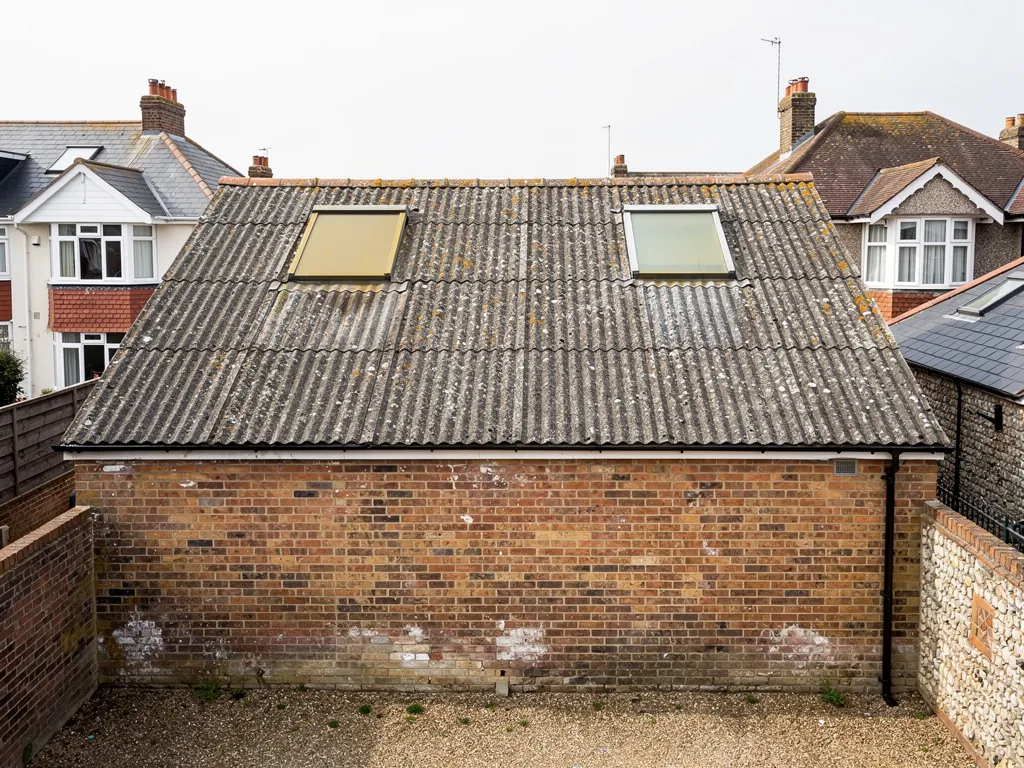
People often picture a roof accident as a slip off a ladder or a step over the edge. On industrial and commercial buildings another hazard sits alongside those: the surface itself gives way. A worker steps onto a sheet that looks like every other sheet nearby and goes straight through it, and the drop below is the full height of the building.
According to the Health and Safety Executive, 22% of the construction industry's fatal falls from height are falls through fragile surfaces, with fibre cement roofs and rooflights singled out. It adds that people on brief jobs, a quick maintenance visit or a clean for example, appear in the injury figures out of proportion to their numbers. The ten-minute job is not the safe one.
This guide is written for the people who own, manage or lease a commercial building, not for roofers. It explains which roofs count as fragile, why rooflights are the trap, how a contractor should plan access so that nobody stands on the surface at all, and what you can do as the client to keep other trades off it. If your unit has an old cement-sheet roof, read it alongside our guide to asbestos cement roofs on industrial units.
Why a fixed roof counts as fragile until someone competent says otherwise
The HSE starts from a cautious default. Once a roof is fixed in place, the HSE wants it handled as fragile until a competent person confirms it is not. The test is simple and it is demanding: a fragile surface is one that will not safely support the weight of a person and any materials that person is carrying. A sheet that would bear you alone may fail under you with a bucket of sealant and a roll of tape.
The word competent matters. It does not mean whoever is holding the ladder, or whoever has been up there before. It means someone who knows how that particular roof is built, what is under the visible layer and how the fixings have aged. Until that judgement has been made and recorded, every step is a risk taken on trust.
The law behind the default
The HSE page on fragile surfaces states that contractors and employers must manage the danger by avoiding work on or near fragile surfaces and dealing with whatever risk is left by using stagings, guard rails and fall arrest systems. People at risk have to be told the precautions, and the people doing the work have to be trained and instructed in them. The related guidance it points to includes the Work at Height Regulations 2005 and the Construction (Design and Management) Regulations 2015.
Near means near
The HSE expects effective precautions for all work on or near fragile surfaces, however short the job, and whether it is construction, maintenance, repair, cleaning or demolition. Near is the part owners overlook. A walkway along a gutter, a plant platform beside a rooflight and the last two metres before a verge all sit close enough to count. If the plan only protects the spot being repaired, it has missed the route to get there.
Which surfaces give way, and the rooflights nobody sees
The HSE lists the surfaces most likely to be fragile. Some are obvious once you know to look, and some are not.
- Fibre cement sheets, meaning non-reinforced sheets whatever the profile.
- Rooflights, especially those set in the plane of the roof.
- Liner panels, the inner skin on built-up sheeted roofs.
- Metal sheets where they have corroded.
- Glass, including wired glass.
- Chipboard or similar boards where they have rotted.
- Wood wool slabs, slates and tiles.
A built-up sheeted roof is the common steel-clad design on warehouses and units: a liner sheet underneath, insulation above it and an outer sheet on top. The outer sheet may look solid while the liner beneath it has gone brittle or rusted, so what you see is not what carries the load. Wood wool slabs, an older material, and rotted boards beneath a felt covering give the same false comfort: the top layer looks sound, and the structure under it is not.
Why rooflights are the real trap
The HSE singles out rooflights that sit in the roof plane because they can be hard to see in certain light conditions, or when they are hidden by paint. Years of dirt, moss and a coat of roof paint can make a translucent panel look identical to the steel around it. Low winter sun or a wet surface makes it worse. Anyone walking a line across a roof they do not know can step onto one without any warning. Glass, including wired glass, belongs on the HSE list too, which surprises owners who assume the wire makes it strong.
Our page on industrial rooflight replacement covers what to do when old panels have gone brittle. Corroded steel is a separate problem with its own causes, and it weakens sheets as well.
The practical lesson is that a visual check from the roof edge settles nothing. The question of what each part of the roof is made of has to be answered from records, from below, or from a survey carried out with the right protection already in place.
Avoidance first: doing the work without standing on the roof
The HSE sets out a hierarchy, and the first rung is avoidance. Plan and organise the work to keep people away from fragile surfaces as far as possible, for example by working from below the surface on a mobile access platform or another suitable platform. A mobile access platform is the cherry picker or scissor lift you see on building sites, and a good deal of inspection and minor work can be done from one.
On a commercial survey, avoidance can mean looking at the roof from the ground, from a platform at the eaves and from inside the building. Staining on liner panels, pinpricks of light through a sheet and wet insulation all show from below. Photographs taken this way give a first picture without anyone setting foot on the sheets. Where a closer look is needed, a drone survey is another way to keep people off the surface. Checkatrade, in a table updated September 2026, gives around £210 to survey a home's roof by drone and £770 to £1,100 for commercial premises, plus VAT.
Where avoidance runs out
Some jobs cannot be done from below. Replacing a sheet, re-sealing a lap along the ridge or renewing a rooflight means working at the surface. At that point the plan moves to the next rung, with the roof protected before anyone uses it.
Avoidance also has a practical side inside the building. A platform needs clear floor, stable ground and room to move, and that can mean shifting pallets, pausing a forklift route or closing an aisle for a few hours. These are things the owner knows and the contractor does not, which is why the HSE asks contractors to work closely with the client. Our guide to roof work while the business keeps trading deals with the trading side of the same conversation.
Controlling the risk that remains: stagings, rails, nets and harnesses
Where work on or near a fragile surface cannot be avoided, the HSE asks for a combination of measures. It names stagings, guard rails, fall restraint, fall arrest and safety nets slung beneath and close to the roof. The word combination matters. One measure on its own is rarely enough, and a harness clipped to a weak point is no protection at all.
It helps to know what each term means.
- Stagings are platforms or walkways that spread a person's weight across several supports, so they never stand on a single sheet.
- Guard rails fence the edges of the staging and the open edges of the roof.
- Fall restraint is a lanyard or line cut short enough that the wearer cannot reach the edge or the fragile surface.
- Fall arrest catches a person after they have started to fall. It needs a strong anchor and a plan for getting them down, because hanging in a harness is dangerous too.
- Safety nets are slung beneath and close to the roof so the drop through a sheet is short.
Putting them in the right order
Restraint is better than arrest, because it stops the fall happening, and a staging is better than relying on either. The edge also needs attention. Our page on roof edge protection sets out how perimeter systems work on flat and low-pitched commercial roofs.
Nets and platforms need to go in before the main work, not halfway through it. That has a bearing on the programme and the price, since protection takes time to rig and to take down again, and the roof is only as safe as the last section checked. After the survey you receive one written total price, and the access plan sits behind that figure. Ask any contractor what the access plan is, in plain words, before you agree a start date.
Signs, training and the client's part in keeping others off
The HSE lists four strands of precaution: avoidance, control, communication and co-operation. The first two are the contractor's. The last two involve you.
Communication
Warning notices must be fixed on the approach to any fragile surface, and those doing the work must be trained, competent and instructed in the precautions. For an owner, that means the access hatch, the ladder bay and the door onto the roof all deserve a sign that says what is up there. It also means telling people, in writing, which roofs are off limits.
Co-operation
On business premises, the HSE says the contractor and the client should agree together how the work will be managed. The client knows who else goes onto the roof. That includes the alarm engineer, the aerial installer, the solar or air-conditioning crew, the window cleaner and the member of staff who clears the gutter outlet at the weekend. The HSE points out that brief, one-off upkeep and cleaning tasks are over-represented in injury statistics, so these visits are exactly where the risk sits.
What you can do as the owner
- Keep roof access locked, and release the key only against a named job.
- Keep a note of the roof construction and where the rooflights are.
- Pass survey photographs and findings to anyone else who needs to work up there.
- Check, if you lease the building, who is responsible for the roof under the lease.
On a commercial survey we photograph what we find and give a plain verdict, then you get a written figure covering the whole job. The access arrangements are agreed with you before work starts. The commercial roofing page lists the rest of the work we do on units, shops and blocks.
Questions
Fragile roof questions
Does clearing a gutter or checking a flashing count as work on a fragile roof?
Yes, if the roof or anything near the work is fragile. The HSE says effective precautions are needed for all work on or near fragile surfaces, however short the job, and it notes that brief maintenance and cleaning visits feature heavily in the injury figures. A quick job still needs a plan for access.
Can I tell whether my roof is fragile by looking at it?
No. The HSE expects every fixed roof to be handled as fragile until a competent person says otherwise, and it warns that rooflights can be hidden by paint or hard to see in some light. Paint, moss and dirt make panels look alike, so treat every roof as fragile until a survey says different.
Who is responsible for fragile roof safety, the owner or the roofer?
Both have a part. The HSE says contractors and employers must manage the danger, and that on business premises contractors should agree arrangements with the client. Clients, designers and contractors are all expected to treat falls through fragile surfaces as a priority hazard. Ask your contractor to explain the access plan before work begins.