
Flat roofing in Bognor Regis
A flat roof lasts as long as its covering, its falls and its edges allow. We survey the roof, photograph what we find and say plainly whether to maintain it, re-cover it or rebuild it, before any price.

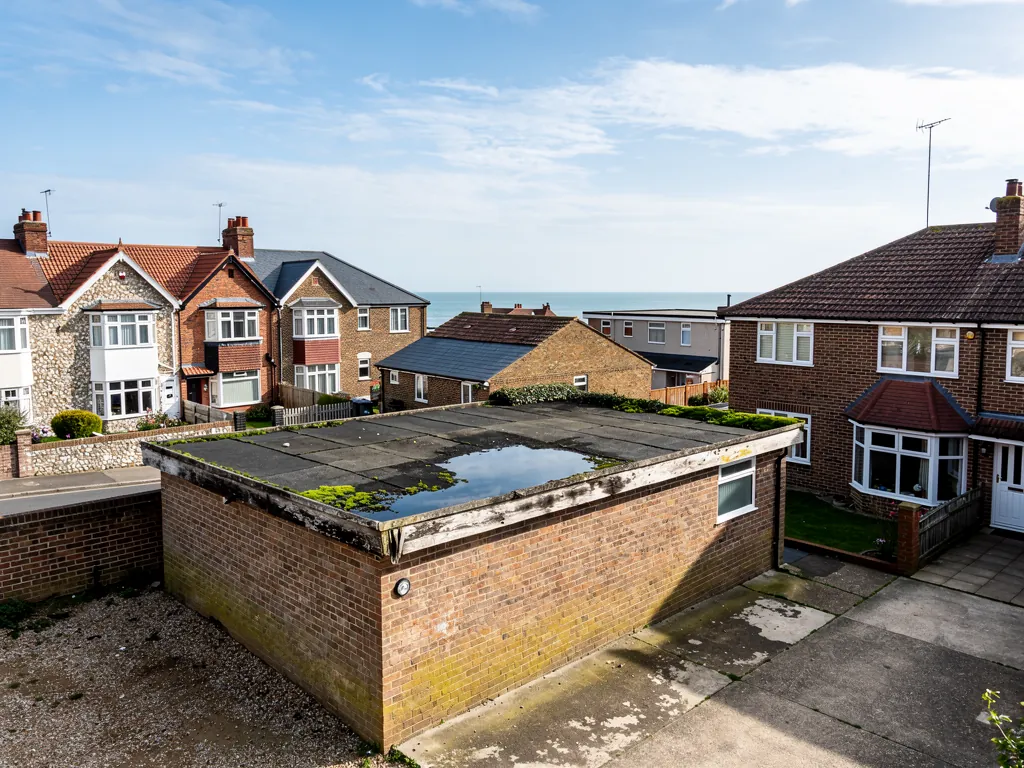
- Repair or replace,
said plainly - Photos of
your own roof - Written quote,
one total price - Ridges and verges
fixed to BS 5534
Signs
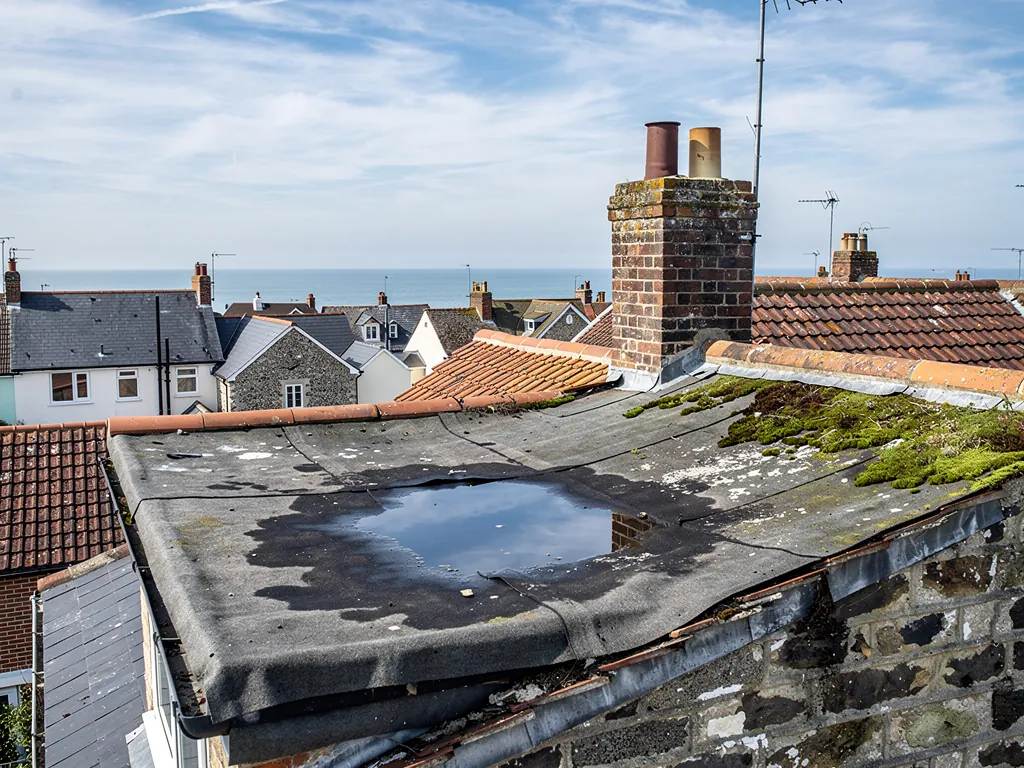
Signs a flat roof is nearing the end
- Water pooling for days after rain
- Blisters or splits in the covering
- A damp patch on the ceiling below
- Edges and upstands lifting from the wall
- Grit and moss gathering at the outlet
Flat roof work
Flat roof projects across Bognor Regis and West Sussex
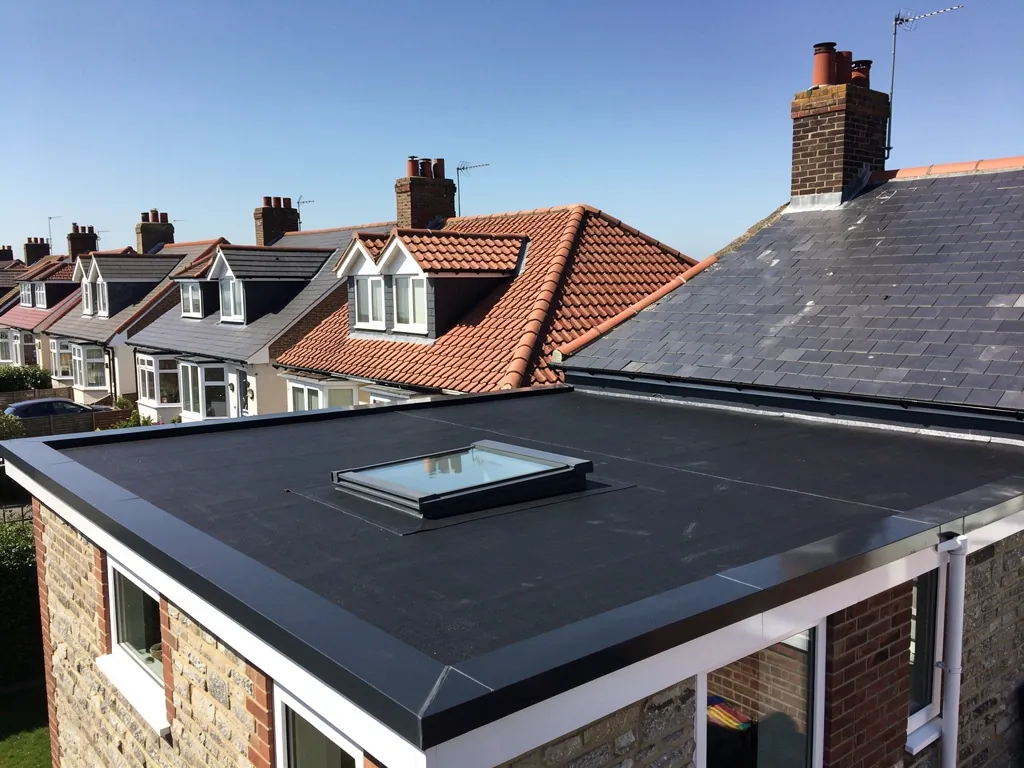
New flat roof installation
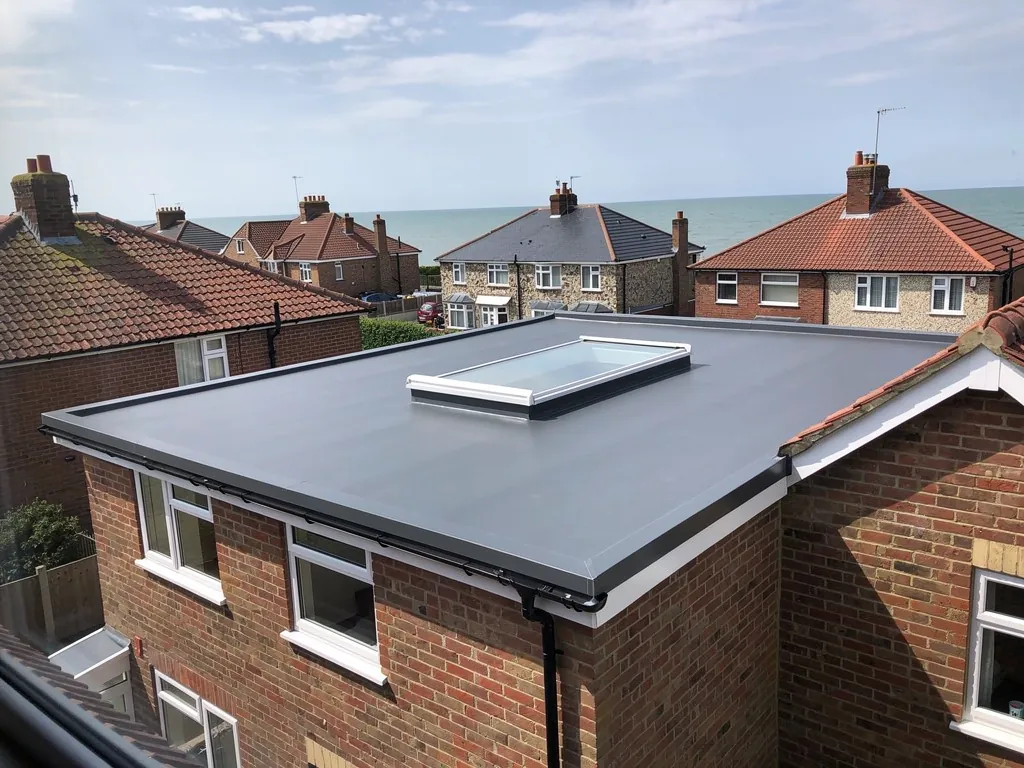
A complete new roof for an extension, garage or dormer, with the deck, falls, insulation, covering and edge trims built together as one system.
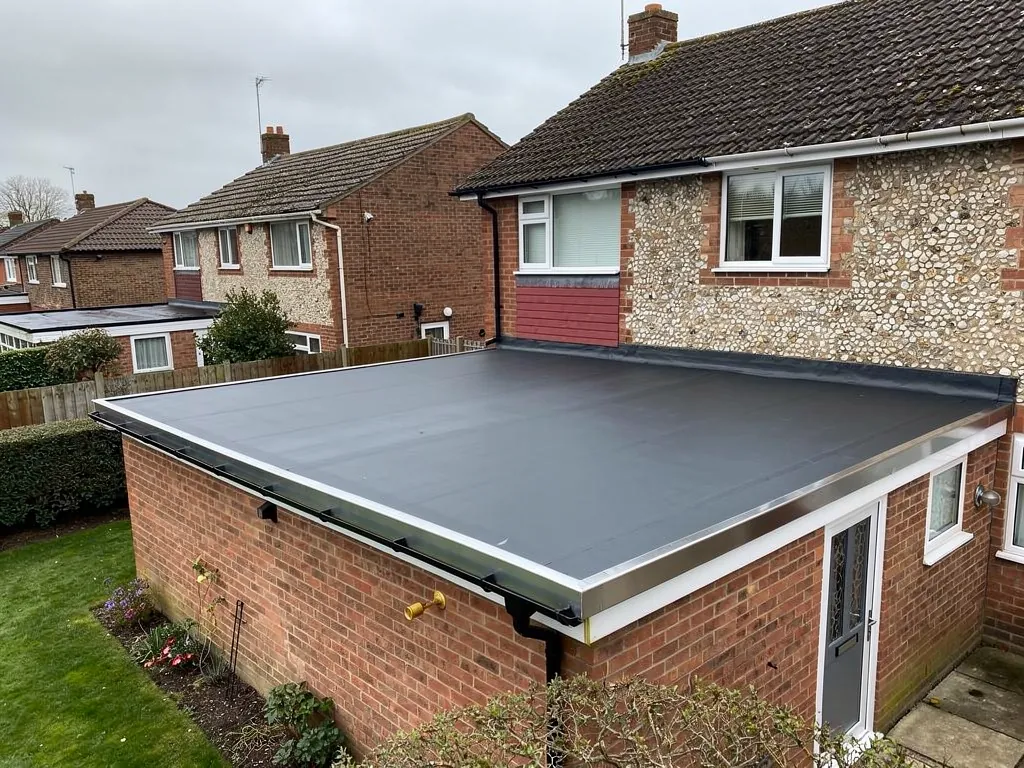
Flat roof replacement
We strip a failed covering, test the deck, renew any boards that have gone soft and lay a new waterproof layer matched to the roof.
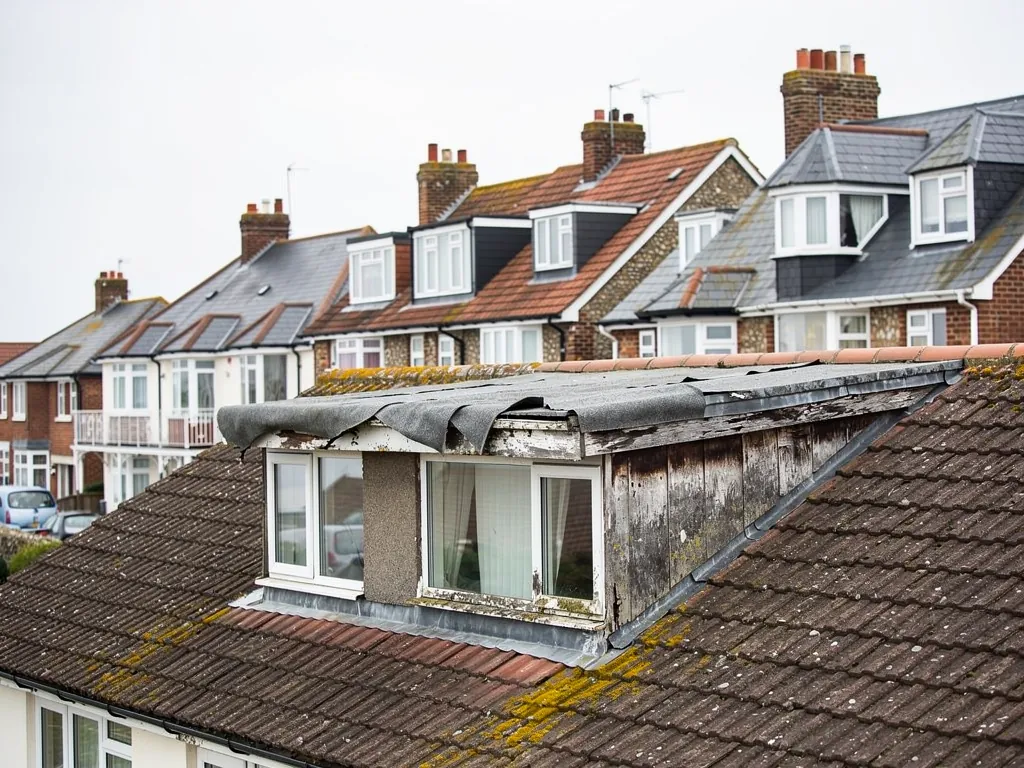
Flat roof repair
Where the deck is dry and the covering is otherwise sound, we repair splits, open laps, lifted upstands and blocked outlets rather than selling a new roof.
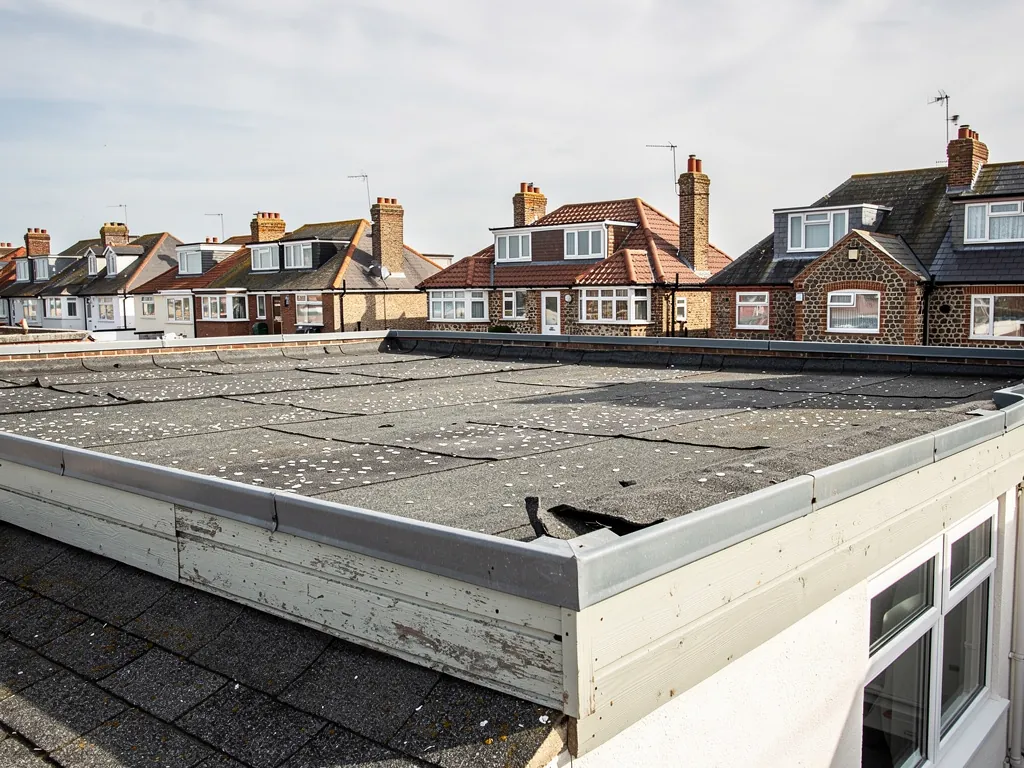
Felt, EPDM and GRP coverings
Torch-on felt, one-piece rubber sheet or a fibreglass laminate, chosen for the shape, use and edges of your roof, and explained before you commit.
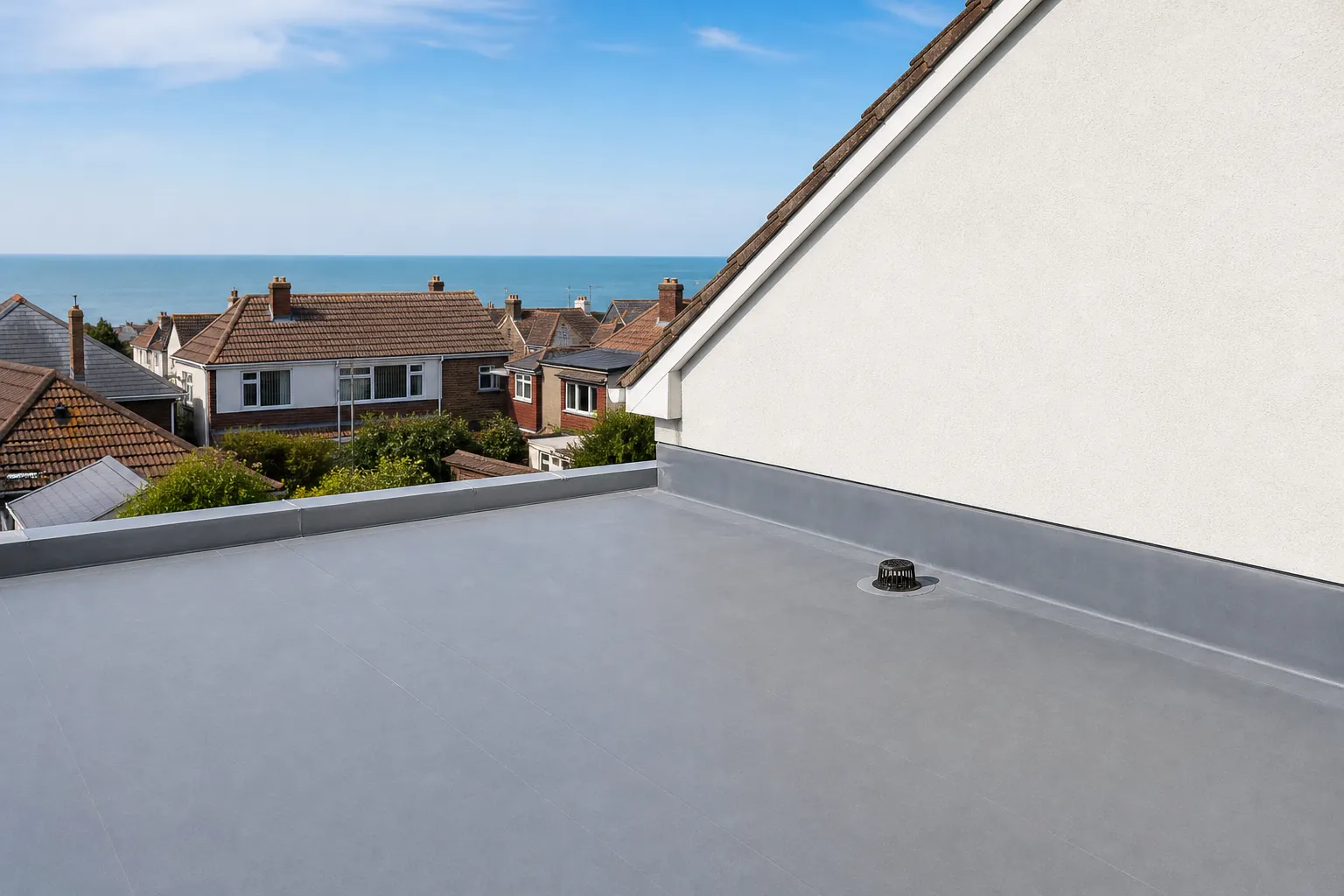
Edges, outlets and rooflights
Edge trims, gutters, outlets, lead flashings and rooflight kerbs, the details where flat roofs leak first, finished neatly so they look right from the street.
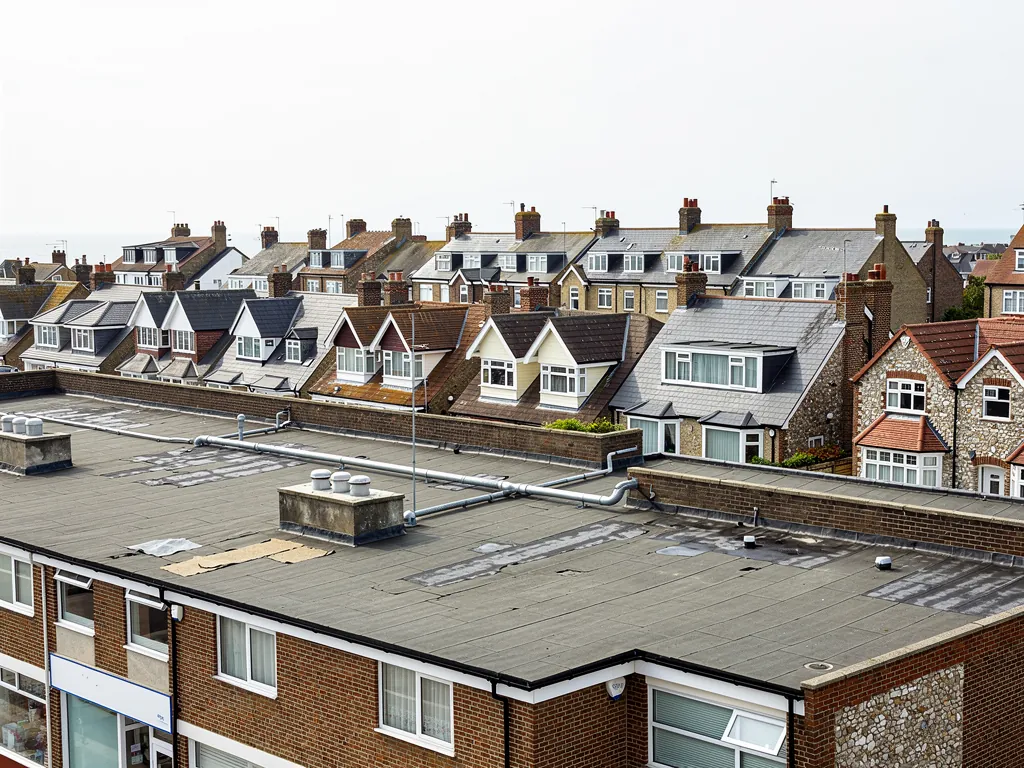
Commercial flat roofs
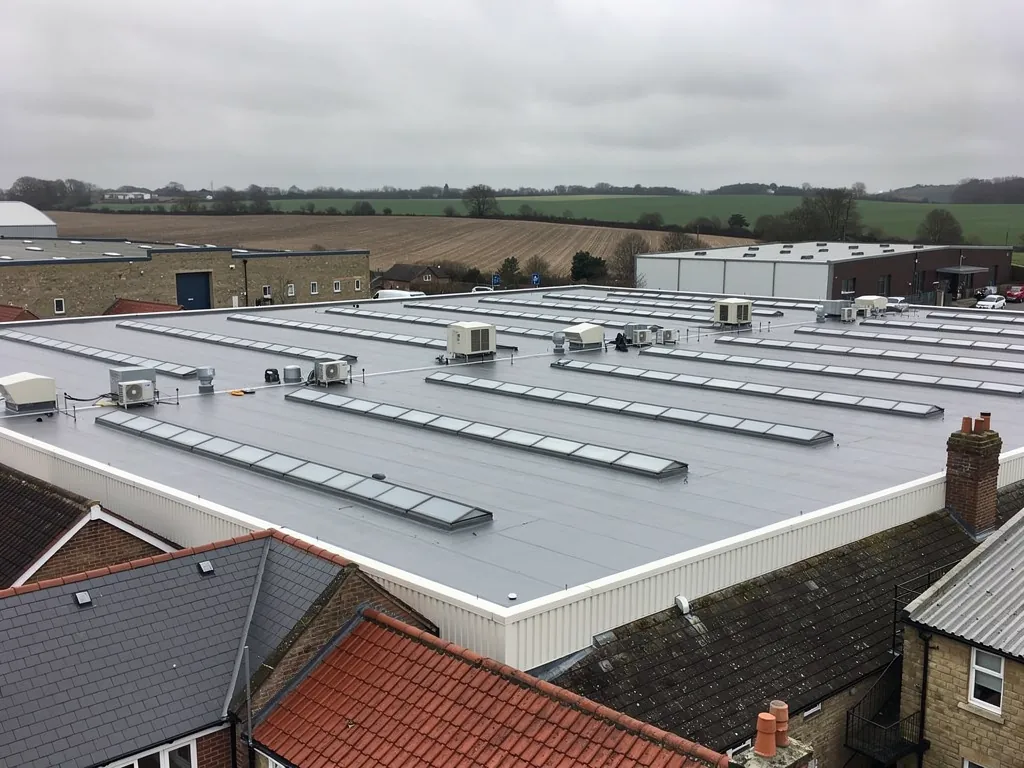
Shops, units and blocks of flats with larger roofs, planned around the people using the building, its access and the weather window for the work.
What it costs
What flat roofing costs in Bognor Regis
£1,000 to £5,000
JJ Roofing's published guide range for flat roofing
A small garage roof with a sound deck sits near the bottom; a larger extension needing new boards, insulation and a scaffold sits towards the top.
How a flat roof job runs, one step at a time
- 1Send photos and the roof's sizeCall 01243 252373 or WhatsApp us a picture of the roof and any stain on the ceiling under it, with a rough idea of its size.
- 2Survey, with the deck testedWe inspect the covering, outlets and edges, press the deck for soft patches and photograph each fault so the verdict rests on evidence.
- 3A verdict, then one written priceYou hear whether to maintain, re-cover or rebuild the roof, and why, and a written quote with a single total price follows.
- 4The finished roof and the tidy-upWe lay the roof in dry spells, photograph the finished falls and edges, then clear the site and take the waste away.
Flat roofing, in depth
Laying and mending flat roofs well near the Sussex sea
Coverings, falls and insulation, the repair-or-replace call, prices, problem junctions and the rules that apply, in six chapters.
Chapter 1: Felt, EPDM or GRP: choosing the covering2440
Sheet 01 / 06The covering matters less than the roof underneath it, but each material suits a different shape of roof, and each has its own weak spot.
Most flat roofs in Bognor Regis and across West Sussex are covered in one of three materials. The choice shapes how the roof looks, how it is detailed at the edges and how long it can be expected to last. Whichever you pick, the quality of the finished roof depends far more on the preparation underneath than on the name printed on the roll. We still start with the material, because it is usually the first question people put to us.
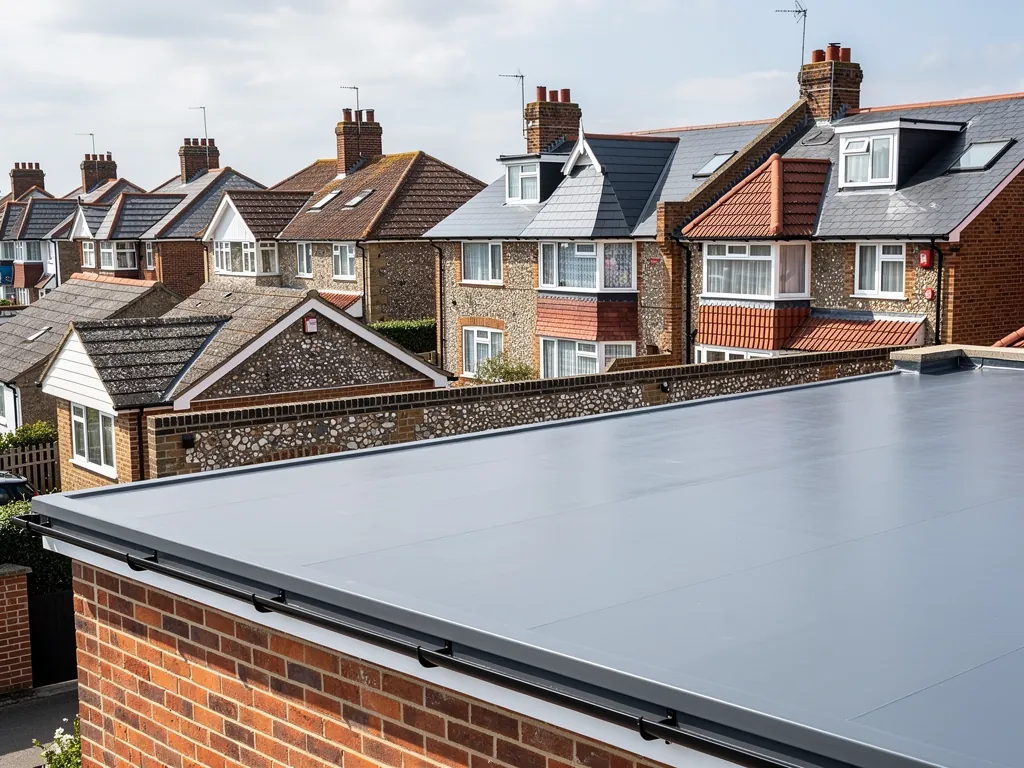
20 to 30 years
expected life of single-ply membranes, GreenSpec
The best covering on a poor deck will still fail, so the base comes first.
Two coverings, two characters
Torch-on felt
Layers of bitumen membrane fused on site, suited to larger, plain roofs.
EPDM rubber
One cut sheet with few joints, suited to small roofs with simple outlines.
1.1 Torch-on felt
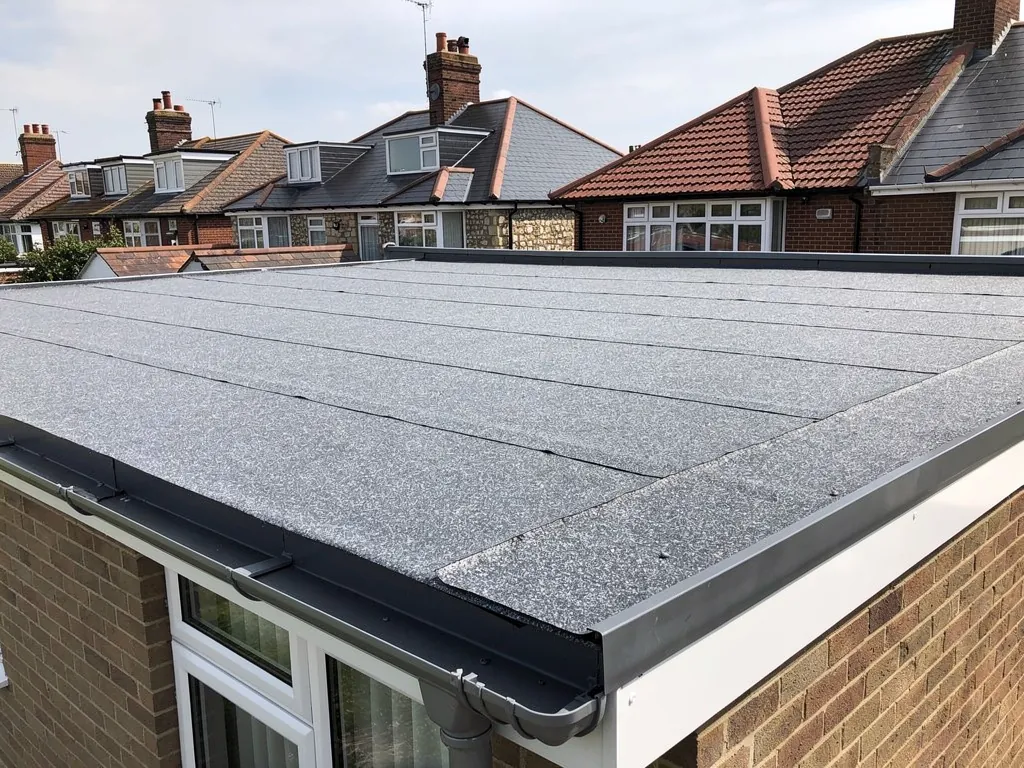
Torch-on felt is a built-up bitumen membrane. Two or three layers are fused to the deck, the flat boarded base of the roof, by warming the underside with a gas torch, and the laps are sealed as each roll goes down. Less, the home improvement cost guide last updated in March 2026, puts its life at 10 to 20 years and notes that a good felt job can last 20 years while a poor one might fail in under ten. That gap between good and poor is workmanship: how well the laps are sealed, how neatly the upstands are finished and whether a cap sheet is fused over the base layers. Felt suits larger, plain roofs such as garages and wide extensions, where the area is simple and the edges run straight.
1.2 EPDM rubber
EPDM is a synthetic rubber membrane, usually supplied as one sheet cut to the size of the roof and glued down to the deck. With so few joints there are fewer places for water to find a way in. GreenSpec gives single-ply membranes an expected service life of 20 to 30 years, while Less quotes 30 to 50 years for EPDM, and the difference between those two sources is a good reason to treat any lifespan as a range rather than a promise. Rubber suits small roofs with simple outlines. Corners, rooflight kerbs and awkward junctions are dressed with preformed pieces and adhesive tape, so the neatness of those details tells you most about the person laying it.
1.3 GRP fibreglass
GRP, glass-reinforced plastic, is a resin and glass-fibre laminate built up in place on the deck and finished with a topcoat. It forms a hard, joint-free skin that follows irregular shapes, which is why it is often chosen for roofs with several pipes, curved edges or an awkward outline. Less puts its life at 25 to 40 years. Because the laminate is rigid, the deck below it must be stiff and well fixed: a deck that moves will crack a GRP roof along the line of the movement. Our guide to choosing between EPDM, GRP and felt sets the three side by side.
Liquid-applied coatings are the fourth option. They are rolled or brushed over an existing covering that is still sound and dry, and they can extend the life of a roof that has only surface wear. They cannot cure a soft deck, a ponding roof or a failed upstand, so we look underneath before recommending one. Sheet metals such as lead are used on small roofs and dormers; Less gives a lead flat roof 50 to 100 years, which suits detail-led jobs better than a wide garage roof.
Chapter 2: Falls, decks and insulation under the membrane2806
Sheet 02 / 06Three things under the covering decide whether a flat roof works: the fall that moves water, the deck that carries it and the insulation below.
Get the fall, the deck and the insulation right and almost any good covering performs. Get them wrong and the best material sits in a puddle. That is why we photograph the deck and the falls while the work is open, so you can see what lies under the finished surface rather than taking it on trust.
1:80
minimum finished fall under BS 6229:2025
Two questions for any survey
Ask what fall the new roof will have and how the deck was checked. A clear, specific answer says a great deal about the work.
2.1 Falls and ponding
A fall is the slight slope that sends rain towards the outlet or gutter. BS 6229:2025, the British Standard code of practice for flat roofs with continuously supported flexible coverings, replaced the 2018 edition in December 2025 and keeps a minimum finished fall of 1:80, which is one unit of drop for every 80 along. It covers roofs pitched at up to 10 degrees. Roofers usually design for something steeper, around 1 in 40, so the roof still drains once the deck has settled. Where the joists are level, firring strips, which are tapered timbers fixed on top, create the slope. A roof that ponds after rain is not always failing, but standing water adds weight, speeds up wear and shows where the fall is missing.
2.2 The deck
The deck is the boarded surface the waterproofing is fixed to, usually plywood or similar boarding over timber joists. It has to be flat, dry and firmly screwed down, because every later layer copies whatever is wrong with it. Before any new covering goes down we test it, pressing and probing for softness, staining and layers peeling apart, and any board that gives way is replaced. A covering laid over a damp or weak deck will blister, split or lift whatever it is made from. Where a roof has leaked for years the joists beneath may need attention as well, and we show you photographs of anything we find.
2.3 Warm roofs, cold roofs and condensation
In a warm roof the insulation sits above the deck, so the structure below stays at room temperature. In a cold roof the insulation sits between the joists and a ventilated void above it keeps the timbers dry. BS 5250, which deals with damp and condensation in buildings, is the reference for condensation risk. The right choice depends on the existing build-up, the ceiling height and the finish indoors, so we decide it at the survey rather than from a catalogue. Our guide to warm and cold flat roofs compares them.
Falls are also where a good drainage plan pays off. Outlets should sit at the low points, gutters need their own slight fall and edges should push water into them rather than down the fascia. Our guide to flat roof falls and drainage explains why water ponds and how it is cured, and it is worth reading before you choose between a patch and a new roof. Gutters and downpipes that cannot take the flow turn a well-laid roof into a leaking one, so we check their size and condition with the roof.
Chapter 3: Repair, re-cover or rebuild an old flat roof2684
Sheet 03 / 06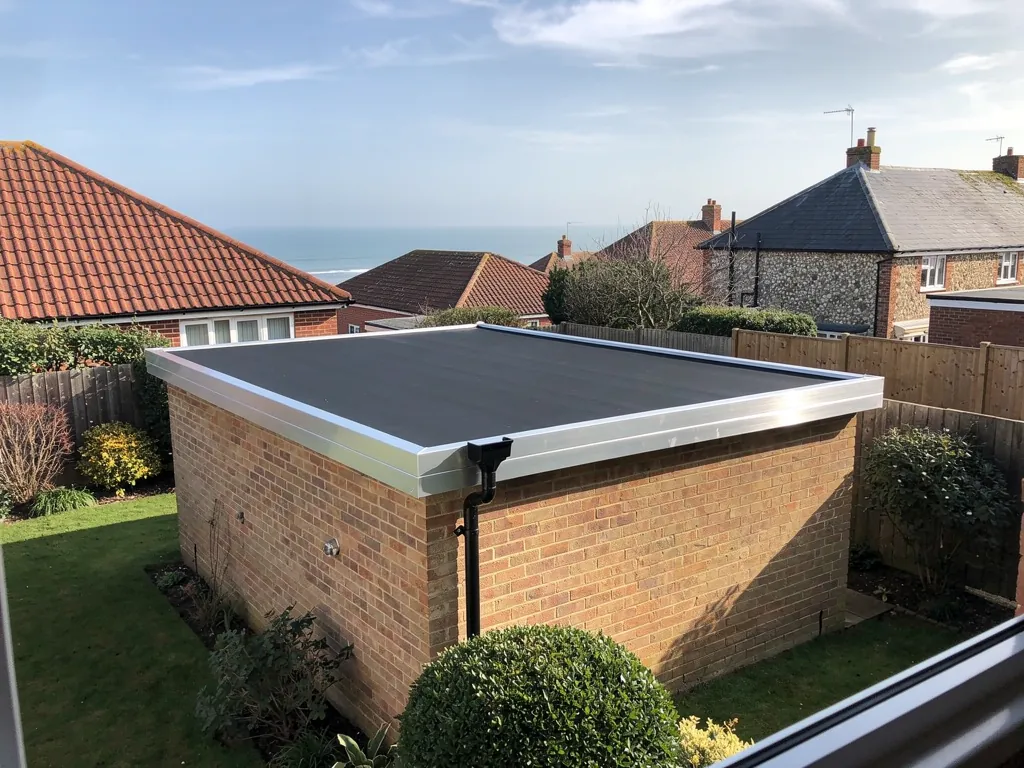
Not every tired flat roof needs stripping. The survey decides, and we say which of three routes fits before we talk about money.
The verdict we give is one of three: maintain the roof, re-cover it or rebuild it. A reliable verdict needs evidence, which is why we photograph the covering, the outlets, the edges and the ceiling below, then explain what each picture shows. You can keep the photographs and show them to anyone you like.
3.1 What the survey looks at
We start with the water. Staining on the ceiling, a musty smell or bubbling paint tells us where it has been getting in. On the roof we look for splits, blisters, open laps, lifted upstands, which are the short upturns of membrane where the roof meets a wall, and outlets clogged with leaves or grit. We press along the deck for soft patches. A roof that is dry and firm underfoot has choices; one that is spongy or stained underneath is usually past patching. We also ask when the roof was last done and with what, because an old felt roof and a young rubber one fail in different ways.
Maintain, re-cover or rebuild
- MaintainCovering sound and deck dry: clear outlets, reseal edges and review the roof later.
- Re-coverCovering worn out but boards and insulation dry: a new layer on a prepared base.
- RebuildSoft deck, wet insulation or no fall: strip back to the joists and start again.
3.2 When a repair is the right call
If the covering is otherwise sound, one split, a failed upstand or a blocked outlet can be put right for a small sum. Less puts small flat roof repairs at £150 to £500, a very different outlay from a new roof, and we put forward the smallest job that cures the fault for good. A reliable flat roof repair needs sound material around it to tie into, and the survey shows whether that exists. Where the deck has stayed dry, a repaired upstand or a resealed outlet can carry on for many more seasons. Our roof repairs service covers leak tracing across every kind of roof.
3.3 When a new roof costs less in the end
Patches pile up. A roof with several repairs already, ponding across its middle, felt that has turned brittle or insulation that is saturated is telling you the covering has reached the end of its useful life. Felt is quoted at 10 to 20 years, so an older roof showing wear is often better replaced than nursed. Replacement also lets the fall be corrected, the insulation upgraded and the edges rebuilt, none of which a patch can do.
£150 to £500
typical small flat roof repair, Less March 2026
The survey also settles whether a new covering can go over the old. Laying over a wet or failed layer traps moisture, so the old layers usually come off, and the weight and fire performance of any new covering need checking against the structure. That is why we ask for photographs and a deck test before we offer a verdict, and why a quick figure from a doorstep caller tells you very little.
A repair is worth paying for only while the roof around it is sound.
Chapter 4: Flat roof prices, scaffold and VAT2074
Sheet 04 / 06Size, access and what lies under the old covering set the price of a flat roof more than the choice of material does.
JJ Roofing's published guide range for flat roofing is £1,000 to £5,000. A small garage roof reached from a ladder, with a sound deck, sits near the bottom of that range; a larger extension needing new boards, insulation and a scaffold sits towards the top. National guides run wider because they include bigger roofs. Checkatrade's roof replacement guide, whose October 2026 table is headed plus VAT, puts a flat roof replacement at £2,800 to £7,500 and a garage re-felt at around £1,000 to £2,000. Treat every guide figure as a rough marker. Only a survey of your own roof produces a price you can rely on.
Typical UK flat roof figures
- Flat roof replacement£2,800 to £7,500
- Garage roof re-felt£1,000 to £2,000
- Small flat roof repair£150 to £500
- Scaffold, terrace to bungalow£800 to £1,000 a month
These are national markers, mostly shown before VAT. Your own number comes only after the survey.
Source: Checkatrade cost guides, tables last updated October 2026; Less flat roof cost guide, March 2026
4.1 What moves the price
Area comes first, because the covering is laid by the square metre and a ten-metre roof costs far more than a porch. Then the condition of what lies beneath: a sound deck can stay, while a rotten one means new boarding and sometimes new joists. Then insulation and falls, since building a warm roof with tapered insulation costs more than relaying a covering on a level deck, though it gives a roof that drains and a room that stays warmer. Then the number of details, because every rooflight, pipe, wall junction and outlet adds careful hand work. Checkatrade gives roofers' rates as around £280 to £360 a day, so the days a job takes show up directly in the total.
4.2 Scaffold, licence and access
A single-storey garage can often be reached with ladders and an access tower. A two-storey rear extension or a dormer needs a scaffold. Checkatrade's scaffolding guide, whose table was refreshed in October 2026, gives around £875 for a month of hire on a two-storey semi-detached house, £800 for a terrace and £1,000 for a detached bungalow. When the scaffold has to occupy the footway or the road, the scaffolding firm needs a highways licence from the county council. West Sussex County Council wants 10 working days' notice and charges £266 for a month. Hampshire County Council, whose area includes Havant and Emsworth, wants a clear ten working days and charges £211.90 for the first fortnight. The survey shows whether your roof needs one, so the lead time is clear before you commit.
VAT is charged at the standard 20 per cent on a re-roof. When two prices for the same roof differ, the first thing to check is which one includes VAT and which one includes the scaffold, because a figure that leaves either out is not comparable with one that counts them. We think our pricing is good and fair, and our flat roof cost guide works through what shapes the total on a typical job.
£1,000 to £5,000
JJ Roofing's published guide for flat roofing
Chapter 5: Extensions, dormers, garages and commercial roofs2989
Sheet 05 / 06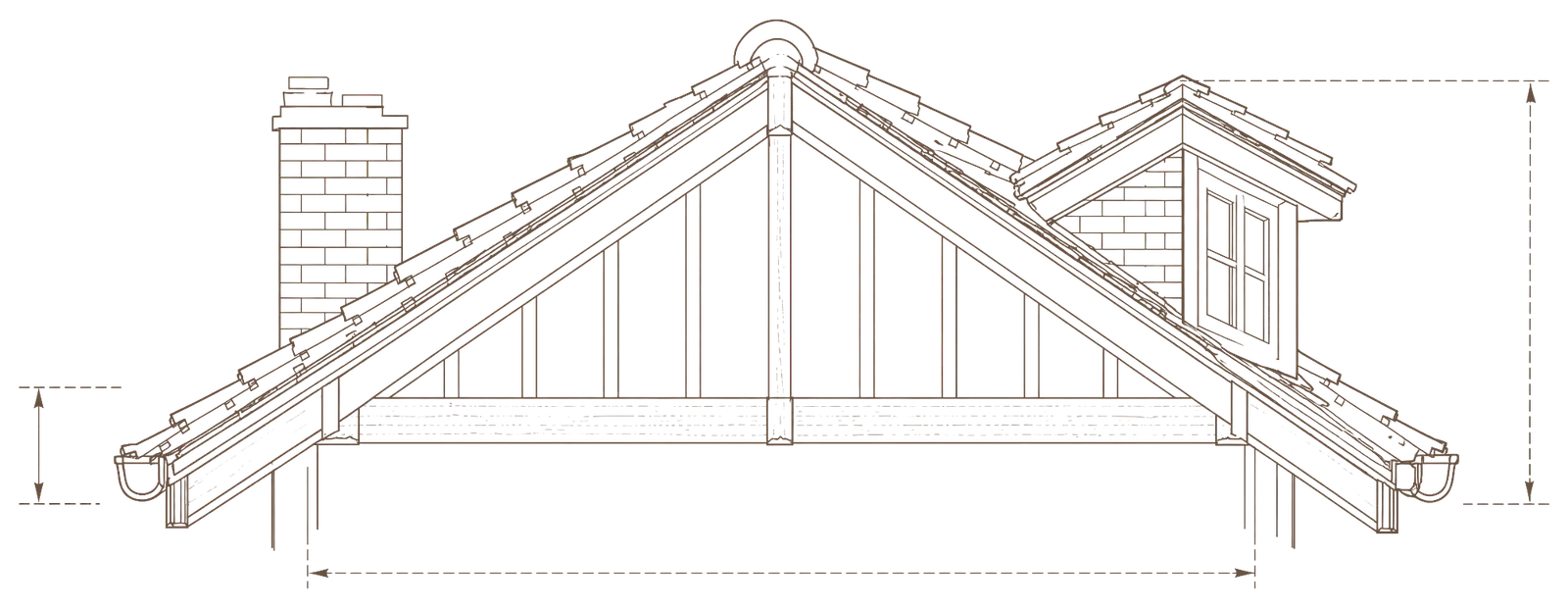
- Ridge Water from the pitched slope above lands on the flat roof below.
- Eaves The edge trim throws water clear of the fascia and into the gutter.
- Dormer cheek Lead and the flat top meet here; leaks start at this junction.
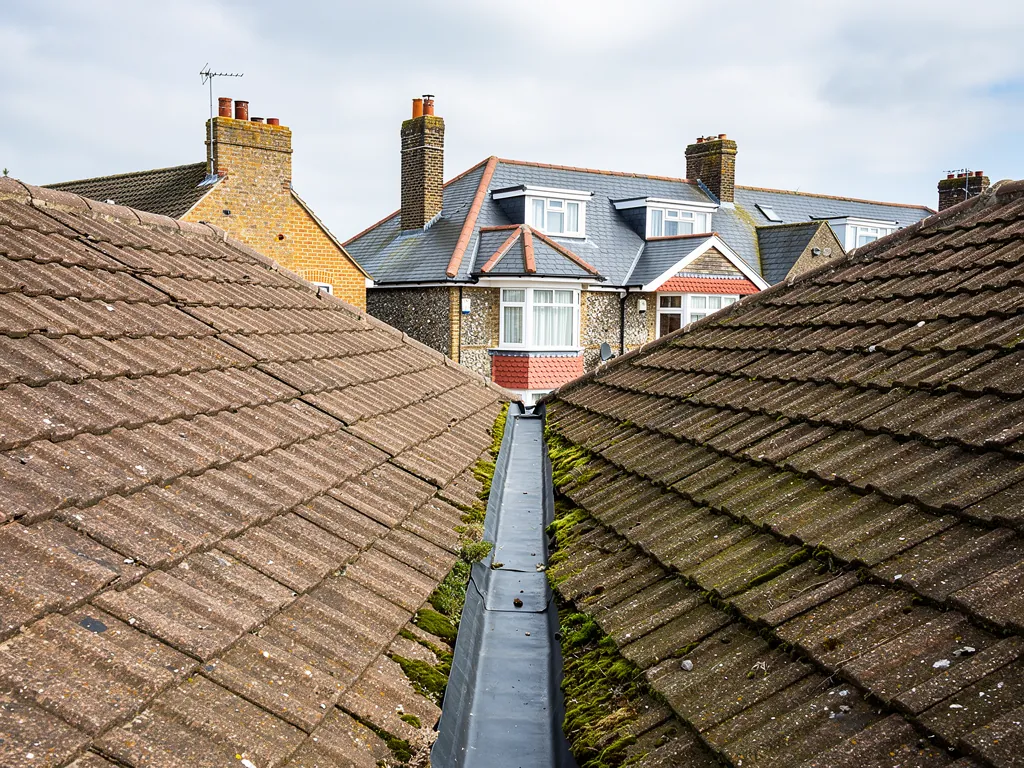
- Valley Where a flat roof abuts a pitch, extra run-off needs a clear route.
- Gutter outlet A blocked outlet leaves water ponding across the flat roof.
Flat roofs fail at their edges and junctions long before the middle of the membrane gives way, and sea weather tests every one.
Flat roofs turn up wherever a pitched roof cannot reach: over a rear extension, a garage, a porch, the top of a dormer, a shop front or a small block of flats. We work on all of them, from Aldwick and Felpham through Chichester and the harbour villages to Littlehampton, Worthing and the Downs towns. Each has its own habits, but the weak points are nearly always the same: where the flat roof meets a wall, where it ends at an edge and where something pokes up through it.
Junctions we check first
- Upstand height and lead cover
- Edge trim seal and drip
- Outlet and gutter clearance
- Rooflight kerb and sealing
- Pipe collars and penetrations
5.1 Extensions and dormers
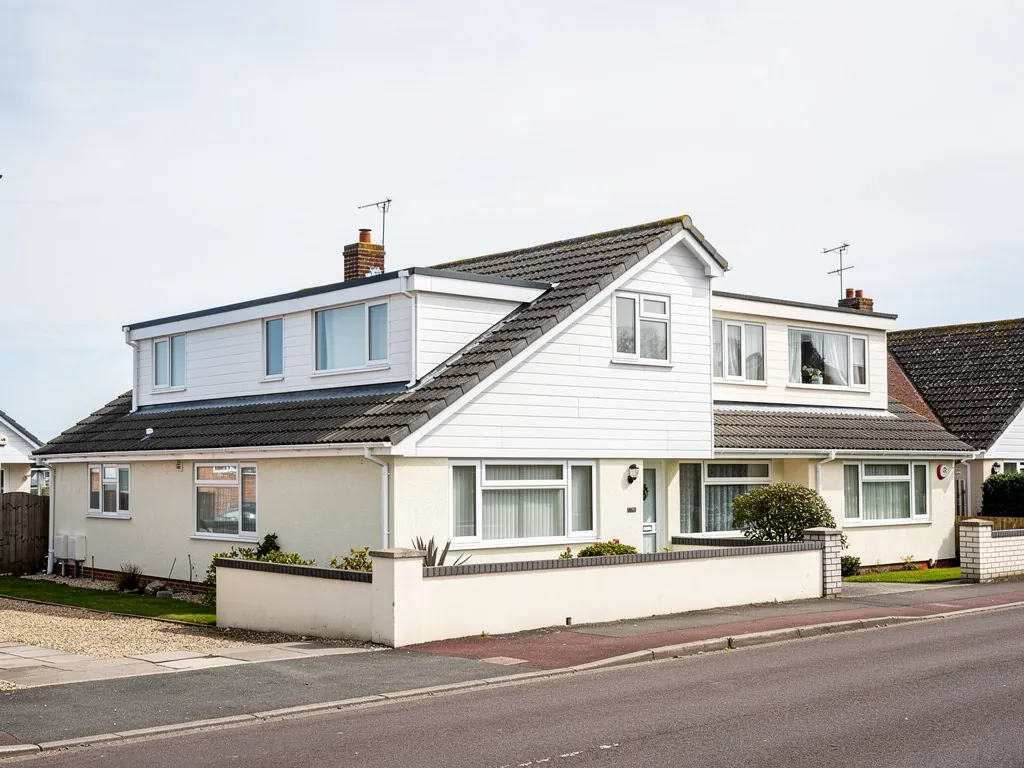
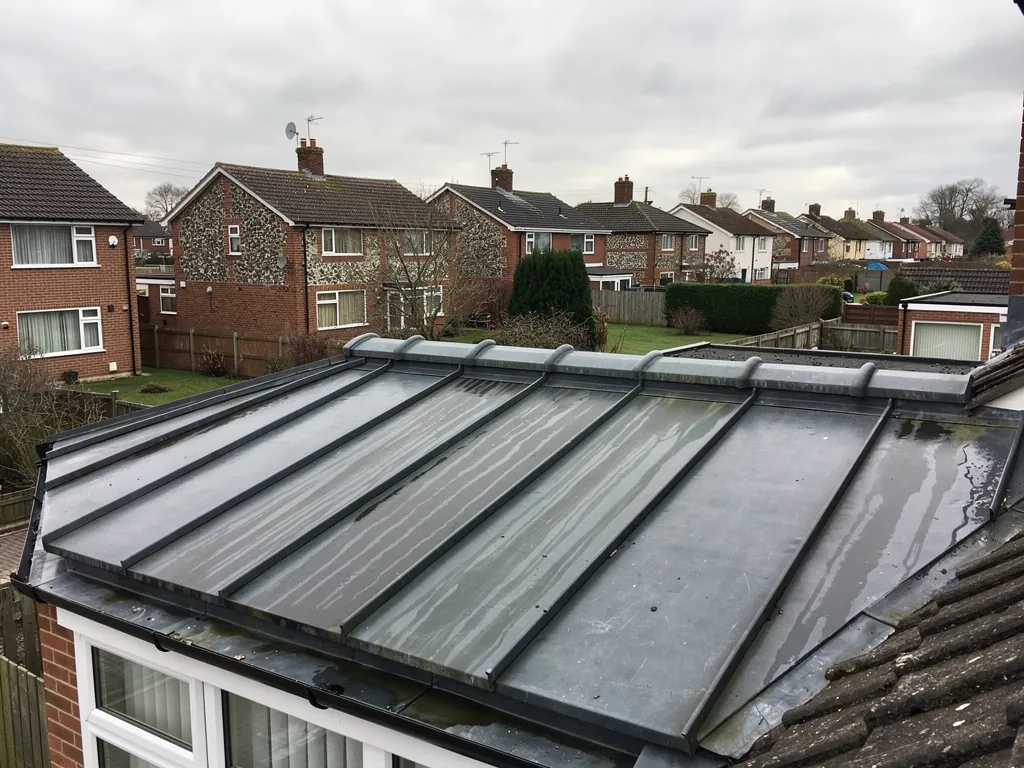
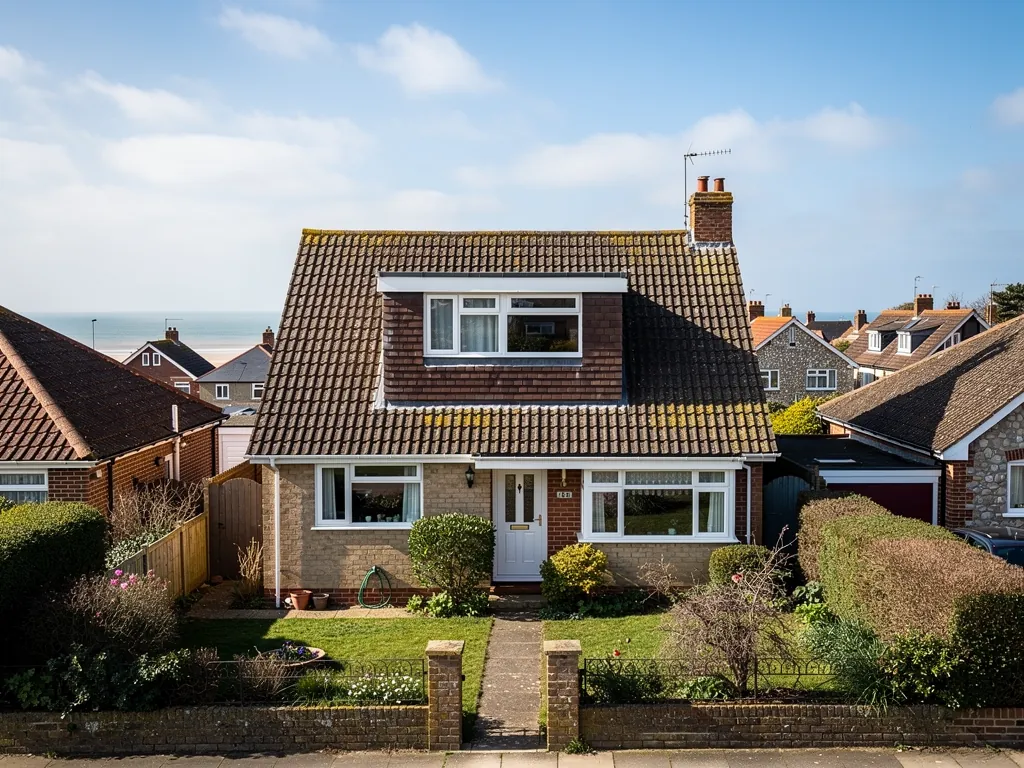
Where a flat extension roof meets the house wall, the membrane turns up the brickwork as an upstand and is covered by a lead flashing, a strip of lead let into the wall and dressed over the top edge. Water that gets behind a poorly sealed flashing runs down the inside face of the wall, so the stain appears indoors beneath the roof rather than at the junction. A flat dormer roof adds cheeks, the vertical side walls of the dormer, with their own lead and tile junctions. These are small areas that carry a lot of risk, and they are the first details we photograph on a survey. Our guide to extension and dormer flat roofs goes through them one by one.
5.2 Edges, outlets and rooflights
The edge trim is the metal or plastic profile that finishes the membrane at the perimeter and throws water clear of the fascia, the board that carries the gutter. A trim set too low sends water behind the gutter; one that is not sealed lets wind lift the edge of the covering. Outlets and gutters need clear paths and a fall towards them. Rooflights sit on upstands, and Approved Document L lists 2.2 W/(m²·K) as the limiting U-value for a rooflight, the measure of heat lost through it, with 0.35 as the maximum for an upstand built on site.
5.3 Commercial and shared roofs
A commercial flat roof raises questions that a garage does not: who else uses the roof, how it is reached, whether the building stays occupied during the work and how rainwater is carried away. Shops, workshops and flat-roofed blocks near the seafront tend to have bigger areas, with rooflights and plant to work around, and the outlets are sized to match. Our commercial roofing service covers those buildings in detail.
Near the sea, gales and driving rain test every edge, which is a reason to look at these details regularly rather than only when something leaks. Maintenance is simple: clear the outlets and gutters after leaf fall, glance at the laps and edges, and photograph anything that changes. A short note to us with those photographs is often all it takes to tell whether a small repair now can save a larger job later.
Flat roofs rarely fail in the middle; the edges and junctions go first.
Chapter 6: Permission, Building Regulations and the order of work3294
Sheet 06 / 06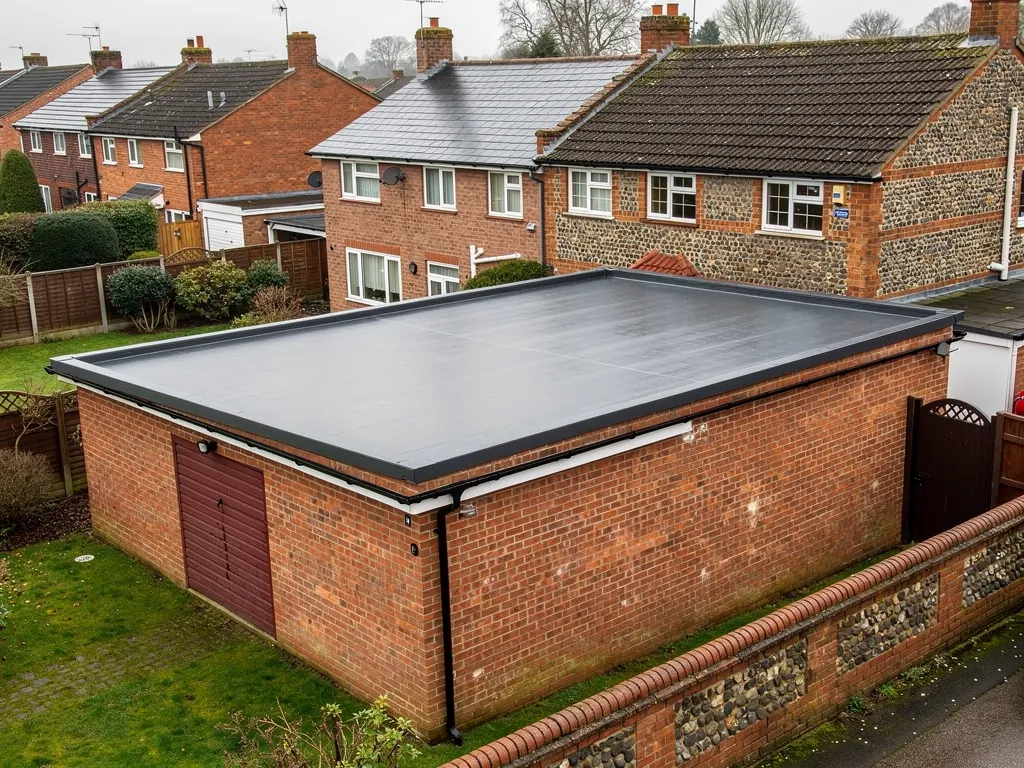
A like-for-like flat roof replacement does not usually need planning permission, yet Building Regulations, listed status and asbestos can each alter the plan.
The paperwork decides the order of work, so we find out what applies to your roof at the survey, explain it in plain English and handle the notification where the work is notifiable.
The order of work on a replacement
- 1SurveyPhotographs, a deck test and an outlet check before any figure is given.
- 2StripOld layers are lifted and the waste is taken away as the work goes on.
- 3Deck and fallsBoards are renewed and tapered timbers or insulation are set to the fall.
- 4MembraneThe covering is laid in dry spells, with laps and corners finished by hand.
- 5EdgesTrims, flashings and outlets are finished, then the site is cleared.
6.1 Building Regulations and Approved Document L
Planning Portal guidance says no building control application is normally required while under 25 per cent of the total building envelope and under 50 per cent of the roof is affected. A new covering that adds 15 per cent or more to the existing roof's weight, or that would behave differently in a fire, also needs approval. Arun District Council's building control page also lists replacing roof coverings among the alterations needing approval, so we confirm the position for your job with the council or a registered building control approver. Under Approved Document L, a new waterproof layer on a flat roof is classed as renovation. Where more than 50 per cent of the roof surface is renovated, it gives a threshold of 0.35 and an improved value of 0.16 W/(m²·K) for the existing roof, and a new roof element is limited to 0.15. The 2021 edition applies until 24 March 2027, when the 2026 edition takes effect. A new solid roof on an extension is new building work and needs approval too. Our guide to flat roofs and Building Regulations sets this out step by step.
6.2 Planning, conservation areas and listed buildings
Putting a matching covering back on a flat roof is generally outside planning control, since it leaves the building's outward appearance unchanged. A listed building is different: works that affect its character need listed building consent. The Steyne and Waterloo Square conservation area in Bognor was designated in August 1979 and extended in July 1994, and Aldwick Road in July 1994, and Arun's Article 4 directions in the town do not remove roof rights. Should your home be listed, or should the change alter how the roof looks, speak to the planning team at Arun District Council before any materials are ordered.
6.3 Bats, asbestos and weather
Bats and their roosts are legally protected and a roof job can disturb one, so we check for signs of them before stripping begins. For a building put up or refurbished before 2000, HSE guidance is to treat asbestos as present until it has been checked, which is relevant to older garage roofs. Asbestos cement sheeting is fragile, so nobody should walk on it. We also plan the strip-out around the forecast, so the deck is never left open to rain.
Price guide
Typical UK flat roof prices
| Job | Typical range |
|---|---|
| Flat roof replacement | £2,800 to £7,500 |
| Garage roof re-felt | £1,000 to £2,000 |
| Small flat roof repair | £150 to £500 |
| Roofer day rate | £280 to £360 |
National guide figures, mostly excluding VAT. Once we have surveyed the roof, the written quote carries one total price for the entire job.
Source: Checkatrade cost guides, tables last updated October 2026; Less flat roof cost guide, March 2026
Guides and answers
Flat roofing guides and answers
Guides on coverings, falls, insulation, prices and permissions, with short answers on leaks, ponding, lifespan and repair, written for flat roofs in and around Bognor Regis.
 How much does a new flat roof cost in the UK?9 min read
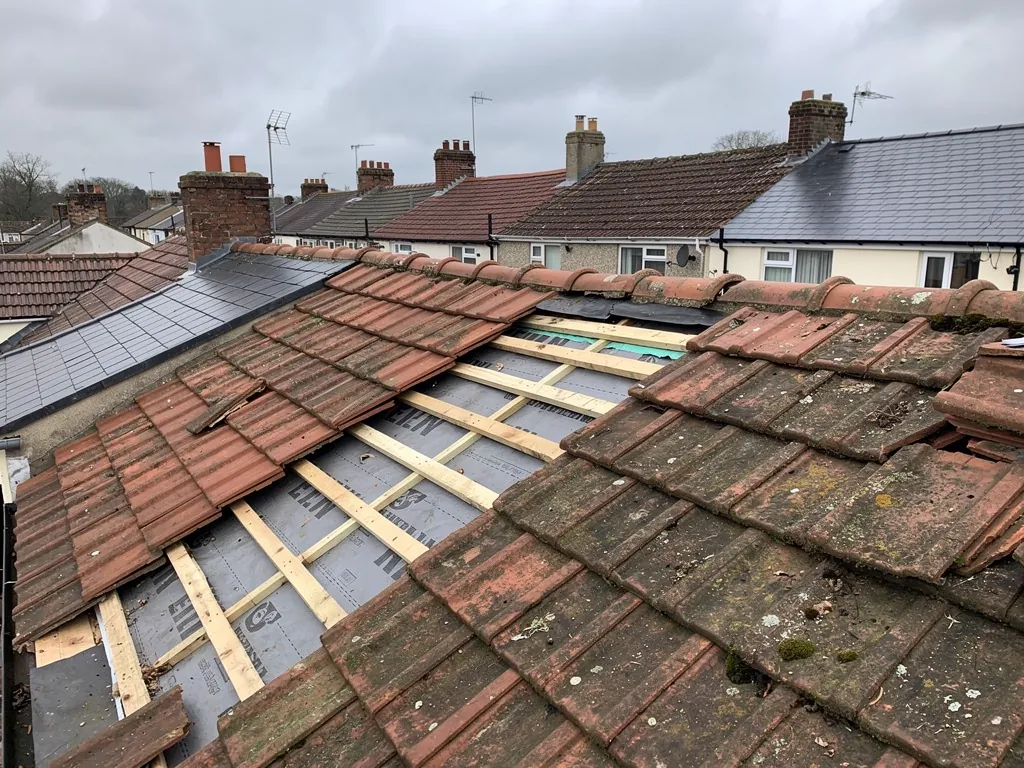 Flat roof repair or replacement: how to decide10 min read
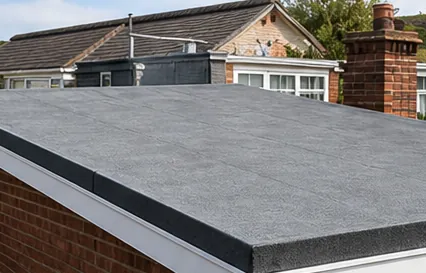 Flat roofs and Building Regulations: insulation, falls and approval9 min read
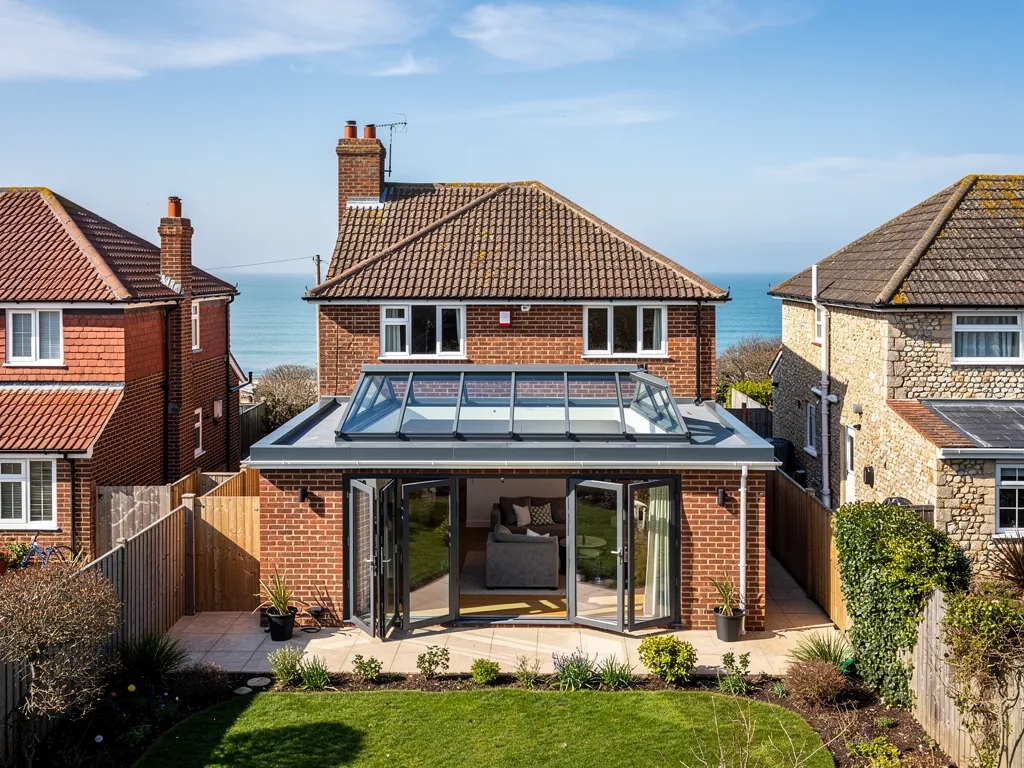 EPDM vs GRP vs felt: choosing a flat roof covering9 min read
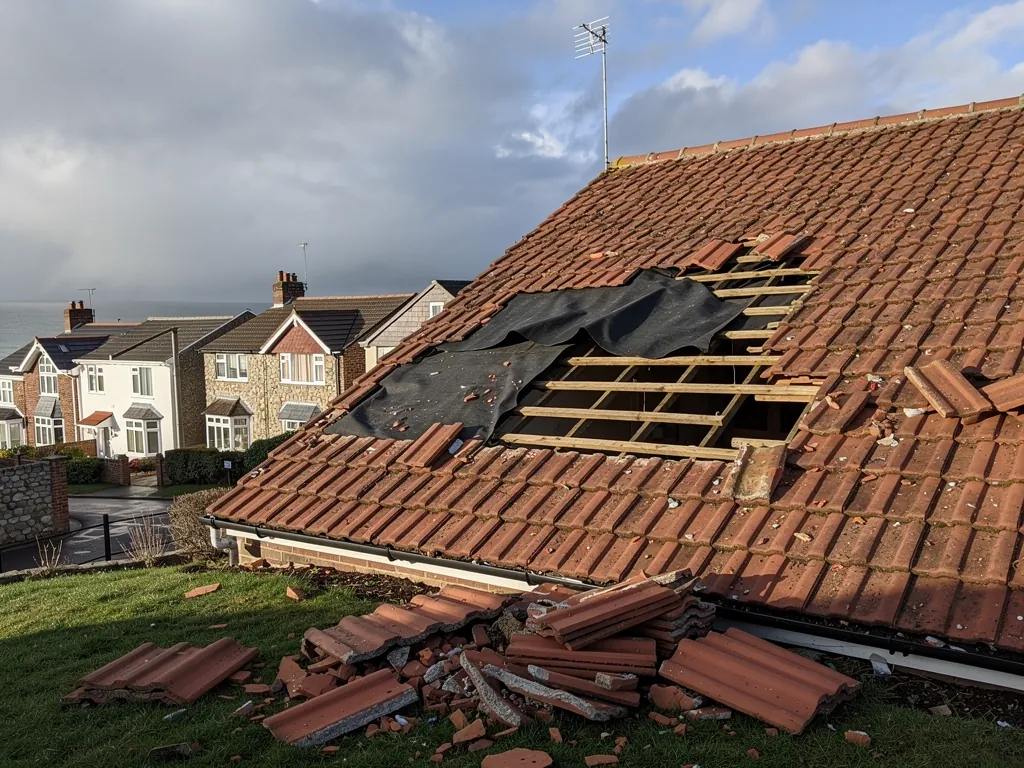 EPDM rubber roofing: how it is fitted, how long it lasts and what it costs9 min read
 GRP fibreglass flat roofs explained9 min read
 Torch-on felt roofing: the modern built-up system9 min read
 Liquid roofing and flat roof coatings: when they work and when they don't9 min read
 Warm roof or cold roof: insulating a flat roof properly9 min read
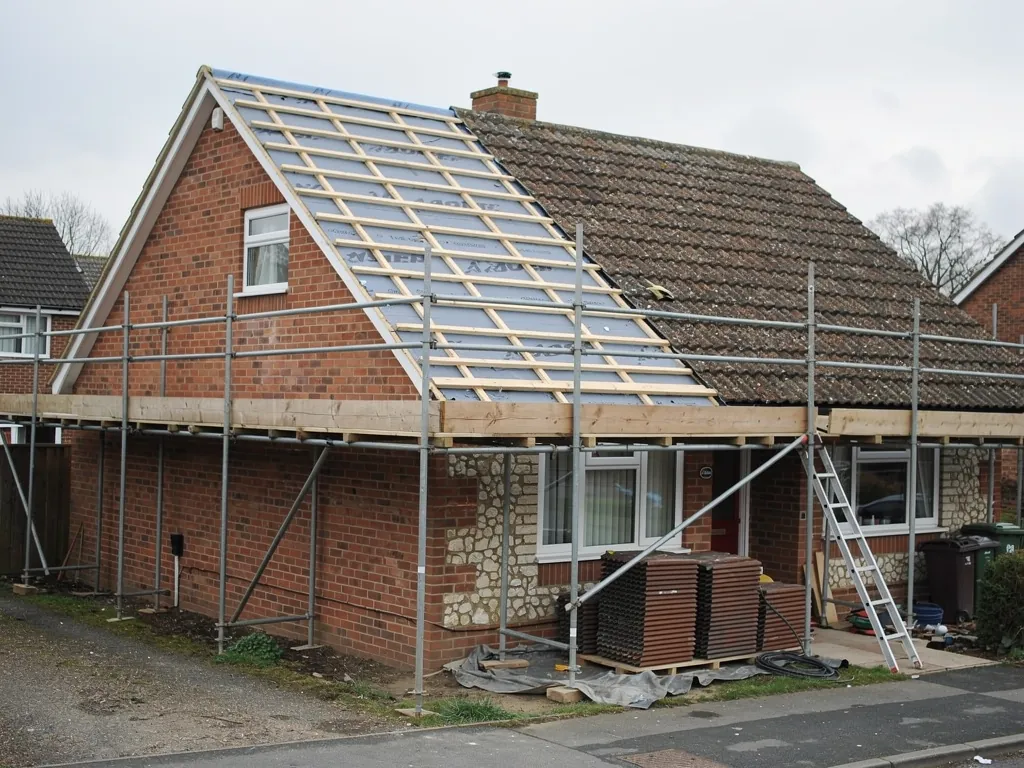 Flat roof falls and drainage: why water ponds and how it is fixed9 min read
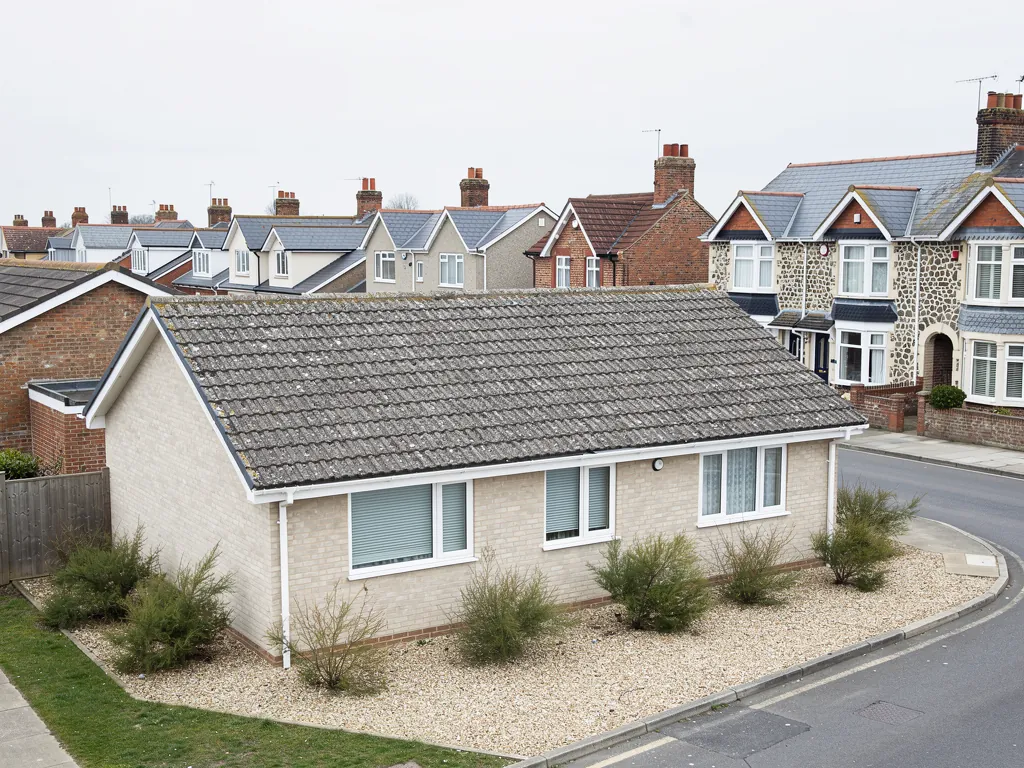 Flat roofs on extensions and dormers: the details that fail first9 min read
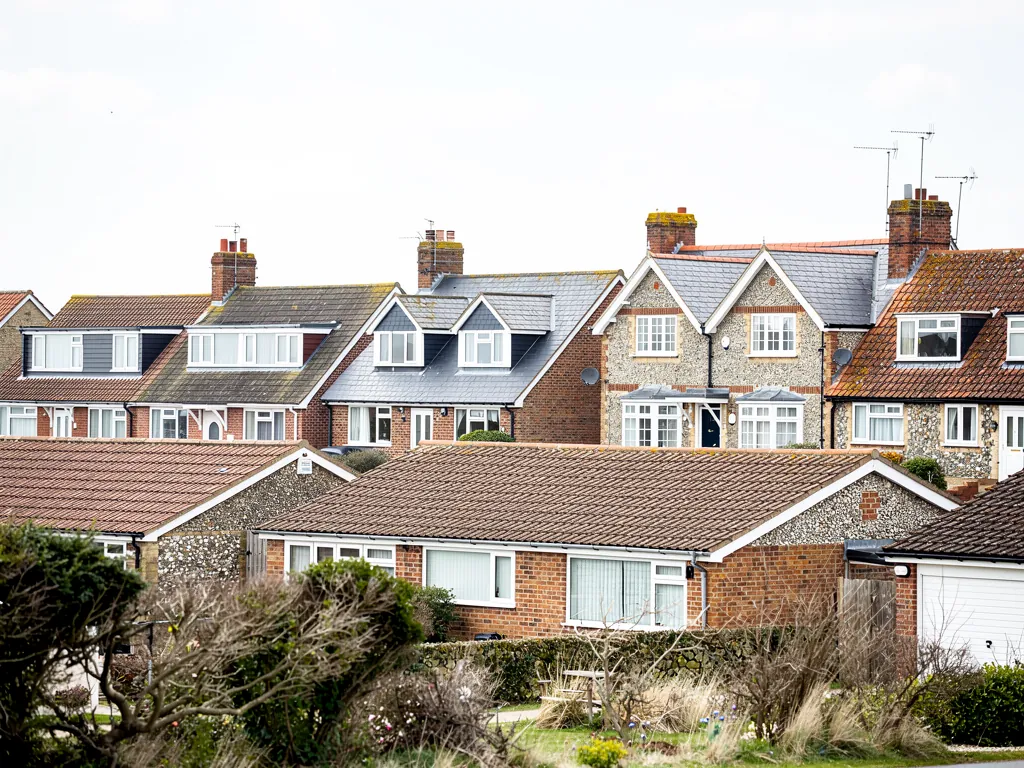 Flat roofs in winter: storms, ponding and wet-weather repairs10 min read
Quick answers
- What is the cheapest flat roof covering?
- How long does a flat roof last?
- When does a flat roof need replacing? The signs to look for
- Does home insurance cover a leaking flat roof?
- Do you need permission for a new flat roof in a conservation area?
- How long does a flat roof repair take?
- Can a flat roof be repaired in bad weather?
- How long does an EPDM roof last?
- Is EPDM cheaper than felt?
- Do you have to insulate a flat roof when you replace it?
- What is the minimum fall for a flat roof?
- Is standing water on a flat roof a problem?
- What causes blisters on a felt flat roof?
- How do you find a leak on a flat roof?
- Why is there condensation under my flat roof?
- Why do GRP roofs crack?
- Can you lay a new flat roof over the old one?
- Can you walk on a flat roof?
- What are flat roof edge trims and drip details?
- Do flat roofs still need stone chippings?
Questions
Flat roofing questions, answered
What will a new flat roof cost on a typical extension or garage?
It depends on the area, the state of the deck, whether insulation and falls are being rebuilt and how the roof is reached. Our own published guide for flat roofing runs from £1,000 to £5,000. Checkatrade's October 2026 replacement table, shown plus VAT, gives £2,800 to £7,500 across the UK. Check whether any figure includes VAT and scaffolding, then ask for a written price from a roofer who has surveyed the roof or studied photographs of it.
Which flat roof covering costs least, and is it the best buy?
No single covering is the lowest price everywhere, because area, outline and edge details change the sum, and the lowest to lay is not always the lowest to own. Less says a good felt job can last 20 years and a poor one may fail in under ten, while GreenSpec gives EPDM 20 to 30 years and Less gives GRP 25 to 40. We recommend on the roof in front of us and show you why.
How do I spot a dodgy roofer before they start on my flat roof?
Be wary of anyone who knocks unasked after a storm, wants cash up front, cannot give a written price or will not explain what happens if the roof fails. Ask for photographs of the problem, a written quote that says what it includes, VAT and scaffolding, and cancellation terms: a contract made at your home carries a 14 day cancellation period, though urgent repairs you ask for are treated differently. Ask what guarantee covers the workmanship, too.
Is there a government grant towards a new flat roof?
Most homes will not get a grant for a new roof. No national scheme we know of pays for re-roofing or roof repair. Government schemes fund insulation and heating: ECO4 ends on 31 December 2026, while the Great British Insulation Scheme shut on 31 March 2026. Households with a low income, or with a disability, can ask Arun District Council about local help, and gov.uk lists what is open now, because eligibility is never automatic.
Can a flat roof be laid or repaired in wet weather, and how long does it take?
A leak can be stopped for the time being under a temporary cover whatever the weather, and we give leaks and storm damage priority. Permanent work needs a dry deck, because felt, rubber adhesive and resin all bond badly to wet boards, so a new covering waits for a dry spell. How long it takes depends on the area, the layers to strip, any deck repairs and the weather, and the survey gives you a realistic order of work for your roof.
Will home insurance pay for a flat roof that has started leaking?
Sometimes, but not automatically. Which? warns that damage traced to a roof in poor repair may be treated as wear and tear, which is generally excluded. Tell your insurer first, make a temporary repair, take photographs of the damage and keep the receipts for any urgent work. If the decision seems wrong, put your complaint to the insurer, and after that to the free Financial Ombudsman Service. Our survey photographs of the roof come with the written quote.
Get a quote
Tell us about your flat roof
Send a photo of the roof and the ceiling below it, with its rough size and what you can see; we start with the deck, the outlets and the edges.
Loading the enquiry form. You can also call 01243 252373.