
Leaking joints and sagging gutters · 9 min read
Leaking gutter joints and sagging runs: repairs explained
How to tell a leaking joint from an overflow, why gutter runs sag, and which repairs last, with what to check on the fascia and brackets before anything is refitted.
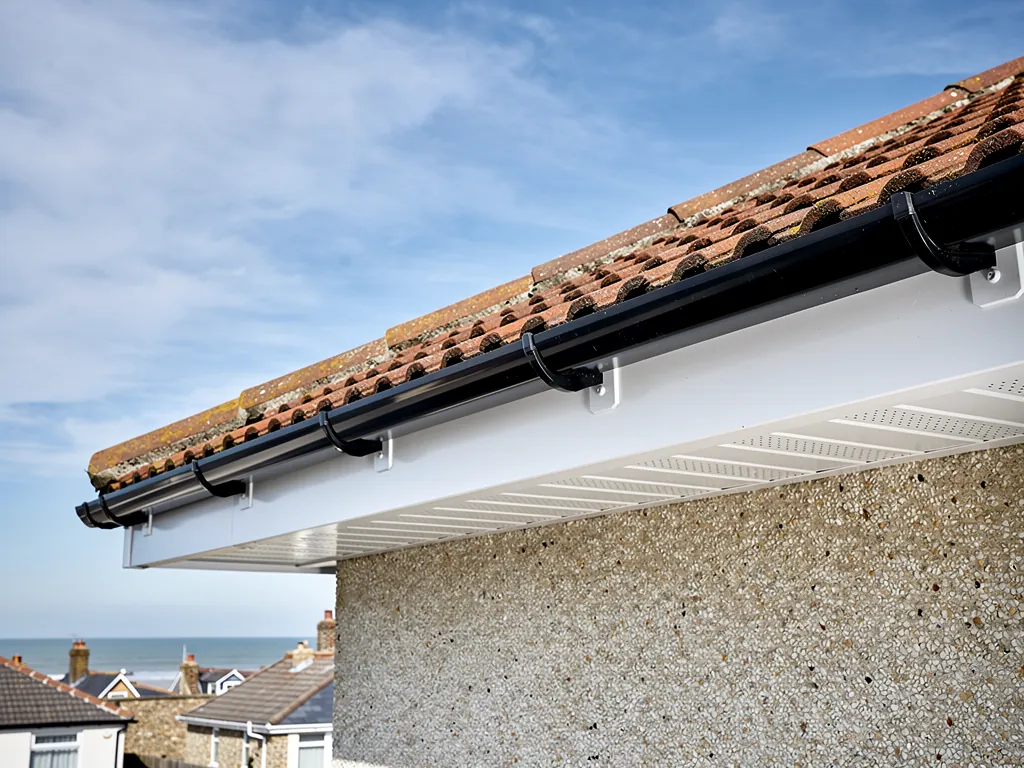
A gutter that drips at a joint or droops in the middle is telling you something. It is rarely just the joint or just the sag. The two faults usually travel together: a run that has dropped out of line puts strain on its joints, and a joint that has started to weep lets water soak the board it hangs from.
The temptation is to squirt sealant at the drip and hope. Sometimes that is all it needs. More often the leak comes back in a few months, because the real cause was a missing bracket, a lost fall or a blocked outlet, and the sealant treated the symptom.
This guide sets out how to read the fault, why joints fail, what a proper fall and bracket spacing look like, which repairs are worth doing and when it is time to replace a run instead. For the wider picture of the system, see our guttering, soffits and fascias page.
Leak, overflow or something else
Water on the wall below a gutter has several possible causes, and the repair differs for each. Sorting them out first saves money.
An overflow
Water that spills over the front edge in heavy rain usually means a blockage, or a channel whose slope has gone. The channel is full, so the water leaves by the lowest edge. Clearing the run solves it if the cause is debris. Our guide on gutters that overflow covers the signs.
A joint leak
Drops forming under a union, a wet streak that starts at one fixed spot or a green stain trailing down from a joint all point at the seal. The water gets out at the joint, not over the edge. It may only leak when the gutter is full, so a dry spell can hide the fault.
A hole or crack elsewhere
A split in the back of a length, a hole where a bracket has rubbed through or a crack from an old impact can all leak in a line along the gutter. A leak at the back runs down behind the channel and soaks the fascia without a drip showing at the front.
A roof edge problem
Sometimes the water was never the gutter's fault. A slipped tile at the eaves, a failed felt drip at the edge or a gap between the roof covering and the gutter can send water behind the channel. The test, described below, tells these apart from a genuine joint failure.
A wet patch inside near the eaves is worth reporting early, so the cause can be found before it spreads.
Why joints fail
A gutter joint is a small, hard-working part. It has to hold two lengths in line, stay watertight and cope with the channel moving as it warms and cools. Most failures come from a short list of causes.
The seal wears out
Many plastic systems rely on a rubber seal inside the union bracket, and in time the rubber hardens, shrinks or slips out of place. Older systems and cast iron joints used a compound, which dries and cracks. Once the seal stops pressing against the gutter, water finds the gap.
Debris holds water in the joint
Grit and silt collect against a union and keep it wet, and a blocked gutter fills the joint with standing water. A joint that would cope with passing flow may leak when it is submerged. That is why a clean-out often shows up leaks that were hidden.
Movement and poor alignment
Plastic expands and contracts with the temperature, and a run that has been fixed too tight cannot move. The pull works on the joint. A length that is not seated fully into the union can also leak from the start. Where one section has dropped below its neighbour, the joint is under strain and the seal is carrying more than it was designed to.
The fixings behind
If the brackets are loose or the fascia behind is soft, the whole run shifts under load. Joints do not leak in isolation; they leak when the structure carrying them gives way.
Repairs that last begin by correcting that structure.
How to test a joint before repairing it
A simple running-water test locates a fault in a few minutes and saves guesswork. It is worth doing before any sealant is bought.
The hose test
Block the downpipe end or begin at the high end of the run, and run water from a hose into the gutter in a steady flow. Watch each joint, the underside of the channel and the wall below. A second person helps, because the leak may only be visible from one side.
Work from the top of the run downward and stop at the first drip you find. Mark it with a pencil or tape so you can find it again when the gutter is dry. A slow drip that appears only after a minute or two is as real as a fast one, because heavy rain lasts much longer than a test.
Looking from above
On a low gutter, a look along the channel shows where water pools. Water standing in a pool after the flow has stopped marks a low point, and that is a sign of lost fall. Water that disappears from the channel before it reaches the next joint marks a hole or a failed seal.
What to record
Note where each leak is, whether it is at a joint or a length, and whether the brackets nearby are firm. Photographs help an installer see it without being there. If the downpipe or outlet is slow to take the water, check that too, and see our page on a blocked downpipe.
If the test shows no joint leak at all, the problem sits elsewhere, and you hear that after a proper look.
Sagging runs, brackets and fall
A gutter that dips between brackets holds a pool of water and silt. The weight of that water adds to the sag, and the dip gets worse. Understanding why it dips tells you whether to refix it or replace it.
Bracket spacing
Gutters need support at regular intervals. Brett Martin's installation guide sets a ceiling of 900mm between brackets. A run with brackets missing or placed too far apart will sag, particularly if it has been loaded with wet debris. Our page on gutter bracket spacing explains where extra supports go, such as at joints, corners and outlets.
The fall
Every run is set with a gentle slope towards the outlet. Brett Martin gives 1mm for every 600mm, and FloPlast gives 1:350 for its MiniFlo system, so the right slope depends on the system. A gentle fall means a run can look level to the eye while still holding water. If the fall has gone, water stands in the channel, silt settles and the joints stay wet.
What pulls a run out of line
Brackets that have loosened in a soft fascia, a fascia that has dropped or rotted, a bent bracket, or a full gutter loaded with silt all drop a run out of line. Sagging also follows a ladder or a falling branch hitting the front edge.
Before refitting a sagging gutter, we check the board behind it. Our guide to a sagging gutter goes into this in more detail.
Repairs that hold, and when to replace
Not every leak needs a new gutter. The skill is in telling a fault that can be corrected from one that will keep coming back.
Repairs worth doing
A joint that has simply lost its seal can be cleaned, dried and resealed, or have a new union fitted. A loose bracket can be refixed into sound timber, and extra brackets can be added to bring the spacing back. A run that has lost its fall can be lifted and reset. A small crack in one length may be treated as a short-term repair, though replacing the length is more reliable.
Repairs that rarely last
Sealant smeared over a dirty, wet or moving joint holds for a short time at best. Tape wrapped around a split is the same. A bracket screwed into rotten timber will pull out again. These fixes leave the cause in place, so the leak returns, and the price of repeating them soon passes the cost of doing it properly.
When to replace the run
If most joints leak, the plastic is brittle, the gutter has faded and cracked or several lengths have split, replacement is the better value. The same applies when the fascia behind has rotted, because refitting old gutters onto new boards carries the old faults across. Our guide on replacing twenty-year-old gutters sets out the signs.
Our rule is to fix what has failed and leave what has not. If a reseal and two new brackets will do, that is what we propose, with photographs of the fault beside it.
Cost, access and insurance
The price of a joint or bracket repair depends on the work, and on how you reach it. The job varies too much from house to house for a single figure to mean much, so our written quote, sent after the survey visit, carries a single total for your own gutters.
What sets the price
How many joints and brackets are involved is the first factor. The height of the gutter and the access needed come next: a low run reached from a ladder is quick work, while a high gutter needs a tower or scaffold. The condition of the fascia matters too, because soft timber behind the gutter adds carpentry. Checkatrade's scaffolding table (last updated October 2026) puts a house of two storeys, semi-detached, at about £875 for a month of scaffold, which is why we pair repairs with other roofline work where we can.
VAT
VAT is added at the standard 20 per cent. Whenever you weigh one price against another, ask whether each includes VAT and any access equipment.
Insurance
Whether a policy responds to a gutter fault turns on the cause. Insurers treat ordinary ageing as wear and tear, and Which? names a poorly maintained roof as one case. Where a storm is to blame, tell the insurer before anything else, make the area safe, photograph the damage and file any receipts for a temporary fix.
If water is already getting into the wall or the eaves, tell us when you get in touch. We prioritise leaks, and early action is cheaper than waiting. Our guide to gutter cleaning explains how regular clearing helps joints last.
Questions
Gutter joint and sagging questions
Can I use sealant to fix a leaking gutter joint myself?
On a dry, clean, sound joint a gutter sealant can slow a drip for a while, and it is a reasonable short-term measure from a safe, low ladder. It will not cure a joint under strain, a missing bracket or a lost fall, and it should never be the only fix on a sagging run. If the leak returns, the cause is the structure, not the seal.
Why does my gutter only leak in heavy rain?
Because the gutter only fills enough to reach the leak in heavy rain. A joint set a little above the normal water line stays dry in light rain and weeps when the channel is full. A blocked outlet or slow downpipe can make this worse, so it is worth checking that the water drains away freely.
Is a sagging gutter dangerous?
It is a sign of weakness, not an emergency, but a full, heavy gutter can pull away from the fascia and drop. That is a risk to anyone beneath it and to the wall below. A sagging run is best looked at soon, and not left until a gale or a heavy downpour brings it down.