
Consent for stone roofs · 9 min read
Re-roofing a stone roof in a conservation area: do you need permission?
Re-roofing a stone roof in a conservation area raises two separate questions, planning and building control, and a third if the house is listed. This guide sorts out which one applies and who to ask.
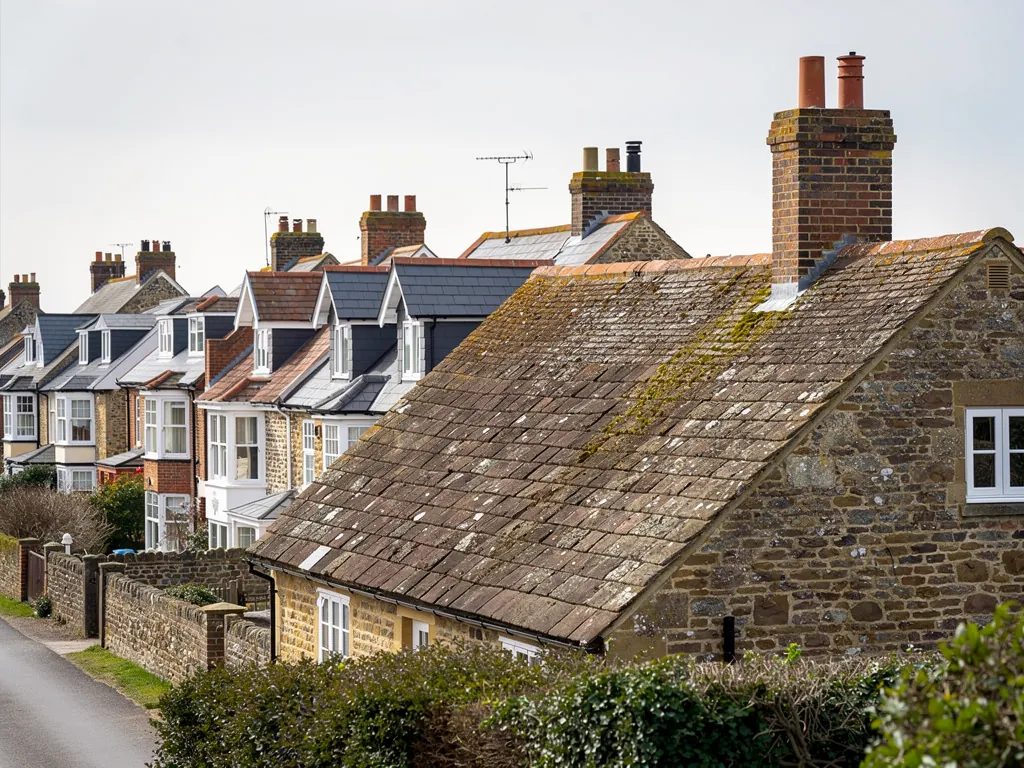
Many Horsham stone roofs sit on buildings with strings attached. A village centre may be a conservation area, a farmhouse may be listed, and a barn conversion may carry conditions from the day it was approved. So before a ladder goes up, owners ask whether they need permission, and the straight reply is that it depends on three things: what the work is, what the building is, and where it stands.
Plain repair work seldom calls for a planning application. The trickier cases are those where the covering changes, where the building is listed, or where the council has withdrawn some of the usual freedoms with an Article 4 direction. Those deserve a call to the council before you sign anything, and a roofer who has met them before can tell you early which kind of job yours is.
What follows is general guidance drawn from published planning law and council pages. It is not legal advice, and your own council has the final say over your own roof. The stone roof work we carry out is described on our Horsham stone roofing page.
Planning, building control and listing are three separate questions
People often use the word permission as though it covered everything, but a roof can face up to three different checks. Planning permission is about how a building looks and how land is used. Building control is about whether the work is safe and meets the technical rules for structure, fire and energy. For a re-roof it has its own thresholds: the Planning Portal says approval is normally not needed when less than 25 per cent of the building envelope and less than 50 per cent of the roof is affected, while Arun District Council lists replacing roof coverings among its approvals, so check with your own building control body. Listed building consent protects buildings with a recognised special interest. A job can need one, two, all three or none.
Standing in a conservation area does not by itself forbid re-roofing, and many owners there carry out sensible repairs every year without any application. It means the council takes an interest in how the area looks, and it can add controls a house elsewhere would not have. Listing is different and stricter, and attaches to the individual building whether or not it also stands in a conservation area.
Start with what the work actually is
Re-fixing slipped slabs, replacing a few cracked ones with matching stone and renewing a flashing are maintenance. Stripping and re-laying a slope with its own stone is a bigger job but still the same roof. Replacing the stone with another material changes how the building looks. Each of these sits at a different place on the permission scale, which is why the first thing any council asks is what you are proposing, in some detail. A clear description with a few pictures of the existing slopes can save the council, and you, several days of back and forth.
Mention any listing or conservation area designation to the roofer in your very first conversation. It changes the survey, the method and the timetable, and it can change the price.
Like-for-like re-roofing and planning law
Planning law begins with section 55 of the Town and Country Planning Act 1990, which defines development. Its list of exceptions includes work that does not materially alter a building's exterior, and such work needs no planning application. Putting back the same covering, laid the same way, is the clearest example. That is why plain repairs to an ordinary house rarely call for permission.
Two caveats matter. The first is that the test is appearance. Moving from stone to concrete tile, or from a graded stone roof to a uniform one, alters how the building looks, and in a conservation area the council will take that seriously. The second is that listed buildings and Article 4 land have rules of their own, covered below.
Changing the covering
If you are thinking of swapping stone for something else, treat it as a question for the council's planning team and not something to settle with the roofer alone. The Class C permitted development right for other alterations to a roof has no exclusion for conservation areas, but an Article 4 direction or a planning condition can remove it, and a listed building still needs listed building consent. Even where the right exists, it limits how far an alteration may stand proud of the roof slope, and it keeps the highest point of the roof as it was. Our guide to replacing a stone roof with tiles goes into that choice.
A new dormer is a much bigger step than a re-roof, and it has planning rules of its own. If you are weighing one up, start with our guide to skylights and roof windows, and speak to the planning team before you commission drawings.
Where an Article 4 direction changes the answer
Government planning guidance describes an Article 4 direction as a tool that lets a council or the Secretary of State withdraw named permitted development rights across a defined area. Conservation areas are a common home for them, and what they remove differs from one direction to the next. Some touch only front boundaries or hard surfaces. Others reach roofs, chimneys and windows on the side facing the street.
A few examples show how widely they differ. Portsmouth's direction for Old Portsmouth reaches the re-covering of a roof slope on the front elevation, and also taking down or altering chimney stacks. Arun's two, the Craigweil House direction at Aldwick and the one for shared houses, take away no roof rights whatever. Elsewhere, directions can be decades old, and a plan on the council's own website is the only dependable check.
How to find out for your address
Ask the planning team whether your property lies inside a conservation area, and whether any Article 4 direction applies to it. Ask for the reply in writing if the job is large, and send the planning team the address exactly as it appears on your council tax bill so they check the right property. Do not assume a neighbour's experience tells you about yours, because directions are often made street by street. For a stone roof in particular, ask whether stone is mentioned in the area's appraisal. Appraisals across West Sussex often describe the local roofing materials as part of the area's character, which is a reason councils tend to prefer that the stone is kept.
If the reply is that no direction applies, which is the usual outcome for a plain repair, like-for-like work normally goes ahead without an application, though building control may still be involved. If one does apply, get the council's view before you accept a quote, and file the reply with your other papers.
Listed buildings are a separate matter
For a listed building the starting point is section 7 of the Planning (Listed Buildings and Conservation Areas) Act 1990. Put simply, any alteration likely to change a listed building's special character needs authorisation before it is carried out. A stone roof is very often part of that character, so work to it is rarely a casual matter.
On its listed buildings page, the South Downs National Park Authority explains that regular upkeep and minor in-situ repairs in the same material do not need listed building consent. That wording matters. A re-lay of a whole slope, a change of fixings or a new underlay goes beyond a small repair, so ask the conservation officer before assuming it is covered. Consent applies to the whole building, and the roof is part of it.
Churches and other special cases
Not every listed building follows the same route. Some churches in use are covered by the ecclesiastical exemption and answer to their denomination's own process, for example a faculty for the Church of England. Others, including closed churches and those held by the Churches Conservation Trust, fall under ordinary listed building consent. A scheduled monument needs scheduled monument consent. If your stone roof is on any of these, ask before you plan.
Our guide to like-for-like consent on a stone roof looks at the repair end of the question in more detail. And if bats roost in the roof, remember that they are protected by law, so tell your roofer before the stone comes off.
The practical lesson for a listed owner is to involve the conservation officer early, before the survey is finished if possible, so the method can be shaped around what they will accept. A roofer who can describe the proposed method clearly, with photographs of the existing roof, helps the officer give a quick and useful reply.
Who to contact, and what to send them
The right authority depends on where you live. According to West Sussex County Council's guide to who does what, building control, listed buildings and conservation areas sit with the district and borough councils. Inside the South Downs National Park, the Park authority itself handles planning in the Arun, Horsham, and Adur and Worthing areas. Across the Chichester and East Hampshire sections, applications go to the district council, which handles them for the Authority. Building control remains with the district council throughout.
Horsham town lies outside the Park, so Horsham District Council acts as the local planning authority there. Arun's conservation area page adds that the Park authority is the one responsible for conservation areas within the Park, which matters in villages near Midhurst and Petworth where the boundary runs close to the village edge.
What to send
Send the address, a plain description of the work, photographs of each slope and the chimneys, and any survey report. Say whether you plan to reuse the existing stone and how much you expect to replace, and mention any chimneys, lead or ridge work that will be touched at the same time. A council officer can only comment on what they can see, and clear pictures often speed things up. If you would like us to talk to the officer, say so, and we will explain the proposal and the method. Our page on working with the conservation officer describes how that goes.
Whatever the reply, keep it in writing alongside the quote. If the council asks for a method statement, a sample slab or a sketch of the courses, treat that as normal for a stone roof and not a sign that something is wrong. It protects you if anyone later questions the work, and it tells the next owner what was agreed.
Questions
Conservation area roof queries
Can I replace broken stone slabs with matching ones without telling the council?
On an unlisted house in a conservation area, a straight like-for-like repair does not normally count as development, since it leaves the appearance much as it was. If the house is listed, or an Article 4 direction covers your street, check with the council's planning team first. A call and a photograph usually settle the point quickly.
Can I fit a roof window into a stone roof in a conservation area?
Not by itself. The permitted development right for roof alterations still applies in a conservation area unless an Article 4 direction or a condition removes it, and a listed building still needs consent as well. A roof window in stone also needs careful cutting and lead work, so ask us about the roof itself before you order the unit.
My village is inside the South Downs. Who handles my stone roof?
That varies by district. For the Arun and Horsham parts of the Park, the National Park Authority deals with planning itself. Chichester and East Hampshire applications are passed to the district council on its behalf. Building control stays with the district council whichever applies. Your council's website will show which rule fits your address.