
Winter and stone roofs · 9 min read
Stone roofs in frost and winter storms
Sandstone takes in water, and water that freezes expands. This guide covers how frost flakes stone, what winter gales shift, and what to do when a stone roof starts to leak.
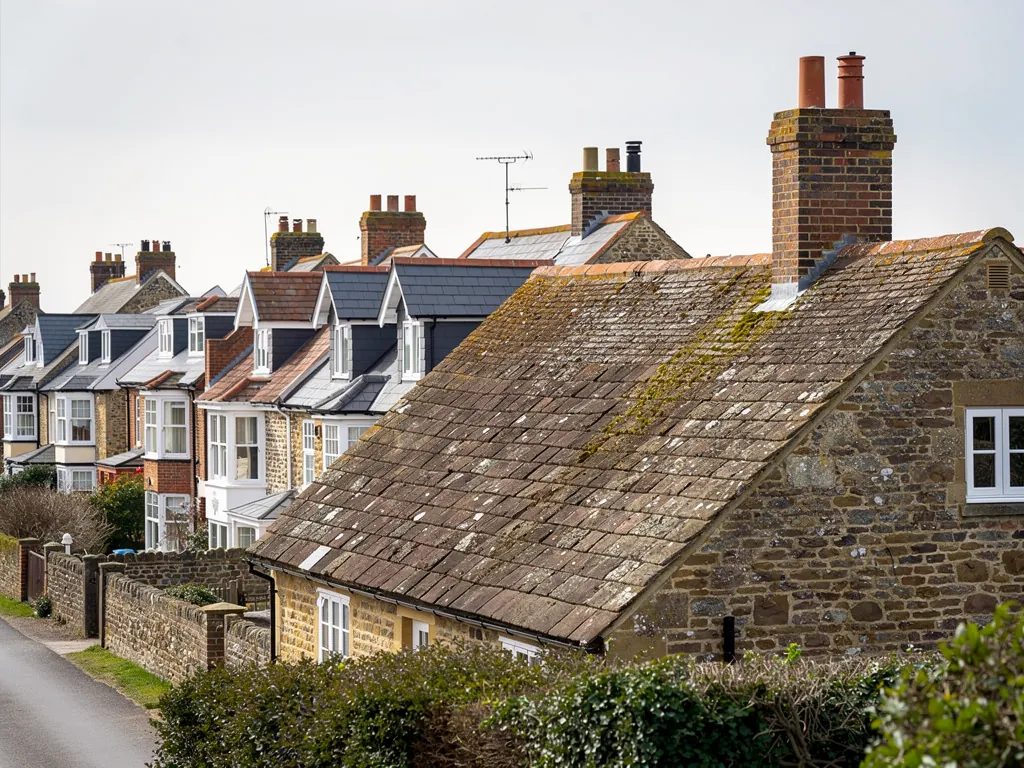
Stone is a hard material, so a stone roof seems the last thing a cold night could harm. Sandstone is also porous. It drinks water from the air and from the rain, holds it in the grain, and gives it up slowly. When that water freezes it expands, and the stone, which cannot stretch, has to take the strain. Over enough winters the face of a slab can lift away in thin layers.
Winter brings a second set of problems, which are blown stone and blocked water. Gales find the slabs whose fixings have tired, and cold, wet weather fills the valleys and gutters with debris. Stone remains a fine covering. The point is to know the early signs and who to call when you spot them.
This guide takes the winter in order: what frost does, how to spot the signs, why drainage matters, what gales shift, how to make a leak safe and tell your insurer, and when repair work suits the calendar. It carries no weather statistics, because what to do depends on your own slopes and timbers.
How frost gets into stone
Think of a sandstone slab as a hard sponge. Between its grains there are tiny gaps, and rain, mist and condensation work their way into them. In mild weather the water dries out again. In freezing weather it can turn to ice inside the slab, and the ice needs more space than the water did. The stone around it is pushed apart from within.
One night does little. A slab that stays wet through a long cold spell, thaws, and freezes again is another matter. Each cycle widens the weakness a little, and the stone tends to give way along its natural bedding planes, the layers it was split along. The surface comes away as a thin flake, often called spalling, and the slab gets thinner and rougher, and it holds more water than before. Damage feeds itself, which is why early notice pays.
Which slabs suffer first
Wet stone suffers first. That means slabs under a mat of moss, which holds water against the face, and slabs at the eaves, where all the water from the slope above runs through. Slabs round a leaking gutter, in a shaded valley or on a north-facing slope that dries slowly are at risk too. Stone that dries quickly in the wind and sun tends to last. Stone that stays damp does not.
Old fixing holes
The hole near the head of each slab is a weak point. If the fixing rusts or rots, water collects in the hole and freezes, and a crack can run out from it. A slab that has cracked from its fixing hole may still look in place from the ground. It has often lost its grip, and the next gale is the test.
Spotting frost damage: from the garden, the gutter and the loft
The first signs show from the garden. A pair of binoculars helps, and so does a look at the ground.
From the ground
- Gritty flakes or small shards of stone lying below the eaves or in the flowerbed
- Slabs that look rough or scaly on the face rather than smooth and weathered
- Dark patches that stay wet long after the rest of the roof has dried
- A slab sitting lower, or tilted against the ones beside it
- Green or black growth that thickens on one slope in particular
In the gutter and at the downpipe
Stone grit in a gutter is a sign that a slab above is shedding its face. A handful of fine sand-coloured grit after a cold spell is worth noting; a gutter full of shards means a slope needs a closer look. Check the downpipe outlet as well, since grit can block it and send water back over the eaves.
From the loft
Inside, torchlight along the underside of the slabs will show daylight through a cracked slab or damp patches on the battens beneath. Stained timber, a smell of damp or drips after a thaw all point to water coming in. Any photographs you can take from the hatch, keeping your feet on the joists, are a real help to us.
We do the same checks on the survey, but from the slopes as well, and every cracked, flaking or slipped slab is marked on the photographs. Our short answer on whether a cracked stone slate can be repaired says what can be done for the ones that have failed.
Gutters, valleys and the water that stays
Stone does not fail from rain alone, and so the first defence against frost is drainage. Water that leaves the roof quickly gives frost nothing to work on. Water that stays gives it everything.
Gutters are the weak point. A gutter blocked with leaves, moss and old grit overflows, and the water that spills runs back over the lowest course instead of away. In a cold spell that wet band freezes along the eaves, exactly where the biggest slabs sit and where the roof timbers meet the wall. A gutter that has dropped or sagged leaves a pool where there should be a channel and does the same job. Gutters and outlets are therefore the first thing to clear, and the least costly.
Valleys and gaps behind chimneys
A valley is the sunken angle where two slopes meet. It collects water from both, and on a stone roof it is often formed by slabs swept round the corner or by a lead lining. Moss, leaves and silt build up in it and slow the flow. Water then spreads sideways under the nearby slabs, or freezes in the channel. Behind a chimney stack there is a similar trough, formed by the lead gutter that carries water round the stack.
Moss
Thick moss holds water against stone for days. A light dusting is harmless, and lichen belongs on an old roof. Heavy moss is not. We remove it by hand and with a soft brush, and avoid anything that scours the surface of old stone. Our answer on removing moss from a stone roof says more about the method.
Do not wash a stone roof in winter. Water forced into the grain just before a frost does the very harm you want to avoid.
Winter gales and slipped stone
Frost is slow. A gale is quick, and it finds what the frost has loosened. A slab whose fixing has rotted, or which has cracked from its hole, may hold for years until one night of wind and rain lifts its tail or slides it down the slope. Stone is heavy, so a slipped slab does not blow off like a tile. It drops, jams against the course below, or falls to the ground.
After a storm, look for gaps in the courses, a slab lying in the garden or on a lower roof, and a line of stone that looks out of true. Check the ridge and the verges too. The ridge is the capping that finishes the apex, and the verge is the sloping edge where stone stops against a gable wall. Both are bedded in mortar, and wind-driven rain can open the joints. Our short answer on why stone slates slip goes through the usual causes.
A word on safety
Do not go up on a stone roof to look. Wet and frosted stone is slippery, the slabs may be loose, and old battens do not always take a person's weight. A fall from a roof is a far greater danger than a slipped slab. Look from the ground, take photographs with a zoom and leave the roof to those equipped to work on it. If slabs are lying in a path or near a door, keep people away from the area until it is made safe.
We prioritise leaks and storm damage. A first visit makes things safe, with temporary cover where it is needed, and the lasting repair follows once conditions allow.
Making it safe, telling your insurer, keeping the evidence
When a stone roof is leaking, the order of events matters. Both Which? and the Institution of Structural Engineers put the insurer early in the list. Which? adds that anyone paying for emergency repairs should report them and keep the receipts, and the Institution stresses photographs of the damage plus a note of any temporary covering put up.
That gives a simple sequence:
- Make the area safe and keep people away from loose stone
- Ring your insurer and ask what they need
- Photograph the damage from the ground, the loft and indoors
- Arrange temporary cover so no more water gets in
- Keep every receipt and every dated photograph
Do not throw away damaged stone until the insurer has seen it or said you may. Fallen slabs are evidence, and some can be reused.
What cover usually depends on
Whether a claim is paid depends on the policy and on what caused the damage. Which? names rain entering via a poorly kept roof as a wear and tear case. Flaking built up over many winters is slow damage of that kind, so a sudden storm loss and a long decline can be treated differently. Nobody can promise an outcome, and the claim itself is between you and your insurer. Older photographs of the roof and records of upkeep are useful support. Our guide to roofing advice has more on claims.
Unhappy with a decision? Take the complaint to the insurer first. If that fails, the Financial Ombudsman Service is free to use.
After the survey you get a written quote at one total, with a photograph of each fault.
Winter work and the weeks that suit repair
A stone roof can be made safe in any month. A full repair or re-lay is a different matter, and some of it suits the calendar. Freezing weather is hard on fresh bedding, because mortar that has not set can be damaged by frost. Rain and ice make slopes dangerous to work on. For that reason we separate the urgent from the planned: the urgent is covered at once, and the planned waits for settled conditions unless the roof cannot.
What can be done in cold months
Temporary cover, clearing gutters and valleys, refixing a slipped slab where the weather allows, and surveys all go ahead in winter. Photographs taken in winter often show more than summer ones, because the wet patches and the flakes stand out. If the question is whether to repair, re-lay or replace, our guide on repairing or re-laying a Horsham stone roof covers the choice.
Getting ready before the cold
The best protection is dull. Clear the gutters and downpipes in the autumn. Check the valleys and the area behind chimneys. Take off heavy moss gently. Look at the courses from the garden for slipped or scaly stone. Fix anything small while the weather is still kind. A stone roof that drains well and dries well seldom needs more than that.
When you want a view, ring 01243 252373 or send photographs on WhatsApp. We give a plain verdict, repair, patch or re-lay, with the reasons, and one written total price. Our Horsham stone roofing page lists the stone jobs we take on.
Questions
Winter stone roof questions
Why is my stone roof shedding grit into the gutter?
Stone grit means a slab above is losing its surface, which is often the work of water and frost in the grain. A little is normal on an old roof. A steady fall of flakes, or shards of stone, means one or more slabs are failing, and a survey will find which. Clear the gutter so the water does not back up.
Is it safe to leave a leak until the weather improves?
A leak should be made safe first. Water indoors damages ceilings and insulation, and a wet roof deteriorates faster in frost. Temporary cover can be fitted in poor weather. The full repair can then wait for settled conditions. Tell your insurer, take photographs and keep the receipt for any temporary cover.
Can frost-damaged stone slabs be repaired, or do they all need replacing?
It depends on how far the flaking has gone. A slab with a lost surface layer but a sound body can sometimes stay. A slab that admits water has to be swapped for matching stone. If flaking runs across a whole slope, a re-lay may be the better answer, and the survey photographs show which.