
Chimney repair costs · 9 min read
What is the average cost to repair a chimney in the UK?
Typical UK prices for chimney repairs in 2026, from a patch of lead to a full repoint, with the scaffolding, labour and VAT that decide where a real bill lands.
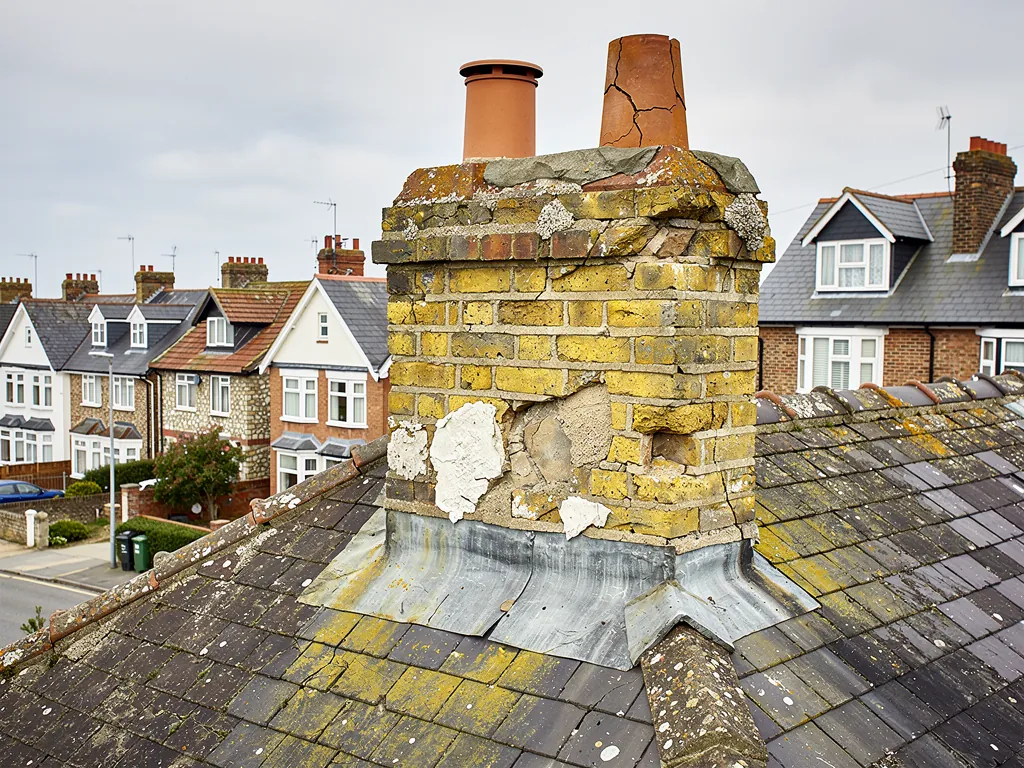
A chimney stack is a small structure with a big effect on a bill. It stands at the highest point of the house, it is exposed on every face, and it carries several separate jobs: brickwork and mortar joints, a mortar cap called flaunching, lead flashing around the base of the stack, and the pots on top. Any one of them can fail alone, and each has its own price.
This guide sets out typical UK figures from national cost guides, each with the guide named and, where the guide gives one, the date of its table. Treat them as the middle of the market, never as a price for your chimney. What they do show is how a bill is built: the type of repair sets a base, the height and access add to it, and labour and VAT sit on top.
Most of the swing comes from getting to the stack, not from the repair itself. A small patch of lead can cost twice as much when a scaffold has to go up for it. Keep that in mind as you read, then judge a written quote against a survey of your own stack, with photographs of the fault, rather than against a national average.
Typical UK prices for the common chimney jobs
Three jobs account for most chimney repair bills: repointing the brickwork, repairing or replacing the lead, and rebuilding what has failed. National guides put figures on the first two. The ranges below are typical for the UK as a whole, not a quote for a stack in Bognor Regis or anywhere else.
| Job | Typical UK range | Source |
|---|---|---|
| Chimney repointing | Around £750 on average | Checkatrade, table updated October 2026 |
| Chimney lead, patch repair | £150 to £250 | MyJobQuote, updated 22 September 2026 |
| Chimney lead, full replacement, no scaffold | £350 to £460 | MyJobQuote, updated 22 September 2026 |
| Chimney lead, full replacement, with scaffold | £700 to £920 | MyJobQuote, updated 22 September 2026 |
A rebuild has no single typical figure, because its price turns on how much of the stack comes down, how tall it is and what the roof below needs afterwards. The written quote that follows a survey fixes that number, and it arrives as one total.
None of these figures covers the damage water has already done indoors, such as a stained chimney breast or wet timber in the loft. Nor do they cover replacing a cracked pot or a cowl, the cap that keeps rain and birds out of a flue. Ask about both at the survey so the quote leaves no loose ends.
The widest range on the page belongs to repointing, and the reason is plain. A stack with a few open joints near the top is a very different job from one that needs every face raked out. Our guide to chimney repointing explains how to tell which one you have, and the rest of this page takes each piece of the bill in turn.
Why repointing quotes vary so widely
Repointing means raking out the old mortar joints to a set depth and filling them with fresh mortar. On a chimney, the cost follows three things.
Height and number of faces
A stack that rises a short way above the ridge presents less brickwork than one standing tall beside a gable. Every face adds area, and the top courses, which take the worst of the weather, are often the ones needing most work. A stack with several flues is wider and taller again.
How far the decay has gone
Where joints have only weathered back a little, the job is routine. Where bricks have loosened, or the face of a brick has started to flake, the roofer may need to cut out and replace individual bricks first. That takes longer, and the price moves up the range.
The mortar itself
On older brickwork the usual advice is to keep the joint softer than the brick, so the brick is not the part that wears. That often means a lime-based mix, which costs more to buy and takes longer to apply than a bag of cement mortar.
Repointing on its own is a sound buy on a stack that is still true and solid. It is a poor buy on a stack that leans or has lost its core, because new joints will not hold up bricks that are moving. That call is made at the survey, and the verdict comes before any price. If the stack has gone too far for pointing, the quote moves into rebuild territory, which we cover below.
Chimney lead: patch it or replace it
Lead flashing is a folded band of sheet lead that closes the gap between the chimney and the roof covering. Where the stack sits partway down a slope, lead also forms a small gutter behind it, which carries water around the chimney. Soakers are separate pieces of lead, one per course of tiles, that sit under the covering and turn up against the brickwork.
MyJobQuote prices a patch repair at £150 to £250 and a full replacement at £350 to £460 without scaffolding or £700 to £920 with it (updated 22 September 2026). Checkatrade, in its roof repair guide with a table dated June 2026, gives lead flashing repairs at £50 to £70 per metre, excluding VAT.
A patch makes sense when the lead is sound and has lifted or split in one place. Replacement is the better route when it has cracked along several folds, been smothered in sealant, or no longer tucks properly into the joints. MyJobQuote says flashing in lead can last for over 80 years, so a properly dressed new set should be a one-off cost, provided the brickwork it tucks into is sound.
Thickness is described by a code number. In the Royston Lead brochure, code 3 is recommended for soakers only, and code 4 is the lightest listed for flashings. Heavier codes cost more and suit more demanding details, such as the gutter behind a stack that sits partway down a slope. Which code a stack needs is a matter for the survey. Our guide to chimney flashing explains what each piece does, and why a leak showing in the loft often starts at one of them.
Scaffolding is the swing factor
On a bungalow, a roofer can often reach the stack with a roof ladder. On a two-storey house, safe working at the top of the stack usually means a scaffold. The MyJobQuote lead figures show the effect: the same replacement costs £350 to £460 without scaffolding and £700 to £920 with it, so access can double a small job. That is why a roofer who prices the stack without looking at how to reach it has only given you half of an answer.
Checkatrade's scaffolding cost guide, in a table dated October 2026, lists a chimney scaffold at around £660 a week. Its monthly rates for a full scaffold are around £875 for a two-storey semi, £800 for a terrace, £1,000 for a detached bungalow and £1,200 for a detached house.
When the scaffold stands on the pavement
Putting scaffolding where it blocks a footway or carriageway takes a highways licence under section 169 of the Highways Act 1980, from the highway authority. West Sussex County Council lists £266 for one month and wants at least 10 working days between application and erection. Hampshire County Council lists £211.90 for the first two weeks and wants ten clear working days. Plan the repair around that wait, because a leak does not always allow for it, which is why a temporary cover is sometimes fitted first.
Ask any roofer whether the price includes the scaffold. A quote that leaves it out is not the cheaper job if it turns up later as an extra. Whether a tower or a ladder can cover the job is settled at the survey.
Labour, VAT and the quote itself
Checkatrade puts roofers at around £35 to £45 an hour, or £280 to £360 a day. Chimney work tends to be priced by the job rather than by the hour, but a day rate is a handy check when a quote looks far off either way. Small jobs often carry a minimum charge, because the roofer still has to travel, set up and clear away. A single visit that does the joints, the cap and the lead together usually works out better than three separate callouts spread over a year.
VAT comes on top. The standard rate is 20 per cent, and Checkatrade states that its repair figures exclude it. A £1,000 job at those rates becomes £1,200. Before you set two quotes next to each other, check whether each one includes VAT and whether each one includes the scaffold. Those two items explain more of the gap between quotes than the repair does.
Put three questions to every roofer: does the price include scaffolding, does it include VAT, and what did the photographs of your stack show.
You get the written quote once the survey is done, as a single total, and it is a good and fair price for the work. The survey photographs arrive with it, so you can look at the lead, the joints and the cap yourself before you decide anything. If the pictures show a stack that is leaning or crumbling, the right answer may not be a repoint at all, and the verdict says so.
For the full range of stack work we carry out, see our page on chimney repairs in Bognor Regis.
When the bill outgrows a repair
Some chimneys cost more than the ranges above because the problem is bigger than a joint or a flashing. A stack that leans, has loose bricks near the top, or has lost the mortar cap that sheds water may need part of it taken down and built again. Our guide to rebuilding a chimney stack covers when that becomes the sensible choice. It is priced on survey, since the roofer has to see how much sound brickwork is left.
Storm damage can push a bill up at short notice. A pot blown off, or a stack hit by flying debris, calls for a safe temporary fix first. Which? advises contacting your insurer as soon as possible, telling them of any urgent fix you pay for and holding on to the receipts. The Institution of Structural Engineers adds that photographs of the damage help a claim. Whether the policy pays depends on its wording and on how the damage happened.
Wear and tear is a different matter. Which? cites a poorly maintained roof letting rain in as an example of damage that insurers may treat as upkeep rather than an insured event. Regular checks therefore save money twice: they catch the cheap fault early, and they show the stack has been looked after.
Ten minutes with binoculars after a gale is a reasonable habit. Look for pots that have shifted, mortar on the ground, or lead standing proud of the brick. Photograph anything you see, with the date, since a record of when a fault appeared is useful for the roofer and for an insurer.
Questions
Chimney repair cost questions
Is a low-priced chimney repair worth taking?
It can be, when the fault is small and the stack is sound. A patch of lead or a few raked joints costs little and does the job. The risk is a low price for work that treats a symptom, such as sealant smeared over cracked lead, while the cause stays in place. Ask what the survey photographs showed and what the written quote covers.
Do chimney repair prices include VAT?
Not always. Checkatrade states that its repair figures exclude VAT, and the standard rate is 20 per cent. Other guides are less clear. Whenever two quotes sit side by side, confirm that VAT and scaffolding are counted in both, because leaving either out can make one roofer look far cheaper than another.
Can acting early keep a chimney bill down?
Often, yes. A small failure in the lead or a few open joints is quick to fix, while water left to soak into the brickwork and down the chimney breast leads to bigger work and damp indoors. Checking the stack from the ground after bad weather shows loose pots or missing mortar before they turn into a larger job.