
Cut-edge corrosion · 9 min read
Cut-edge corrosion on metal roofs: treatment and repair
Why rust appears first along the cut edges of coated steel roof sheets, how to spot it from the ground and from inside, and the treatment that suits each stage of the damage.
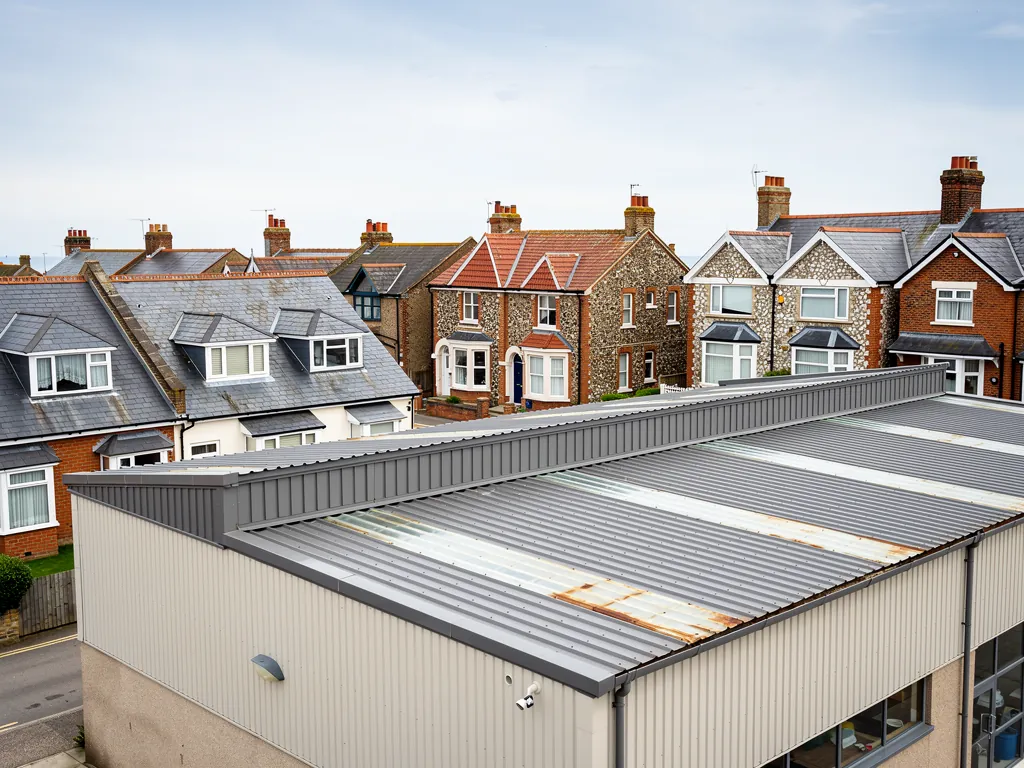
Walk round the back of an older industrial unit and look up at the roof sheets. Often there is a thin orange line running along the bottom of each sheet, or brown streaks tracking down the profile from the laps. That is cut-edge corrosion, and it is one of the most common ways a metal roof begins to age. It is also one of the most treatable, as long as someone catches it before the steel has gone.
Coated steel sheets leave the factory with a protective skin: a zinc layer on the steel and a painted or plastic finish over that. Wherever a sheet is cut, drilled or sheared on site, that skin is broken and bare steel is exposed along the edge. Moisture finds it, and the rust spreads from the edge under the paint, lifting the coating as it goes.
This guide explains the mechanism, where to look, what treatment fits each stage and when it is cheaper to replace than to keep repairing. It forms part of our commercial roofing work for industrial and agricultural owners.
How a cut edge starts to rust
A coated steel sheet is a sandwich. A steel core is covered on both faces by a thin layer of zinc, and over the zinc sits a coat of paint or a plastic-based finish. The zinc does two jobs. It seals the steel from air and water, and where the surface is scratched it corrodes in preference to the steel beside it, which is why a galvanised sheet can take a scrape without rusting straight away.
That protection is at its weakest on a cut edge. The sheet was cut, and at the cut the steel core is exposed in a sliver the thickness of the sheet. Zinc can only defend a small distance either side, and when it is used up the steel begins to rust. Rust takes up more room than the metal it replaces, so it swells and pushes the paint away from the edge, opening a larger gap for water and repeating the cycle.
Why the laps suffer most
Profiled sheets overlap each other along the length of the roof, and at the ends of each run. Water gets into the overlap by capillary action, the way it climbs a sugar lump, and then it cannot easily dry. The cut edge sits in that damp pocket for months at a time, so rust gets a head start. The same thing happens at the foot of the sheet where it meets the gutter, and around any hole cut for a rooflight, flue or vent.
Understanding the mechanism matters because it explains the cure. Treatment has to stop the rust, seal the edge from water and give the zinc time to do its job, in that order. A coat of paint alone does none of the three for long, and that is why quick cosmetic fixes disappoint.
Where to look and what you will see
Most owners first notice the problem from the ground. A rust-coloured stain runs down the face of a wall below an eaves, or a downpipe is stained at its head where run-off has carried rust. Streaks like those are a prompt to go up and look properly.
On the roof
The signs, in rough order of seriousness, are these:
- a thin orange or brown line along the bottom edge of a sheet
- paint blistering or flaking back from an edge, often near the laps
- rust bloom around fixing holes and around cut-outs for rooflights
- flaking and pitting on the sheet face, with the zinc gone beneath it
- holes, where the steel has rusted right through
The first two are early. The last two usually mean the sheet is beyond saving. Anything between is a judgement that depends on how many sheets are affected, how deep the rust runs and what lies underneath.
From inside the building
Inspecting from below tells you more than people expect. Daylight showing through a sheet means a hole. Drip marks on stock, rusted purlins close to a lap, or damp patches on a liner are reasons to climb up and trace the water back. Tracing a leak from the inside back to the sheet above follows the same trail in reverse, and rusted laps are a frequent end of it.
Before anybody walks on the roof, remember that old sheets and rooflights can fail under a person. The HSE publishes guidance on fragile roofs, and our page on fragile roof safety explains the access we use, because the survey itself has to be done safely.
Treating it early
When the rust is surface-deep and confined to the edges, a repair that is done properly can add years. The steps matter more than the product, and the order is fixed.
Preparing the metal
Loose paint and rust scale come off first, with wire brushes, scrapers or abrasive pads, down to sound metal or to paint that is firmly stuck. Skipping this is the usual reason treatments fail, because a coat applied over loose rust simply lifts with it. The surface is then cleaned and left dry. Washing and drying in cold, damp weather is awkward, which is one reason the work is better planned for a spell of settled conditions than done in a rush.
Stopping and sealing
A rust-inhibiting primer, or a converter that chemically stabilises the thin rust that remains, goes onto the bare edge. A flexible coating follows, brought a little way over the paint on each side so it overlaps sound material and keeps water from creeping underneath. On laps the coating is worked into the gap as far as it will go, and a sealing tape or sealant closes the end of the overlap where that is suitable.
The coating has to suit the existing finish and the sheet. A product that does not bond to a plastic-based topcoat will peel within a season. This is the reason we pick the system after inspecting the roof and not before. Where the whole surface is tired and not only the edges, a full coating treatment may be the better answer, and our page on metal roof coating sets out how that works.
Edge treatment buys time. It does not restore a sheet that has been eaten through, and a good roofer will tell you which of the two you are paying for. A re-inspection after the first winter is sensible, because a missed spot shows itself quickly.
Spot repairs against whole-slope treatment
A small number of rusting edges in an otherwise sound roof can be handled one by one. A patch of rust at a rooflight cut-out, say, or a short run at the eaves. The cost is modest, the work is quick and it can often be done with the building in use. Photographs before and after show exactly what was treated, so you can see the work and keep the record for next time.
The picture changes when the same fault shows up on every lap along a slope. Treating each edge by hand then becomes slow and the quality uneven, because the roofer is working at awkward angles and cannot always reach into the lap. At that point a slope-wide treatment, with the surface prepared and coated as a single system, is better value and gives a more even finish.
Fixings and washers
While you are up there, the fixings need to be checked. Self-drilling screws pass through the sheet and carry a sealing washer. A washer that has perished or been crushed lets water down the shank, and the hole becomes another place that rusts. Replacing worn fixings and washers along the treated area costs little and removes a second source of leaks. Missing or loose fixings also let the sheets flutter in a gale, which wears the coating at every contact point.
Gutters and valleys
Steel sheets drain into gutters and valley gutters, and these are often the first components to corrode in a standing-water pocket. If a gutter leaks onto the sheet foot, treating the edge without sorting the gutter just repeats the damage. We look at the drainage as part of the same visit.
When coating stops being the answer
There is a point past which no coating will help, and it is better to be told than to pay for a treatment that will not hold. The deciding factor is the steel itself. Surface rust can be removed and sealed. Steel that has lost thickness, flaked in layers or been perforated cannot be built back up.
Press a firm tool against the rusted area when the sheet is accessible. If it flexes, crumbles or marks easily, the metal has gone. Sheets like that also pull away from their fixings, because the steel around each screw has weakened. A painted-over sheet in that condition can look sound from ground level yet give way under a person's weight, or leak in the next heavy storm. Looks are a poor guide, which is why the inspection includes touching the metal.
Replacing sheets and the structure beneath
Where the damage is local, individual sheets can be replaced like for like, with the new sheet lapped and fixed to match. Where it is widespread, the answer is a new roof. Our page on replacing steel roof sheets sets out how that is done and what you should expect.
The structure under the sheets deserves a look as well. Purlins and rails that have been wet for years can corrode in their turn, and a lightweight roof that has lost fixings may not be restrained as designed. This is the stage at which a structural opinion can be sensible, and the survey will say so rather than leave it to chance.
The sums are simple to state. If the cost of treating a deteriorated roof approaches the cost of a new covering, the treatment is poor value. Our verdict says which side of that line your roof is on, and why.
Old sheets, asbestos and safe working
Not every old industrial roof is steel. Plenty of units put up before the year 2000 carry fibre cement sheets, and some of those contain asbestos. For any building that dates from before 2000, or was refurbished then, the HSE tells owners to work on the basis that asbestos is there. That matters here for a practical reason: wire-brushing, drilling or cutting an asbestos cement sheet to deal with a different fault releases fibres.
Corrosion treatment is for metal. If the roof turns out to be asbestos cement, or a steel roof laid over an old fibre cement one, the plan changes. HSE guidance treats careful, intact removal of asbestos cement as non-licensed work, and any breakage that raises significant dust turns the job into a notifiable one. Fibre cement roofs are also fragile. Nobody crosses a roof until it has been checked, and where asbestos is suspected the sheet is identified before anyone brushes or cuts it.
Working at height
Most corrosion repair happens at the edges of a roof, which is exactly where falls happen. Edge protection, harnessed access or a platform from below should be set up before the first sheet is touched, and scaffolding that stands over the footway is licensed under the Highways Act, which needs advance notice. Allow time for that in the plan.
Last, check whether each price includes VAT, currently 20 per cent at the standard rate, and whether the access equipment is counted in the total.
Questions
Cut-edge corrosion questions
Is a little orange along the sheet edges a reason to worry?
It is a reason to look, not to panic. Light surface rust on an otherwise firm sheet can be cleaned, sealed and coated, and treated early it can hold for years. If the rust is flaking in layers or has holes, the conversation changes to replacement.
Can the work be done while the unit stays open?
Usually, with planning. Edge treatment is mostly outdoor work and rarely needs the building emptied, though access routes, loading areas and anything stored directly below the working zone may need to be protected or moved for the days involved.
Does painting over rust work as a cheap fix?
Rarely. Paint over loose rust lifts with it, usually within a season, and traps moisture against the steel. The result looks tidy for a while and then fails faster than a properly prepared edge, so the preparation is where the money is best spent.