
Single-ply roofing · 10 min read
Single-ply roofing: PVC, TPO and EPDM membranes
How the three single-ply membranes used on shops, units and flat-roofed blocks compare, how a sheet is held down and jointed, and the points on the roof where a good job is won or lost.
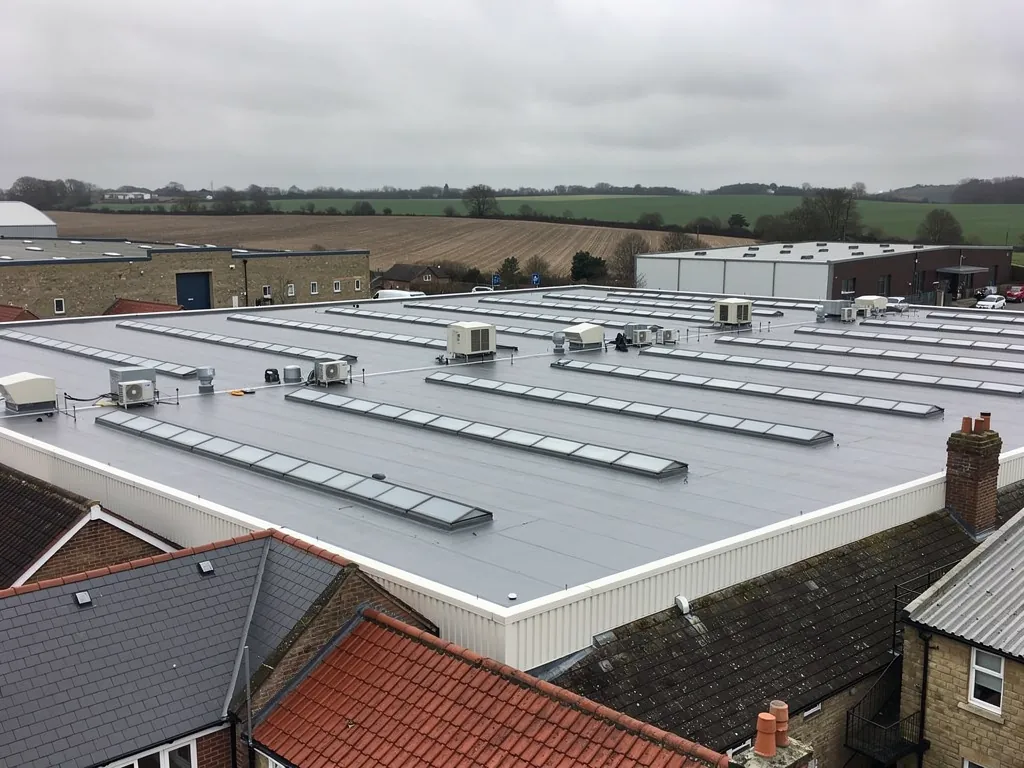
Single-ply is the name for a waterproof sheet that arrives on site as one layer of factory-made membrane, rolled out across the roof and joined at the edges. It is a different animal from built-up felt, which is put together from several bitumen layers on site, and from liquid coatings, which go on wet and cure in place. On commercial buildings it is often the first system a surveyor reaches for when a large, low-pitched roof needs recovering.
Three materials do most of the work: PVC, thermoplastic polyolefin and EPDM. They look alike from the pavement and behave differently on the roof. Two are welded with hot air, one is glued or taped, and each reacts in its own way to heat, to standing water and to the foot traffic of whoever services the plant on top. Choosing between them is not brand loyalty. It comes down to what the existing roof is made of, what the building is used for and how much upkeep the owner wants to carry.
This guide follows the order the work happens: the material, the fixing, the build-up underneath, the details and the paperwork. It sits within our commercial roofing service.
What makes a membrane single-ply
The defining feature is the sheet itself. The manufacturer makes it in a controlled factory, to a set thickness and width, so the waterproofing layer does not depend on how warm the day is or how steady the hand of the person laying it. On site the job is to position the sheets, secure them and make the joints. Done well, the joints are the only places the roofer has to answer for.
That is the main appeal for a commercial owner. A large warehouse or retail unit may have a roof the size of a football pitch, and covering it in a sheet product means fewer hours working with hot bitumen, fewer naked flames near a building full of stock and a quicker route to a watertight surface. It also suits a building that stays open for business, because the work is cleaner and quieter than most alternatives.
Where it fits and where it does not
Single-ply is at its best on large, low-pitched roofs with few penetrations: a distribution unit, a supermarket, a school block. It is slower and dearer per square metre on a small roof broken up by rooflights, pipes and plant, because every one of those needs a hand-formed detail instead of a long straight run of sheet.
It is also no cure for a roof that is failing underneath. A membrane can only be as sound as the deck and insulation it sits on. If the deck is rotten, the insulation is waterlogged or the roof holds water because the falls are wrong, a new sheet hides the problem for a while and then repeats it. The survey comes first, and our commercial roof survey page sets out what we look for before recommending a system.
PVC, polyolefin and EPDM compared
Think of the three as cousins with different temperaments. Each suits a particular building, and our separate page on choosing between the first two goes deeper.
PVC
PVC membranes are flexible, reinforced sheets whose seams are welded with hot air, so two sheets become one continuous layer at the joint. That welded seam is the great selling point. PVC also copes with the chemical exposure found on roofs above kitchens, extraction plant or industrial processes, which is why it is often specified for restaurants and food units. The trade-off is that PVC contains plasticisers that keep it supple, and over the years a membrane can stiffen as they leave, so the maker's formulation matters.
Thermoplastic polyolefin
This is the newer arrival. It offers the same hot-air welding, usually in white or light grey so it reflects heat, and it appeals to owners who want a welded seam without the plasticiser question. Formulations vary between makers more than they do with PVC, so the data sheet and the track record of the specific product count for more than the name on the roll.
EPDM
EPDM is a synthetic rubber, usually black, supplied in very wide sheets so a modest roof may be covered with no seam in the field at all. Where joints are needed they are glued or taped. For service life, GreenSpec lists an expected 20 to 30 years, while Less, in its March 2026 cost guide, says 30 to 50 years. The sources disagree, which tells you to treat a lifespan as a range and not a promise. EPDM stays flexible in cold weather and is easy to repair, though a glued joint depends on a clean, dry surface when it is made.
How the sheet is held down
A membrane that is not secured lifts in a gale and behaves like a sail. Three methods secure it, and which one is right turns on the structure beneath.
Mechanically fixed
Fixings and plates are screwed through the sheet edge into the deck, along the lap, and the next sheet is welded or glued over the top to hide them. It is quick, suits many decks and is a common choice on large industrial roofs. The deck must be able to hold the fasteners, so on an older building the survey includes pull-out testing of a sample.
Fully adhered
The sheet is glued across its whole area to the surface below. That spreads wind load evenly and gives a smooth, quiet finish, so it often suits roofs with plenty of detail or those that must stay light. It needs a clean, dry, compatible surface, and it is the method most affected by the weather on the day.
Ballasted
Here the membrane lies loose and is held by a layer of stone or paving. Nothing passes through the deck, but the weight added is considerable and the structure has to carry it. Where the new covering is much heavier than the one it replaces, the Planning Portal suggests asking an engineer or surveyor first, and it lists a new covering that adds 15 per cent or more to the roof weight as needing approval. Ballast also hides the membrane, which makes leaks harder to trace.
Which method suits you is a conclusion of the survey, not a preference. The written quote names it, with the reason.
Falls, insulation and what sits beneath
Calling the membrane the roof is a little like calling the paint the wall. Under it sit the deck, a vapour layer where the building needs one, insulation and sometimes a tapered layer that provides the slope. Rain only leaves the roof if that build-up is right.
Falls and ponding
No flat roof is truly level. BS 6229:2025, which replaced the 2018 edition in December 2025, keeps a minimum finished fall of 1:80, and roofers usually design around 1:40 so the completed roof still drains. Pools that stay after rain mean a fall is not working. Some membranes tolerate a little ponding better than others, but water that sits for days loads the structure, collects dirt and ages the sheet faster. If your roof holds pools, read our guide to commercial flat roof ponding before deciding anything.
Insulation and Part L
Under Approved Document L, putting a fresh waterproof layer over a flat roof counts as renovation work. Where more than 50 per cent of the surface of the thermal element is renovated, an upgrade is expected, and the document gives 0.35 W/(m²·K) as the limit for an existing roof and 0.16 as the improved value. In practice a recovering job is usually when insulation is added or topped up, which can raise the roof height at edges and doorways, so the detailing has to absorb it.
Moisture inside the build-up is the other risk. If the old insulation is wet, a new sheet traps the water. A good survey checks with moisture tests and core samples, and the result decides between recovering the existing roof and stripping to the deck.
Details where leaks begin
The open area of a roof rarely fails. Water gets in at the details: upstands against walls and plant, outlets, rooflights, expansion joints and the edge trim. A roofer's skill shows here, because each one is cut and formed by hand from the same sheet.
Upstands and terminations
At a wall junction the membrane turns up the face as an upstand and finishes under a flashing or a rigid bar sealed to the masonry. A common failing is a bar left unsealed, or a flashing set too low. An upstand tall enough that driven water cannot slop over its top, and shaped to shed water away from the wall, lasts longest.
Outlets and penetrations
Outlets are where ponding water most wants to leave and where leaves collect, so the outlet should be a purpose-made fitting joined into the membrane and not a blob of sealant. Pipes, flues and cable routes are best covered with pre-formed collars or boots, with an upstand around larger plant.
Edges and joints
The roof edge is where wind begins to lift a sheet, so the perimeter fixing and the trim hold the whole system down. A welded seam should be probed along its edge to find any gaps, and a record of that testing is worth asking for. A neat edge trim makes the roof look right from the street, which is the square finish we aim for on every job.
Repair, recover or replace
Single-ply roofs are repairable. A puncture, a split at a joint or a failed detail can often be patched with a matching piece of the same material, welded or glued in place. Matching does the work in that sentence. A different membrane, or a bituminous product stuck onto a sheet it does not suit, may seem to hold on day one and fail by the next winter.
The question for an owner is when patching stops being sensible. Several signs point towards a larger job:
- repeated leaks at different places in the same year
- seams that open along their length rather than at one spot
- a membrane that has gone brittle, crazed or hard to the touch
- wet insulation found when a leak is opened up
Where the existing build-up is dry and the deck is sound, a new membrane can sometimes go over the old roof on a separating layer. Where it is not, the old covering comes off. Our commercial repair or replace guide sets out how that choice is made.
Whatever the answer, you get the verdict first, with photographs of your own roof. If a repair will hold, we quote for the repair.
Regulations, tax and what moves the price
Single-ply work raises the usual Building Regulations questions. The Planning Portal says building control approval is normally unnecessary for work touching under 25 per cent of the total building envelope and under 50 per cent of the roof. A whole-roof recovering usually exceeds that, and Arun District Council's building control page names re-covering of pitched and flat roofs as work that needs approval. We explain what your job needs and see to the notification when the work is notifiable.
Safety and access
A new membrane makes the roof look safe to walk on, yet fragile rooflights and old fibre cement sheets remain places where people fall through, and the HSE publishes guidance on fragile roofs. A scaffold reaching over the road or pavement needs the highway authority's licence, and the waiting time belongs in your programme.
What moves the price
Quotes differ because roofs differ. The main drivers are area, the number of details, how much of the old build-up has to come off, the insulation specification, access and whether the building stays open. The standard rate of VAT is 20 per cent, so ask whether any price includes it and whether scaffolding is in the total. Commercial membranes vary too widely by specification for a national figure to help. After the survey comes the written quote, giving a single sum for the entire job.
Questions
Single-ply roofing questions
Can a single-ply membrane be laid over an existing felt roof?
In some cases. The old roof has to be dry, sound and flat enough to take the new layer, and on a separating layer that stops the two materials reacting. Wet insulation found by core samples usually rules it out. The survey tells you which applies.
Is a white membrane better than black EPDM for staying cool?
Light colours reflect more sunshine than black, so they pick up less heat, which can matter on a plant-heavy roof. Colour is only one factor, though. Seam method, chemical resistance, foot traffic and the existing build-up often count for more than the shade of the sheet.
Who checks that the welded seams are sound?
The roofer should probe the seams as the work proceeds, running a tool along each weld edge to find any gap, then mend what shows. Ask for the check to be recorded and for photographs before the plant is refitted.