
Leaks in heavy rain · 10 min read
Roof leaking in heavy rain: causes and fixes
A roof that only leaks in heavy rain is telling you where its weak point is. This guide covers the usual causes, how to trace them from inside, and the fixes.
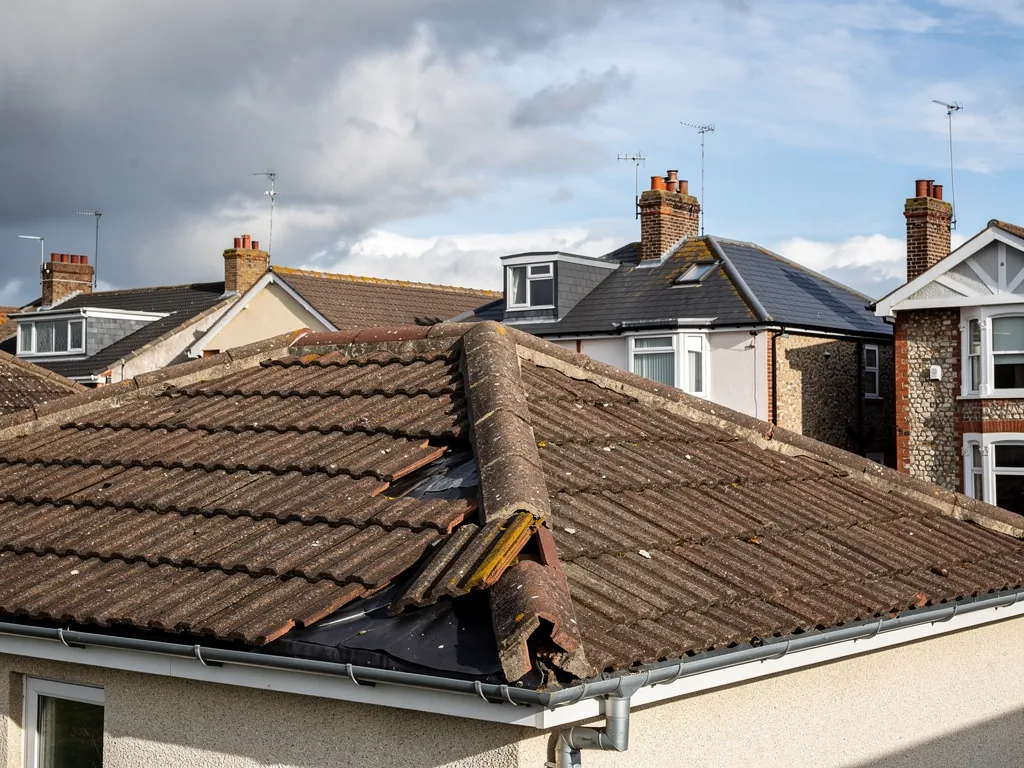
Plenty of leaks behave oddly. The roof is dry for weeks, then one long downpour sends a drip into the landing, and by the next morning the stain has dried and you wonder whether you imagined it. A roof that leaks only in heavy rain is rarely imagining anything. It has a weak point that copes with light showers but gives up when water arrives faster than the roof can shed it.
On the Sussex coast that often means rain driven at the building by the wind, which pushes water sideways and upwards into laps, joints and junctions that stay dry when the rain falls straight down. Sea weather adds gusts that lift tiles a fraction and let water in underneath. Gutters that overflow in a cloudburst pour water over the lip and down the wall, or push it back beneath the roof edge.
This guide takes the likely causes one at a time, shows how to narrow down the spot without climbing up there, and says which fixes are small and which are not.
Why the rain has to be heavy before it gets in
A pitched roof does not keep rain out by being watertight in the way a bucket is. It works by overlap. Each tile or slate sits over the one below, and water runs down the face and off the bottom edge. Underneath, a sheet of underlay is meant to catch anything that blows past. Between them these layers shed light rain easily.
In a downpour, three things change. There is far more water on every square metre. The wind pushes it against the roof from the side, forcing droplets into the gaps that gravity alone would never use. And the water runs faster and further, so any trickle that was sheltered in a light shower is suddenly carrying a sheet of rain down onto a junction that was never built to take it.
That is why the failure point is usually a junction and not the open field of tiles. Start with the places where the roof stops and something else begins:
- the lead or flashing round a chimney
- the joint with a taller neighbouring wall
- a valley, where two slopes meet and water collects
- the ridge and hips at the top
- the roof window or flat-roofed dormer
- the gutter line at the eaves
A flat roof fails differently, and we come to it in its own section.
Note which wall is damp and what the weather was doing, because the pattern narrows the search. Damp that follows storms from one side suggests a windward junction or a slipped tile on that slope. Damp after any long downpour points to a valley, a gutter or a flat roof that cannot clear its water fast enough.
Flashings, chimneys and valleys: the junctions that fail first
Flashing is the metal dressing, normally lead, that closes the gap where roof covering meets masonry. Water that runs down the wall is meant to be carried over the roof covering by the flashing. When the flashing lifts, cracks or pulls out of the mortar joint it is tucked into, rain runs behind it. In a light shower there is not enough water to find the gap. In a downpour there is.
MyJobQuote, in a page last updated on 22 September 2026, puts the life of lead flashing at over 80 years, which tells you that a lead flashing which has failed has usually been disturbed, not worn out. Movement in the chimney, a loose mortar joint, or the earlier work of someone who sealed the gap with a bead of mastic instead of dressing the lead are typical reasons. Our page on flashing leaking in rain goes through the signs.
Valleys and abutments
The valley is the inside corner formed by two slopes, and the run-off from both ends up in it. Leaves, moss and debris slow that flow, and a lead or tile valley that is blocked can overflow sideways under the tiles. A roof abutment, where the slope butts up against a wall, relies on a stepped flashing; if one step lifts, water follows the wall down.
What the repair involves
A flashing repair can be as small as re-dressing and re-fixing the lead, or as large as stripping the old lead and fitting new. Checkatrade's June 2026 table puts lead flashing repairs at £50 to £70 per metre, excluding VAT. For chimney leadwork, MyJobQuote gives a patch repair at £150 to £250. Those are typical UK ranges from national guides. For your own roof the figure is the one in the written quote after the survey.
Chimney stacks have their own failures, from cracked flaunching (the mortar collar round the pots) to loose pointing. Our chimney repairs page covers them.
Slipped, cracked and lifted tiles after a hard downpour
Even a sound tiled roof leaks when a tile has moved. A single slipped tile leaves a gap in the overlap. The underlay below may cope with the odd splash, but in a heavy shower the gap passes enough water that the underlay is overwhelmed, and the drip appears inside.
Tiles slip for several reasons. Nails corrode or pull out, and the tile creeps down. Frost cracks a tile in winter, and the damage only shows once the crack widens. Strong wind lifts a tile and drops it back askew. Slate roofs have their own version of this, where the nail that holds a slate gives out and the slate sags out of line. A tingle, a narrow lead or copper strip nailed below and curled up to hold the slate's foot, can often put a slipped slate back.
Spotting them from the ground
You can often see damage from the garden without going near the roof. Look for a tile standing proud of its neighbours, a visible gap, a dark patch where a tile should be, or broken pieces lying in the gutter or along the path. A pair of binoculars helps. Photograph what you see with your phone's zoom, because the picture is useful evidence later. Never climb a ladder onto a wet roof.
Repair or something bigger
Replacing a handful of tiles is a small job. If many tiles have slipped because the fixings have failed across a slope, the sensible answer may be to strip and relay that slope with the sound tiles reused, and the survey report will say so. It ends in a plain call on the slope: mend it, hold it with a stopgap, or renew it. We put forward the least work that stops the leak.
Checkatrade's June 2026 table puts concrete tile repairs at £90 to £120 per m² and clay tile at £110 to £160, excluding VAT, which shows how the covering sets the base cost.
Gutters, downpipes and the roof edge
Sometimes the roof is sound and the water is arriving through the eaves. A gutter that is blocked or sagging cannot take a cloudburst. It fills, overflows, and sends water down the face of the wall or over the back of the gutter into the fascia and the roof edge. Inside, you see a damp patch on an upstairs ceiling near the outside wall, or a stain on the wall itself.
Two timbers matter here: the fascia, which faces outward and carries the gutter, and the soffit, which covers the underside of the eaves overhang. Rot in either lets water into the wall plate and the ends of the rafters. A felt strip at the roof edge, called the eaves tray or eaves support, should guide water into the gutter and not behind it. If the felt has slipped or was never laid properly, water runs back beneath the bottom course of tiles.
What to check
- Do gutters overflow at joints or at one corner during a downpour?
- Is there a green line or staining down the wall below the gutter?
- Does a downpipe discharge slowly, or back up?
- Is the gutter dipping or pulling away from the fascia?
- Are there weeds, moss or leaves in the run?
Gutter falls are gentle. Manufacturer guidance such as Brett Martin's and FloPlast's gives roughly 1:600 to 1:350 depending on the system, so a run that holds standing water has sagged out of line. Raising it a few millimetres at one end often fixes the problem, and replacing a failed length is cheaper than repairing rotten timber behind it later.
Clearing a gutter is a modest job with a big payoff. Our guttering, soffits and fascias page covers repairs and replacement.
Flat roofs, ponding and heavy rain
Flat roofs are the usual suspects when the leak appears only after a very wet day. A flat roof is not flat; it should fall towards an outlet. BS 6229:2025, which replaced the 2018 edition in December 2025, keeps the minimum finished fall at 1:80. Designers aim steeper, around 1:40, to leave the finished roof some margin to drain. If it was laid with less, water stands in puddles, and standing water finds every weakness in the covering.
Heavy rain tests that. Water that clears in an hour after a shower may sit for days after a downpour. The membrane under it is being soaked constantly, and any pinhole, split seam or lifted edge lets it through. Water also finds its way in at the edges, where the covering turns up against a wall or runs over the edge trim.
Signs on a flat roof
- puddles that remain long after the rain has stopped
- blisters or bubbles in felt or a soft, spongy feel underfoot
- splits along seams, or lifted edges at the wall
- blocked outlets or a gutter that does not clear
- stains on the ceiling directly under the flat roof
The Less cost guide, dated March 2026, puts small flat roof repairs at £150 to £500. It gives torch-on felt 10 to 20 years, GRP 25 to 40 years and EPDM 30 to 50 years. If a roof is near the end of that range and keeps ponding, patching it again may cost more over time than recovering it. If the deck beneath is soft, a patch will not hold.
Our flat roofing page explains the coverings. At survey stage we photograph the ponding, seams and outlets, and the verdict comes before any figure.
What to do while it is raining, and the fix afterwards
Water coming in during a downpour needs quick action indoors, because you cannot sensibly repair a roof in the rain. Put a bucket or bowl under the drip and a towel or sheet round it to stop splashing. Move furniture, electronics and rugs out of the way. If the ceiling is bulging with water, make a small hole at the lowest point so it drains into a bucket and does not collapse in one go. Switch off the power to any light fitting near the water and keep away from it until it has dried; see our page on a roof leak near a light fitting.
Write down the time, the weather and where the water came through. If it is safe, go into the loft with a torch and look for wet timber, dripping felt or dark patches, and take photographs. Our guide to checking the loft for a roof leak explains what to look for. Water tends to track along a rafter before dripping, so the damp area in the loft can lie some distance from the hole in the roof.
Getting it fixed
Once the rain stops and the roof is dry, a roofer can survey it. Where needed the roof is covered first; then the fault is traced and photographed, and a written verdict follows with one total price. When you compare roofers, check that VAT and scaffolding are covered in whatever figure you are given. Our emergency roof repairs page covers the call-out side of this work.
If you have insurance
A leak that came after a storm belongs with your insurer: report it, photograph the damage and keep the bills for any temporary work, which is the Which? advice. Wear is treated differently from storm damage, and our storm damage insurance claim guide explains the difference.
Questions
Heavy rain leak queries
Why does my ceiling stain appear days after the storm?
Water travels. It can soak into insulation, run along a rafter or sit in the plasterboard before it shows as a stain, and the stain may appear well away from the actual hole. Trace it from the loft where it is safe to do so, and photograph the stain as it grows.
Can a roof leak in heavy rain if the tiles look fine?
Yes. Many failures sit at junctions or behind the visible covering: a lifted flashing, a worn valley, a split in the underlay or a gutter that overflows into the roof edge. A good survey looks at those details and the loft, not only the open slope.
Is it worth patching the roof just for the winter?
Sometimes. A small, well-defined fault such as a few slipped tiles is worth repairing at once. If the roof is generally tired, a patch may buy a season. The verdict says which, with photographs, and the smallest job that cures the leak is the one we suggest.