
Flat roof falls · 9 min read
Flat roof falls and drainage: why water ponds and how it is fixed
A flat roof is never meant to be dead level. This guide explains the slope it needs, the reasons water gets left behind, and the work that puts a roof right.
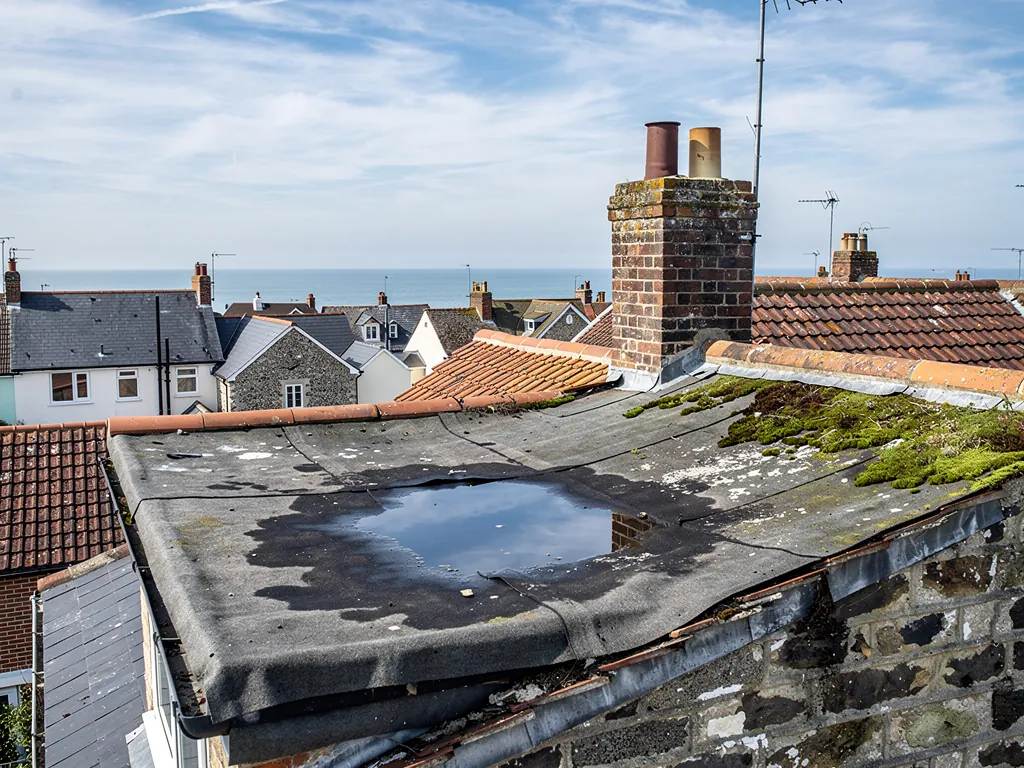
Stand on a landing window and look at a neighbour's flat roof a few hours after a shower. If you can see bright patches of water still sitting out there, the roof is not draining. The covering may be sound today, but the puddle is working against it every day it stays.
The word roofers use for the slope that sends water away is the fall. It is expressed as a ratio, one unit of drop for so many units of run, and it is so slight that the eye cannot always pick it out. That is the difficulty. A roof can look flat and be fine, or look flat and hold a lake in one corner, and only a level and a wet day will tell you which.
Below, we cover what the current British Standard asks for, why water ponds, what the water does to the covering, how outlets and gutters carry it away, and how a fall is put in where it is missing. Everything here sits under our flat roofing service, and a survey of your own roof turns the general rules into a plain verdict you can act on.
What a fall is, and what the standard asks for
A fall is a gentle slope built into the roof so rain runs to an outlet or gutter instead of lying where it landed. Two figures matter, and they are easy to confuse.
The first is the minimum finished fall. The current British Standard for roofs laid with continuously supported flexible coverings is BS 6229:2025. A roofing trade update of 18 December 2025 confirms it keeps a 1:80 minimum finished fall, for both general roof areas and internal gutters. BSI shows the 2025 edition as current, published on 16 December 2025, with the 2018 edition withdrawn on that date. Its scope is roofs, flat or curved, that slope by no more than 10 degrees.
The second is the fall a roofer designs. Roofing manufacturers such as IKO advise designing for 1:40, so that after the deck deflects a little, the timbers settle and the boards sit slightly out of true, the finished roof still reaches 1:80 or better. GreenSpec also recommends at least 1 in 40.
Putting the ratio in plain terms
A 1:80 fall drops 12.5 millimetres over a metre. A 1:40 fall drops 25 millimetres over the same distance, roughly the thickness of a finger. Across a three-metre extension, a 1:40 fall means the high edge sits some 75 millimetres above the low edge. Ordinary flat-looking roofs hide these small differences well.
When we say a roof was laid to proper falls, we mean it was built to the design figure, not merely to the lowest figure the standard tolerates. For the numbers laid out one by one, see our page on the flat roof minimum fall.
Why water ponds in the first place
Ponding rarely has one cause. In our experience of surveys it usually comes from some mix of the following, and the survey is where we work out which.
The roof may never have had a proper fall. Flat roofs on garages and old extensions were sometimes laid with the deck almost level, and the covering simply followed it. Water then sits wherever the surface dips by even a few millimetres.
The structure may have moved. Joists sag under their own load and the weight of the covering. Deck boards can swell when they have been wet, then dry out to a different shape. A wall at one end may have settled and dragged the roof edge with it.
Outlets, trims and old repairs
Sometimes the fall is fine and the outlet is the problem. A leaf-clogged outlet, a gutter whose own slope runs the wrong way, or an outlet set slightly proud of the surface can hold back water that should drain freely. A trim fixed along the edge too high can act as a dam.
Previous repairs can cause it too. A new layer of felt laid over an old one lifts the surface and can create a ridge across the line the water wants to take. Patches that overlap each other may form a low step. The roof then drains badly even though no one meant to harm it.
Not every damp patch is ponding. A thin film of moisture that dries in the sun is different from a puddle that stays for days. Our guide to standing water on a flat roof helps you judge which one you have.
What standing water does to the covering
Water is heavy and constant. A puddle that sits on a flat roof week after week creates conditions the covering was not meant to live in, and each material shows the strain differently.
Bitumen felt is the most sensitive. The mineral surface that protects the bitumen from sunlight wears away under standing water, and the exposed layer ages faster. Blisters and splits tend to open along the edges of the puddle, where the surface goes through repeated cycles of wetting, warming and drying.
EPDM, the synthetic rubber sheet laid in one piece, is more tolerant of water sitting on it, because the sheet itself does not absorb moisture. The weak points are the seams and the upstands. If the pond reaches those details and the edge trim is not sealed, water finds the joint. GRP, glass-reinforced plastic that is brushed on liquid and sets hard on the roof, can craze at the surface and may show hairline cracks where flexing happens under the weight of water.
Dirt, algae and the knock-on effects
Standing water collects silt, seeds and leaf litter, which grow algae and moss. That in turn holds more moisture against the surface and can block the outlet the pond is trying to reach. In frosty weather the water freezes in the hollow and expands.
The structure gets its share too. A covering that has been breached under a pond lets water into the deck. Timber boards that stay wet lose strength and can rot, and then the dip gets deeper, which is why ponding that looks cosmetic early on becomes a structural cost later.
Guides give the lifespans as typical ranges: Less, last updated in March 2026, quotes 10 to 20 years for torch-on felt, 25 to 40 years for GRP and 30 to 50 years for EPDM. Persistent ponding shortens the odds of reaching the top of any of them.
Outlets, gutters and the route the water takes
A fall is only half of drainage. The other half is where the water goes next. On most house roofs, the fall carries water to one edge, where it drops into a gutter and down a downpipe. On a larger or boxed-in roof, the fall may lead to an internal gutter, a channel built into the roof itself, or to an outlet fixed through the deck.
Under BS 6229:2025 an internal gutter has the same 1:80 minimum finished fall as the main roof area. These gutters hide leaves and silt well, and an internal gutter that is slow to empty is a common source of the staining that appears on the ceiling below.
Rainwater goods on the edge
Plastic guttering is not covered by the flat roof standard, but manufacturers publish their own advice. Brett Martin suggests a fall of 1mm for every 600mm of gutter and supports no more than 900mm apart. FloPlast gives 1:350 for its MiniFlo system. A safe summary is a fall of roughly 1:600 to 1:350, depending on the system.
A gutter with no fall at all will hold water at its ends, and one with brackets too far apart will sag between them, so it ends up with its own small ponds. When the edge detail is wrong, even a perfect roof deck cannot drain.
Our checks on a drainage run are simple: whether each outlet is clear, whether the water flows towards it, whether the gutter or downpipe takes it away without spilling over the face of the wall, and whether the trim at the edge is set so water does not stop short. Our page on guttering, soffits and fascias covers the roofline in full.
How a roofer puts the fall right
The fix depends on why the water is staying. We start by finding the reason, then choose the smallest job that cures it.
If the outlet is blocked or set wrongly, the repair is local: clear it, reset it, and re-seal the covering around it. If a patch has created a dam, removing or reshaping the patch may be enough.
If the whole roof has too little fall, the answer is to build one in. On a cold roof, that usually means firrings, which are tapered timbers fixed across the joists or on top of the deck to create a slope. A new deck sheet goes over them and the covering goes on top. On a warm roof, tapered insulation boards can do the same job, laid as a set so the slope comes from the boards rather than from the structure.
Why a patch over a pond does not hold
A patch laid over a hollow leaves the hollow behind. Water returns to the same place and the new work takes the same punishment as the old. If the deck is sound and the pond is shallow, a local repair may give you several more years, and we will say so. Where the dip is deep or the deck has gone soft, the honest advice is to re-cover with the fall corrected.
Approved Document L of the Building Regulations puts a re-covered flat roof in the renovation category, where an insulation upgrade can follow, so the fall and the insulation are usually planned together. We explain this in our guide to warm and cold flat roofs.
Repair or re-cover: what the survey decides
The decision comes down to a few things we can photograph and measure on the day. How deep and wide is the pond? Is the deck underneath firm, or does it flex underfoot? Is the covering split along the edge of the water? Does the fall run to a working outlet?
Small flat roof repairs are typically priced between £150 and £500, according to Less (last updated March 2026). Checkatrade's repair table, last updated in June 2026, shows £100 to £140 per square metre for bitumen felt, £120 to £170 for EPDM and £130 to £180 for GRP, excluding VAT. A full re-cover, with a fall built in, is a different scale of job: Checkatrade's replacement table, last updated October 2026, shows flat roofs from £2,800 to £7,500, headed as plus VAT.
Those are national typical ranges, not a price for your roof. Your figure moves with the size of the roof, how much deck is replaced, the access, and whether the fall can be corrected from above or the structure needs altering. The quote we write after the survey is one total price.
What to ask any roofer
Ask what the fall will be after the work, and how they will check it. Ask what happens to the old covering and the deck. Ask whether the price covers VAT and any scaffold. A roofer who cannot say where the water will go has not yet solved the problem, whatever covering is being sold.
The sum itself, repair against replacement, is one we work through with photographs of your own deck.
Questions
Falls and drainage questions
Is a flat roof that holds a little water after rain a problem?
A thin film that dries within a day is common and usually harmless. Puddles that remain for days point to a dip, a blocked outlet or too little fall, and they shorten the life of the covering. A survey measures the depth and checks the deck before anyone recommends work.
Can the fall be corrected without taking the whole roof off?
Only in limited cases, such as a local hollow or a badly set outlet. Where the whole roof is too flat, the covering is lifted, tapered timbers or insulation are added, and the roof is re-covered. We say which applies after looking at photographs of the deck.
Does fixing the fall mean new insulation too?
Often, because the Building Regulations class a replacement flat roof membrane as renovation. How much insulation follows is set by the share of the roof and building the work touches. Arun District Council's building control team or your own approver can confirm what your job needs.