
Winter flat roof repairs · 10 min read
Flat roofs in winter: storms, ponding and wet-weather repairs
Winter finds the weak spots in a flat roof. This guide covers what gales, rain and frost do to one, what can safely be mended in the wet, and what is better left to a drier spell.
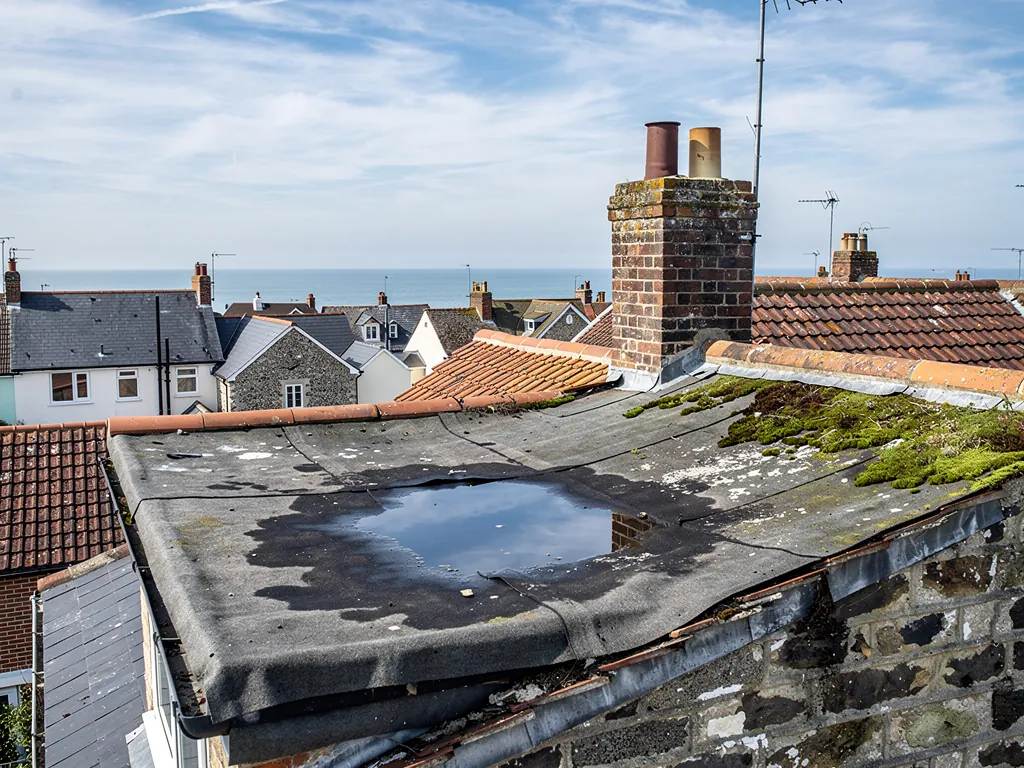
Flat roofs on this coast get a hard time from October to March. The sea weather comes in off the Channel, gales push rain sideways against upstands and edges, and the long grey spells keep every surface damp for days. A roof that sailed through summer can start to leak in the first proper storm.
Few of us think about a flat roof until water arrives on the ceiling, which is usually the worst moment to be choosing a roofer. The questions come in a rush. Is it safe to go up? Can anything be done in the rain? Should a temporary cover go on and the proper job wait for spring? And what do I do about the insurer?
This guide answers those in order. It starts with what winter does to the roof, then separates the repairs that can be done in wet weather from those that cannot, sets out the storm-damage steps that protect an insurance position, and ends with a sensible pre-winter check. It belongs with our flat roofing pages, and where a leak is active, stopping the water coming in takes priority.
What a Bognor winter does to a flat roof
A flat roof takes weather differently from a pitched one. Water does not run off quickly, so every shower leaves a film on the surface, and anything that slows drainage keeps that film in place for longer. Seams, edges, upstands and outlets are all given a longer soaking than they would get on a steeper roof.
Wind works on a flat roof in a particular way. It blows across the top and, around the edges and corners, tries to lift the covering from below. A trim that has loosened over the summer, or a membrane edge that is no longer held down, is the first part to give way. A gale that does no harm to a sound roof can strip a weakened one in a single night.
Cold and damp on the inside
Winter also exposes problems that have nothing to do with the covering. Heating and breathing put moist air into the house, and that air is more likely to reach a cold surface in a roof when the weather is cold. Condensation under a flat roof can look exactly like a leak, with ceiling stains and damp patches that appear after cold nights rather than after rain. Our page on flat roof condensation explains how to tell the difference.
Frost has its own effect. Water lying in a hollow on the roof turns to ice and expands, and a covering that is already splitting or blistering can open further. Seams and laps that were tight in the summer sometimes reveal their weakness in the first cold snap.
For all these reasons, a roof that looks fine in September deserves a look before the weather turns, and one that starts leaking in November deserves a plain answer on whether to patch it or plan its replacement.
Storm damage on a flat roof: what to look for
After a gale, the damage on a flat roof is often visible from an upstairs window or the garden, and it tends to fall into a few types.
A lifted or torn edge is the most common. The covering peels back from the trim, flapping in the wind and letting rain underneath. A section of felt may be torn clean away, or an EPDM sheet may have pulled free of its adhesive at a corner. The edge trim itself can be bent, twisted or pulled off the fascia.
Debris is another. A branch, a roof tile blown off a neighbour's house or a fence panel can puncture the covering. Gravel or chippings, where the roof is dressed with them, can blow into drifts at one end, leaving bare patches that sunlight and rain attack.
Safety before inspection
Do not climb onto a wet flat roof to look. The surface is slippery, edges can be hidden, and some coverings are fragile, as a roof with rooflights or old fibre cement sheeting may be. A good photograph from a window or a safe distance tells a roofer a great deal. Water coming in is worth a bucket, a towel and a phone call, not a risky climb.
Stopping the water is the first job on a leaking flat roof, and it can mean a temporary sheet fixed over the damaged area, a sealed patch over a split or a secured edge, so that the water stops coming in while the proper repair is planned. That is a holding measure, and we call it one when we hand it over.
A punctured roof can let water into the deck and insulation below, so what looks like a small hole may involve a larger area of damp. That is why the survey after a storm includes the deck, not just the surface.
Ponding and frost: the slow damage of a wet winter
Storms are dramatic. Standing water is slow, and in a wet winter it can do more harm over the months. A hollow that holds water through November, December and January keeps the covering saturated at exactly the time it is least able to dry.
The effects build up. Felt loses its protective surface and ages. Seams that lie in the water are tested again and again. Algae and silt gather and hold moisture against the surface. When a freeze comes, any water that has crept into a split expands and opens it further.
What to do with a pond in winter
First, check the outlet. A blocked outlet or a gutter clogged with leaves is the simplest cause and the simplest fix, and a clear drain may be all that is needed. Autumn leaves are the usual culprit, and a roof beneath trees may need clearing more than once a season.
If the outlet is clear and the water still stays, the roof probably has too little fall or a dip. That is a build problem rather than a maintenance problem. BS 6229:2025 sets a minimum finished fall of 1:80, and roofers design nearer 1:40, so a roof that holds water for days after rain is not meeting the standard it was probably built to. A temporary measure may carry the roof through the winter, but the lasting cure is to correct the fall, which is a job for drier weather. Our guide to flat roof falls and drainage explains the options.
A roof that is ponding and also splitting is a candidate for replacement rather than patching, and the survey says so in plain terms, just as it says so when a repair will hold.
What can be repaired in wet weather, and what has to wait
Waterproofing needs a dry surface to bond to. That is the rule behind most of the answers on winter repair, and it separates the work into two groups.
The first group is emergency and temporary work. Securing a lifted edge, fixing a temporary cover over a split, clearing an outlet, re-seating a trim and sealing around a pipe can often be done in difficult conditions, because the aim is to stop water for now. These are make-safe measures, and they buy time.
The second group is the permanent repair. Welding or bonding new felt, laying a fresh EPDM sheet with adhesive, laminating GRP and curing it all depend on a clean, dry deck and surface. Applying them in the rain or on a damp substrate risks a poor bond that fails again the first time the weather turns. Cutting corners with a rushed permanent repair in the wet is how a roof ends up needing the work done twice.
Choosing between patching and waiting
If the leak is small and the covering is otherwise sound, a sound temporary repair can hold until a dry spell, with a view from us on how many weeks it should buy. If the covering is old, blistered or split across large areas, repeated patching costs more over the winter than a planned replacement in spring.
The bad-weather limits are real, and our page on flat roof repair in bad weather goes through them. A roofer who promises a lasting permanent repair on a soaked roof in a storm is promising something the materials cannot deliver. Our sequence is short: stop the water, photograph the damage, agree the lasting work, and carry it out once the roof can take it.
After the survey, the permanent repair is priced as one total figure, in writing.
After a storm: protecting your insurance position
When a gale damages a roof, the order of events can matter to an insurance claim. The pointers below draw on Which? (20 November 2025) and the Institution of Structural Engineers (28 January 2025). They are general guidance, not a reading of any particular policy.
Make the building safe first. If part of a roof or structure looks dangerous, keep away from it and keep others away. Anything that looks unstable can be reported to the building control team at your council, the Institution says.
Contact your insurer early; Which? points out that insurers run emergency helplines for this. Take photographs before anything is shifted, because the Institution describes them as vital evidence for a claim. Should you need to book emergency work yourself, say so to the insurer and hold on to each receipt, which becomes part of the claim. Keep damaged belongings for the insurer to see, unless they are a health risk.
Wear and tear, and complaints
Not every roof leak is an insured event. Which? treats rain coming through a badly kept roof as wear and tear, and passes on Financial Conduct Authority data showing a payout on only 32% of storm-related claims made in 2024. Nothing here can be taken for granted.
If a decision seems wrong, take it up with the insurer, and after that with the Financial Ombudsman Service, which costs nothing to use.
Our part is the roof itself: a survey with photographs, a plain verdict on whether this is storm damage or an old fault, and a written quote you can pass on. The claim stays between you and your insurer.
A winter plan: checks, costs and lead times
The least costly winter repair is the one that never becomes an emergency. A short check in early autumn catches most of the problems described above.
From the ground, look at the edges and trims for lifted sections or gaps. Look at the gutters and outlets for leaves. From a window, check for puddles that remain a day or more after rain. Indoors, look at the ceilings under the flat roof for new stains, and the corners for mould. If any of these show up, a survey before the first storm is better than a repair during it, and a few photographs taken now give you something to compare against later.
What it costs and how long it takes
National guides give a sense of scale. Less, last updated in March 2026, puts small flat roof repairs at £150 to £500. Checkatrade's repair table, last updated June 2026, lists £100 to £140 per square metre for bitumen felt, £120 to £170 for EPDM and £130 to £180 for GRP, with VAT to be added. These are typical UK ranges; the price for your own roof is the one we put in writing after the survey.
Access affects winter work. A single-storey flat roof is often reached by ladder, but a higher roof may need scaffolding, and a scaffold standing over the pavement has to be licensed. A licence comes from the highway authority; West Sussex County Council asks for at least 10 working days' notice, and Hampshire County Council ten clear working days. If a repair can safely wait, build that time into the plan.
Lifespans are the last piece. Less gives torch-on felt 10 to 20 years, GRP 25 to 40 years and EPDM 30 to 50 years, so a roof already in the last part of that range may be better replaced than patched through one more winter.
Questions
Winter flat roof questions
Can a flat roof be repaired properly in the rain?
A temporary repair can be made in wet weather to stop water coming in. A permanent repair needs a dry surface for the new covering to bond, so it waits for a dry spell. Stopping the water comes first, and the lasting work is timed to the forecast.
Should I climb up to check my flat roof after a storm?
Look from a window or the ground instead. A wet flat roof is slippery, edges can be hard to see and some roofs hide fragile panels. Photographs taken from a safe place help both a roofer and an insurer, and they cost nothing.
Will my insurer pay for storm damage to a flat roof?
That depends on your policy and on whether the cause was a storm or wear and tear. Speak to your insurer at the start, have the damage made safe, keep your photographs and receipts, and ask what they need from you. If you disagree with the outcome, the Financial Ombudsman Service is free to use.