
GRP fibreglass roofs · 9 min read
GRP fibreglass flat roofs explained
A GRP roof is a hard, jointless shell of glass-reinforced plastic made in place on the deck. This guide covers how it is built, where it suits, why it sometimes cracks and what it costs.
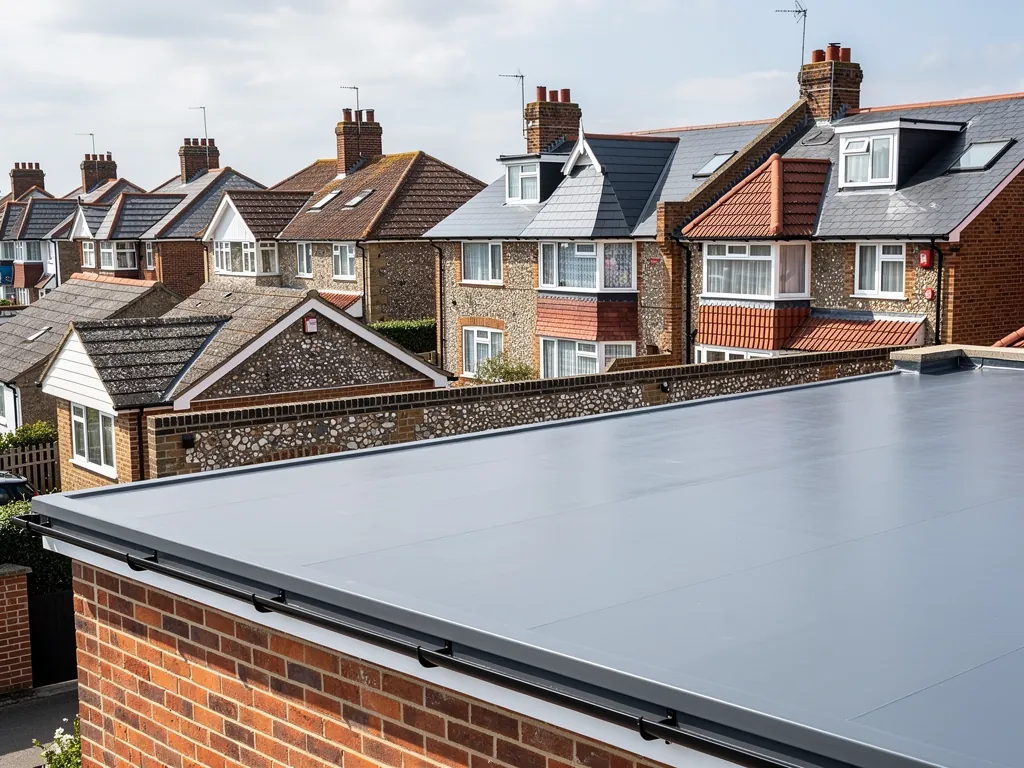
GRP stands for glass-reinforced plastic, and on a roof it is usually called fibreglass. Unlike a rubber sheet or rolls of felt, it does not arrive as a finished covering. The roofer makes it on site, layer by layer, by wetting glass matting with resin until it cures into one continuous skin.
That method gives GRP its strengths and its weak spots. There are no seams to open up, the finish is hard enough for a balcony or a roof terrace, and the shell wraps neatly round awkward shapes such as dormer tops and bay roofs. Against that, the cured shell is stiff. If the deck below moves or the laminate is laid thin, the shell can crack, and a crack lets water in.
The sections below explain what goes into a GRP roof, how the work is done, when it makes sense, why failures happen and what the published lifespans and prices say. The figures come from named UK cost guides with their dates. They are national typical ranges and describe the market at large, so do not read them as the price of any one roof.
What a GRP roof is made of
Think of a boat hull laid flat on top of a building. A GRP roof is built from three working parts: the resin, which is a liquid plastic that sets hard; the glass matting, which is a fabric of fine glass strands that gives the resin its strength; and a topcoat, the coloured outer layer that takes the weather and the footsteps.
The resin and matting go on together. The roofer rolls the matting out over the deck, then works resin through it with a roller until the strands are fully wet and any trapped air is pressed out. When the resin cures, matting and resin become a single rigid sheet fused to the surface below. The topcoat goes over the top and gives the roof its colour and a surface that sheds water and wears well.
Why people choose it
The big advantage is that there is no join across the middle of the roof. A rubber sheet or felt roll has seams, and each of those joins must stay sealed for years. A fully cured GRP shell has none, and it runs up walls and over upstands as part of the same piece. An upstand is the short upright section where a flat roof turns up to meet a wall.
Hard-wearing is the other reason. Because the surface is firm, GRP is a common choice where people walk on the roof: a balcony, a small terrace over a garage or a flat above a porch. Our guide on choosing between EPDM, GRP and felt compares these three coverings across weight, finish, movement and price.
How a GRP roof is laid
Good GRP work is slow at the start and quick at the end. The preparation decides how the roof performs, because cured resin is no better than the surface it stuck to.
Deck and falls
The deck must be dry, flat, firmly fixed and free of dust. Boards that are soft, stained or lifting are replaced. A fall, the slope that carries water off, is built in with firrings, which are tapered timbers laid across the joists, because water left standing on a flat roof ages any covering faster. BS 6229:2025 keeps a minimum finished fall of 1:80 for general roof areas, and roofers usually design to around 1:40 so the finished roof still drains.
Trims first, then the shell
Preformed edge trims go on before the laminate so the resin can run over them and seal the junction. Then comes the laying: matting cut to size, resin worked in, air rolled out, and extra layers at corners and around outlets where stress is greatest. At walls the laminate turns up as an upstand and is closed off beneath a flashing, which is a lead or metal strip tucked into the wall so rain cannot track behind the laminate.
Weather and cure
Resin is fussy about conditions. It needs a dry deck and dry air, and it cures well only within the temperature range set by the manufacturer. That is why GRP jobs are planned around the weather and why a roofer who promises to lay it in a downpour should be turned away. The smell during laying is strong and fades once the resin cures, so close windows below and warn neighbours who share a wall.
When it has set hard, the surface is inspected, any pinholes are filled and the topcoat is rolled on.
Where GRP suits a roof and where it does not
The best fit for GRP is a small to medium flat roof on a stable timber deck, particularly one with awkward outlines. Dormer tops, bay roofs, porches and the flat roofs over bungalow extensions all fall in that group, because the resin follows curves and corners without needing a patchwork of cut sheets.
It is also at home on roofs people use. Balconies and small terraces need a surface that tolerates feet, furniture and plant pots, and a cured laminate is firm enough to do that without a separate protective layer. Our short answer on whether you can walk on a flat roof covers what to check first.
Where it is less comfortable
GRP is rigid, so movement is its enemy. A deck that flexes, a roof where one part of a building settles against another, or a long extension with timbers that move with the seasons can all put stress on the shell. A thin laminate over a springy deck is the classic route to cracking. Where that kind of movement is likely, a flexible covering such as EPDM or a felt system may be the safer pick.
Size also matters. A big roof takes longer to lay, which raises the chance of weather interrupting the cure, and large areas expand and contract more. Roofers differ on how big is too big, so ask for the reasoning rather than a rule of thumb.
A flat roof with no insulation is another point to settle early. Asking what sits under the laminate, and whether the build-up is warm or cold, belongs in the first conversation before anyone mixes resin.
Why GRP roofs crack and what to do about it
A cracked GRP roof is the most common complaint, and it is rarely random. Cracks have causes you can often read from where they sit.
Movement is the first. A hairline crack that follows a board joint in the deck usually means the boards flexed, because the laminate is stiff and the joint underneath is not. Cracks near the edge or where the roof meets a wall can mean the structure and the roof are moving at different rates. A crack running across the middle of a wide span suggests the deck was too springy or the laminate too thin.
Poor preparation is the second. If the deck was damp, dusty or greasy when the resin went on, the bond is weak and the shell can lift and split. Laying in cold or wet conditions has the same effect. Resin that was mixed badly may cure patchily and stay soft in places.
Impact is the third. A dropped tool, a heavy pot or a ladder foot can chip the topcoat and fracture the laminate beneath. Sunlight and wear also dull and thin the topcoat over time, which exposes the laminate.
Repair or replace
A small crack in an otherwise sound shell can be ground out, laid up again with new matting and resin and topped to match. A modest repair in the Less guide (March 2026) is put at £150 to £500. Where the deck is soft, the cracks are many or the roof still ponds, the sensible path is a new covering, usually with a new deck. Our answer on why GRP roofs crack goes through the signs in more detail, and a photo of the crack helps us give a plain verdict.
How long GRP lasts and what it costs
The Less flat roof guide gives GRP a lifespan of 25 to 40 years. That is a typical range for a well-laid roof, not a promise, and a manufacturer's warranty is a separate matter that depends on the maker's conditions. Lifespan is shortened by deck movement, ponding, a thin topcoat and edge details that were rushed. It is lengthened by a sound deck, a laminate laid to the maker's method and a topcoat renewed when it wears. Looking over the surface once a year for chips, lifted edges and blocked outlets is a cheap habit that catches small faults before they turn into leaks.
On price, Checkatrade publishes repair rates per square metre. Its June 2026 table lists GRP fibreglass at £130 to £180 per m², against £120 to £170 for EPDM and £100 to £140 for bitumen felt, and states that every figure excludes VAT. So GRP sits at the top of the three for repairs, though the gap is small beside the effect of access and condition.
| Source | What it covers | Typical UK figure |
|---|---|---|
| Checkatrade, June 2026 | GRP repair, per m², excluding VAT | £130 to £180 |
| Less, March 2026 | Small flat roof repairs | £150 to £500 |
| Checkatrade, October 2026 | Replacement of a flat roof, plus VAT | £2,800 to £7,500 |
The replacement range covers every flat roofing material, so it speaks for flat roofs in general, with GRP only one of the options. Drivers include the size of the roof, whether the deck needs renewing, how many outlets, upstands and edges there are, and whether insulation is part of the job. Standard VAT is 20 per cent. The cost guide for a whole new flat roof puts the figures in context.
Insulation, approval and what to ask before you agree
Stripping a flat roof back and fitting a new waterproof layer is renovation in the language of Approved Document L. Insulation must meet the current standard once more than 50 per cent of the roof's surface is renovated, which is why a full GRP re-cover usually brings insulation into the job. The 2021 edition applies now, and the 2026 edition takes effect on 24 March 2027 with the same triggers. Whether laying GRP over an existing membrane counts as renovating it is a point to settle with your building control body before work starts.
Separately, the Planning Portal sets thresholds under which a building control application is not normally needed: under 25 per cent of the total building envelope and under 50 per cent of the roof. Arun District Council's own page names re-covering of roofs as work it wants applications for. Ask the council's building control team, or a registered building control approver, what your own project needs, and expect us to explain the position at survey.
A solid GRP roof is a significant piece of work, so it deserves a few questions before you agree to anything:
- What is the deck made of, and will it be replaced where it is soft?
- What slope will carry water off once it is finished?
- Which resin and topcoat system is used, and to whose instructions?
- How are the edges, outlets and wall junctions being finished?
- Is insulation included, and is VAT?
We give a plain verdict backed by photographs of your roof: patch it, re-cover it or renew the deck. The price arrives in writing as one total, and we leave the place tidy. The wider flat roofing page lists every covering we handle.
Questions
GRP roofing questions
Can fibreglass be laid over an old felt roof?
That turns on what lies beneath the old layers. Resin needs a clean, dry, sound surface, and a covering that is blistered, damp or loose cannot provide one. In most cases the old layers come off so the deck can be checked. We tell you which applies once we have photographed the roof.
Does a new GRP roof smell and how long does it last indoors?
Resin has a strong smell while it is laid and curing, and it fades once the shell has set. Keep windows below closed during the work and warn anyone who shares a wall. If the smell persists well after the roof has gone hard, mention it to the roofer because it can point to a resin that has not cured properly.
Is GRP better than EPDM for a roof terrace?
GRP is firm underfoot, which is why it is popular on balconies and small terraces. EPDM is flexible, which helps where the deck moves, but it needs protecting from heavy foot traffic. Neither is better in every case. Deck movement, expected use and edge details decide, and we say which we would pick for your roof.