
Flat roof coverings · 9 min read
EPDM vs GRP vs felt: choosing a flat roof covering
EPDM, GRP and torch-on felt compared in plain terms: how each is made, the lifespans and prices national guides quote, and the questions that match a covering to a particular roof.
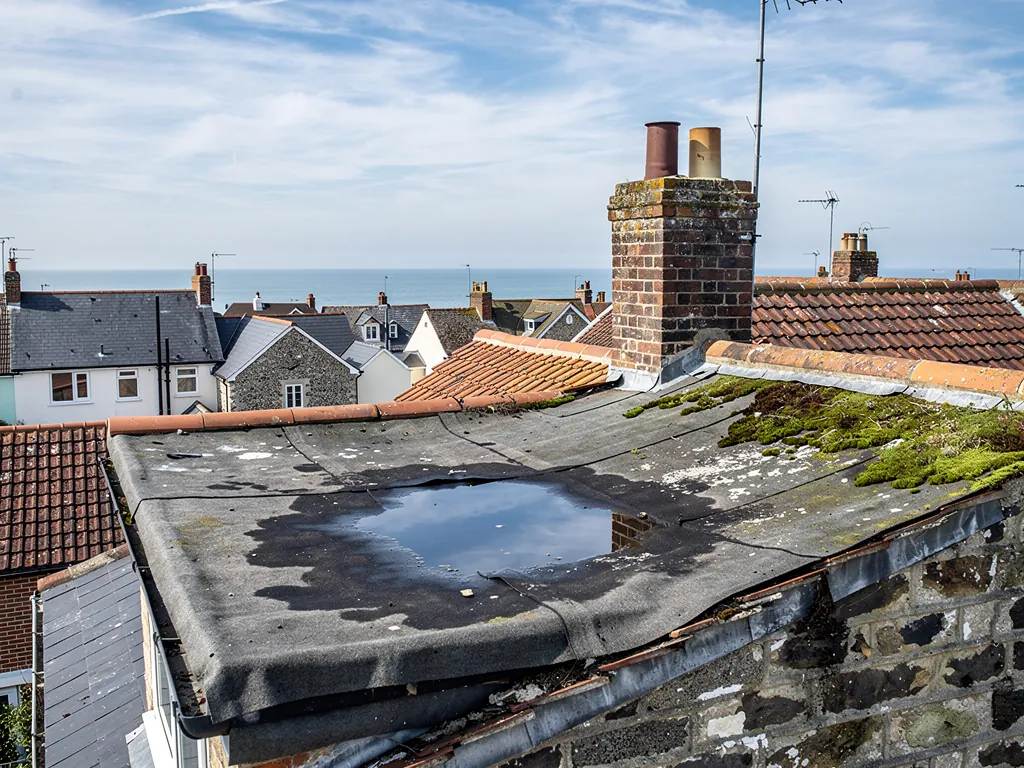
Ask three roofers which flat roof covering to choose and you can hear three answers, each delivered with total confidence. The truth is less dramatic. All three coverings can make a good roof when they are laid well on a sound deck, and all three can fail early when they are not. What differs is how each behaves, what it asks of the roof underneath, and what the published guides say about life and cost.
This guide describes each covering in ordinary language, sets the quoted lifespans side by side, shows what the cost guides say, and then turns to the practical matching: roof shape, details, foot traffic and access. It also flags where the guides disagree, because on felt in particular they do.
It will not tell you that one covering wins on every roof, because none does. It will tell you what to ask when a roofer recommends one, so you can judge the reasoning rather than the sales patter. For our own work on flat roofs, see flat roofing, and for more on each material, see our pages on EPDM rubber roofing, GRP fibreglass roofing and torch-on felt roofing.
What each covering actually is
The three names describe three different ways of making a waterproof skin.
Felt
Felt in this context means bitumen roofing felt, usually laid in two or three layers. The top layer is commonly fixed by torch, which softens the underside so it sticks to the layer beneath, which is why the product is often called torch-on. Mineral chippings or a factory-applied granule finish protect the surface from sun.
EPDM
EPDM is a synthetic rubber, supplied as a large single sheet that can be cut to the roof. The sheet is glued to the deck, or held down in another way, and the edges and joints are sealed. Because the sheet is so wide, a small roof may have no joints at all across the main area of the roof. That is a point in its favour on a simple rectangle, though it makes no difference to the upstands and edges, which are formed by hand on every roof.
GRP
GRP stands for glass-reinforced plastic, often called fibreglass. A resin is brushed or rolled over glass matting on the deck, then topped with a finishing coat. It cures on the roof into one continuous rigid skin, with no laps. The finishing coat gives colour and a surface to walk on, and it is the layer that takes the weather, so it is worth asking what product will be used.
Put plainly, the difference is this. Felt is a stack of layers with laps. EPDM is one flexible sheet. GRP is a skin formed in place.
These are not exotic products. Each has been on British roofs for a long time, and roofers who lay all three have views on each. Treat anyone who dismisses one outright with some caution, and ask what they have seen go wrong.
How long each is said to last
Published lifespans vary, and the spread is wide enough that any single figure should be handled carefully. The table below gives what the guides we use say, with the source for each.
| Covering | Published life | Source |
|---|---|---|
| Torch-on felt | 10 to 20 years | Less, March 2026 |
| GRP | 25 to 40 years | Less, March 2026 |
| EPDM | 30 to 50 years | Less, March 2026 |
| EPDM | 20 to 30 years | GreenSpec |
Two readings stand out. First, the sources disagree on EPDM by a wide margin, which tells you the figure depends on the product, the thickness and how it is installed. Second, Less gives felt the shortest life, with workmanship the swing factor: 20 years for a good job, under 10 for a poor one. CORC reports felt lasting 30 years or more, so there is no settled number.
The takeaway is not that one covering is certain to outlast another. It is that workmanship and the condition of the deck underneath are variables as large as the material. A well-laid felt roof can outlast a badly laid membrane.
A guarantee from a manufacturer or installer should never be mistaken for a lifespan. It tells you what the seller will put right, for how long and on what conditions. It does not predict how long the roof will actually last. When a roofer offers a guarantee on a covering, read what it covers and what it excludes, then ask who stands behind the installation.
What the cost guides say
National guides rarely give a like-for-like replacement price for each covering, but they give enough to show the pattern. Checkatrade's June 2026 repair table puts bitumen felt at £100 to £140 per m², EPDM at £120 to £170 and GRP at £130 to £180, all excluding VAT. Repair rates are not replacement rates, but the order tells you how the trade prices the three.
For a complete flat roof, Checkatrade's roof replacement guide, updated in October 2026, gives a span of £2,800 to £7,500 for flat roofs in general, with its table headed as plus VAT. A garage re-felt comes in lower, at around £1,000 to £2,000 on the same guide. None of those numbers separates the coverings, so do not use them to rank the three. Use them to check that a quote for any covering is in a plausible place.
Price per year is a better test than price today. A roof that lasts twice as long can justify a higher price, provided the longer life is real, which is why the lifespan table above carries a warning. A covering that lasts 15 years at a modest price and one that lasts 35 at a higher price are both reasonable, depending on how long you expect to own the building.
What is not in the price
Scaffold, VAT, a rotten deck and insulation can each alter the total whatever the covering. Our guide to what a flat roof costs covers them, and the quote we write after surveying your roof gives one total price that answers the question for your roof alone.
Matching a covering to the roof
This is where the real decision sits, because the roof itself narrows the field. Four things matter most.
Shape and details
A simple rectangle with few penetrations suits a single sheet of EPDM, since there is little to cut around. A roof with many rooflights, pipes, steps and curved edges gives more places where a sheet must be cut and sealed by hand. GRP, which is formed in place, follows awkward shapes without joins in the field, and felt is cut and lapped around whatever is there. In each case the quality of the details decides how the roof performs.
Foot traffic
If the roof is a terrace, a route to a plant area or a place where tools and ladders land, the surface needs to take wear. Ask the roofer how each covering is protected against foot traffic, and what finish you would be walking on. A roof meant for regular walking needs a different surface from one nobody visits, and the choice should be made at the start.
The deck underneath
Each covering expects a firm, dry, smooth deck. Rot, movement or damp will defeat any of them. That is why the deck is checked before the covering is chosen, and why a recommendation made without looking at the deck should be questioned.
Access and timing
Weather, the height of the roof, and the means of reaching it all affect what can be laid when. Some coverings suit being laid in a single visit, others depend on cure time. Ask what the programme is, how many visits it takes, and what happens to the roof overnight if the weather turns while the old covering is off. A good answer names the forecast, the temporary protection and the point at which work stops.
The faults to ask about for each
Every covering has a typical way of failing, and whoever recommends one should be able to name the weak point of their own choice. Here is what to ask.
Felt: blisters, laps and surface wear
Felt can blister when moisture trapped beneath it expands, and laps can open as the roof moves. The granular or chipped top surface shields the layers from sun, and when it wears away, the bitumen below ages faster. Ask how the laps will be sealed and how the surface will be protected. Blisters in particular are worth asking about, because they point to moisture trapped in the roof.
GRP: cracks and movement
GRP forms a rigid skin, so it can crack where the deck beneath it moves, especially at joints in the boards. A well-prepared deck and the right fixing and finishing reduce the risk. Ask how the deck will be prepared and what allowance is made for movement.
EPDM: seams, edges and punctures
EPDM is flexible and rides out movement well, but it depends on its seams, its edge details and the care taken when it is laid. A tear at an upstand or a lifted edge can let water in. Ask how seams and corners will be made and sealed, and how the edges will be held by the trim.
None of this makes any covering a poor choice, and every one of these faults is more likely on a rushed job than on a careful one. It makes each one a question of detail. The roofer who can tell you plainly how the covering fails and what is done to prevent it understands the product.
A recommendation should come with the reasons for it. If the answer to why this covering is only that it is what they always use, ask again.
Rules that apply whichever you choose
Whatever the covering, the roof around it has to follow the same rules.
Falls come first. BS 6229:2025, which replaced the 2018 edition in December 2025, applies to flat or curved roofs up to 10 degrees with continuously supported flexible waterproof coverings. Its minimum finished fall is 1:80, and roofers usually design for around 1:40. A covering laid on a roof that ponds will be tested by standing water on every joint, whichever material it is.
Insulation comes next. Approved Document L treats a replacement flat roof membrane as renovation, and the roof has to be improved once more than half of its surface is renovated. Insulation therefore usually goes in with a new covering of any type. Our guide to flat roofs and Building Regulations sets this out, with the Part L figures in full.
Changing the covering type can raise a separate point. The Planning Portal lists approval as needed where the performance of a new covering will be significantly different from the old one in a fire, or where a new covering would make the roof 15 per cent heavier or more. Switching from felt to a different system is not automatically one of those, but it is a question for your building control body or your roofer to answer before the work starts.
Finally, the finish. Edge trims, outlets and upstands are where a flat roof meets the eye and the weather. We lay them to the same standard on every covering, because the covering is only as good as its edges.
Questions
Choosing a flat roof covering
Does EPDM always outlast felt?
Not always. Less gives EPDM 30 to 50 years and felt 10 to 20, but GreenSpec puts EPDM at 20 to 30, and Less notes a good felt job can reach 20 while a poor one may fail in under 10. Laying quality and the deck matter as much as the material, so judge the installation as well as the product.
Can I change from felt to a different covering when I replace the roof?
Often you can, but check first. The Planning Portal says approval is needed where the new covering performs significantly differently in a fire, or makes the roof 15 per cent heavier or more. Ask your roofer and your building control body to confirm that your chosen system falls on the right side of both.
Does the cost guide figure for one covering apply to my roof?
Only as a rough guide. Checkatrade's June 2026 repair rates for felt, EPDM and GRP are per square metre and exclude VAT, and full replacement ranges do not split by material. Your own price depends on area, deck condition, details and access, which is why the written quote follows a survey.