
Downpipes and hoppers · 10 min read
Downpipes, hoppers and where roof water goes
Follow a raindrop from the roof to the drain, see where downpipes, hoppers and shoes go wrong, and decide whether a pipe needs a re-fix, a new section or a full replacement.
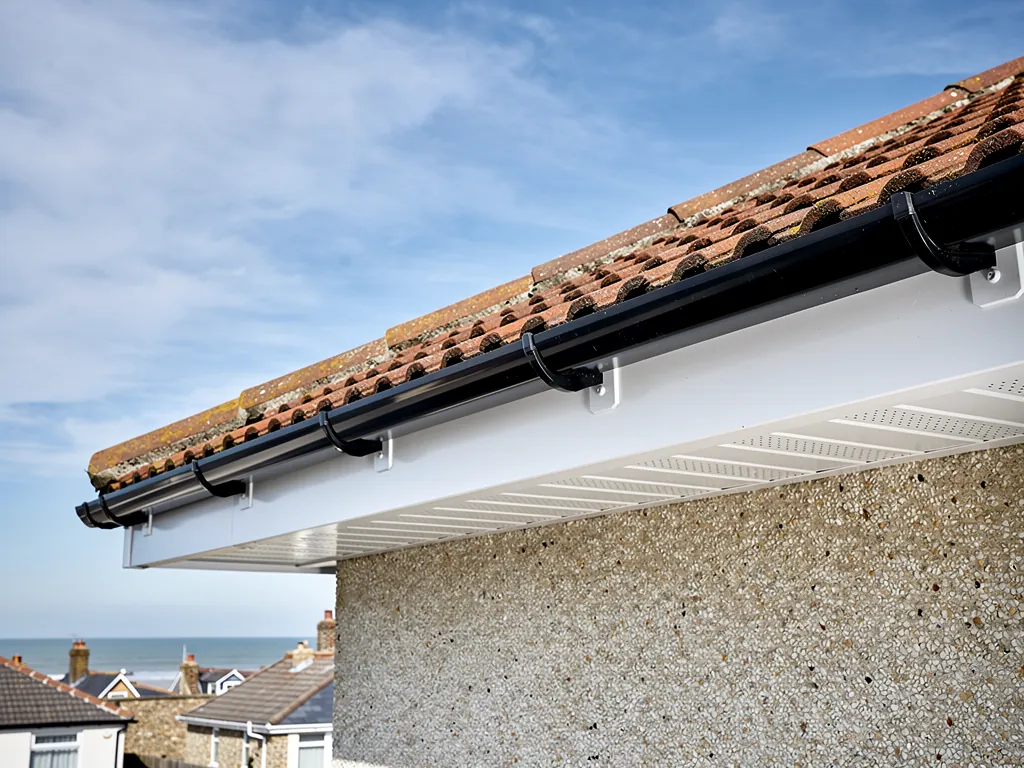
A gutter only collects water. It is the downpipe that gets rid of it, and a downpipe in poor repair is one of the quieter ways for a house to get damp. Water that leaves a cracked pipe halfway down a wall does not reach the drain. It runs down the brickwork, soaks the render and ends up against the foundations.
Most of the trouble sits at three spots: the outlet where the gutter meets the pipe, the joints along its length, and the bottom end where it should deliver into a gully or drain. A hopper, the open box that catches water from an upper roof or a waste pipe, adds a fourth.
This guide follows the water in order. It explains what each part is called, what the typical faults look like from the ground, how to judge between mending and replacing, and what changes the price. Where a fault belongs to the gutter above, it says so, because a perfect pipe under a blocked gutter still leaves the wall wet.
The route water takes from roof to drain
Rain lands on the roof covering and runs to the lowest edge, where it falls into the gutter. The gutter is laid to a slight fall so the water drifts towards an outlet. Brett Martin, a gutter manufacturer, suggests about 1 mm of fall for every 600 mm of run, and FloPlast quotes 1:350 for its MiniFlo system, so these are very gentle slopes you will not see by eye.
At the outlet the water drops into the top of the downpipe. The pipe carries it down the wall, held by clips or brackets, and ends at a shoe or a bend that turns the flow towards a gully. The gully is a trapped drain opening at ground level. From there the water goes to a surface-water drain, a soakaway or, on some older houses, a combined drain.
Where the parts have different names
Roofers use a handful of terms that show up on quotes:
- Outlet: the opening in the gutter base that feeds the pipe.
- Hopper: a box, often cast or pressed metal on older houses, that collects water from a pipe above and passes it on.
- Offset: a pair of bends that steps the pipe in to clear a projecting eave.
- Shoe: the angled foot that throws water away from the wall.
- Gully: the drain opening that takes the discharge.
If you know which part is failing, a quote becomes much easier to read, and a photograph with the problem circled helps the survey just as much.
Spotting a failing downpipe from the ground
Most pipe faults leave a trail you can read without a ladder. Walk round the house during or just after rain and look at each pipe in turn. The best time to look is when water is actually moving, because a leak that shows nothing on a dry day will be obvious in a downpour.
The signs fall into a few groups. Green or black staining running down the wall beneath a joint says the joint is weeping. A dark tide mark on the brickwork under a clip points to a loose or split section. Water spilling over the top of the outlet means the pipe is blocked, or too slow to take what the gutter delivers. A pipe that has pulled away from the wall, or sways when touched, has lost its brackets or its fixings.
What the staining is telling you
Patterns matter. A single stain at one joint is usually a seal that has failed. A broad damp patch spreading down from a bend suggests a blockage that has forced water out sideways. Moss and algae at the base of a wall often mean the shoe is discharging onto the wall rather than into the gully. A damp patch inside the house on the same wall, level with the pipe, is worth a closer look because it can mean water has been getting into the brickwork for a long time.
None of these is proof of what is wrong, and that is why a survey looks from the top as well as the bottom. Our guide to a blocked downpipe covers the clearing side of the problem, while this page deals with the pipe itself.
Mend, re-fix or replace the pipe
There are three levels of job. The smallest is a re-fix: new clips or brackets, a resealed joint, or a pipe pushed back fully into its socket. Plastic pipe often parts at a socket because the clip below has failed and the weight pulls the sections apart. Fixing the clip and seating the pipe puts it right, and nothing else needs touching.
The middle level is a replacement of a section: a cracked length, a broken shoe, a split bend or a hopper whose corner has rusted through. Sections for plastic and aluminium pipe come in standard sizes, so a like-for-like swap is usually quick. Cast iron is harder because profiles vary and old sections may not be made any more. Our guide to cast iron guttering repair covers what is possible there.
The top level is a full replacement of the pipe, which makes sense when it is brittle, bowed or cracked in several places, or when every clip is failing. A pipe that has gone brittle with age will often crack again within weeks of a patch next to it, so the sum favours renewing.
A repair holds when the pipe is firm and the fault is local. A patch on a pipe that is failing everywhere is money spent twice.
One more case: if the pipe is fine but the hopper is not, the hopper alone is changed. Because hoppers often take water from a flat roof or a first-floor bathroom waste, a split one can soak a wall quickly, so it should not be left.
Brackets, fixings and the wall behind the pipe
A downpipe is heavy once it fills with water, and a full length can weigh far more than the empty pipe suggests. Brackets are what stop the pipe from leaning, so they matter as much as the pipe itself. A bracket that has rusted, loosened or lost its plug in the masonry lets the pipe drift, and a drifting pipe pulls on the joint above it.
A pipe is normally clipped close to each joint and at set intervals between, and the spacing comes from the maker's instructions for that system, not from a rule of thumb. For the gutter above, Brett Martin supports its brackets no more than 900 mm apart, so a long run needs plenty of them.
When the wall is the problem
Fixings in old brick, flint or soft render can fail even when the bracket is sound, because the wall will not hold a plug. On a house with lime mortar or crumbling pointing, the fixing may need to go into a sound brick, or the area repointed first. On rendered walls, water running behind a cracked pipe can blow the render, and the pipe is then mended along with a patch of render.
Bracket holes that have opened up wide suggest damp has been working on that brickwork for some time. It does not always mean a big job, but the pipe fix should come with a look at the masonry beside it.
Hoppers, flat-roof outlets and older pipes
Hoppers turn up on houses with extensions, on flats and on older terraces where the first-floor waste or a side roof drains into a downpipe from above. They collect water that would otherwise splash down the wall. A hopper full of leaves is the cause of many sudden overflows at a first-floor level.
Flat roof outlets, where a flat roof drains into a pipe, behave in the same way. A pipe fed from a flat roof receives a lot of water in a short time, because a flat roof sheds rain quickly, and a restricted pipe backs water up onto the roof surface. If water is standing round an outlet, that is a roofing issue as well as a pipe issue, and the covering around the outlet is checked at the same visit.
Asbestos cement and old rainwater goods
Houses and outbuildings from before 2000 may still have asbestos cement downpipes and gutters. HSE lists asbestos cement rainwater goods as non-licensed work, so long as they come off carefully and unbroken, and that covers weathered material that is not otherwise badly damaged. Such pipes must not be snapped, drilled or dropped. If a grey, rigid downpipe has cracked, or a section has gone missing, tell us before anything is touched and the job is planned around it.
On a modern house none of this applies, and plastic or aluminium suits a like-for-like swap. Cast iron has its own repair methods, and a period property may call for matching profiles. A listed building needs a word with the planning team at its own council first.
Where the pipe ends: gullies, soakaways and the wall base
The bottom of the pipe is where most outside damp is made. A shoe that points at the wall throws water against the brickwork. A gully blocked with silt or leaves backs water up the pipe until it spills at a joint. A pipe that discharges onto a path close to the wall can leave a wet patch that never quite dries.
Gullies fill with leaf litter, moss and grit washed off the roof, and the pipe often gets the blame for a problem that is really in the drain. Pouring a bucket of water down the pipe and watching the gully tells you in a minute whether the exit is clear. If it is slow or backs up, the drain needs rodding, which is a drainage job and not a roofing one. Where a soakaway has silted up, a drainage contractor is the right call.
Keeping the splash off the wall
Even a working pipe can leave a wall wet if the shoe discharges too close. A short run of splash path or a repositioned shoe can move the water away from the footings. It is a small change worth including in any pipe repair.
Rainwater in a combined drain is a separate matter. Where a downpipe is joined to a foul-water pipe, the work belongs to someone who deals with drainage, and the advice is to ask the water company or a drainage firm before changing anything.
What drives the price of downpipe work
Downpipe work is priced on the survey, not by a rate per metre, because the number of fittings and the height of the wall matter more than the length of pipe. No national guide we trust gives a single price for a downpipe, so the honest answer is that a re-fix on a bungalow wall costs a fraction of a replaced pipe on a three-storey front.
Four things move the figure. The first is height and access: a pipe reached by ladder is quick, one that needs a tower or scaffold is not. Checkatrade's scaffolding table, last updated in October 2026, puts a two-storey semi-detached at around £875 a month, so access that needs scaffold can outweigh the pipe itself. The second is the material, because plastic is the lowest-cost, aluminium sits in the middle and cast iron can be the most expensive to buy and fit. The third is the number of bends, offsets and hoppers. The fourth is what else is wrong, such as gutter outlets, fascia boards or a gully.
The survey photographs show each of these. The verdict comes first (re-fix, replace a section, or renew), then one written total. Several faults on one elevation are usually better done together, because the access is shared.
For the supports above the pipe, see our guide to a sagging gutter. The guttering, soffits and fascias page lists the rest of the roofline work we do.
Questions
Downpipe questions
Why does my downpipe leak at the joint?
Most plastic downpipes leak where a section meets its socket. The usual reasons are a clip that has failed so the weight pulls the sections apart, a pipe that was not pushed fully home, or a seal that has dried and shrunk. Re-fixing the clip and seating the pipe often cures it. Repeated leaks along the same pipe mean the pipe is brittle.
Can I join a cracked downpipe with tape or sealant?
A wrap of tape or a bead of sealant may slow a drip for a few weeks, but it rarely lasts, because the pipe moves with temperature and with the weight of the water. If the crack is in the middle of a plain section, replacing that length is a cleaner fix and takes little longer.
Should a downpipe discharge into a drain or onto the ground?
Rainwater from a downpipe should go into a gully, drain or soakaway, not drip beside the wall, where it can soak the footings and mark the render. How a particular house is connected depends on its drainage layout, so ask your local council's building control team or a drainage contractor before any change to the connection.