
Cast iron gutters · 9 min read
Cast iron gutters on period and listed homes
How to read the condition of cast iron gutters on an older house, when mending is enough, and what to check before changing anything on a listed or conservation-area home.
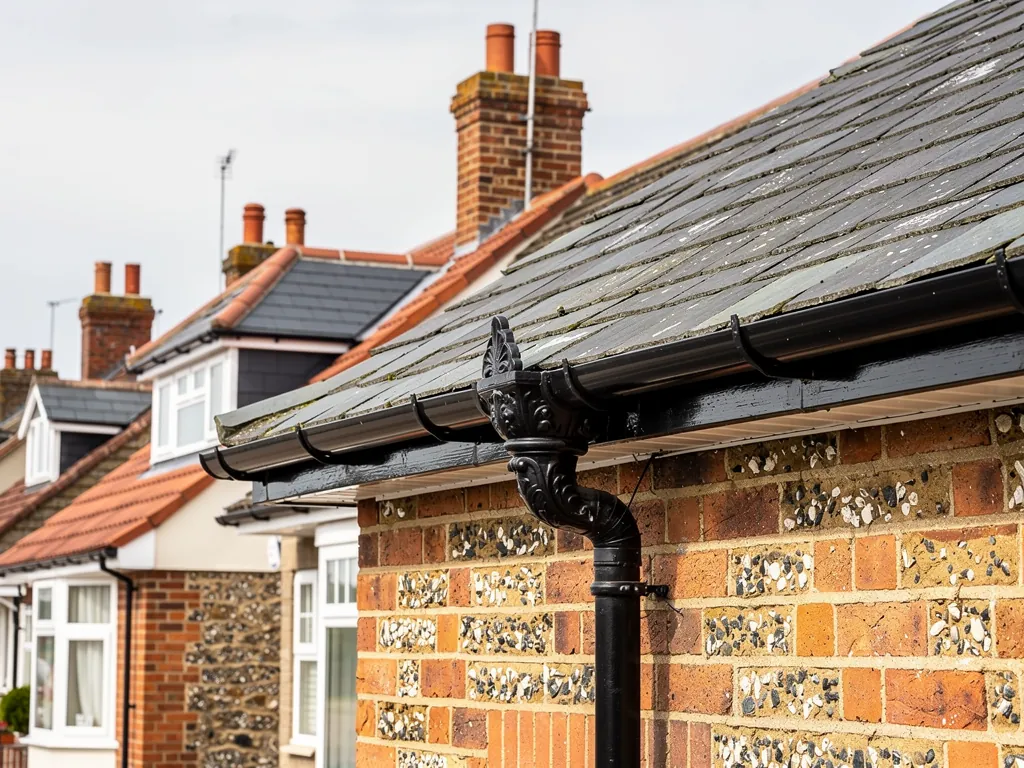
Cast iron gutters are part of what an older house looks like. The ogee and half-round profiles, the heavy brackets and the square-section downpipes belong to the Victorian and Edwardian terraces and villas that line parts of the Sussex coast. When the gutter goes, the street scene changes with it.
They are also heavy, bolted together, and painted by hand. That makes them very different to repair than a plastic system. A leak at a joint is not fixed with a clip, a cracked length cannot be glued, and the quality of the paint on the back decides how long the iron lasts.
This guide is for owners of period houses who want to know what is wrong, whether it can be mended and what rules apply. It covers the signs of failure, the repair options, the position for listed buildings and conservation areas, and the costs. For the comparison with other materials, see our guide on uPVC against cast iron guttering.
Why older houses have cast iron
Before plastic became common, cast iron was the standard material for rainwater goods. It could be moulded into decorative profiles, it was strong and it took paint well. Many of those original runs are still in service, and some have been repaired many times.
In Bognor, Arun's conservation area guidance for Aldwick Road describes imposing terraces of the early 19th century, Victorian and Edwardian years, with a good deal of stucco, slate and flint in their make-up. It asks for the original roofing to be put back where it has been replaced. A gutter belongs to that same roofline picture, and a mismatched replacement is easy to spot from the pavement, so owners of terraces like these tend to care about the profile as much as the function.
What the iron does well
Cast iron does not sag between brackets the way a thin plastic channel does. It is rigid, it holds a profile, and it is not damaged by ladders being leant against it. A well-kept system keeps its lines for a long time.
What it needs in return
Iron needs paint. Gutters are painted on the outside and, ideally, on the inside and back, and the coating has to be renewed. Where the paint is left to flake, rust starts at the joints and at the low points where water sits. That is the usual story behind a gutter that looks beyond saving when it can often be rescued. If you live in one of those older terraces, the paintwork you can see from the road may be the best of it, with the worst hidden on the back face and in the joints where nobody looks.
The first job is to read what the iron is telling you, one length at a time.
Reading the damage
From the ground, rust streaks and flaking paint are visible, but the real condition shows up close. A survey looks at the whole run and records what it finds with photographs.
Surface rust and rust-through
Surface rust sits on the paint and rubs off to sound metal beneath. It is a maintenance job. Rust-through is different: the metal is thin, flaky or holed, and a tap with a hammer handle sounds dull or crumbles. A gutter with a few small holes can be patched, but a length that has rusted through along the base has reached the end of its service.
Cracks and breaks
Cast iron is brittle. A hard knock, a heavy fall of debris or a blocked run that has frozen can crack a section. A hairline crack at the back may seep for years before it is noticed, because the water runs down behind the gutter and the stain shows on the wall.
Failed joints and loose brackets
Lengths are joined with bolts and a sealing compound between the flanges. The seal perishes, the bolts rust and the joint starts to weep. Our page on leaking gutter joints covers the faults that apply to every material. With cast iron, check the brackets and the fascia or rafter ends they are fixed to, because the iron is heavy and wet timber behind it will not hold.
On a seafront house, wind-driven rain and sea weather keep a rusting gutter wet for longer, so it deteriorates faster once the paint has gone. The verdict that follows is usually one of three: refix and reseal, replace some lengths, or replace the run. Each is described below, along with the point at which one gives way to the next.
Repair, replace a length or replace the run
Which job fits turns on how much of the system is still sound. Our aim is to match the work to the fault, and with cast iron that often means a repair, since the metal is usually better than it looks. Replacing a whole run because one joint weeps would waste good metal and change the look of the house for no gain.
When repair is enough
Open joints can be cleaned out, resealed and re-bolted, and a worn bolt can be exchanged for a fresh one in the correct size. Loose brackets can be refixed into sound timber or moved to a firmer position. Surface rust can be wire-brushed, treated and painted. Where a run is mostly sound but slightly out of fall, the brackets can be adjusted to bring the water to the outlet again. These are the repairs that keep a period house looking right.
When to replace a length
A cracked or rusted-through length can be taken out and replaced. New cast iron sections are made in common profiles, and reclaimed lengths can fill an odd gap. The skill is in matching the profile, because ogee and half-round do not mix and different foundries made slightly different shapes. A mismatch shows as a step in the run.
When the whole run has gone
If most of the iron is thin and the joints are failing everywhere, patching becomes a repeat call-out. Replacing the run in cast iron keeps the look. Cast aluminium and plastic copies are lighter and lower maintenance, but they look different close up and may not be accepted on a listed building. Our guide to replacing twenty-year-old gutters sets out how we weigh the decision, and the same reasoning applies to iron of any age.
Whichever path is chosen, the written quote states what is being done and why, with photographs of each length that is in question so you can see it for yourself.
Listed buildings and conservation areas
Period houses are the ones most likely to have extra rules, and it pays to check them before ordering anything. Replacement guttering is not always a free choice.
Listed buildings
Section 7 of the 1990 listed buildings Act bars alterations to a listed building that change its special architectural or historic interest, unless the works are authorised. According to the South Downs National Park Authority, listed building consent is not needed for regular maintenance or for minor repairs made in situ to match the original. Switching the material, the profile or the position of a gutter is a different matter, and consent may be needed. Ask your council's conservation officer before any change, and do it before the order goes in, not after the old iron has been skipped.
Conservation areas
Living in a conservation area does not by itself stop you repairing a gutter. Arun District Council says it will give consideration to Article 4 directions in its conservation areas, but none removing roof rights has turned up for Bognor. Inside one, a repair that keeps the existing profile is the safe route, and a change of material is worth a call to the planning team first.
Who decides where
Inside the South Downs National Park, the Authority itself handles planning for the Arun and Horsham parts, while for the Chichester part the district council acts on its behalf. Building control stays with the district council wherever you are. The same questions come up on the page about guttering, soffits and fascias, which is the best place to start if you are unsure what your house needs.
Keeping the iron going: paint and upkeep
Good repairs fail early if the iron is not protected afterwards. Paint is the maintenance that matters most.
Preparing the metal
Loose rust and flaking paint are brushed off to bare metal where needed, then the iron is primed with a metal primer before finish coats. The back and underside of the gutter are painted as well, since they stay wet longest. That work is far easier with the gutter removed, and a repair that involves taking a length down is a good moment to paint it on all sides.
Clearing and checking
A blocked cast iron gutter holds water and silt against the metal, and that is where rust starts. Keeping the run clear matters more than almost any other upkeep. Our guide to gutter cleaning covers how it is done and how often to look, and the same habit protects old iron.
Brackets and the structure behind
Iron is heavy when full of water, and the brackets carry all of it. Timber at the eaves that has gone soft must be put right, or the repaired gutter will pull away again. We check this during the survey and say so if the rafter ends need attention.
Colour is usually black on an old house, but period schemes vary, and a listed building may have a recorded colour. If the house has had its gutters painted in a particular shade for years, matching it keeps the street scene intact. The aim is a gutter that looks as though it has always been there, because it has.
What cast iron repairs cost
Cast iron repair varies more than almost any other roofline job, so a number printed on a page would mislead. Once we have surveyed the house, the written quote gives your figure as one total. What follows is what shapes it.
What sets the price
The number of joints to be reopened and resealed is the first factor. The number of lengths needing replacement is the next, and how easy it is to match them. Painting adds time, particularly when sections are taken down and treated on all sides, and period colours may need matching by eye. Access matters, because iron is heavy and awkward to handle from a ladder at height.
Scaffold and VAT
A tall period house usually calls for a scaffold. In Checkatrade's scaffolding table (last updated October 2026), a terrace comes to about £800 a month and a detached house to £1,200. Scaffold erected over the footway needs a licence under section 169 of the Highways Act 1980, issued by the county council, and West Sussex wants at least 10 working days to process it. VAT is charged at the standard 20 per cent, so ask whether the total on your quote has it in.
Where the gutters, fascias and soffits all need work, doing them in one visit shares the scaffold between them. Our page on replacing soffits, fascias and gutters on a four-bed house explains the sequence, and the same logic holds for a period terrace.
We photograph what we find, give a plain verdict, and tell you where a smaller repair will do.
Questions
Cast iron gutter questions
Can a cracked cast iron gutter be welded or glued?
Small cracks can sometimes be filled and sealed as a short-term measure, but cast iron does not weld easily and a glued-on patch on a gutter that moves with water and temperature tends to open again. A cracked length is usually better replaced with a matching section than patched, so the run holds together.
Is cast iron better than plastic guttering?
It depends on the house. Cast iron suits older buildings in looks and in rigidity, but it needs paint and upkeep. Plastic is lighter and needs less maintenance but looks different close up and may not suit a listed building. The right choice follows the age of the house and any consent rules.
Will my insurance pay to repair damaged cast iron guttering?
Your policy wording and the cause of the damage settle it. Sudden storm damage may be covered, while rust and ordinary ageing are usually treated as wear and tear. Contact the insurer before work starts, make the area safe, and hold on to photographs and receipts if a temporary fix is needed.