
Gutter cleaning · 9 min read
Gutter cleaning: how often, how it is done and what it costs
A plain guide to clearing gutters on a house near the coast: what blocks them, how often to look, the methods a roofer uses, and what moves the price of the job.
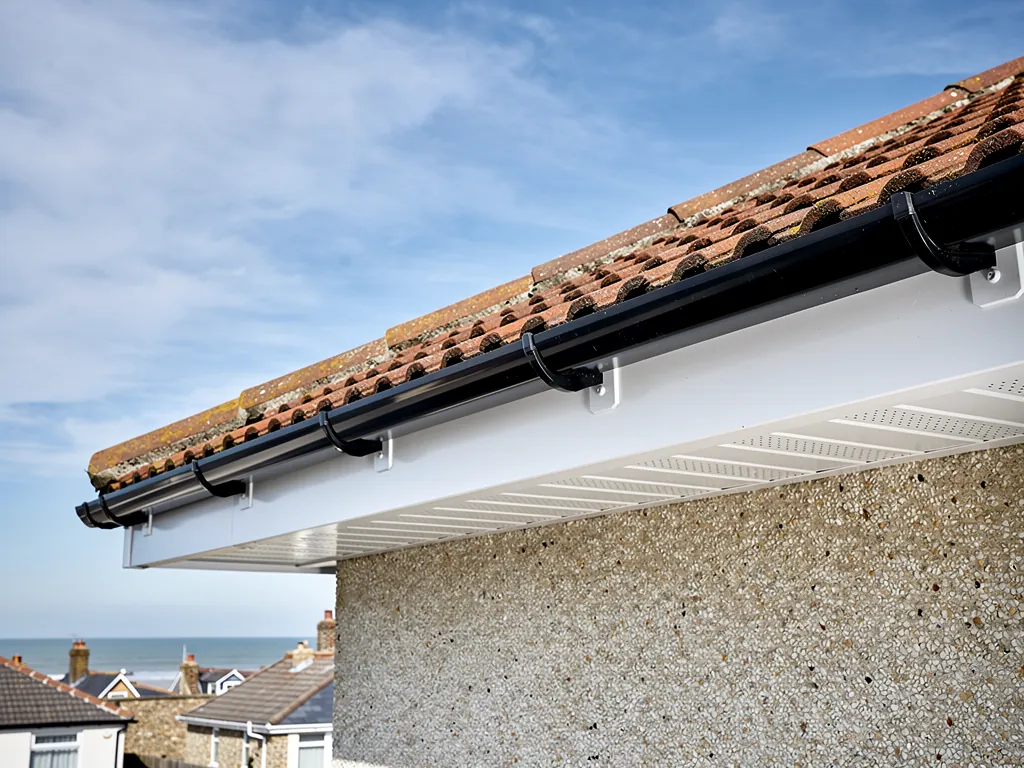
Gutters do one job. They catch the water that runs off the roof and carry it to the downpipes, and they only manage it while the channel is open. Once leaves, moss and grit settle in the run, the water has nowhere to go. It spills over the front, runs down the wall or backs up under the tiles at the eaves.
Few of us give the gutters a thought until something drips past the window. By then the damage has usually started: a stained wall, a damp patch inside a bedroom corner, or a fascia board that stays wet for weeks. A clear gutter prevents most of that and costs far less than the repairs that follow a long blockage.
This guide covers what actually blocks a gutter, how often it is sensible to look, how a proper clean is carried out, and what sets the price. It also explains what a clean-out often turns up, because clearing the channel is the moment the real condition of the gutter shows. For the wider picture, see our guttering, soffits and fascias page.
What actually blocks a gutter
Leaves are the obvious culprit, but they are rarely the whole story. A gutter on a house with no trees nearby can still clog, because the roof itself sheds material every time it rains.
Debris from the roof
Concrete tiles lose a little surface grit over the years, and it washes into the gutter as a gritty silt. Moss that has grown on the tiles dries out, breaks off and drops in clumps. Together they pack down into a dense, wet mud that holds seeds, and a gutter with a seedling growing in it is a common sight in spring.
Leaves, seeds and nests
Autumn leaves from nearby trees fill a run quickly, and sycamore and lime seeds add to the mass. Birds also build in and around gutters and the gaps at the eaves. The law protects a wild bird's nest while the birds are building or using it, so a clean-out that turns up an active nest is put off until the family has gone.
Silt at the downpipe
Debris travels with the fall of the gutter and ends up at the outlet, where it narrows the opening or drops into the downpipe and sets there. A blocked outlet makes a gutter look as if it needs replacing when all it needs is clearing. A blocked downpipe is a separate fault with its own cure, and it is worth checking after any clean.
Overgrown plants are the last cause worth naming. Ivy and buddleia rooted in a gutter can lift a joint or pull a bracket loose, and they need cutting out rather than brushing out.
How often gutters should be cleared
No one interval fits every house, and a roofer who quotes a fixed one is guessing. The rhythm comes from whatever surrounds and sits above the gutter.
A house under or beside deciduous trees collects leaf fall in a matter of weeks. A bungalow in an open street with a clean roof may go much longer between visits. A roof with a lot of moss sheds more than one that has been cleaned, and a low-pitched roof such as a flat-roofed extension that drains into a short gutter can silt up with very little warning.
A simple routine works for most houses: look after the leaves have come down, look again in spring, and look after any gale that brings branches down.
Signs you can read from the garden
You can tell a lot without a ladder. Water overflowing the front edge in steady rain is the clearest sign. Green or black streaking on the wall below a gutter, a drip from the underside of a joint, plants growing along the top of the run and a downpipe that stays dry while the gutter overflows all point to a blockage.
Binoculars from the garden are worth using. Fascias that stay dark and wet long after the rain has stopped suggest water is sitting behind or over the board.
Close to the sea
Houses near the coast get sea weather: gales that strip branches, driving rain and salt air. After a rough spell it is sensible to check the run whatever the calendar says. Our guide on how often to clean gutters goes through the same question for different kinds of house.
How a gutter is cleaned properly
A decent clean is a method, not a quick scoop. The order matters because the debris has to leave the building, not simply be moved along the gutter into the downpipe.
Working by hand
On a low roof the gutter can be cleared by hand from a ladder or a tower. The roofer scoops the sludge into a bucket, lifts out the heavier clumps and brushes the channel clean. The outlet is checked on the way, because that is where the dirt collects.
Vacuum with extension poles
Many houses are now cleared with a gutter vacuum on carbon-fibre poles, which pulls debris out of the run from the ground and often includes a camera so the operator can see the channel. It works well on two-storey houses with reasonable access. It is less useful when the sludge is old and set solid, or when there is a sharp bend, a conservatory or a long extension roof in the way. Our page on gutter vacuum cleaning sets out where each method fits.
Flushing and checking afterwards
Once the bulk is out, clean water goes down the run. That shows whether the water travels to the outlet, whether it pools in a low spot and whether any joint weeps. A gutter that drains but holds a puddle has lost its fall, and a drip at a joint means the seal has gone. Both are noted, photographed and explained.
Debris is bagged and taken away. It is not left in the garden or washed into the drains, and the ground below is left as we found it.
What gutter cleaning costs
A clean-out is priced on the house in front of us, so this page sets out what moves the price instead of quoting a number. Those factors are the same from one street to the next, and they explain why two similar-looking houses can be quoted differently.
Height comes first. A low run within easy ladder reach goes quickly. A tall detached house, or one where the eaves overhang a drop, needs a tower and more time on site. Length follows: a long run with many corners and several downpipes takes longer than a short one with a single outlet. Condition is the third factor. A gutter cleared every year is mostly light silt, while one that has not been touched for a long time can be packed with compacted material and vegetation.
When scaffolding enters the picture
A clean alone rarely justifies scaffolding. Checkatrade's scaffolding table (last updated October 2026) puts a month of scaffold on a semi-detached house of two storeys at about £875, and on a detached house at £1,200. Either sum dwarfs a clean. Where the gutters also need repair or replacement, one scaffold is shared across the whole job, which is how a cleaning visit sometimes grows into a roofline project. The cost of the clean itself is covered in our guide to the cost to clean gutters.
Getting a price
Our written quote arrives after we have looked at the house, and it gives a single total. When you set it beside another firm's figure, ask each whether VAT is included (the standard rate is 20 per cent) and whether tower hire is inside the price or added afterwards. Our prices are good and fair.
What a clean-out often turns up
Clearing a gutter is the first time anyone has seen the inside of it for months or years, and that makes it the best moment to find problems early. We photograph what we find, because a picture settles an argument faster than a description.
Joints and brackets
Many leaks are only seen once the channel is clear and water runs through it. A joint that was masked by silt starts to drip, a bracket that has pulled away leaves the run sagging, and a section with a cracked back shows up on the ground in the form of a wet patch. Each of these has its own repair, and a leaking joint is the one we meet most often once the channel is flowing.
The fascia behind the gutter
The fascia is the long board that carries the gutter along the eaves, and the soffit is the panel under the overhang beneath it. When a gutter has overflowed for a long time, the top edge of the fascia can go soft. Pressing a screwdriver into the board at the back of the run is a quick test: sound timber resists, rotten timber gives.
The roof above
Granules and moss in the gutter point at the roof. A lot of loose moss means the tiles above are holding moisture, and slipped or cracked tiles may show where the debris is coming from. We tell you what we can see from the gutter line and recommend an inspection only where the evidence calls for one.
The aim is a plain verdict. Sometimes a gutter simply needs clearing and nothing else, and that is the verdict you get.
Gutter guards, old materials and safety
Once you have paid to have a gutter cleared, it is natural to ask how to avoid doing it again. Gutter guards are one answer, but they are not a cure.
What guards do and do not do
A guard is a mesh, brush or cover fitted along the top of the gutter to keep leaves out. It cuts the volume of large debris. It does not stop fine grit and seeds from washing in, and moss and silt can still build up on or beneath the guard. Some need lifting for a proper clean. Our page on gutter guards weighs the options.
Older houses and asbestos cement
Older garages, outbuildings and some mid-century houses were fitted with gutters and downpipes made from asbestos cement. According to HSE, a building put up or refurbished before 2000 should be treated as containing asbestos. Under HSE guidance, asbestos cement rainwater goods count as non-licensed work when they are carefully handled and not broken up, and the work becomes notifiable once the material is substantially damaged or breaks into pieces.
So a grey, rigid gutter on an older outbuilding is never scrubbed, scraped or pressure-washed, because each of those breaks the surface and releases fibres. If we suspect a gutter is asbestos cement, we stop and explain how it should be dealt with before anyone touches it. A cracked length is the case to be most careful about.
Working at height
Gutters sit at the edge of a roof, which is the most exposed place to work. Reaching one from a ladder is for short, light tasks. Anything longer or more involved is done from a tower or scaffold. That is why we look at the house first and choose the method to suit, rather than going up with one approach for every job.
Questions
Gutter cleaning questions
Can I clean my own gutters safely?
Many people clear a low single-storey run from a stable ladder and a bucket, and that is a reasonable job. Above that, reaching and leaning at the edge of the roof carries real risk, and a tower or professional access is a better choice. Never climb onto a fragile roof, and leave asbestos cement alone.
Will clearing the gutter stop the damp patch on my wall?
It will if the damp comes from overflow, which is common. Water that spills over a blocked run soaks the wall below and the fascia above. If the stain returns after a clean and a test flush, the cause is likely a leaking joint, a cracked section or a fault in the roof edge, and it is worth a closer look.
Do I need permission to clean or work on gutters on a listed home?
Cleaning does not change the building, so it does not need consent. Replacing or altering gutters on a listed building can affect its character and may need listed building consent. For work beyond routine upkeep, check with your council's conservation officer before anything is ordered.