
Gutter guards · 9 min read
Gutter guards and leaf mesh: do they work?
What gutter guards and leaf mesh can and cannot do, which types suit which roofs and trees, and the questions to ask before paying to have them fitted along your eaves.
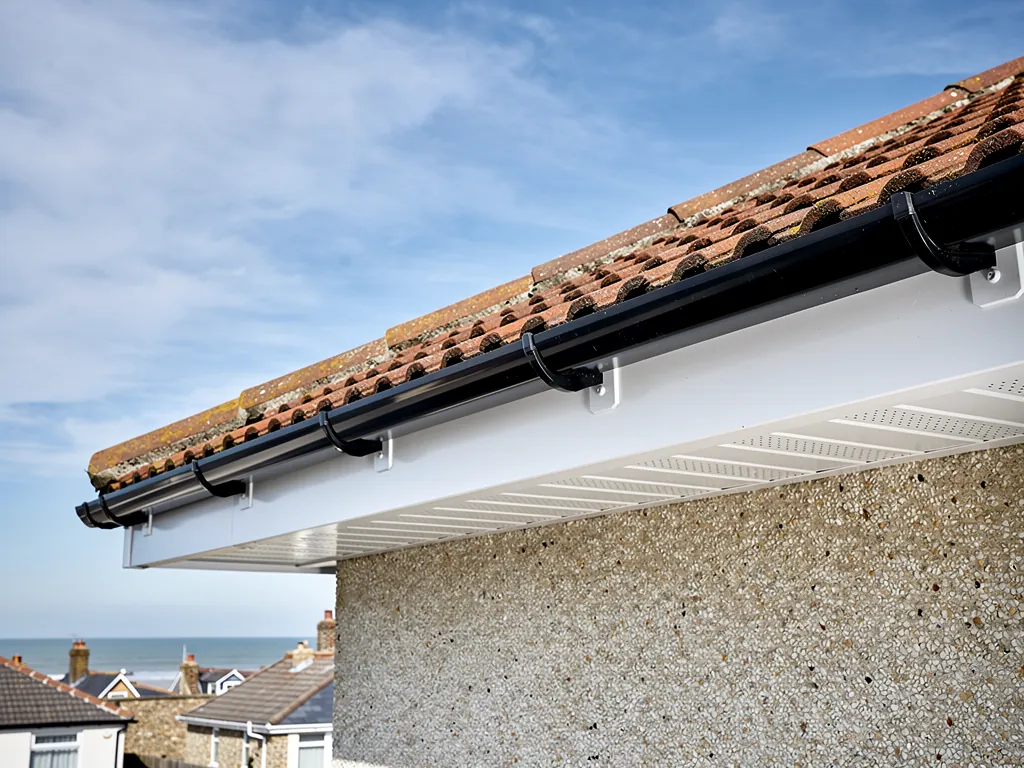
Gutter guards are sold on a simple promise: fit them once and stop climbing a ladder to scoop out leaves. The promise is partly true. A guard can keep large debris out of a gutter, and on a house under a big tree that matters. What it cannot do is turn a gutter into something that never needs looking at again.
Anything a guard keeps out of the gutter ends up somewhere else, usually on top of the guard. Fine grit from the roof, moss, seeds and the sticky film that builds on mesh can still collect and, in time, hold water or block the openings. A guard that is badly matched to the gutter can also make a repair harder, because it has to come off before anyone can reach the channel below.
This guide covers the main types, what each one suits, the problems that turn up after fitting, and how guards sit alongside ordinary cleaning. It gives no price per metre for a product, as the cost depends on your gutter profile, the height of the eaves and the system chosen. The survey sets the figure, and one written total follows it.
What a gutter guard is meant to do
A guard sits in or over the gutter and lets water pass through while stopping most solid material. The aim is to cut the number of times the gutter silts up, which in turn cuts the chance of overflow, damp walls and fascia boards that stay wet.
Whether that aim is met depends on three things: the size of what falls on the roof, the pitch and area of the roof that feeds the gutter, and how well the guard is fitted. Leaves from an oak or a beech are large and mostly stay on top. Needles, seed cases, blossom and moss are small enough to pass through some meshes or to settle on top and mat down.
Guards reduce the work, they do not remove it
A fair way to think about guards is as a way to lengthen the time between cleans, not to abolish them. The gutter underneath still takes in the fine silt that washes off roof tiles, and it still needs a look after a gale or a long wet spell. Anyone who tells you a guard means the gutter never needs checking is overstating the case.
On houses with no trees nearby, the sums rarely favour guards. A gutter that collects a little moss and grit once a year may be better served by a regular clean than by a mesh that costs money, may catch its own debris and must be lifted for every inspection. Our guide on how often to clean gutters helps set that rhythm.
The main types and what each one suits
There are several designs, and the names vary between suppliers, so look at how each one works rather than at the label.
Flat or domed mesh and perforated sheet
These lie across the top of the gutter, either clipped to the front lip and tucked under the roof covering at the back, or sitting on the gutter edges. They suit larger leaves. Fine mesh stops more, but it clogs faster, and a flat sheet with small holes can bridge over with a skin of moss.
Brush and foam inserts
A bristle tube or a foam block sits inside the channel. Water passes between the bristles or through the foam. They are the lowest-cost option and they fit many profiles without drilling. They do trap fine debris within the body of the insert, so they can become a mat that holds damp, and they have to be lifted out and cleaned.
Cover systems and rigid guards
Rigid covers shaped to the gutter let water curl round a curved front lip and into the channel, while leaves slide off. They are more involved to fit and can interfere with the roof edge, but they are designed to shed leaves instead of filtering them. Their performance in heavy downpours depends on how well the profile matches the gutter. Because the cover is rigid, the gutter below can only be reached by unclipping or lifting it, so ask how that is done and who does it.
If you have seamless gutters, an unusual profile or old cast iron, check that the guard system is made for it before you buy. Universal fit is a sales phrase, and the gap between a guard and a gutter that does not quite match is where leaves and water find a way through. Ask to see the guard sitting on a sample of your own profile, or a photograph of it fitted on the same type.
Where guards help and where they cause trouble
Guards earn their keep in a few situations. A house with large deciduous trees overhead, a gutter that is hard to reach, or an owner who cannot safely go up a ladder are the cases where fitting one makes sense. They can also help where birds drop twigs, or where a nearby hedge sheds seed.
They cause trouble in others. A guard fitted over a gutter that already sags or has a poor fall will not cure the sag, and may hide it. A mesh that sits proud of the edge can catch roof water and send it over the front instead of into the channel. Guards that overlap the bottom row of roof tiles can lift the tiles slightly, and in a gale that is a weak point. Where the covering is slate or old clay, ask the fitter how the guard is held without disturbing the tiles.
Heavy rain and the overshoot problem
Roof water runs fast in a downpour. If a guard has a front lip, the water can shoot off the roof edge, over the lip and past the gutter. Wide roof planes feeding a narrow gutter are the worst case. This is the same problem that gives rise to the symptoms in our guide to why a gutter overflows, and guards can make it more likely if the fit is not right.
The fix is a guard chosen for the roof as well as the gutter, with the fall, the fixings and the roof edge looked at together.
Fitting, fixing and what lies underneath
A guard fitted to a faulty gutter is money spent on the wrong thing. Before any guard goes on, the gutter underneath should be clean, level to its intended fall, firmly supported and free of leaks at its joints. Brett Martin sets a fall of about 1 mm per 600 mm and brackets no more than 900 mm apart on its system, and a gutter outside those norms deserves attention first.
The fascia behind should be sound too. If the board is soft, the brackets and any guard clips lose their grip. A screwdriver pressed into the lower edge of the board shows quickly whether the timber is firm, and a soft board should be dealt with before anything else goes on the front of it. Fitting a guard to a gutter whose fixings are already pulling out only moves the day when the whole run comes down.
Questions for whoever fits the guard
- Is the guard made for my gutter profile, or adapted?
- How is it fixed, and does it touch or lift the roof covering?
- How do I lift it for cleaning and inspection?
- What happens to the eaves gap, and can birds get in?
- Is the fall of the gutter checked before the guard goes on?
If the answers are vague, the product may be a good one badly matched to your roof. Where water has been getting past the gutter for a while, we check the boards behind before recommending anything that covers them.
Fitting at height is a job for a roofer with proper access. Pushing a guard in from a stepladder looks easy, but a tilted ladder against plastic guttering can crack it.
Cleaning with guards, and cleaning instead of guards
A gutter with a guard still gets cleaned. The job is different: the guard is lifted or brushed off, the debris on top is cleared, and the channel is checked from above. That is quicker than a bare gutter that has been left too long, but it is still a visit.
Many owners compare guards with a regular professional clean. Vacuum cleaning from the ground uses a long pole and a suction head, and it can be done without a ladder where the eaves are low enough. Our piece on gutter cleaning goes through the methods and what each involves. A guard does not rule out vacuum cleaning, but a rigid cover can get in the way of the suction head.
A simple way to decide
Ask what actually blocks your gutters. If the answer is large leaves from a tree that stands over the house, a guard is worth pricing. If it is moss and grit from the roof itself, cleaning plus a roof treatment is more likely to help. If water spills even when the gutter is clear, the cause is fall, size or bracket sag, and a guard will not touch it.
A survey photograph of your own eaves usually settles this in a few minutes. If a guard would help, the verdict says so. If cleaning is the better spend, the verdict says that instead, and there is no pressure to buy the dearer option. Trees change too: a sapling that sheds little today may drop heavy leaf in ten years, so think about where the canopy is heading.
Wildlife, rules and when guards are not wanted
Eaves are a favourite place for nesting birds, and nests that are in use are protected. A guard that closes a gap should be fitted outside the nesting season or only after checking the eaves are clear. If you can see birds going in and out, wait.
Bats use roof edges too, and the law protects them and their roosts. Work that disturbs a roost is not something to push ahead with. If you have seen bats near the eaves, say so before anything is fitted.
Planning and permission
Fitting guards is routine maintenance and not normally something that needs permission, but a listed building or a house with special controls on its exterior is a different case. If yours is listed, ask the council's planning team whether the change to the eaves needs consent. The same question is worth asking where an Article 4 direction or a conservation area applies, because the answer depends on the house and the council, and a quick phone call costs nothing.
When a guard is the wrong answer
Guards are a poor match for a gutter that is full of old debris, rusting through, or pulling away from the wall. They are also unhelpful on very shallow roofs where water arrives slowly and mat builds easily, and on old cast iron where the profile does not take a standard fitting.
A plain verdict comes with the quote: fit, do not fit, or fix something else first. Nothing is fitted until you have seen the photographs and agreed the price, and the site is left tidy. See our guttering, soffits and fascias page for the other jobs we take on at roofline level.
Questions
Gutter guard questions
Will a gutter guard stop my gutters blocking altogether?
No. A guard cuts out most large leaves, but moss, seed, blossom and fine grit still build up on or under it. The gutter will need cleaning less often, not never. Anyone who says a guard means no maintenance is selling more than the product can deliver. Check the gutter after storms either way.
Do gutter guards make gutters overflow in heavy rain?
They can, if the guard is mismatched to the roof. In a downpour, fast roof water may shoot over a guard lip and miss the gutter. Fine meshes can also sheet over with moss and slow the water down. A guard that suits the gutter, the fall and the roof edge reduces that risk.
Can I fit gutter guards myself?
Some foam and brush inserts simply drop into the channel, and an owner who can work safely at ground level or from a proper platform may manage them. Anything clipped to the roof edge is a job for a roofer with safe access, because a stepladder against plastic gutters is a common cause of cracks and falls.