
Repair or re-lay · 9 min read
Repair, re-lay or replace a Horsham stone roof?
A leaking stone roof does not always need stripping. This guide explains the three choices, repair, re-lay or replace, and the signs from the stone and the timbers that point to each.
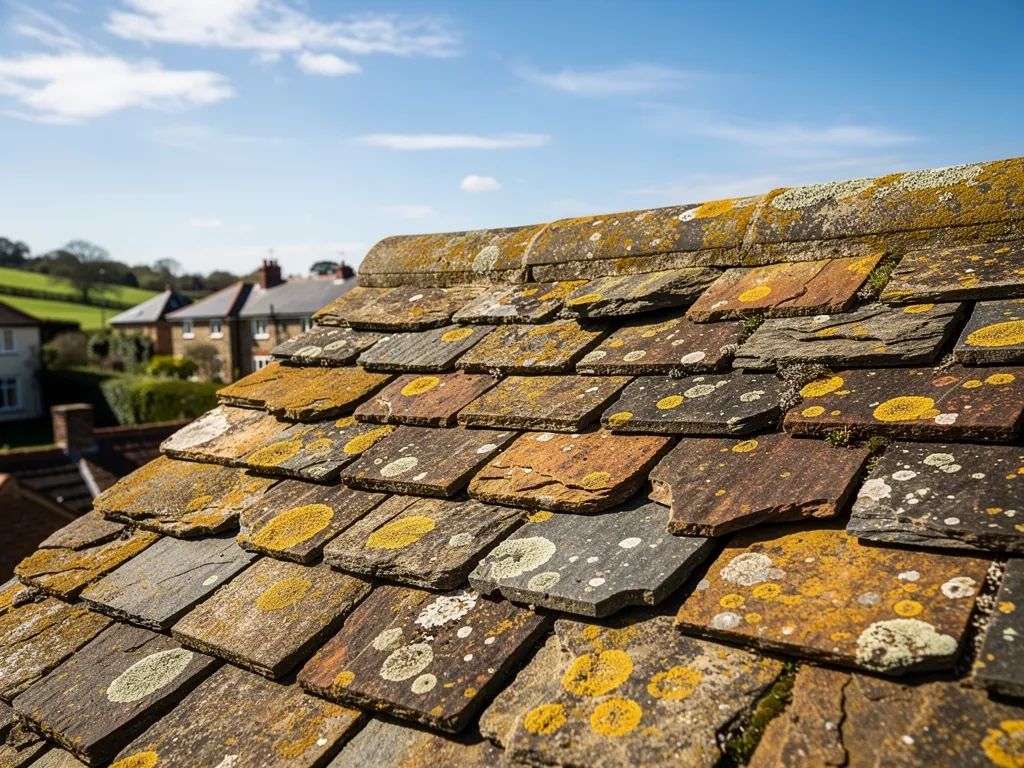
A stone roof that lets in water puts the owner in a difficult spot. The covering looks as though it should last for ever, the bill for stripping it sounds alarming, and everyone you ask has a different view. The truth is usually plainer than the arguments. Most stone roofs that leak are failing at their fixings and details, and the stone is fine.
That is why the first question is never how old the roof is. It is what exactly has failed, and how far the failure has spread. A handful of slipped slabs over one gutter calls for a repair. A whole slope with soft battens and tired pegs calls for a re-lay, which means lifting the stone, mending what is underneath and laying the sound slabs back in order. A roof whose stone is flaking through and whose timbers are beyond saving may need a new covering.
This guide sets out how those three verdicts are reached and what each involves. It is general advice, not a diagnosis, because your own roof can only be judged by looking at it. The work we do on these roofs is set out on our Horsham stone roofing page.
Three verdicts and what each one covers
Think of the choices as three rungs on a ladder, each one a bigger commitment than the one below it. Repair is the smallest job that stops the water: refixing slabs that have slid, swapping a few broken ones, renewing a failed length of lead or a crumbled bedding of mortar. Re-laying is the middle rung. The stone on a whole slope, or a whole roof, is lifted and stacked, the battens and underlay beneath are put right, and the slabs go back in their graded courses with new fixings and any replacements needed. Replacement is the top rung: the old covering is removed for good and a new one fitted, whether that is new or reclaimed stone or something else.
Each rung costs more and disturbs more than the last, with more scaffold, more days and more of the roof open to the weather, so the rule we follow is to recommend the lowest one that properly fixes the roof. The reverse mistake is real too. Patching a roof whose battens are rotten only moves the leak along, and the money spent on a third repair would have gone further as part of a re-lay.
Why the stone is rarely the culprit
On a stone roof the rock outlasts almost everything attached to it. Checkatrade's slate guide notes that stone slate, looked after, can last a hundred years or more. What goes first is the peg or nail holding each slab, then the batten it hangs from. This is useful because it means a verdict can often be reached without condemning the covering. If the stone is sound and the failure is underneath, a re-lay keeps nearly all of the original material, and the look of the roof survives.
When repair is the right call
A repair fits where the fault stays in one place and the roof around it is sound. Typical cases include a small group of slipped slabs, a few cracked ones near the eaves, a ridge whose mortar has crumbled while the stone beneath is firm, or a chimney flashing that has lifted. In each, the cause can be found and put right without disturbing the rest of the slope.
The key is to ask why the slab moved before putting it back. We lift the slipped slab and the ones beside it, look at the batten and the fixing, and replace whatever has failed. Where the neighbours are sound, the new fixing holds and the course closes up again. Our guide to slipped stone slates goes through the process step by step.
Signs a repair will hold
Several things point towards a repair. The leak is in one place and the loft shows dry timber around it. The slabs next to the fault are firmly seated. The battens are solid when pressed. The faults are the sort a single visit can address, such as a lead flashing, a valley edge or a few slabs, and there is no sign of the roof moving or sagging overall. Where all of that is true, repair is both the lowest-cost and the least disruptive route, and it keeps every sound slab in its original place. If water has appeared in the same spot more than once, the cause is hidden, so look further before agreeing to another patch.
Some repairs are best done soon rather than later, particularly before autumn gales arrive on a slope that is already loose. A slipped slab leaves a gap for rain and for wind to lift its neighbours, and a short delay can turn a small repair into a larger one. If water is already coming in, tell us and we will make it safe first, then repair once the weather and the stone allow.
When the roof needs re-laying
A re-lay makes sense when the faults are widespread but the stone is mostly good. Common triggers are soft or rotten battens across a slope, pegs that have decayed along many courses, slabs sagging in a line, or daylight showing through the loft side of the covering. Repeated patching in several places is another sign. When a roof needs fixing in six spots, treating it as one job is often better value than six visits.
The sequence matters. The stone is lifted course by course from the ridge down and stacked in size order so that the largest slabs are ready for the eaves. The battens and underlay are then inspected and renewed where they need it, damaged slabs are weeded out, and the sound ones go back with fresh fixings in diminishing courses. The proportion of original stone reused depends on how many slabs have cracked or flaked, which only shows once the roof is open.
What a re-lay keeps and what it changes
The great advantage of a re-lay is character, which no new covering can quite copy however well it is chosen. The roof comes back looking like itself because it is mostly made of itself, and for a listed building or one in a conservation area that matters a great deal. What changes is everything out of sight: new battens, a modern underlay, properly dressed lead and a structure that has been looked at in full. Our guide on how long it takes to re-lay a stone roof covers the timetable, and the roof is made weathertight in stages, slope by slope.
A re-lay is also the usual moment to deal with the details that have been patched for years, such as valleys, hips, chimney lead and the ridge. Doing them with the stone off the slope gives access that a repair on a finished roof never has.
When replacement is the answer
Full replacement is for the roof that cannot be saved in any other way. The usual reasons are stone that has lost its face through frost and delamination across large areas, a structure that needs major timber work, or a covering that has been repeatedly patched with unsuitable materials. In those cases a re-lay would reuse too little to be worth the labour.
Replacement raises a choice about what goes back. New stone, reclaimed stone and other coverings each carry a different cost, a different look and, on a protected building, a different answer from the council. Our page on stone roofs in a conservation area explains why that choice is not simply yours to make.
A word on honest limits
We would rather tell you a roof can be saved than sell you a new one. But a roof is sometimes past saving, and saying otherwise would be a poor service. The photographs from the survey are there for that reason: you see the flaking, the rotten timber or the failed lead for yourself, and the verdict follows from what is on the screen. Should you want a second opinion on any roof, go and get one. A good roofer will be glad for you to compare their photographs and their written price with another.
Replacement also brings the building regulations into play more often than a repair does, which the next section explains. It is worth asking at the survey stage whether the job is likely to cross the thresholds, because that decides how much paperwork sits between the quote and the first day on site, and the answer is easier to plan around if you have it early.
How the survey decides, and what building control says
The survey that settles the question begins in the loft. There we check the battens, the rafters and the back of the stone for damp, daylight and decay, then work across each slope on the outside, marking every slab that has moved or cracked. The photographs go with the written quote, and that quote gives one price covering the recommended job.
The regulations depend on how much of the roof is touched. The Planning Portal sets the line like this: building control is normally not involved if under 25 per cent of the total building envelope and under 50 per cent of the roof is affected. Over at Arun, the district council's building control pages name replacement coverings as work needing approval, so the safe course is to ask your council's building control team, or a registered building control approver, about your job.
Thermal upgrades and weight
Approved Document L makes renovating over 50 per cent of a roof's surface the point at which its insulation has to be brought up to standard, and a large re-roof can also fall under the wider 25 per cent test for the whole building envelope. Whether and how that applies to an old or protected building is for building control to say. A new covering that is 15 per cent or more heavier is another trigger.
None of this should put you off a repair. A modest repair on a stone roof will usually sit well under the lines above, and that is one reason the smallest sound fix is also the simplest one to arrange. Most local work sits under the thresholds. It is bigger jobs that need a conversation with the council before the first slab is lifted, and we explain where that applies once the survey is done. Our guide to the stone roof survey shows what we check.
Questions
Repair or re-lay queries
Will a re-laid stone roof look the same afterwards?
Largely, yes. A re-lay reuses the existing slabs, graded again, big stone low and small stone high, so the colour and texture stay. Any slab replaced for cracking or flaking is chosen to match as closely as possible. New fixings and battens are out of sight, and the lead is dressed neatly, so the roof looks like itself, just sounder.
Can a leaking stone roof be patched until I decide what to do?
Yes, a temporary make-safe is often the sensible first step while you decide. We prioritise leaks and storm damage. Water coming in is stopped first, and the permanent answer follows. Meanwhile, contact your insurer, take pictures of what you see and keep every receipt. The permanent answer, repair, re-lay or replacement, is then decided on the survey once the weather allows.
Does re-laying a stone roof need building regulations approval?
The result depends on the share of the roof touched. Planning Portal guidance puts the limits at 25 per cent of the building envelope and 50 per cent of the roof, while Arun District Council names replacement coverings in its own approvals list. Ask your own council's building control team before work starts.