
Lime mortar · 9 min read
Why must lime mortar be used on old roofs?
Old stone roofs were built with lime, and repairs in hard cement tend to do harm. This guide explains what lime mortar does, where it sits on a roof, how it fits modern fixing standards and what to ask a roofer.
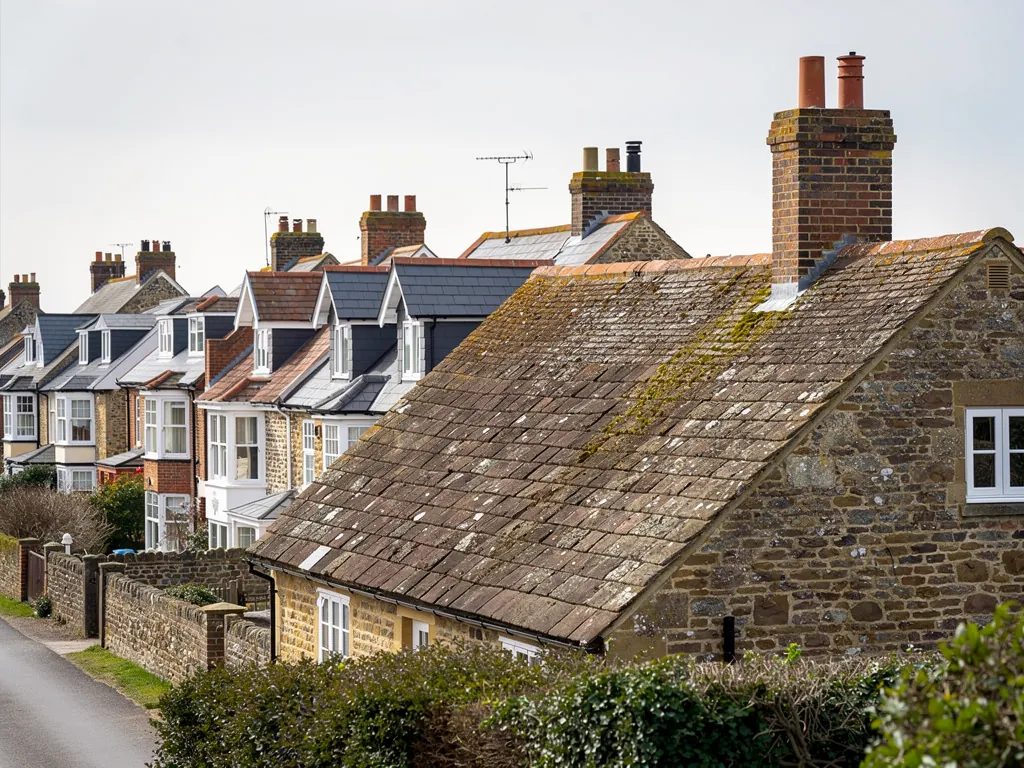
Ask a conservation officer what goes wrong most often on old roofs and cement will come up quickly. It is a strong, quick, familiar material, and it is the wrong one to use against old stone. A ridge bedded in a hard cement mix looks tidy on the day. Years later it may be cracking, letting water in or pulling at the stone around it.
The title asks why lime mortar must be used. The plain answer is that it is the mortar the roof was built with, and it behaves differently from cement. It is softer and more flexible, so it can move with an old structure instead of fighting it. On a listed building the council may write it into the consent. On other old roofs it is simply good practice, and a roofer who reaches for a bag of cement without asking is worth questioning.
This guide covers what lime mortar is for, where it is used on a stone roof, how it works alongside modern fixing standards such as BS 5534, and the questions to put to anyone quoting. The mix, the sand and the method for your roof are settled at the survey, and on a protected building with the conservation officer. Our Horsham stone roofing page shows the wider work.
What lime mortar does that cement does not
Mortar has two jobs on a roof: to bed one piece of masonry to another, and to seal the joint against weather. Old roofs did both with lime, a binder made from burnt limestone, mixed with sand and water. Modern mixes use cement, which sets hard and fast.
The difference that matters is hardness. Lime mortar is softer than most cement mixes and more flexible. A stone roof moves a little with the seasons, with the weight of the slabs, with wind and with the settling of old timbers. A flexible mortar tolerates that movement. A rigid one cannot, so it cracks, and the crack lets rain in behind the bedding.
There is a second idea behind the practice. Where a hard mortar sits against a softer stone, the weaker material tends to take the damage. In the old approach the mortar is meant to be the part that gives way first, because mortar can be raked out and renewed. A stone slab cannot be renewed once its face has flaked off. That is the reasoning conservation specialists give for matching the mortar to the masonry, and it is why a hard cement repair on an old roof is treated with suspicion.
Lime mortar also sets slowly. It does not reach full strength the way cement does within days, and it needs weather that suits it. Our roofers plan lime work for settled conditions and shield fresh bedding from rain, sun and frost while it cures.
None of this makes cement a bad material. On a modern house with concrete tiles it is a normal bedding. The point is that an old roof is not a modern roof, and the materials should agree with each other.
Where mortar appears on a stone roof
On a plain tiled roof mortar sits mainly at the ridge. A Horsham stone roof uses it in more places, and each has a name worth knowing.
Hips are the outside corners running down the slope, and the ridge is the crest they meet at the top. Both carry ridge pieces bedded in mortar. The verge is the gable end finish, where the slabs overhang the wall and are bedded or pointed into a mortar fillet. Chimneys have flaunching, the sloping mortar crown around the pots that sheds rain.
Inside the roof there is torching. This is a layer of lime mortar pushed up between the battens, the timber strips the slabs hang from, from inside the loft, to seal the gaps between slabs against wind-blown rain and fine snow. Roofs with torching show a pale lime layer from the loft hatch, and it is easy to disturb. Ask your surveyor to show you the loft side as well as the ridge, because torching, pointing between slabs and old repairs often show only from inside. Our answer on what torching is on a stone roof goes through it, and our answer on the ridge on a Horsham stone roof looks at the top line.
Valleys can use mortar too. Swept valleys, where the stone is cut and curved round the angle between two slopes, depend on well bedded slabs, and lead-lined valleys still have mortar at their edges. Around a stack, the lead flashing is dressed over the masonry and the pointing behind it matters as well.
When we survey, we look at all of these places, because earlier repairs are often the weak point. Hard grey cement at a ridge, a verge or a stack on an old stone roof is a sign that a past repair was made without thought for the material underneath.
Lime mortar and modern fixing standards
People sometimes ask whether lime is still allowed now that standards have moved on. The short answer is that the standards do not rule out lime, but they do change how ridge and hip pieces are held.
BS 5534 is the standard for slating and tiling. Marley explains that after the 2014 revision, the tensile strength of mortar on its own stopped being a safe basis for fixing ridge and hip tiles, and it wants every bedded tile and fitting to carry a mechanical fixing too. The same source adds that installing to BS 5534 is not required by law. In practice a ridge or hip piece is bedded and also held with a screw, clip or similar fixing, so the mortar is no longer the sole support in a gale. In plain terms, expect a stone ridge to be bedded in lime and also pinned or clipped out of sight. That is what the standard and the old craft ask for together.
For an old stone roof the picture is more particular. BSI cautions that the standard's recommendations may not suit some old roofs when they are re-slated or re-tiled, especially roofs covered in traditional or reclaimed material. The right approach is neither to ignore the standard nor to apply it blindly. We look at each roof, decide where a hidden mechanical fixing can sit without harming the stone or the look, and bed the piece in a mortar that suits the masonry.
It is the same thinking as the finish we aim for on any roof: ridges and verges held properly and neatly done. On stone, the finishing material is lime rather than cement.
Where the building is listed, the fixing and mortar method is part of what the conservation officer approves, so it belongs in the application. Our answer on whether BS 5534 applies to an old stone roof goes into this in more detail.
Mixing, curing and the work itself
Good lime work is mostly patience. The mix is not a bag from the builders' merchant. The proportions of lime to sand, and the colour and grain of the sand, are chosen to suit the roof, and a sample patch is often made so the owner and the conservation officer can judge the colour.
The old mortar comes out first, by hand and with care. Raking out too deep or too hard can chip the edges of the stone, so the work is slow. On a roof that has been patched in cement, removing the hard cement without damaging the slab beside it can take longer than the new bedding.
The new bedding goes in damp. The stone is wetted so it does not draw the moisture out of the mortar too fast, and the mortar is pressed home in layers. After that the work has to be protected. Lime cures slowly, and rain, hard frost or fierce sun in the first days can spoil it. That is why settled weather matters and why we may stop and cover a stretch of work instead of pushing on.
The finished surface is not left shiny or smooth. A lime ridge or verge should look as if it belongs to the roof, with a texture and tone close to the old work, and it should not stand proud or shout from the street.
Timing is part of the plan. Stone often has to be found, consent may need to be granted and lime has a season it prefers, so a planned job in good weather beats a patch in midwinter. When rain is coming in, a temporary cover goes on first and the proper work follows when conditions allow. A roof that is letting water in is made safe first, and the proper work follows.
What to ask a roofer about mortar
You do not need to be an expert to test a roofer's approach. A few plain questions show whether they understand old roofs.
Ask what mortar they propose for the ridge, hips, verges and chimney flaunching, and why. A good answer names lime and says it suits the roof. Be wary of a quote that names a mortar only as mortar, or that mentions cement for the whole job. Ask whether the ridge pieces will be mechanically fixed as well as bedded, and how the fixings will be hidden. Ask who deals with the conservation officer if the building is listed or sits in a protected area. Ask whether a sample will be shown first.
Ask, too, what is done about the old repairs. If the roof has hard cement patches, the answer should say how they come out and what goes back. Ask how the work is protected while it cures. And ask for the price in writing as a single total, with a note of whether VAT and scaffolding are included. You get that from us after a survey with photographs of your roof, and where lime is needed the quote says so in plain terms.
If the building is listed, the consent route comes first, and our guide on Horsham stone roofs on listed buildings explains it. On the Building Regulations side, the Planning Portal sets the line at under 25 per cent of the total building envelope and under 50 per cent of the roof, but Arun District Council counts replacement roof coverings as approval work, so confirm with your building control body.
To start, send photographs of the ridge and the stacks to WhatsApp, or ring 01243 252373.
Questions
Lime mortar questions
Can I use cement mortar on an old stone roof?
It is usually the wrong choice. Cement sets hard and rigid, and an old roof moves, so the mortar cracks and lets water in. Where it is harder than the stone, the stone tends to take the damage. On a listed building the council may specify lime. Ask your roofer what mortar they propose and why.
If lime is used, does the ridge still need mechanical fixings?
Generally yes. Marley reads the 2014 revision of BS 5534 as meaning mortar cannot carry ridge and hip tiles by itself, so a mechanical fixing is added. BSI cautions that some old roofs may not suit the standard's recommendations. The detail for a stone roof is settled at the survey.
How long before fresh lime mortar can get wet?
There is no single answer, because it depends on the mix, the thickness and the weather. Lime cures slowly, so fresh work is covered against rain, hard frost and strong sun. A roofer who rushes it, or who works in poor weather without protection, is putting the repair at risk.