
Listed stone roofs · 9 min read
Horsham stone roofs on listed buildings: consent and the conservation officer
A listed house with a Horsham stone roof turns every repair into a question of consent first. This guide explains which work needs permission, who decides, and what to put in front of the conservation officer.
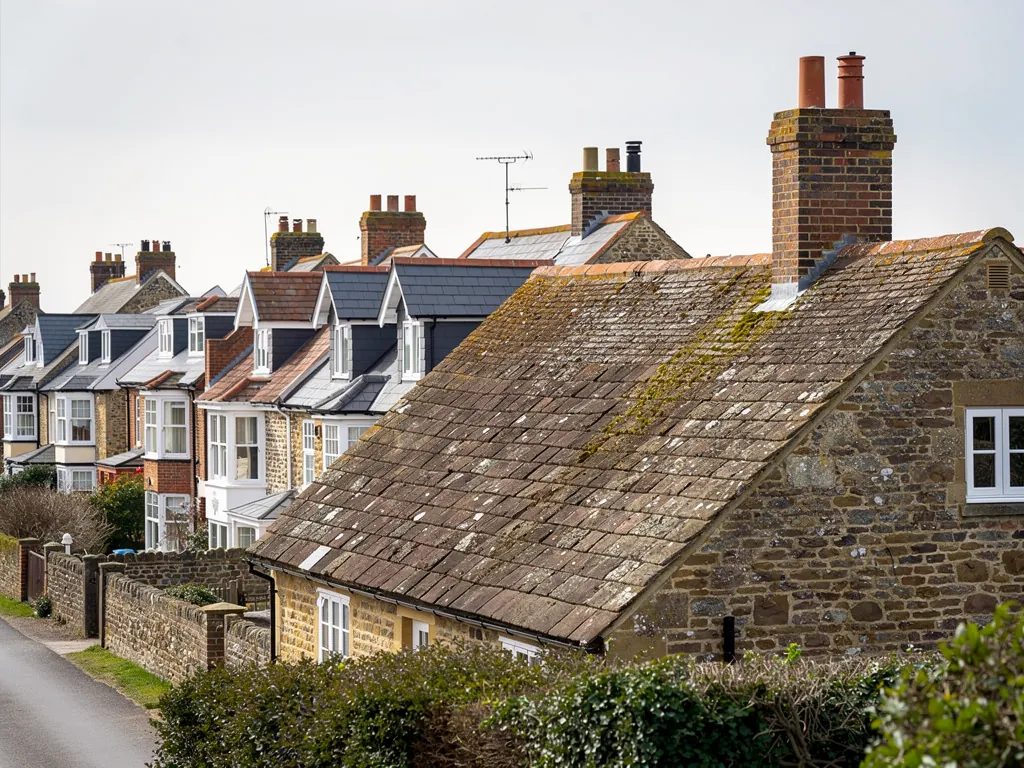
A listed house with a stone slab roof is protected twice over. The building is listed for its architecture or history, and the roof is usually a big part of why. Lift the wrong slabs, or swap them for something else, and you may have changed the very thing the listing protects.
Most owners meet this the wet way. A slab slides off, a stain spreads across a bedroom ceiling, and the first call goes to a roofer when the first question ought to be what the listing allows. Plenty of ordinary stone roof upkeep can go ahead without a formal application. Whether yours can depends on the detail of the work, and the person who decides is at the council, not the roofer and not the owner.
This guide takes the stone roof on a listed building step by step. It covers what the law says, what counts as a like for like repair on stone, which council you deal with in this part of Sussex, what a conservation officer expects to see, and how consent sits alongside the Building Regulations. It is general guidance, not legal advice. Your council has the final word on your own roof, and our Horsham stone roofing page shows the work we carry out once consent is settled.
What the Listed Buildings Act says about a stone roof
The rule sits in section 7 of the Planning (Listed Buildings and Conservation Areas) Act 1990. In plain terms, nobody may demolish a listed building, or alter or extend it in a way that touches its special character, unless the works have been authorised. For most roof jobs, that authority is a formal consent granted by the council's planning department.
Two things follow for a stone roof. First, the test is about character, not about size. A modest change to a prominent slope can matter more than a big repair that leaves the look untouched. Second, the listing takes in the building as one whole, so the old timbers carrying the stone belong to the same story as the slabs on top.
The South Downs National Park Authority makes a practical point on its listed buildings page. Its position is that everyday maintenance, and minor repairs carried out in matching materials without removing the original fabric, need no listed building consent. That is helpful, because most day to day stone roof work sits on the right side of the line. Refixing a few slipped slabs, setting a matched slab where one has cracked, clearing a valley and rebedding a loose ridge piece in suitable mortar are all repairs in place.
Where consent starts to matter
Trouble begins when the work changes what the roof is. Swapping stone for tile or slate does that, and so does altering the pitch or opening up the roof structure. Adding a roof window changes the roof as well, and permitted development rights for roof alterations do not stand in for consent on a listed building. Once the plan moves past repair, stop and ask the council before anyone prices it.
What like for like means on Horsham stone
On a plain tiled roof, like for like is easy to picture: a tile for a tile. Stone is harder to match, which is why conservation officers look hard at stone proposals. A Horsham stone roof is not a set of identical units. It is a hand sorted covering of thick, uneven slabs, graded so that the biggest sit low on the slope and the smallest high up. Those are the diminishing courses. If the grading is lost, the roof reads differently from the lane even when every slab is stone.
A proper like for like repair therefore keeps several things. The first is the stone itself: the same kind of sandstone, in a similar thickness, size and colour, so a new slab does not glare among weathered neighbours. The second is the laying pattern. The third is the fixing method, often an oak peg or an iron nail passing through a drilled hole in each slab, which hangs from a batten, which is a narrow timber strip running across the rafters.
The fourth is the detail at the edges. Ridges, hips, valleys and verges each have a traditional finish, and a roof with swept valleys should not come back with lead channels because that is quicker. The fifth is the mortar. Old stone roofs were bedded in lime, and our guide on why lime mortar is used on old roofs explains why the council may insist on it.
Where the survey shows that old slabs cannot all go back, the question of salvaged or freshly cut stone comes up. Our guide to reclaimed or newly quarried Horsham stone sets out the choice, and the conservation officer will want to hear which route you propose, with photographs of the stone.
Treat the whole list as a checklist for the application. A proposal that names the stone, the courses, the fixings, the edge details and the mortar gives the officer something concrete to approve.
Which council decides, and who the conservation officer is
A listed building consent application goes to the local planning authority, and the council's conservation officer advises on it. That officer reads your proposal for what it does to the character of the building. They are a specialist who usually knows the local stone, and they are much easier to work with when you write to them early with clear photographs than when the first they hear of the job is a scaffold going up.
Which council that is depends on where the house stands. West Sussex County Council's guidance on who does what says that district and borough councils deal with listed buildings and conservation areas, as well as building control. In Horsham, Chichester and Arun districts, that means the district council's planning and conservation team.
The South Downs National Park adds a layer. Inside the Park, the SDNPA is responsible for planning in the parts that lie within Arun and Horsham districts, and it decides applications there directly. In the parts within Chichester and East Hampshire, the district council handles applications on the SDNPA's behalf. Houses around Petworth and Midhurst are the likely ones to meet this, so ring the council's planning team and ask who takes your application.
Building control is separate again. Even inside the Park it stays with the district council or a registered building control approver. A listed roof can therefore involve two sets of people, one for consent and one for the Building Regulations, and neither replaces the other.
If you cannot tell whether the house is listed, the council's planning team can confirm it. Our guide to re-roofing a stone roof in a conservation area covers the neighbouring case, where the house itself is not listed but the street is protected.
What to send the conservation officer
A good application is mostly good evidence. The officer cannot climb your roof, so the photographs and the written description do the work. A stone roof survey from us produces most of what follows.
Start with photographs of every slope, taken at ground level and again close up from the roof, plus the loft timbers, the chimney stacks and any earlier repairs. Close shots of failed areas show the cause: a rotted batten, a snapped peg, flaking stone, a patch of cement. Then add a plain written schedule of what you want to do. It should name the slopes involved, how many slabs are to be lifted and refixed, what happens to stone that cannot be reused, which mortar is proposed for the ridge and hips, and how the lead is to be dressed.
Include the stone plan. Say whether replacement slabs are reclaimed or newly quarried, where they come from, and how they will be matched. A sample slab, or a photograph of the delivered pallet, answers the question quickly. Add any listing details, conservation papers or earlier consents you already hold.
Timing needs thought. A decision on consent takes weeks, and the right stone may have to be found or salvaged, so an early conversation beats a scramble in midwinter. If rain is getting in today, cover the roof temporarily first. Which? advises telling the insurer early, with photographs of the damage and receipts for the emergency work. A sheet can be lifted off again later, which leaves the lasting repair for the council to answer.
After the survey, we write the findings up in terms an owner or an agent can hand on, with a photograph for every point. Our answer on working with a roofer and the conservation officer goes through that conversation in more detail.
Churches, monuments and the Building Regulations
Not every old stone roof sits on a house. Many Horsham stone roofs cover churches, barns and outbuildings, and the consent route changes with the building.
Take the Church of England first: a church still used for regular worship is outside the listed building consent system, and its repairs go through the faculty system. Catholic and Methodist congregations run their own procedures. A Baptist church qualifies only when a named trust corporation holds it, and a United Reformed church only when it sits on the specified trusts. Quakers, Unitarians and every other faith have no exemption, so their buildings need ordinary consent from the council.
The exemption ends when worship stops. Closure changes things. A church that has shut, and any church passed to the Churches Conservation Trust, comes back under ordinary controls. Separately, a scheduled monument, even one standing in a churchyard, needs scheduled monument consent, which the Secretary of State grants. Government guidance adds one more caution: being exempt from consent leaves planning permission in play wherever development would change the outside of a listed church.
Building Regulations on a listed roof
Consent and the Building Regulations answer different questions, and passing one does not settle the other. The Planning Portal puts the usual cut-off at 25 per cent of the total building envelope together with 50 per cent of the roof: below both, building control is not normally involved. Above them, or where the covering chosen is 15 per cent or more heavier than the existing one, an application follows. Arun District Council's building control page also names roof re-covering in its list of alterations needing approval, so confirm the position with whichever body will inspect your job. The survey tells you where your roof stands, and where the work is notifiable we deal with the paperwork.
Questions
Listed stone roof questions
Can I replace a few cracked slabs on a listed Horsham stone roof without applying?
Often yes, where the work is a small repair in place using matching material. The South Downs National Park Authority treats routine upkeep of that kind as needing no listed building consent. The word small matters. Ask the conservation officer before work starts, send photographs, name the stone you plan to use and keep their reply.
Does my cottage need consent if it is in a conservation area but not listed?
That is a different set of controls. A conservation area can carry its own limits, and an Article 4 direction can remove rights that other houses have. Putting back the same covering seldom calls for planning permission, yet the council's planning team can say what applies on your street before any stone is ordered or lifted, so ask first.
What if the roof leaks before the council has replied?
Make it safe first. A temporary cover keeps the water out without altering the roof, and we prioritise a leaking roof. Let your insurer know, take pictures of what has happened and hold on to receipts for the emergency work. Nobody can promise a claim will be paid, and the lasting repair still waits for consent.