
Clay or concrete tiles · 9 min read
Clay vs concrete roof tiles: which suits your house?
How clay and concrete roof tiles compare on lifespan, cost, pitch, fixing and looks, with figures from named sources, so you can match the covering to the age and setting of your house.
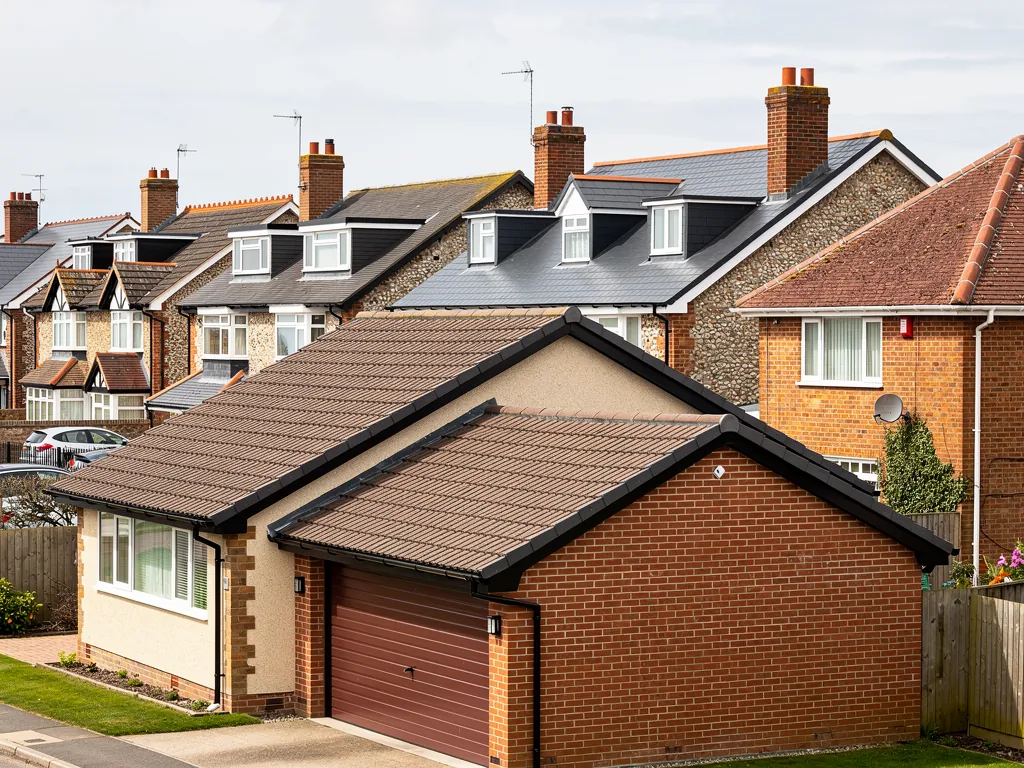
Choosing between clay and concrete tiles looks like a question about money, and money does come into it. In the Checkatrade repair table, concrete is the cheaper of the two to mend. But the better question is which covering suits the roof underneath it: its pitch, its age, its neighbours and the street it faces.
On a Victorian terrace, a pre-war semi or a bungalow estate, the original tile is part of how the house reads from the pavement. On a modern roof at a shallow pitch, only certain tiles are made to work at all. And on a house in a conservation area, the council may have a view before you do.
Here the two are compared on the points that matter in practice. It gives the lifespan figures from Marley and the Building Research Establishment, the repair costs from Checkatrade, and the minimum pitches in Marley's tables, and then explains how fixing, weight and appearance shape the choice. These are published figures, not a price or a promise for your roof. Our survey photographs and written quote deal with your own house, and where an existing roof can simply be mended, that is the advice you get first.
What actually differs between the two tiles
Clay tiles are fired in a kiln from shaped clay. Concrete tiles are cast from a cement and sand mix. That difference in make-up sits behind most of what follows, but the more useful split for a homeowner is shape and lap.
Plain tiles are small, flat or slightly curved, and laid in overlapping courses so that every part of the roof is covered by at least two thicknesses, with the joints in each course staggered over the tile below. That is called double-lap, and it is the traditional look of old clay roofs. Interlocking tiles are larger, with a channel along their sides that locks each tile into its neighbour. They are single-lap, which means one layer covers the roof and the side joints do the sealing. Both clay and concrete are made in interlocking form, and clay is also made as the traditional plain tile.
Why the profile matters more than the material
A flat plain clay tile and a bold concrete double Roman tile have different shadows, different weights and different lower limits on pitch, even though the roofer calls both tiles. Choosing on material alone, without the profile, tells you very little, and a quote that names only clay or concrete has left the important part out. A pantile is a third shape again, with a pronounced S-curve, and Marley lists a clay one among its tiles.
Our guide to interlocking against plain tiles goes into those shapes in more detail, and a separate page covers plain clay tile roofs. If you are comparing slate as well, the page on slate against tile covers that third option.
Lifespan: what the published figures say
Both materials last a long time, and neither source promises a number, so the figures below are best read as the order of magnitude to plan around. Marley expects concrete tiles to give around 60 years, while stressing that the figure carries no warranty behind it. For clay, Marley refers to the Building Research Establishment, which gave a minimum life expectancy of 60 years. Since that figure is no promise, a fair way to put it is that concrete often lasts somewhere between 30 and 60 years.
The 60-year clay figure comes with a warning. A building conservation article calls it an unreliable yardstick for old peg-tile roofs, because tile quality, fixing and upkeep differ so much from one roof to the next. A hand-made clay roof that has been looked after can outlast the 60 years. One that has been walked on, left with slipped tiles or never had its underlay touched can fail much sooner.
What really decides how long it lasts
The tile is only one layer. Underlay, battens, nails or clips, ridge fixings and flashings all age at their own rates, and a tile that outlives its battens still needs the roof taken apart. A common pattern is that the tiles are sound and everything beneath them has given up. When you read any lifespan figure, read it as the tile alone, in good conditions, with sound fixings, on a roof that gets looked at from time to time.
Our guide to how long a tiled roof lasts follows the whole system, and our survey tells you where yours stands.
Cost: repairs and replacement compared
Checkatrade splits its repair table by covering, which makes the comparison simple. In a table dated June 2026, concrete tile repairs run at £90 to £120 per m² and clay tile repairs at £110 to £160 per m². Both exclude VAT. Clay is dearer to repair, and one reason is matching: older clay tiles differ in size and shade, so a close pair takes time to find, which adds labour as well as material.
The big national re-roof guide does not split its total by tile type. Checkatrade has an average near £8,000 for a whole re-roof, with most between £4,000 and £19,000, but it leaves the choice of tile to the individual job. That makes sense, because the difference between two clay tiles from different makers, or two concrete ranges, can be larger than the gap between clay and concrete as families.
Where the money goes
Material is one part of the sum. Scaffolding, labour, the underlay, the battens and the ridge system all sit in the total regardless of which tile you choose. A dearer tile raises the figure by the difference in material cost, and a heavier one can trigger a structural check that raises it further. Delivery matters too, since tiles are heavy and a long carry from the lorry to the scaffold slows the crew.
If a tile is no longer made, the sensible option can turn out to be reusing sound old tiles where they will give an even finish. Our page on reusing old roof tiles explains when that is realistic, and the written quote reflects whichever route the survey supports.
Pitch: which tiles will work on your slope
Each tile has a lowest workable slope, and under it rain can be driven beneath the laps. Marley's data lists the figures, and they differ more than most owners expect. Always check the product's own data sheet, because the number belongs to the tile, not the material.
| Tile type (Marley) | Minimum pitch |
|---|---|
| Clay plain tile, Canterbury | 40° |
| Clay plain tile, Ashdowne | 35° |
| Concrete plain tile | 35° |
| Clay pantile, Lincoln | 15° |
| Concrete interlocking, Mendip | 15° |
| Concrete interlocking, Anglia | 25° |
Other interlocking products in the same range sit between 12.5° for one Mendip profile and 25°, with a Double Roman at 22.5°. A plain tile needs a steep roof. An interlocking tile or a pantile can go on a much shallower one.
Why this settles more choices than taste does
If your roof is a shallow-pitched garage, porch or extension, the options narrow quickly, and plain tiles may be ruled out. If it is a steep main roof, you can choose freely. Changing from one tile type to another can also change the spacing of the battens and the weight, so a swap between types is a design decision rather than a simple exchange.
Wind plays in as well. Marley adds that on slopes shallower than 30°, the windward face can be pulled upwards hard by suction, which is one reason fixing on low roofs gets extra attention. A separate guide to the minimum roof tile pitch has the full list, and the pitch of your roof is something we measure at the survey.
Looks, conservation areas and local character
Appearance is where clay and concrete part company most visibly, and it is the area where an eye for the street counts as much as any table. Arun District Council's own guidance gives local examples. For Craigweil House conservation area in Aldwick, its statement describes traditional building in local stock brick, topped with plain clay tile. Felpham village's appraisal puts orange-red clay tile on its roofs. On Aldwick Road the council records modern interlocking concrete standing in for original slate in many places, and says that harms the buildings.
Those are statements about three specific areas, not about Bognor as a whole. But they show how a council reads a roof. A concrete interlocking tile on a street of slate or plain clay is the sort of change that draws comment, and in a conservation area it can draw more than comment. Our page on changing tiles in a conservation area explains how to find out where you stand.
Matching an older roof
On an older house, the aim is often to make a repair vanish. That takes the right size, colour and texture, and with clay it can take reclaimed tiles. New tiles beside old ones show from the street for a long time. For a house with no particular character to protect, a good modern concrete tile in a matching profile is often the sensible and tidy choice, and the Checkatrade repair table suggests it costs less to mend. Whichever you pick, the finish at the edges, ridge and verges is what the street sees first, so ask how those will be done.
On a listed building, consent comes first, and the choice of covering is for the conservation officer as much as for you.
Fixing, weight and the final choice
Fixing is the part of the roof you cannot see from the road and the part that decides whether it stays on in a gale, whichever tile you have chosen. BS 5534:2014+A2:2018 covers slating and tiling, and Wienerberger's reading of it is that each single-lap tile carries a mechanical fixing at the least. Since the 2014 revision, bedding mortar by itself is not what holds a ridge or hip tile on. The exact fixing schedule depends on the site: location, altitude and local wind exposure all feed into it, so it is set for your roof rather than copied from another.
BSI's own summary adds a caution for some older roofs, especially ones laid in traditional or reclaimed materials, where the recommendations can be a poor fit. That is another reason to ask a roofer how they intend to fix your particular tile.
Weight
The Planning Portal flags a weight check whenever a replacement tile will weigh a good deal more or less than the old one, and lists a rise of 15 per cent or more as a trigger for approval. Its advice is to involve a structural engineer or a surveyor before work starts, which for a swap between tile families is sensible. Our page on changing the roof covering deals with the practical steps.
Making the call
Match the tile to the roof first, to the street second and to the budget last. Ask the roofer which tile, which underlay and which fixings are in the price, and ask for the manufacturer's data sheet for the tile you pick. It lists the lowest pitch and the fixing advice for that tile. For a more detailed look at the numbers behind a whole new roof, see our pitched roofing page and the guide to the cost of a new pitched roof.
Questions
Clay and concrete tile questions
Can clay and concrete tiles be mixed on one roof?
It is not good practice on the same slope. The two differ in profile, lap, weight and the way they sit on battens, so a patchwork can leak or look uneven. A repair should use the closest match to the existing tile. If you want a different covering, the usual route is to re-cover the whole slope, after a structural check.
Do clay tiles need different fixings from concrete?
The principle is the same. Under BS 5534, a single-lap tile gets a mechanical fixing at the minimum, and ridge and hip tiles are fixed as well as bedded. The detail depends on tile, pitch and location, and the manufacturer's data sheet sets it. We follow the sheet for the tile chosen rather than a general rule.
How can I tell what kind of tiles my roof already has?
Look at a fallen or spare tile, or from the loft. Small, flat or gently curved tiles that overlap in many courses are plain tiles. Larger tiles with a channel along the side are interlocking. Send photographs through WhatsApp or the form, and we will identify them at the survey.