
Roof tile types · 9 min read
Types of roof tiles: plain, interlocking, pantile and more
A plain guide to the covering families on British pitched roofs: what each tile is, the pitch it needs, how long it is expected to last, and where each one tends to suit a house.
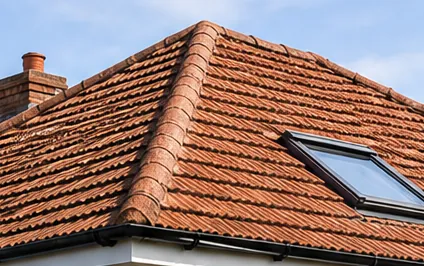
Stand in any street along the Sussex coast and look up. The roofs do not match. One house has small tiles in a warm orange-red, the next has a flat grey concrete tile, a third has the deep curved waves of a pantile, and the Victorian terrace by the seafront wears slate. They all keep the rain out, but they do it in different ways, and they need different handling when something goes wrong.
Knowing which family your roof belongs to is the first step in any repair or replacement conversation. It tells you how the tiles are fixed, what pitch the roof must have, whether matching a new tile to an old one will be easy, and roughly where the cost will land. A tile that looks like its neighbour from the pavement can be a different product entirely once it is in your hand.
This guide takes the main types in turn. Pitch figures are Marley's published minimums, and lifespans and prices are attributed to the guide and date they came from. None of them describes your own roof. The survey, with photographs, settles that, and the quote then arrives in writing as one total.
Plain clay tiles
The plain tile is the oldest tile shape still sold in volume. It is a small, flat rectangle, usually with a slight curve across its width, laid in overlapping courses so that each tile is covered by the ones above it. A roof of plain tiles has a fine, textured look because there are so many joints, and that texture is much of the appeal.
Clay is baked from earth, and the colour comes from the clay itself. Reds and oranges are common, along with browns and mottled shades. Because the colour runs through the body of the tile, a clay roof weathers gently and old tiles gain a patina that new ones lack. That is also why matching is a problem. A replacement tile in the same nominal colour can look obviously new for years.
What they need
Plain clay tiles want a steep roof, because small overlapping tiles shed water only when the slope helps them. Marley sets out minimum pitches by range: 40 degrees for the Canterbury, 35 degrees for the Ashdowne, and 30 degrees for the Hawkins and the Acme Single Camber too. Whatever the figure here, the maker's sheet for your tile has the last word, because it changes from product to product.
For lifespan, Marley quotes Building Research Establishment guidance of at least 60 years for clay, while one conservation writer warns that this is no safe yardstick for old peg-tile roofs. Checkatrade (June 2026) prices clay repair at £110 to £160 per m², before VAT. For one particular family of clay roofs, read our guide to plain clay tile roofs on interwar homes.
Plain concrete tiles
Concrete makers copied the plain tile shape and made it more consistent. From the ground a plain concrete tile looks much like clay, with the same small rectangular format and the same patterned coursing, but it is a manufactured product and the colour is more even. Where clay ages by darkening and mellowing, concrete can lose its surface finish and fade in the sun.
Marley gives its plain concrete tile a minimum pitch of 35 degrees. That puts it on the same steep roofs that suit clay plain tiles, so you will meet it on the same sorts of house, often as a later replacement for the clay that was there first.
Cost and the like-for-like question
Of the main families, concrete sits lowest in Checkatrade's repair table: £90 to £120 per m², excluding VAT. Marley expects concrete tiles to last around 60 years, and states plainly that this is no guarantee or warranty, so use it as a planning number and not as a promise.
The practical question with plain concrete is whether a replacement roof should keep the plain format or move to a bigger interlocking tile. A plain tile takes longer to lay because there are many more of them, while an interlocking tile covers the roof faster. It looks different, too, and that matters on a street where the fine texture is part of the frontage. We set the two options side by side in interlocking versus plain tiles.
One more point: swapping from a lighter covering to a heavier one changes the load on the rafters, which brings us to the weight question later in this guide.
Interlocking concrete tiles
Interlocking tiles are large tiles with a rib and a channel along their edges, so each one locks into its neighbour. They are laid with a single lap, meaning one layer of tile covers the roof where a plain tile roof has two. Each tile covers a big area, so the roof goes on quickly, and the finished surface has fewer joints and a bolder, flatter look.
The family is wide. Among the products Marley lists, the Double Roman and the Ludlow Major are given 22.5 degrees, the Anglia 25 degrees, the Edgemere and Modern 17.5 degrees, and the Mendip and Wessex 15 degrees. Low pitch is the great strength: an interlocking tile will cover a roof much shallower than any plain tile can. Those are the figures for the named smooth products, and the sheet for the specific tile always rules.
How a single-lap tile is held
Wienerberger's rule is that each single-lap tile takes a minimum of one mechanical fixing. Keep that in mind if tiles are slipping on your roof, because a loose interlocking tile is not held by its own weight alone, and a slipped one often points to a clip or nail that is missing. Our companion guide covers the fixing standard in full as tile fixing to BS 5534.
The Aldwick Road conservation area in Bognor Regis shows what follows when this family takes over from another. For that area, Arun District Council notes that concrete interlocking tiles have frequently replaced the original slate, and says the swap spoils the look of the terraces.
Pantiles and other curved tiles
A pantile has a pronounced S-shaped wave across its width. Laid side by side, the waves run down the slope and form a roof of ridges and troughs that carries water away quickly. They are made in clay and in concrete, and you will see them on extensions, outbuildings and farm ranges as well as on houses.
Marley's clay version, the Lincoln, has a minimum pitch of 15 degrees, which makes it one of the shallowest-pitched of the clay options. That makes it a candidate for a lean-to, a porch roof or a low extension where a plain tile would ask for too steep a slope.
When a pantile suits
Think of a pantile when the roof is low in pitch and you want a clay look. It reads well on a simple shape, such as a single-storey rear extension, where the repeated wave looks deliberate. It is less comfortable on a complicated roof with many valleys and hips, because cutting a curved tile to meet an angle takes time and leaves awkward edges. A valley is the gutter-like fold between two slopes that meet, and a hip is the outward corner on a hipped end.
Repairing a pantile follows the same pattern as any single-lap tile. The broken one comes out, a replacement goes in, and a clip holds it where the product calls for one. The hard part is matching. A pantile that has weathered for decades is difficult to replace like for like, and a patchwork of old and new waves shows from the road. When the original has gone out of production, our guide to matching old roof tiles sets out the choices.
Natural slate
Slate is split stone, cut into thin rectangles and hung from battens, the timber laths nailed across the rafters. It is the covering of the Victorian and Edwardian terrace, and it still lines the older streets of Bognor Regis. Arun's appraisal of the Aldwick Road area describes terraces from the early nineteenth century, Victorian and Edwardian, built mostly of stucco, slate and flint, while the Steyne appraisal asks for slate or clay plain tiles to return in place of unsuitable modern coverings.
Slate lasts. CORC puts well-kept slate at 100 years or more, and Checkatrade says the same of stone slate. Cost rises to match. Its repair table runs from £150 to £220 per m², and a whole slate roof comes out at £160 to £210 per m² with an average of £184, (Checkatrade, September 2026). Spanish slate sits lower, at £95 to £125 per m². These figures leave out VAT, so read them as national averages and not as your quote.
Pitch and fixing
According to Cupa Pizarras, BS 5534:2014+A2:2018 puts the floor for natural slate at a 20 degree pitch (500 mm slate, moderate exposure), and says hook fixings must stay off any roof under 25 degrees. When a slate slips, the repair uses a tingle: a thin lead or copper strip that holds the lower end of the new slate, since the slate's own nail holes are hidden beneath the course above.
If slates are slipping across a whole slope, the nails have usually given out and the stone is fine. The usual fix is then to take the slope off and lay it again, reusing the good slates. Photographs from the survey show which of the two applies before a price is discussed.
Cedar tiles and choosing between families
Cedar is the timber option. Marley lists two forms: the thinner version with a minimum pitch of 14 degrees, and the thicker, split shake at 20 degrees. They are uncommon on ordinary houses here and more likely on a chalet, a summerhouse or a garden building. They weather to silver grey, and they need a roofer who has worked with the material, since fixing them is nothing like hanging a clay tile.
Choosing between the families comes down to a short list of questions about the roof you already have. What is the pitch, and which tiles will cover it? Can the roof structure carry the weight? The Planning Portal says a new covering that weighs 15 per cent or more than the old covering means the work needs Building Regulations approval. A tile that is noticeably heavier or lighter than the present one is also something to put to a structural engineer or surveyor before you order. Does the building have listed status, or stand in a conservation area where the council has a say on the look of the roof? And how long do you plan to stay?
Looking at it from the pavement
Your neighbours make a useful guide. If the houses either side kept a plain clay tile, a flat concrete interlocking replacement on yours will stand out. If a whole street has already changed to concrete, matching it may be the simpler course. Our pitched roofing page explains the work we carry out on tiled and slated roofs, from a few replaced tiles to a full re-cover.
Questions
Roof tile type questions
Can I put a different type of tile on my roof when I replace it?
Often you can, but the pitch has to suit the new tile and the structure has to carry its weight. A covering that is 15 per cent heavier or more is a Building Regulations matter, according to the Planning Portal, and a conservation area or listed building may limit what the council will accept. Ask the council before you order.
Which roof tile type costs least to repair?
In Checkatrade's repair table, last updated in June 2026, concrete tile is lowest at £90 to £120 per m², then clay tile at £110 to £160 and natural slate at £150 to £220, all excluding VAT. Access and the amount of damage move a bill more than the covering does.
How do I tell what type of tile my roof has?
Look at the size, the shape and whether each tile locks into its neighbour. Small flat tiles in overlapping courses are plain tiles, large tiles with a rib and channel are interlocking, and a deep wave is a pantile. A close-up photograph from the survey will confirm the product.