
Plain clay tile roofs · 9 min read
Plain clay tile roofs on interwar homes: repair and re-roofing
How a plain clay tile roof on a 1920s or 1930s house wears, what a sensible repair looks like, when it is time to re-cover, and the consent questions that come with older estates.
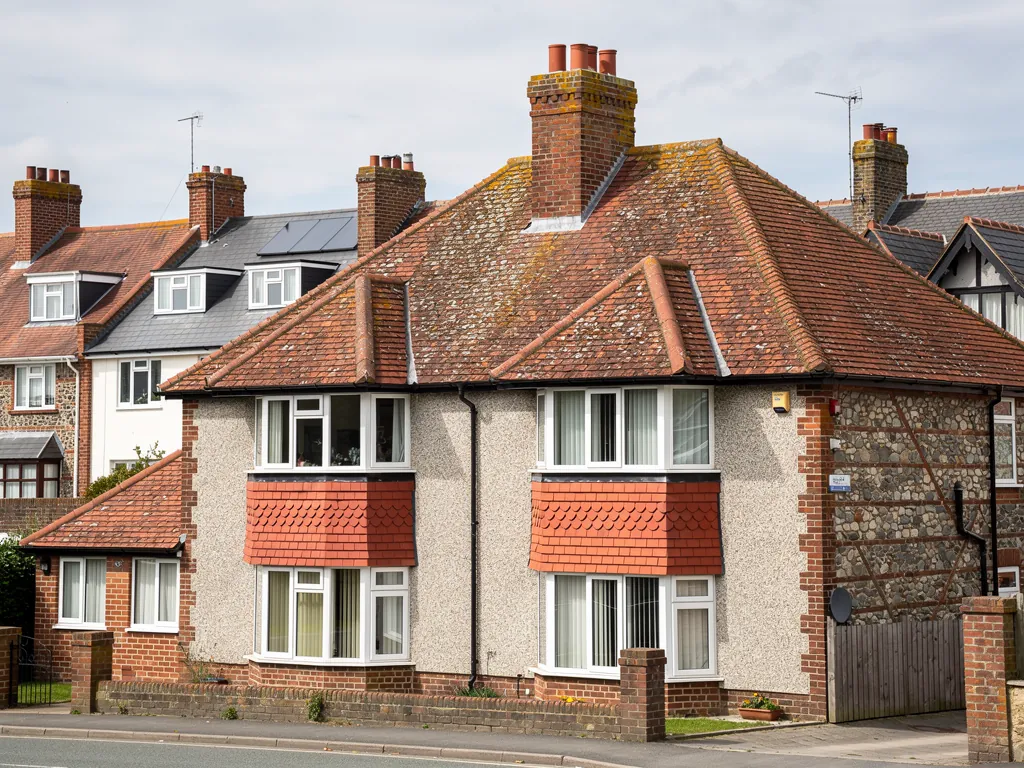
Walk through an interwar estate on the Sussex coast and you will find roofs that look settled in. Small tiles in warm red and orange, a little uneven, some darkened and some pale where they have been swapped over the years. That patchwork is part of the appeal, and it is also the first thing a homeowner worries about when a tile drops into the garden.
Plain clay is a forgiving covering in some ways and a demanding one in others. A well-laid roof can give a very long life, and one damaged tile can be taken out without disturbing the rest. Yet small tiles mean many joints, many fixings and a lot of hand work, and the colour of an old tile is nearly impossible to buy new.
This guide explains how these roofs are put together, how they typically fail, the choices between a repair and a re-cover, and the rules that apply when the house has listed status or lies inside a conservation area. It uses what Arun District Council has recorded about local estates, and national cost guides for the figures. What your own roof needs is for the survey to say.
What a plain clay roof is made of
Each plain tile is a small piece of fired clay, flat apart from a gentle curve across its width. The tiles hang from timber battens in overlapping courses, so every joint between neighbours is shielded by a tile in the course above. That pattern of overlaps is what sheds the water, and it gives the roof its fine grain. Because each tile is small, a plain tile roof has far more joints and far more individual fixings than a roof of large tiles, and that is the reason its repairs are slow, careful work.
Fixing differs by era. Older roofs were laid to the practice of their day, and the current standard, BS 5534, expects mechanical fixing of bedded fittings. BSI adds that its recommendations might not be appropriate where an old roof is being re-tiled in traditional or reclaimed material, so the roof in front of us is assessed as it stands.
Pitch matters
These tiles need a steep roof to work. Marley gives minimum pitches for its clay plain tiles: 40 degrees for the Canterbury, 35 for the Ashdowne, and 30 for both the Acme Single Camber and the Hawkins. The main slopes of a house are usually steep enough, but a flatter roof over a porch, bay or extension may not be. Below its minimum pitch, a plain tile cannot be relied on to shed water in driving rain.
The data sheet for a given tile has the last word, and so does the pitch actually measured on site. If you are not sure what your roof is made of, our guide to roof tile types shows the main families side by side.
Interwar estates and what the council records
Arun District Council's own paperwork is a good guide to what was built nearby. Its statement for the Craigweil House conservation area in Aldwick describes an estate set out on a 1937 layout by J. Auty, whose traditional building materials include local stock brick and plain clay tile for the roofs. One house there, Wychwood, dates from 1934 and carries lead on several entrance porch roofs, and another from the same year, Silvergates, is listed at Grade 2.
The Craigweil conservation area was designated on 15 April 2009. The Article 4 direction made there, sealed on 30 November 2010, deals with fencing in grass verges and paving front gardens. It takes away no rights over roofs.
Felpham and the seaside estates
Felpham tells a similar story at a different scale. The Victoria County History dates the Felpham estates marketed as a garden city by the sea to the 1920s and 1930s, and names Felpham Beach, Summerley, Roundle and Hurstwood, with council housing arriving in the same decades. Arun's character appraisal for Felpham village, designated in February 1985, names clay tile in orange and red tones for roofs, alongside flint and brick walling.
None of this means every house in these areas has a clay roof, and a survey never assumes one. Plenty have been re-covered in something else, and the Aldwick Road appraisal notes how often concrete interlocking tiles have replaced slate on the seafront terraces. What it does mean is that where a clay roof survives, the council's appraisals treat the roofing material as part of the area's character, so the choice of repair material is not purely a private matter. Even outside a conservation area, a street of matching roofs is easy to spoil with one bright patch.
How plain clay roofs wear out
The tiles themselves are long-lived. Marley quotes Building Research Establishment guidance of a minimum life expectancy of 60 years for clay tiles, while one building conservation article says the figure should not be applied to old peg-tile roofs, since the roofs it describes have so often outlived it. Treat any such figure as a planning number and never as a promise about your roof.
What gives out first is usually not the clay. It is the things around it. The battens can rot, especially at the eaves and in valleys where water lingers. The underlay may have split or perished. Ridge and hip tiles may have been bedded in mortar that has since cracked. Lead flashings can wear thin, or the fixings that hold tiles may have worked loose.
Cracked, slipped and missing tiles
A cracked or slipped tile is a symptom, and tracing the cause comes before any repair. A single tile that has cracked from a knock or a ladder is one thing. A scatter of slipped tiles across the same slope suggests the fixings have failed over a wide area, and the question then is how far the fault runs. A single cracked tile is a quick job, and a run of them is a different one.
Moss and lichen grow readily on older, rougher clay, and a green roof is not automatically a failing one. Lifting moss with a hard brush can dislodge tiles that are only just held, so it is best left to someone who checks the fixings first. After a gale, a pale bare patch under the eaves, tiles lying in the gutter or a line of gaps along the ridge are the signs worth acting on.
Repairing a clay roof so it matches
The visible challenge with an older clay roof is colour. New plain tiles are made to be consistent, while a roof that has weathered for decades has a lived-in range of tones. A handful of bright new tiles dropped into it stand out from the street for years.
The usual answers are reclaimed tiles of the right size, colour and camber, or new hand-made tiles chosen to be close, with replacements mixed through the slope so no patch of bright tiles forms in one place. Sometimes tiles can be borrowed from a part of the roof that is hidden, such as the back of a garage or the inner side of a hip, and replaced there with new ones where nobody looks. Our guide on matching old roof tiles sets out the choices when the original is out of production.
Mending in the right order
A sound repair starts with the cause. If a run of tiles has slipped because the battens behind them have rotted, replacing the tiles alone is wasted money, and the battens come first. If the underlay has gone at the eaves, that gets renewed while the courses are lifted.
Repair costs, from Checkatrade's table last updated in June 2026, run at £110 to £160 per m² for clay tile, excluding VAT, as a national typical range. Where only a few tiles are involved the bill depends far more on access than on the tile. A roof reached from a ladder costs a fraction of one that needs a scaffold, and the survey says which you have.
When we repair a clay roof we say plainly if a patch will hold or if the covering is spent. The answer is given after a survey with photographs, never on a doorstep estimate.
Ridges, hips and leadwork
The top of a plain tile roof is where the wind works hardest, and the capping tiles along the ridge and down the hips are a frequent source of trouble. Marley explains that after the 2014 revision of BS 5534 mortar is no longer left to hold ridge and hip tiles alone, and recommends mechanical fixings for every bedded tile and fitting. A ridge on an interwar house that has only ever been bedded may therefore need more than repointing.
For ridge work, Checkatrade gives £50 to £70 per metre for repairing ridge tiles, and the same £50 to £70 for flashing repairs in lead, with VAT extra. Our guide to tile fixing under BS 5534 goes into how ridge fixings work.
Lead around porches, chimneys and bays
Many interwar houses have bay windows, porches and chimney stacks, and each junction with a wall needs a flashing, which seals the gap with a strip of metal. The leaded porch roofs recorded at Craigweil show that lead was part of these houses from the start. It is graded by code, a number that rises with thickness. Royston Lead's brochure lists code 4 for flashings, and code 3 for soakers only, the small pieces that interleave with each course of tiles against a wall.
MyJobQuote says lead flashings can last over 80 years, which explains why so much of it on interwar houses is still doing the job, although the pieces that are cracked, lifted or thin at the folds need replacing. For a chimney, MyJobQuote (updated September 2026) gives a patch repair at £150 to £250 and a full renewal of the chimney lead at £350 to £460 with no scaffold, or £700 to £920 when scaffold is needed.
Consent, cost and repair or re-cover
Re-covering a roof in like-for-like material does not usually amount to development that needs planning permission, since the outside appearance is not materially altered. Two caveats apply. Alterations to a listed building that touch its character need listed building consent, and Silvergates shows that interwar houses can be listed. An Article 4 direction can also withdraw permitted rights, although the Craigweil one leaves roofs alone.
For Building Regulations, the Planning Portal sets the usual no-application test at under 25 per cent of the total building envelope together with under 50 per cent of the roof. Arun's own building control pages, though, put replacing pitched and flat roof coverings on the list of alterations that need approval, so it pays to ask the council's team before work starts, and we deal with any building control notification the work calls for. A move from clay to a heavier tile adds a weight check.
When to repair and when to re-cover
A repair is the right call when the clay is sound and the trouble is confined: a few cracked units, a failed ridge, a worn flashing. Re-covering is right when the trouble is spread across the slope: battens soft across the slope, underlay perished, and fixings that have failed in many places. The existing tiles are often reused on a re-cover with the cracked ones weeded out and new ones added, which keeps the look.
A repair that follows a proper survey costs far less than a re-roof, but a repair on a roof that is finished only delays the bigger bill.
We tell you which of the two applies, with the pictures to show why, and our written quote then arrives as one total price. The full range of work is described on our pitched roofing page.
Questions
Clay tile roof questions
How long should a plain clay tile roof last?
Marley quotes Building Research Establishment guidance of a minimum life of 60 years for clay tiles, and many old peg-tile roofs have lasted longer. Underlay, battens and fixings usually give out before the clay does. Any lifespan figure is a planning number, and a survey of the actual roof is what tells you how much is left.
Can I replace a few clay tiles with new ones?
Yes, and many repairs do exactly that. The difficulty is colour, since new tiles stand out against decades of weathering. Reclaimed tiles of matching size and camber blend better, and spreading replacements through the slope hides the join. Where the house has listed status or lies in a conservation area, ask the council first.
Does a clay tile roof need building control approval?
Not normally if under 25 per cent of the building envelope and under 50 per cent of the roof is affected, according to the Planning Portal. Arun's building control page includes replacing roof coverings in alterations that need approval, so confirm with the council before you start, especially for a heavier tile.