
Dry verge · 9 min read
Dry verge: replacing mortar verges on gable ends
How a mortar verge fails on a gable end, what a dry verge system changes, when a repair is enough and when the whole edge should be redone, and what the work involves from scaffold to last tile.
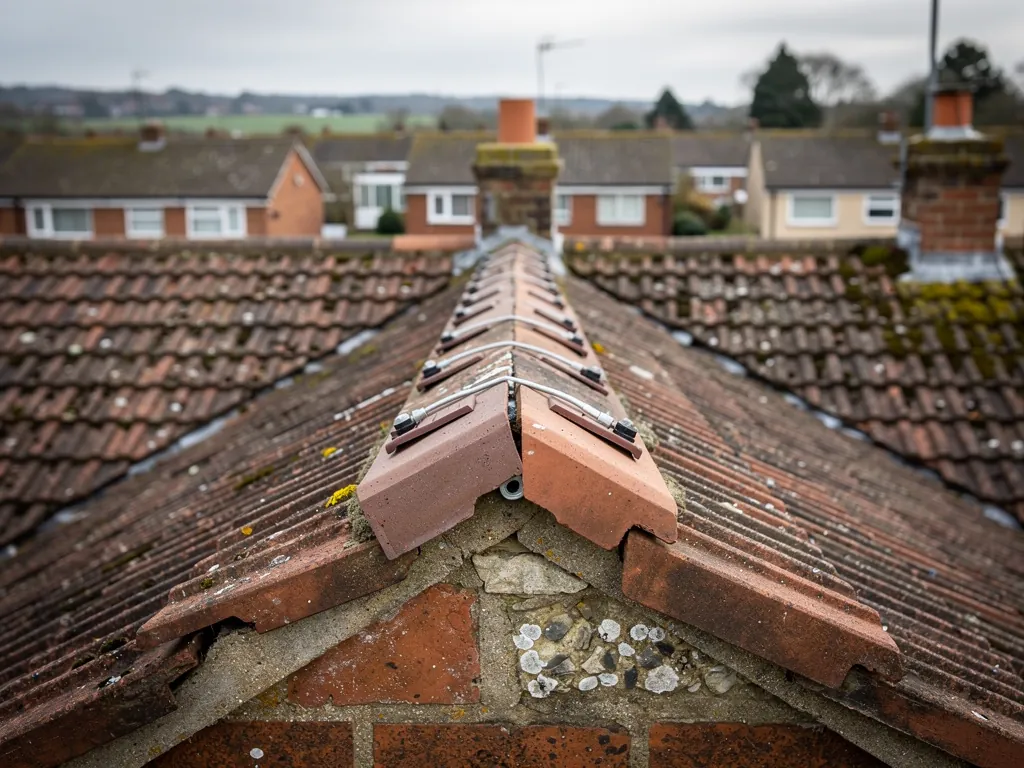
Stand in the road and look at the end wall of a house with a gable roof. The slope finishes in a neat line of tile running up the wall, with a strip of mortar tucked underneath it. That edge is the verge. It meets the weather side-on, it is one of the first places a gale gets a grip, and on plenty of older roofs it is held on by little more than a bed of sand and cement.
A dry verge swaps that mortar for a fixing system made for the job: cleats screwed to the battens, an end unit or cap that closes the gap, and tiles held mechanically instead of being trusted to a bed. The kit is proven against BS 8612:2018, a British Standard written for exactly this type of product. Marley's guidance is that every bedded roof tile and fitting should include a mechanical fixing, and that is the thinking behind the change.
This guide explains how a mortar verge fails, what the dry alternative is, how to decide between a repair and a full replacement, and what the job involves on site. Pictures of your own gable edge settle most of it, and the written price follows the survey as one total.
What the verge is and what it has to do
The verge is the edge of a pitched roof where it finishes at a gable wall, the triangular end of the house. Unlike the eaves, which sit over a gutter, the verge has nothing to carry water away. The tiles simply stop, overhang the wall by a small margin and shed rain down the face of the brickwork or render.
Three layers do the work. Under the last tiles sits the undercloak, a strip of fibre cement, slate or plastic that bridges the gap between the roof and the top of the wall. On a traditional roof the tiles sit on a bed of mortar laid on the undercloak, pointed flush. Behind it are the batten and the roof structure.
The verge has three jobs at once. It keeps rain out of the gap between roof and wall. It stops wind lifting the edge tiles. And it gives the eye a clean line up the end of the house.
Why the verge takes the punishment
Wind pushes against the end wall and then climbs it. At the top the air bends over the verge and tries to get under the edge tiles. Near the sea, with gales coming off the Channel, a verge held only by mortar has little in reserve. Mortar resists being pressed. It is poor at resisting being pulled, and the pull is what a gale applies.
Marley makes the same point about ridge and hip tiles: since the standard changed, mortar has not been trusted to hold them alone. A verge is the same kind of job. Our ridge tile repairs page covers the wider family of capping, hip and verge work.
How a mortar verge fails
Mortar verges rarely fail all at once. They go in stages, and each stage leaves a mark you can spot from the pavement.
The first stage is cracking. Mortar shrinks as it cures and moves with the seasons, so hairline cracks appear along the joint between the mortar and the tile or between the mortar and the wall. Rain gets into those cracks and the bed starts to absorb it.
The second stage is crumbling. Pieces of pointing drop away and the sandy bed behind starts to wash out. You may see grit in the gutter below the gable, or a dark stain on the wall under the verge where water has run out of the gap. Moss or weeds in the cracks mean the mortar has turned soft and is holding moisture.
The third stage is movement. With the bed gone, the edge tiles are held by their own weight and the friction of the courses beside them. A strong gust can lift one, and a loose tile on a gable end is a hazard to anyone on the path below. At that point the verge cannot wait for the summer.
The wall behind it
Water that gets behind a failing verge reaches the top of the gable wall and, in time, the timber that sits on it. Damp patches high on a bedroom wall next to the gable are sometimes traced back to a verge that has been leaking for years. Mention any such stain when you book the survey.
Our guide to mortar falling out of a verge looks at the early signs in more detail.
What a dry verge system is
A dry verge is a set of manufactured parts that replace the mortar bed. No wet trade is involved at the edge. Each manufacturer's kit differs in detail, but the pieces follow a pattern.
A cleat or bracket is screwed or nailed to the roof batten at intervals and grips the edge of the verge tile. The tile is therefore held down by metal or strong plastic rather than by cement. Along the outer edge sits a verge end unit, a moulded strip in a colour matched to the tiles, which closes the gap between the last tile and the wall and shuts out rain, birds and insects.
The standard behind these kits is BS 8612:2018, published on 31 January 2018 and still current. Its scope is the kit that holds those three parts of a roof without mortar. A kit tested to it has been proven against a defined load, which a bed of mortar cannot offer.
What changes for the customer
The look changes slightly. A dry verge has a clean, continuous line with no mortar to stain or crack. Traditionalists miss the rounded mortar edge, and on some older homes the dry strip looks too modern. You should see the unit before it goes on, and on a period building or in a conservation area it is worth asking the council's planning team whether the change is acceptable.
The upkeep changes as well. There is no pointing to crack, so no repointing every few years. It still needs a glance when the roof is inspected, to check the cleats are tight and no tile has shifted. Our page on dry ridge systems describes the same fixing ideas used along the apex.
Repair the mortar or replace it with a dry verge
Which route is right comes down to the survey, and the bigger job is not always the answer. A verge with sound tiles, a firm bed and only a few cracks can often be repointed. A verge with loose tiles, a crumbling bed or a rotten undercloak needs to be taken apart.
This is how we weigh it up. If the mortar is sound and the tiles are tight, a repair is a reasonable short-term answer. If the mortar sounds hollow when tapped, if tiles move under finger pressure or if there is staining below the verge, the bed has failed and repointing only covers the problem. If the verge has been patched more than once already, a mechanically fixed system usually costs less over the life of the roof than repeating the patch.
Photographs of the edge tiles, the undercloak, the batten and the top of the gable wall back up the verdict. It comes back as one of three outcomes: repoint it, rebuild it in mortar with the tiles fixed as well, or fit a dry verge system.
Cost and the sum
National guides do not publish a figure for dry verge alone. Checkatrade gives ridge tile repairs at £50 to £70 per metre, and about £800 to dry-fix the ridge of a semi. A verge is priced on similar lines, by length, but the number of tiles, the height of the gable and access all change the bill. Treat those two figures as the nearest guide, not as a verge price.
Our page on dry verge cost looks at what moves the price.
What the job involves on site
A gable verge is a high job, because the edge sits at the top of an end wall that may be two storeys or more. Access is the first decision. A low gable may be done from a tower, while a tall one needs scaffolding to the edge so the team can work from a safe platform.
Where scaffold blocks the pavement, section 169 of the Highways Act 1980 means a licence has to be obtained from the county council. In West Sussex that takes at least 10 working days and £266 for a month, so build the wait into any verge job that is not urgent.
Once access is in place, the work follows an order. The edge tiles come off and are stacked. Old mortar is cleared back to the undercloak, and a broken undercloak is replaced. The batten at the edge is checked for rot and renewed if soft. The cleats go on, the verge tiles are fixed to them, and the end unit finishes the line. Sound tiles are reused where they match, and broken ones are swapped for the closest available.
Mortar still has a part
On a traditional roof where a mortar verge is the right look, the job can still be done well. The tiles are bedded and also fixed with a clip or screw, so the mortar is cosmetic and the fixings carry the load. That follows BS 5534 without changing the appearance of an old house.
Tidying up is part of the job: the debris goes in our waste, not yours.
Rules, wildlife and how to check a quote
A verge repair on its own is a small job. The Planning Portal sets the test: under 25 per cent of the total building envelope and under 50 per cent of the roof, and building control is not normally involved. Arun's own pages are stricter about re-covering, so for a job beyond a repair, ask your building control body first. On a listed building, ask the council before you start.
The edge of a roof is a place where birds nest and bats can roost. Both are protected, so if a gap at the verge is occupied the work waits.
Comparing two quotes
Make sure two verge prices describe the same job. Ask whether scaffolding is in the figure, because a late scaffold bill erases any saving. Ask whether VAT is included, as the national cost guides usually leave it off and the standard rate is 20 per cent. Ask what happens to the old undercloak and the edge batten, and whether every tile will be mechanically fixed.
A sound quote names the method. If it says repoint, it should say why a repair is enough. If it says dry verge, it should name the system and confirm the tiles are fixed to it. A price with nothing behind it is hard to judge.
From us, the written total comes after the survey, with pictures of your own gable.
Questions
Dry verge questions
Can a dry verge be fitted to any gable end?
Most pitched tiled gables can take one, provided the edge battens are sound and the tile profile suits the manufacturer's kit. Very old roofs with handmade tiles or irregular courses sometimes need a bedded verge with extra fixings. The survey photographs show which route suits your gable.
Does a dry verge stop gales lifting the edge tiles?
It gives the tiles a mechanical fixing instead of relying on mortar alone, which is what BS 8612 tests for. No roof edge is immune to a bad enough storm, but screwed cleats hold much better than a bed that has cracked and dried out. A loose verge after a gale should be looked at promptly.
Will the verge need maintenance once it is fitted?
There is no pointing to crack, so the regular repointing disappears. A look at the cleats, the end units and the nearest tiles whenever the roof is inspected is enough. If you spot a unit that has shifted or a tile that rocks, mention it before the next gales arrive.