
Period ridges and verges · 10 min read
Ridge and verge on period and listed roofs: lime, mortar and matching
Old roofs ask more of a ridge or verge repair than a modern one does. This guide covers the mortar, the matching of tiles, the fixing standard and the consents that apply to period and listed buildings.
A Regency terrace on the Steyne, a Victorian villa on Aldwick Road, a clay-tiled interwar house on the Craigweil estate, a flint cottage on the Downs: each has a roof that was built with the materials and habits of its time. The ridge and the verge are where those habits show most. They are also where a modern, quick repair does the most visible harm.
Arun District Council describes The Steyne as dating from the 1820s, with a predominance of stucco and chimneys that are important features on the skyline. Its Aldwick Road guidance observes that slate has frequently lost out to modern concrete interlocking tile, and counts that a loss for both the houses and the street. Both statements are about roofs. Both say that the covering, and the way it is finished at the top and the edges, is part of what the council protects.
Owners of period homes, conservation-area houses and listed buildings who need a ridge or verge looked at are the readers here. It covers the mortar question, the matching question, how a modern fixing standard sits with an old roof, and who to ask before work starts. The wider work is on our ridge tile repairs page.
What makes a period ridge different
A ridge on a house from the nineteenth century or earlier is not just an old version of a modern one. It was often made differently, from different pieces, and it has been moving gently for a very long time.
The ridge pieces may be clay, in a half-round or angled section, made by a local works to match the plain tiles beside them. On a slate roof they may be clay or lead-covered, or a decorative crested clay that gives the house its character. On a thatched or stone roof the top is something else again. Our Horsham stone roofing page covers the stone end of the range.
Underneath, the timbers may be older and softer than anything built today, and the roof may sit slightly out of true after two hundred winters. A repair that assumes a straight, stiff, square roof can meet a crooked one and fight it. Good period work follows the roof as it is.
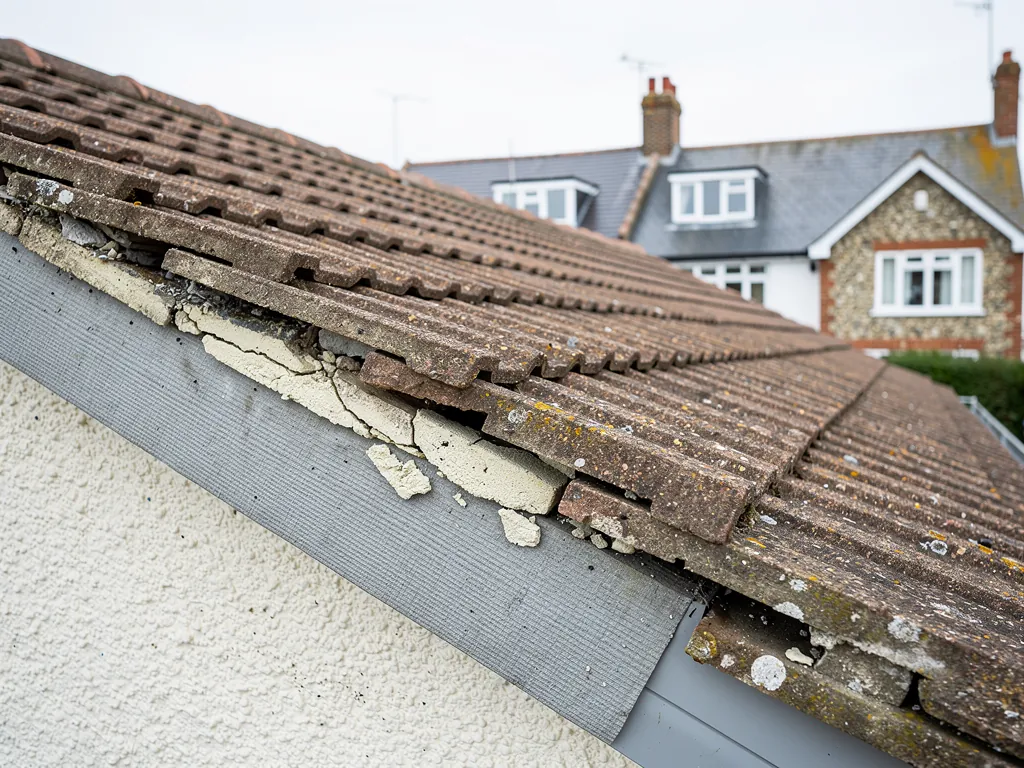
The mortar is the other difference. Old ridges were bedded in a mortar that was soft and breathable. Later repairs often used hard cement, because it is quick and strong. On a period roof that can cause trouble: a hard bed sits against softer clay and brick, cracks as the roof moves, and lets water in behind it. Stripping out a hard cement bed without chipping the pieces around it is slow, careful work.
If the roof is also a scheduled or protected building, the choice of materials and method may be decided for you, which the later sections cover.
Reading the roof before touching it
The first job on any old ridge is to look and photograph. What is the existing bed made of? Have earlier repairs used cement? Are the ridge pieces original, or a mixed set from several repairs? Are the timbers below sound? The answers decide how much can stay and how much must come off.
Lime and mortar: choosing the bed
Lime mortar is the traditional bedding for ridges, hips and verges on old roofs. It is softer and more flexible than most cement mixes, so it moves with an old roof instead of cracking. When a lime joint does eventually fail, it fails in the mortar, which can be raked out and renewed, instead of in the clay around it.
That does not make every old roof a lime job. A roof that was re-covered in the twentieth century with machine-made tiles, or a house from the interwar years, may have a cement bed that has worked well and suits its materials. The right mortar is the one that suits the roof as it is, and your roofer should be able to explain why they have chosen it.
Our guides on stone roofs go further into lime itself, with a full guide on lime mortar on old roofs. Here the point is narrower. For a ridge or verge on a period house, there are three honest options, and the survey should tell you which fits:
- lime mortar, matched in colour and sand to the existing work;
- a traditional sand and cement mix, where the roof is not old enough or protected enough to need lime;
- a dry-fix system, where the roof, the tile profile and the consent allow it.
A dry-fix kit is not always welcome on a period roof. The profile of a plastic or metal ridge unit can look wrong against handmade clay, and on a protected building the council may not accept it. On a plain 1930s house with machine-made tiles it can be an excellent answer. Ask to see a sample if you are unsure.
Whatever is chosen, ask for it in writing, along with the colour and the sand, because the finished joint is on show from the street for decades.
How BS 5534 sits with an old roof
The standard for slating and tiling is BS 5534. BSI lists the 2014 edition, amended in 2018, as current. It carries a warning that matters for period work: parts of the standard might not be appropriate when some old roofs are re-slated or re-tiled with traditional or reclaimed material.
That sentence is the reason a good roofer does not treat the standard as a blunt instrument on an old building. It does not say ignore the standard. It says think.
Marley's reading is that since the 2014 revision a mortar bed is no longer thought sufficient alone for ridge and hip pieces, and each should also be fixed mechanically. Marley adds that working to BS 5534 is not a legal requirement. So the principle for a period ridge is a sensible one: bed it in the right mortar, and also tie it down with a fixing where the pieces and the timbers can take one.
On a handmade clay ridge, a hole drilled for a screw can crack a thin, uneven piece, and a clip may not fit a hand-formed profile. The fixing method then needs adapting. It might be a bracket to a ridge batten, a strap, or a fixing hidden in the bed. What matters is that the ridge has more holding it on than friction and mortar.
The coast adds weight to this. Wind lifts ridges and verges from the top and the edge, and an old roof sits in the same weather as a new one. Our guide to ridge tiles and BS 5534 explains the standard on its own.
So a period roof should be fixed against the wind, but in the way that suits its pieces, and the survey is where that is worked out.
Matching clay, slate and old ridge pieces
On a period house the eye notices a mismatch faster than it notices a leak. A ridge of bright new clay, or one that is a different shape from its neighbours, shows from the road for years.
The Arun guidance for The Steyne and Waterloo Square wants the roofing that was there originally, natural slate or plain clay tile, put back wherever unsuitable modern materials have taken their place. For the Craigweil House conservation area in Aldwick, the council records plain clay tile roofs and local stock brick as the traditional materials, and for Felpham village, orange and red clay tile. The message across those areas is the same: the roof covering is part of the place.
Matching a ridge piece takes some effort. Choices include:
- salvaging the sound original pieces and re-using them in their original order;
- sourcing reclaimed pieces of the same section, colour and age;
- ordering new clay in the nearest available section and colour;
- asking a maker to produce a special if the profile is unusual.
Reclaimed pieces are dearer and slower to track down. New clay will weather and blend over a few years, though it may stand out at first. A roofer should show you what is on offer and say plainly how close it will be.
Where a ridge piece is cracked but a single one, a repair that re-uses the others and brings in one match is often better than replacing the lot. That follows our general approach: the least work that actually cures the problem.
Our guide to matching ridge tiles covers colour and profile in more detail.
Listed buildings, conservation areas and consent
Who you ask, and when, depends on what the building is.
For a listed building, section 7 of the Planning (Listed Buildings and Conservation Areas) Act 1990 bars alterations that would affect a listed building's special architectural or historic character without authorisation. Minor repairs that put back the same thing in the same place, and ordinary upkeep, need no listed building consent according to the South Downs National Park Authority. Whether a ridge or verge repair counts as like for like depends on what is done, so ask the conservation officer before you assume. Inside the Park, who takes the application depends on the location: the Authority itself in the Arun and Horsham areas, but the district council on its behalf for the Chichester and East Hampshire areas.
For a house in a conservation area but not listed, re-roofing like for like does not usually need planning permission. Check, though, whether an Article 4 direction removes any rights. The Arun directions we have found for Bognor and Aldwick do not remove roof rights, but other councils' directions can, so check with your own council's planning team before work starts.
Churches and chapels follow their own route: the ecclesiastical exemption can apply to a building in use, depending on the denomination, so ask before any roof work.
Building Regulations
A ridge repair is usually minor, but re-roofing larger areas can reach the thresholds. The Planning Portal's test: no application is normally needed when under 25 per cent of the total building envelope and under 50 per cent of the roof is affected. Arun's own building control page, though, lists the replacement of roof coverings as work that wants approval. Your building control team can say which applies.
Where work is notifiable we deal with the notification, and we say what consent the building needs before anything starts.
What we look at on a period roof, and what to ask
A period ridge or verge needs a survey, not a guess. On the day we look at the following:
- the existing mortar and whether cement has been used in earlier repairs;
- the age, section and condition of the ridge pieces and the verge tiles;
- the timbers under the ridge and behind the verge;
- the lead at any abutment, chimney or valley close by;
- whether listing, a conservation area or the National Park applies to the building.
The survey brings photographs of your roof, a clear verdict and a written quote stating one total price. The verdict covers whether the ridge can be re-bedded and re-fixed as it stands, whether pieces need replacing, and whether any of it needs consent first. If a few pieces can be saved and re-fixed, the verdict says that, and no one is asked to strip a sound roof.
Questions worth putting to any roofer who quotes for a period roof:
- What mortar will you use, and why that one?
- How will the ridge pieces be fixed as well as bedded?
- How close will replacement pieces match, and can I see a sample?
- How will old cement be removed without damaging the clay?
- Who liaises with the conservation officer if consent turns out to be needed?
Check that every quote states whether VAT and the scaffold are counted. A tall Victorian terrace may need scaffolding to reach the ridge, and if the poles stand on the footway, the firm putting them up must get a licence from the highway authority first, which can move the start date.
WhatsApp or the enquiry form will take photographs of the ridge and verge, along with a note saying if the house is listed or lies inside a conservation area. The more we know beforehand, the sooner you get a clear answer.
Questions
Period ridge and verge questions
Does repairing a ridge on a listed house need listed building consent?
Not always. The Park Authority's guidance treats ordinary upkeep and minor repairs that restore like with like as needing no consent. A change of material, method or appearance may. Ask the conservation officer at your council before work starts, and send them photographs.
Can a conservation-area house have a dry-fix ridge?
Often it can, since dry-fix often leaves the roofline looking much as before. The profile matters on period roofs, and a listed building may need consent. Check with your council's planning team, and ask us to show you a sample profile first.
Why not just use cement because it is stronger?
Strength is not the aim on an old roof. A hard bed against softer clay or brick can crack as the roof moves and let water in. The mortar should suit the roof, and a mechanical fixing supplies the holding power the standard looks for.