
Loose ridge tiles · 9 min read
Signs your ridge tiles are failing
The visible clues that ridge tiles are coming loose, from a wavy skyline and crumbs of mortar in the gutter to stains on a bedroom ceiling, and how to tell a tidy-up from something that needs attention this week.
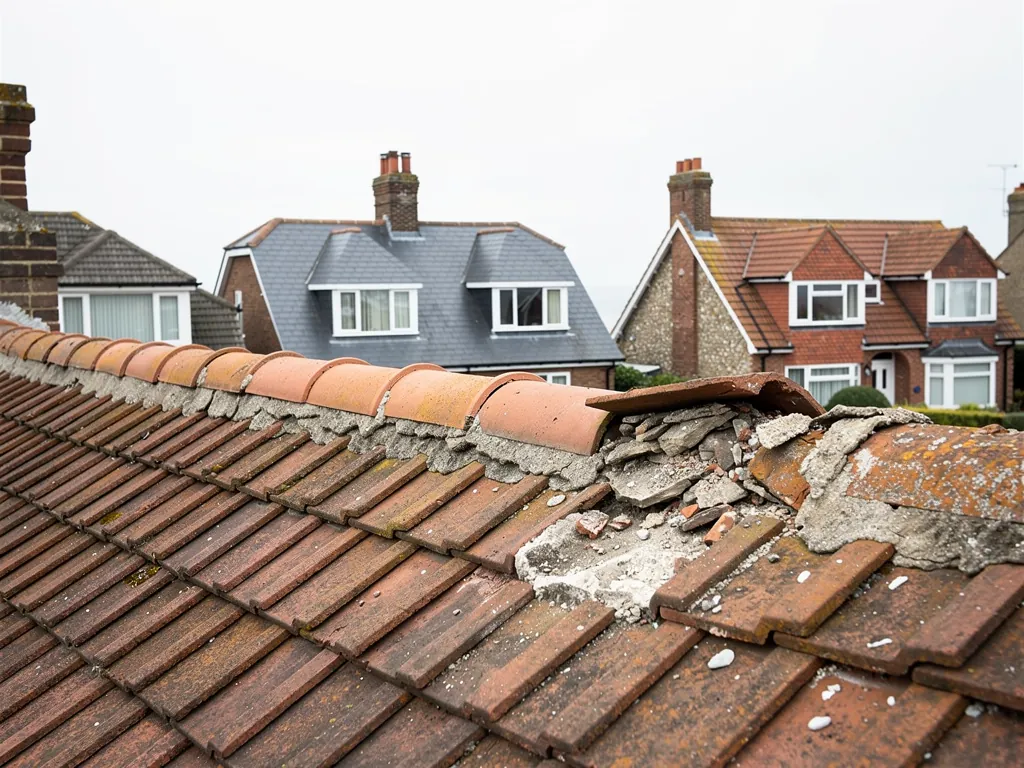
Ridge tiles rarely give up without notice. The row of capping on the apex of a pitched roof sits well out of sight from most windows, but the faults that lead to a slipped tile leave marks that anyone can learn to spot. Some show from the pavement. Some show in the gutter. A few only appear indoors, long after the first crack opened.
This guide lists the signs in the order you are likely to meet them: what shows from the ground, what turns up around the house, what the loft tells you and what changes after a gale. It also explains which signs mean a quick call and which can wait for a convenient date.
The advice throughout is to look, not to climb. A pair of binoculars and a phone camera do most of the work, and the pictures help whoever visits to understand the fault before they arrive.
Clues visible from the pavement
Start with a stand-back look. Choose a spot across the road or at the end of the garden where you can see the whole length of the ridge against the sky. A binocular check from a first-floor window is even better.
A healthy ridge reads as a smooth, level line. Each cap meets the next with a tight joint, and the colour is even from one end to the other. Trouble shows as a break in that rhythm. A tile that sits proud of its neighbours, a dip where a section has sunk, a cap tilted to one side or a visible gap between two tiles all point to a bed that has stopped doing its job.
Look at the pointing too. Ridge mortar usually runs as a continuous band along both sides of the capping. Where it has cracked into short lengths, fallen away in lumps or turned dark and mossy, rain is getting into the join. Pale scars where pieces have dropped out show that the failure is recent. Plants growing along the ridge are a sign of soft, damp mortar that has held moisture for a long time.
The ends and the corners
Check the ends of the ridge, where it meets the gable or the hips. The end tile takes the most abuse from wind, and a missing cap or a mortar patch that has fallen out is easy to spot. On a hipped roof, follow the diagonal lines from the apex down. A hip cap that has crept downhill often shows as a step in the line.
If you see any of these marks, photograph them from the same spot you used to look. Later pictures from the same place show whether things are getting worse. Our page on cracking ridge mortar shows how cracks develop and what each type means.
What turns up around the house
Some of the clearest evidence lands on the ground. Grit, crumbs and lumps of grey or sandy material in the gutter, on a flat roof below the ridge or on the path under the gable are often pieces of ridge mortar. A lot of grit in the downpipe after a windy night is the roof telling you something has gone.
Whole tiles are another sign. A broken piece of curved tile on the lawn or the drive, or a cap missing from an outbuilding roof after a blow, is plain enough. If a tile has fallen, check the ridge above it. Nearby tiles are likely to have been loosened by the same gust.
You may also notice marks on the walls. Where a loose ridge lets rain run down the slope in the wrong place, streaks can appear on the gable end or on the chimney breast. On a house with render, dark trails below the roofline can be traced back to the apex.
Noises and neighbours
Sound can give a warning too. A tile that is free to move may rattle or tick in a stiff wind, and a ridge that was quiet last year but is not this year deserves a second look. Neighbours with similar roofs sometimes spot the signs first, because they can see your skyline more easily than you can. A passing comment about a tile at an angle is worth taking seriously.
None of these signs proves the ridge is failing, but together they give a picture. Two or three at once, such as a wavy line plus mortar in the gutter, is a strong hint that the bed has let go and that the tiles are held by little more than their weight.
What the loft can tell you
The underside of the roof shows what water has done. Where the loft hatch is easy to reach, take a torch and a phone and look along the top of the rafters, where the two slopes meet.
Daylight is the first thing to look for. A fine line of light along the apex, or a bright spot beside the ridge board, means there is an opening in the covering. Rain can follow the same route. Loft staining is the next sign. Dark patches on the timber near the top, a tide mark on the underlay, damp insulation or rusty nail heads all show that moisture has been arriving for a while.
Smell can help. A damp, musty loft in the apex is often the result of a small, long-running leak rather than one big failure. Check the area beneath too. A brown ring on the ceiling of the room below the ridge, or paint that is lifting on the top of a wall, may be linked.
Condensation or a leak
Not every damp loft is a roof fault. Warm damp air from the rooms below can settle on cold timber and mimic a leak. Marley's ventilation guidance describes how eaves and underlay choices affect moisture, and BS 5250 covers moisture in buildings. The practical test is where the wet is. A pattern that follows the line of the ridge, appears after rain and dries in sunshine points to the covering. A general mist of damp across all the timbers points to ventilation.
Our guide to leaking ridge tiles deals with that question in more depth. Whichever it turns out to be, the photographs from the loft are useful for the person who visits.
After a gale or a hard frost
The weather decides when most ridge faults become obvious. A gale pushes air up the slope, over the apex and down the other side, and any tile that has lost its grip is exposed to lift and rotation. Marley warns that a windward slope under 30 degrees can suffer severe suction, one reason bungalow roofs deserve a check after strong winds.
After a blow, take a lap of the garden and look up. Fresh gaps, tiles at odd angles and new debris on the ground are all worth recording. Check the neighbours' gardens too, if you can do so from your own side. A tile that has landed next door is still your tile.
Frost can open cracks that wind then finish off. Water that has entered a hairline crack in the mortar expands when it freezes and breaks the surface from within. A ridge that looked tight in November can look ragged by March for that reason. It is worth a look after a long cold spell as well as after a storm.
Safety on the ground
A loose tile is a risk to people below. If a cap looks about to fall, steer children and pets clear of the ground underneath, and avoid parking beneath the gable. Do not try to knock it down or reach it from a ladder. Where the damage is storm related, make the area safe, tell your insurer before arranging anything, and photograph what you see. Which? and the Institution of Structural Engineers both give the same plain advice: report promptly and keep evidence.
Urgent, soon or at the next service
Not every sign carries the same weight, and sorting them helps you decide how fast to act.
Act this week if a tile has slipped or is hanging, if you have daylight along the apex from the loft, if a ceiling is dripping or if a cap has fallen and others look ready to follow. A moving tile can come down at any time, and a live leak damages insulation, plaster and wiring as it spreads. A leak or storm damage jumps our queue, and a roof letting weather in is made safe first.
Act within a few weeks if the mortar is cracking along its length, if there are crumbs in the gutter but no leak, or if one end cap has gone but the rest look firm. These faults get worse with each wet spell, but they usually allow time to arrange access and a proper repair.
Note for the next visit if you see only moss on the ridge, a slightly dull colour or very fine hairline cracks. Keep a photograph with the date, compare it in six months and mention it when the roof is next inspected.
How the answer is worked out
The weighting comes from what the ridge is holding. A bed that is cracked but the tiles are tight can wait a little. A bed that has gone and tiles that rock cannot. A ridge that is being lifted every time the wind rises is a hazard, however small the visible damage appears. The survey sorts these out with close photographs rather than guesswork, and the verdict says plainly whether the repair is a tidy-up, a rebed or a rebuild.
What happens next and what it costs
Once you have pictures and notes, the next step is a survey of the ridge from the roof itself. That is how a roofer sees what is under the mortar: whether the ridge board is sound, whether the underlay has split and how many tiles are cracked. The visit ends with a written quote and a verdict, and photographs go with both.
For a sense of the money, Checkatrade's June 2026 table puts ridge tile repairs at £50 to £70 per metre, excluding VAT, and its dry ridge guide, updated September 2026, prices the whole kit on a semi-detached house near £800. Both are national typical figures, and neither includes scaffolding. Checkatrade's October 2026 scaffolding table has a terrace at £800 a month and a detached house at £1,200. Access, length and the state of the timber underneath are what separate a small bill from a large one.
What to do before anyone visits
Keep the photographs, with dates, taken from the same spots. Write down what you noticed and when. Check your insurance paperwork if the damage followed a storm, and note any leaks indoors with a bucket or a towel to protect the floor. Do not climb up to look. If someone knocks on your door claiming to have spotted loose ridge tiles from the road, treat it with caution and ask for a written quote after a proper survey.
Our guide to fixing ridge tiles describes what the repair involves once the signs have been confirmed, and the ridge tile repairs page sets out the range of work. If the signs are already there, getting it checked sooner usually costs less than waiting for the next gale to decide.
Questions
Loose ridge tile questions
Can I check a ridge myself without going on the roof?
Yes. Scan the ridge with binoculars from the lawn or an upstairs window, check the gutters for mortar crumbs, and use the loft for daylight or stains along the apex. Take dated photographs. These checks cost nothing and give a roofer a useful starting point.
Is one slipped ridge tile an emergency?
It depends on how far it has moved. A tile that hangs or sits at an angle can fall, so keep people clear and arrange a repair promptly. One that has simply shifted slightly with the rest firm can usually be fixed on a planned visit. Photographs help decide.
Do cracks in ridge mortar mean the tiles are loose?
Not always. Hairline cracks are common and the tiles beneath may be held by their weight and the bed's grip. Under BS 5534 the mortar is not what holds a ridge tile; the mechanical fixing is. A survey checks whether a tile moves when tested.