
Autumn roof check · 9 min read
Why autumn is the time for a roof check
The weeks between the last warm days and the first proper gales are the kindest time to find roof faults. Here is what an autumn check covers and why the timing helps.
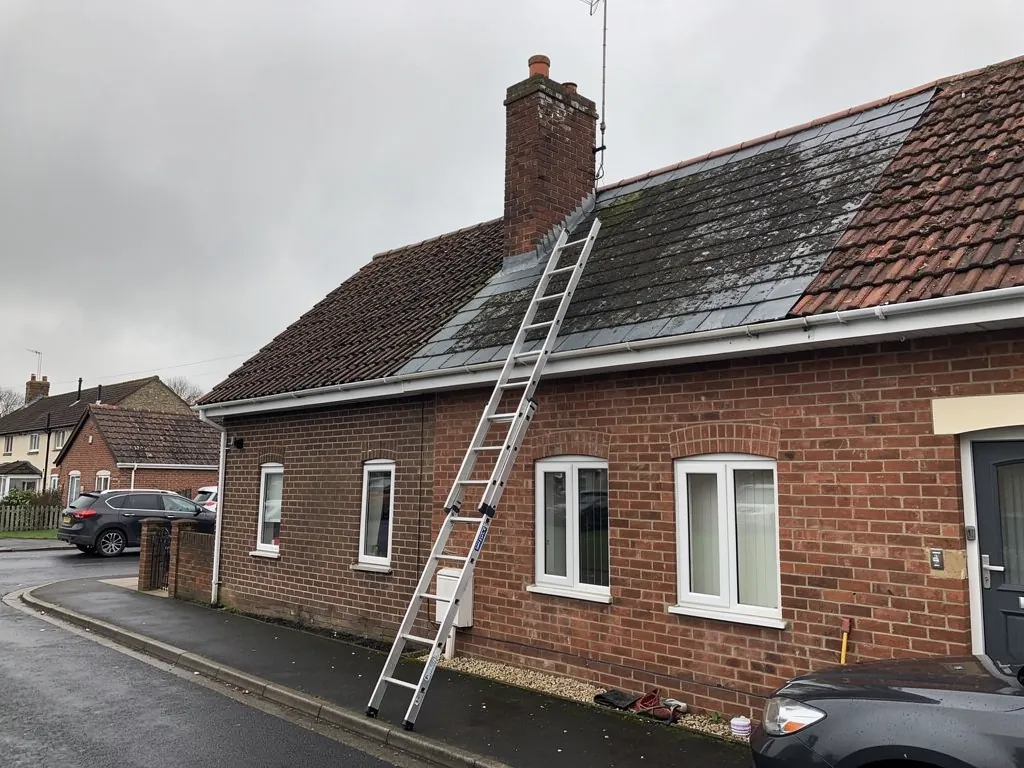
Roofs tend to get attention when they fail. A drip lands in a saucepan, a ceiling blooms with a brown stain, a slate turns up on the lawn. By then it is usually dark, wet and cold, which is the worst time to have anyone work on a roof, and the worst time to be choosing who.
Autumn offers a better deal. The summer has been hard on the covering: sun, dry spells and the quiet growth of moss and lichen. The leaves are coming down but the worst of the sea weather has not yet arrived. A roof checked now can be put right in settled conditions, and a defect found now costs less than the damage it would do over a wet winter.
This guide sets out what an autumn check is for, in the order it is worth doing: the gutters, the covering, the junctions, the flat roofs and the loft. It also explains why timing matters for planning, including the lead time that scaffolding can need. Our roof inspections and surveys page describes the visits we carry out if you would like someone to do the climbing for you.
Why the autumn weeks work in your favour
There are three reasons to look at a roof now rather than in January. The first is the weather. Roofing is outdoor work, and adhesives, mortar and many flat roof materials behave best in mild, dry conditions. A repair carried out in a clear spell in October or November has the best chance of being right the first time.
The second is the sequence of events. A small gap that opens in autumn has months to get worse before spring. Water gets in, soaks the insulation, swells the timber and, if the temperature drops, expands as it freezes in the joint. The frost shows up as damage in February; the cause was there in October.
The third is practical. A job that needs scaffolding can need weeks of notice. Section 169 of the Highways Act 1980 means a licence must be in place before scaffolding goes up over a pavement or carriageway, and the highway authority grants it. In West Sussex the county council allows for 10 working days at the least from the request to the poles going up, and Hampshire County Council wants ten clear working days. Waiting until a gale has taken half a ridge off leaves no room for that.
What autumn is not
It is not a reason to buy a new roof. Most autumn checks end with a short list: clear the gutters, replace a few tiles, refix a section of ridge, re-dress some lead. We say what the roof needs, nothing more, and if mending will do, mending is the advice. Our guide on how often to inspect a roof helps you decide on a rhythm.
Gutters, downpipes and the fall of the leaves
Start at the bottom. Falling leaves, seeds and moss from the roof collect in the gutters, and a blocked gutter behaves like a dam. The overflow pours past the front lip, streaks the brickwork or soaks the fascia board, the timber behind the gutter, which then rots from the back.
Clearing gutters is a ground-level or ladder job that many people do themselves, but a ladder against a gutter is a classic way to crack the plastic or to fall. Use a ladder stay, keep three points of contact and do not lean out. If the gutters are high, over a conservatory or hard to reach, a roofer with proper access is safer.
What to look for as you clear
Check each joint for drips. Look at the brackets for loosening, and run water along the gutter to see that it drains towards the downpipe without puddling. Water lying in the run means the gutter has probably dropped. A downpipe that gurgles or backs up is blocked lower down, often at the bend or the gully at the bottom.
Look at the roofline as well. Fascias and soffits that are cracked, stained or peeling invite the weather in. Wood that is soft under a screwdriver has gone. If water has been overflowing for some time, the brickwork under the gutter may show green growth and dark staining.
The grass around the house gives hints too. A wet streak down the wall near a downpipe tells you something is leaking at the joint.
Our page on inspecting chimneys and gutters covers more detail, and the guttering, soffits and fascias page explains the repairs.
The covering: tiles, slates and moss
With the gutters clear, look up at the covering. From the ground, with binoculars if you have them, you are looking for tiles that have slipped, cracked or gone, slates that have dropped, and any change in the colour of the slope. A dark patch may be a section where moisture lingers.
Autumn is a good moment because the summer's growth is at its height. Moss and lichen thrive on a roof that stays damp, and a thick cushion of moss on a tile holds water against it. Moss that has pushed under the lip of a tile can lift it. It also blocks gutters when it comes off. Brushing it off in a hurry can damage the surface, so ask for advice first. Our roof cleaning and moss removal page explains the options.
Ridges, hips and verges
The lines along the top and sides of the roof take the most wind. The ridge caps the apex, hips run down the angled corners, and the verge is the tiled margin along a gable wall. Sagging mortar, a capping that has shifted or a gap beneath the edge tiles should be reported. BS 5534 was revised in 2014 and stopped treating a bed of mortar as adequate by itself under ridge and hip caps, which now get a screw or clip too. An older ridge that depends on mortar alone may deserve attention before winter.
Nail sickness and slipping
Tiles that sit a little out of line may be starting to slip because the nails holding them have corroded. One slipped tile often means more are following. Autumn is the time to catch them before a gale does it for you.
None of this needs you on the roof. Photograph what you can see and send it on.
Lead, chimneys and other junctions
Water finds its way in at the joints between one part of the roof and another. These are the details a roofer checks most closely in autumn, because they are where the earliest failures appear.
Around the chimney, the lead flashing is the strip of metal dressed between the stack and the tiles. Look for lead that has lifted at the edge, split along a fold or slipped downhill. Cracks in the cement fillet, where mortar was used in place of lead, are common and let water in behind the metal. The mortar bed around the pots, called flaunching, should be firm, sloping and free of cracks.
Beside a dormer or a taller wall, the same checks apply. A dark streak down the wall below a flashing means water is running behind it. A valley, where two slopes join in a trough, has to stay clear of leaves and moss, since a choked one throws water sideways beneath the tiles.
Vents, flues and pipes
Anything that goes through the roof is a possible entry point: a soil vent pipe, a flue terminal, an extractor outlet or a satellite cable. The collar around each should be intact and well sealed. If a vent has a flexible boot that has cracked in the summer sun, replace it before the rains.
Lead is long-lived. A MyJobQuote guide updated in September 2026 says flashing can last for over 80 years, but it can still fail if it has been poorly fixed or disturbed. If a stain has appeared at the top of a wall near the chimney, take a photograph and note the date.
Our pages on chimney repairs and lead roofing and leadwork cover the work in full, and our guide to checks after a gale shows the same junctions in the aftermath of rough weather.
Flat roofs and outlets before the rain sets in
A flat roof needs its own autumn visit, and falling leaves are the reason. Most flat roofs drain to an outlet, a scupper or a gutter at one edge, and a mat of wet leaves across the opening turns the roof into a shallow tank. Water that cannot leave will find any weakness in the covering.
If the roof can be reached safely, for example a low extension roof with a good ladder and a second person, clear the outlet by hand and sweep leaves and debris towards the edge. Do not use a hose with force near the joints, and never use sharp tools on the surface. If you cannot get to it safely, leave it to a roofer.
Signs of trouble
Look for puddles that outlast the shower, blisters or splits in felt, lifted edges on a rubber sheet, and cracks in a fibreglass coating. Look at the trims along the edges and the upstands against walls. BS 6229:2025, which replaced the 2018 edition in December 2025, keeps a minimum finished fall of 1:80, so a roof still wet days after a shower is not draining as it should.
Inside, look at the ceiling beneath for stains or sagging. A flat roof leak seldom shows directly under the fault.
Garage, porch and extension roofs are often forgotten because nobody sees them. They sit low, so small faults reach a ceiling quickly. The flat roofing page sets out the coverings, and our guide to flat roof surveys looks at moisture, seams and outlets.
Leaves on a flat roof are not just untidy; they stop the roof doing its one job, which is to shed water.
The loft, ventilation and a plan for winter
The last part of an autumn check is the loft. The heating is about to go on, and warm, damp air from the rooms below will rise into the roof space. If the space cannot ventilate, that moisture settles as condensation on the chilly roof timbers, and you will see droplets on the underlay, damp insulation and mould on the timbers.
What to look at
With a torch and a careful step, look for daylight, damp patches and dark staining on the rafters. Check that the insulation has not been pushed over the eaves, where it blocks the air path. Marley's cold roof advice, for high-resistance underlay, is a 25mm opening along the eaves at pitches of 15 degrees or under, and 10mm above that pitch. Check that bathroom and kitchen extractors vent to the outside and not into the loft. Our guide to what you can check from the loft yourself goes step by step.
Look out for bats and nests. Both are protected, so photograph and stop rather than clear them.
Making a short list
Write down what you found, with photographs, and sort the list into three. Things you can do yourself safely, like clearing gutters from a stable ladder. Things to watch, like an old dry stain. And things that need a roofer, like slipped tiles, lifted lead or wet insulation.
If the third list is not empty, book the work while the weather is kind. We go up, take pictures of the fault and give you our call on it, then send a written quote, with a single overall price. If you want a written report on its own, Checkatrade gives about £260 for a roof inspection, plus VAT.
Questions
Autumn check questions
Is autumn better than spring for a roof check?
Each has a use. Spring shows what winter did; autumn catches faults before winter does. Because roof work depends on dry, mild conditions and scaffold licences can need notice, fixing problems in autumn leaves more choice about when the work is done. If you can only do one, do autumn, and look again after any severe gale.
Can I clear my own gutters safely?
If they are low and the ground is level, many people can, using a ladder with a stay or a stabiliser and someone to hold the foot. Gutters over a conservatory, above a first-floor window or at the end of a long reach are better left to a roofer. Wear gloves, take the debris away in a bag and never lean out sideways.
What should I do if I find moss on the roof?
Leave aggressive scrubbing and pressure washing alone, which can damage tile surfaces and push water under the laps. A light covering is often just cosmetic, but thick cushions hold water and can lift tiles and block gutters. Take a photograph and ask a roofer how best to remove it for your covering.