
Flat roof surveys · 10 min read
Flat roof surveys: moisture, seams and outlets
A flat roof hides its faults under one continuous skin. This guide explains what a survey measures, from damp in the deck to the seams and outlets where water usually gets in.
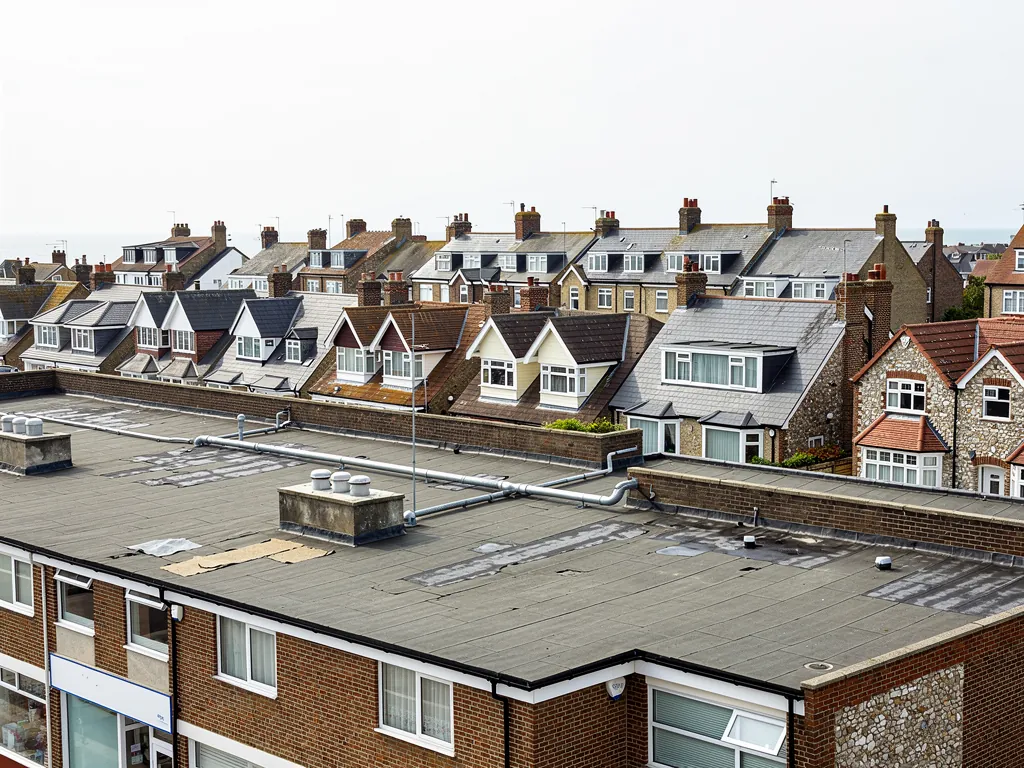
A pitched roof throws water off by gravity and shows its trouble in the pattern of the tiles. A flat roof does neither. It is a single waterproof skin laid over a deck, with water expected to run slowly towards an outlet, and when that skin lets go the first sign is usually a stain on a ceiling that sits nowhere near the real defect.
That is why a flat roof survey looks different from a look at a tiled slope. A surveyor on a garage, an extension or a porch roof works from the top down and from the inside up. The covering is read for splits and weak joints. The outlets are checked for blockage. The falls are judged by where water stands. The deck underneath is tested for damp, because a soaked deck changes the sums on everything else.
What follows is the order of that survey, with the reasoning behind each step. It should help you understand a report when you receive one, and see why a patch over a wet roof so often fails. Our flat roofing page covers the roofs themselves, and the surveys we carry out are described under roof inspections and surveys.
Reading the surface before anything is touched
The survey begins with a slow walk and a lot of looking. On felt, the surveyor looks for blisters, splits, alligatoring (a crazed pattern, like dry mud) and places where the surface has worn through to the layer beneath. On EPDM, the rubber sheet that is laid in one piece, the checks are for tears, punctures, lifted edges and shrinkage at the corners. On GRP, a fibreglass-and-resin coating that cures hard on the roof, the checks are for hairline cracks, particularly along the joints in the deck and where the roof meets a wall.
Stains tell their own story. Moss and algae gather where moisture lingers, so a green patch is a pointer to water standing or seeping there. A pale ring where a puddle has dried shows its previous outline. A dark seam beside a wall may be a joint that is opening.
Which covering is it?
Knowing the material comes first, because everything else is judged against it. The sources disagree on how long each lasts: Less (guide dated March 2026) gives torch-on felt 10 to 20 years, GRP 25 to 40 years and EPDM 30 to 50 years, while GreenSpec puts EPDM at 20 to 30 years. Those are published ranges rather than guarantees, and poor workmanship can shorten any of them.
A surveyor also asks how old the covering is, how many layers there are and whether it has been patched before. Layers of old repairs trap moisture and add weight, and they make a new repair harder to bond. The answers go into the report alongside the photographs.
On a roof with chippings, the stones are lifted in places so the membrane beneath can be seen. Our guide to inspecting your own roof explains what you can see from a window or a ladder.
Moisture in the deck
The deck is the structure under the covering, normally timber boards or sheets, sometimes concrete. When it stays dry it lasts for many years. When water has been getting in, it becomes soft, then dark, then rotten, and a new covering over a damp deck traps moisture that cannot escape.
Surveyors use a moisture meter for this. A pin meter pushed into the timber gives a reading that shows whether the wood is dry, damp or wet. Some readings are taken from the ceiling below and some from the top, wherever the covering can be opened up without causing harm. Thermal imaging can show cooler patches where moisture sits in the build-up, which is the subject of our page on thermal imaging of roofs, but a camera points to a spot. A meter or a small sample confirms it.
What the readings change
If the deck is dry and sound, a repair to the covering can hold. If it is damp in one patch, that section may need cutting out and replacing before re-covering. If it is wet or soft across a wide area, patching is wasted money and the sensible advice is usually to strip the roof back and re-lay it. That is where the decision between mending, holding and renewing is made, and where we take photographs so you can see the reasoning.
Ceilings, the top of the walls and any timber you can reach from the room below are checked as well. A damp plasterboard ceiling with a brown tide mark around a light fitting suggests water has been spreading along the underside of the deck before showing.
Do not trust a roof that feels spongy underfoot. Report it, stay off, and ask for a survey from a roofer with proper edge protection.
Seams, laps and upstands
Most flat roof leaks start at a joint, not in the middle of a sheet. The joints are where one length of covering meets the next, at the foot of every wall, and around anything that pokes through the surface.
On a felt roof, the laps between layers are the first place to check. Heat, movement and age lift them, and a gap at a lap lets water run in. On a single-ply roof such as EPDM, the surveyor presses along the seam strips to find any that have lost their bond. GRP has no laps as such, but it has joints in the deck beneath, and cracks tend to follow them.
Upstands and flashings
At a wall, the covering is carried up the brickwork as an upstand, usually finished with a flashing that stops water running behind it. The surveyor looks for a gap between the upstand and the wall, lifted lead, cracked sealant and any place the covering has pulled away or shrunk. These upstands take much of the movement in the roof, and they are a common failure on extensions built against an older house.
Anything that penetrates the roof, such as a vent pipe, a rooflight kerb or a cable entry, needs a neat collar or upstand of its own. The collar is checked for splits and for sealant that has hardened and cracked.
Edge trims and drip details
The edges decide where water goes when it leaves the roof. A trim that has lifted, rusted or lost its fixings lets water run back under the covering. The surveyor checks that the trim is fixed along its length, that the joints in it are tight and that the covering is correctly lapped over it. Our page on flat roof edge trims sets out the details.
Outlets, gutters and falls
Despite the name, a flat roof should be laid with a slight slope so water travels towards an outlet. If it does not, water stands, and standing water speeds up the ageing of every membrane.
The surveyor checks where water goes. Outlets are examined for leaves, silt and moss, and for how the covering is dressed into them. A blocked outlet turns a roof into a shallow tank. Gutters and downpipes at the low edge are checked too, together with any overflow, a smaller pipe set a little higher that warns of a blockage by dripping.
What the standard says about falls
BS 6229:2025, which replaced the 2018 edition in December 2025, sets a minimum finished fall of 1:80 across ordinary roof areas and for internal gutters. The design is usually steeper, around 1:40, to leave room for tolerances in the finished surface. A level or a long straight edge on the surface will show how close a roof is to that.
Ponding, where puddles remain long after rain has stopped, is the visible symptom of a fall that is too shallow or a deck that has sagged. A patch of ponding does not always mean a leak, but the water adds weight, grows algae and sits on every joint, so it nearly always wears the covering out sooner.
Where the falls are wrong, no coating will cure it. The slope has to be built in with tapered timbers called firrings, or with tapered insulation, beneath fresh covering, so the job becomes a re-cover. Our guide to standing water on a flat roof explains the choices.
Each outlet, gutter and fall measurement goes into the report with a photograph.
Insulation, condensation and the Building Regulations
A flat roof is also a thermal element. How it is built up decides whether it stays dry from the inside. A warm roof has insulation above the deck, so the structure stays on the warm side. A cold roof has insulation between the joists with a ventilated void above, and it relies on air movement to carry moisture away.
A survey records which type the roof is where it can be established, because condensation on the underside of a deck can look like a leak and the cure is different. Spotting the difference matters: a leak follows rain, while condensation follows cold, still weather and warm rooms.
When a new covering means upgrading
If the work goes as far as replacing the membrane, the Building Regulations come into play. Approved Document L names the replacement of a flat roof's waterproof membrane as renovation. Where more than 50 per cent of that part of the building is renovated, the thermal upgrade applies, and for an existing roof the improved target is 0.16 W/(m²K). The current edition is the 2021 one with the 2023 amendments; the 2026 edition takes effect on 24 March 2027 with the same renovation triggers.
In practice, that means a new covering usually comes with new insulation, and the survey will say whether the build-up can take it. Check with your building control body about the route for your own job. Our page on flat roof Building Regulations goes through it.
A survey is not a design. It tells you the condition, the likely cause of any damp and the options. The specification for a new roof comes after the visit, and arrives as a written quote giving one overall price.
The report, the verdict and the cost
A good flat roof report is short and specific. It names the covering and its age, records the moisture readings and where they were taken, lists the defects with photographs and says plainly what to do: repair, patch for now, or replace.
What the verdict looks like
A repair fits a roof whose deck is sound and whose faults are local, such as a split seam, a failed upstand or a cracked trim. A patch makes sense when the covering is tired but dry, and a few years more is worth buying. Replacement is the answer when the deck is wet across a wide area, the falls are wrong or the repairs have stacked up. Our advice is the smallest repair that fixes the cause, and the photographs show why.
What it may cost
Costs vary with the covering, the size and the access. Less, last updated in March 2026, puts small flat roof repairs at £150 to £500. Checkatrade gives an average of about £150 for a flat roof inspection, plus VAT. Neither figure is a price for your roof, and a roof with a soaked deck moves into a different bracket altogether.
When you compare reports, look at what each one measured. A quote that names no moisture readings and no photographs has not told you whether the deck is sound. Ask also whether VAT is included.
If you have a flat roof you are worried about, send us photographs of the ceiling and the roof and we will say plainly what is likely and whether a visit is warranted. Our guide to what a roof survey includes sets out the full list.
Questions
Flat roof survey questions
Can a flat roof be surveyed if it looks fine from the ground?
Yes, and it often should be. A flat roof cannot be judged from below, because the faults sit in the covering, the seams and the deck. A survey from the roof, backed by moisture readings, finds damp that has not yet shown on the ceiling. It is most useful before a purchase, after a storm or when a stain has appeared.
Does standing water always mean the roof is leaking?
No. Water can stand on a sound membrane for a while and not get in. It is still a warning, because it shows the falls are shallow or an outlet is blocked, and it speeds up the ageing of the covering. A survey checks whether the water is simply a drainage fault or a sign that the deck has sagged.
Will a flat roof survey say how long the roof has left?
It gives a reasoned view, not a promise. Published lifespans run from 10 to 20 years for felt up to 30 to 50 years for EPDM, according to Less, but the real figure depends on how well the roof was laid and what has happened since. The report records the age, the condition of the covering and the deck, and what each means.