
Scaffolding for repairs · 9 min read
Do you need scaffolding for a roof repair?
Some roof repairs need a full scaffold and many do not. Height, slope and the type of job decide it, and the choice of access can move the price a long way.
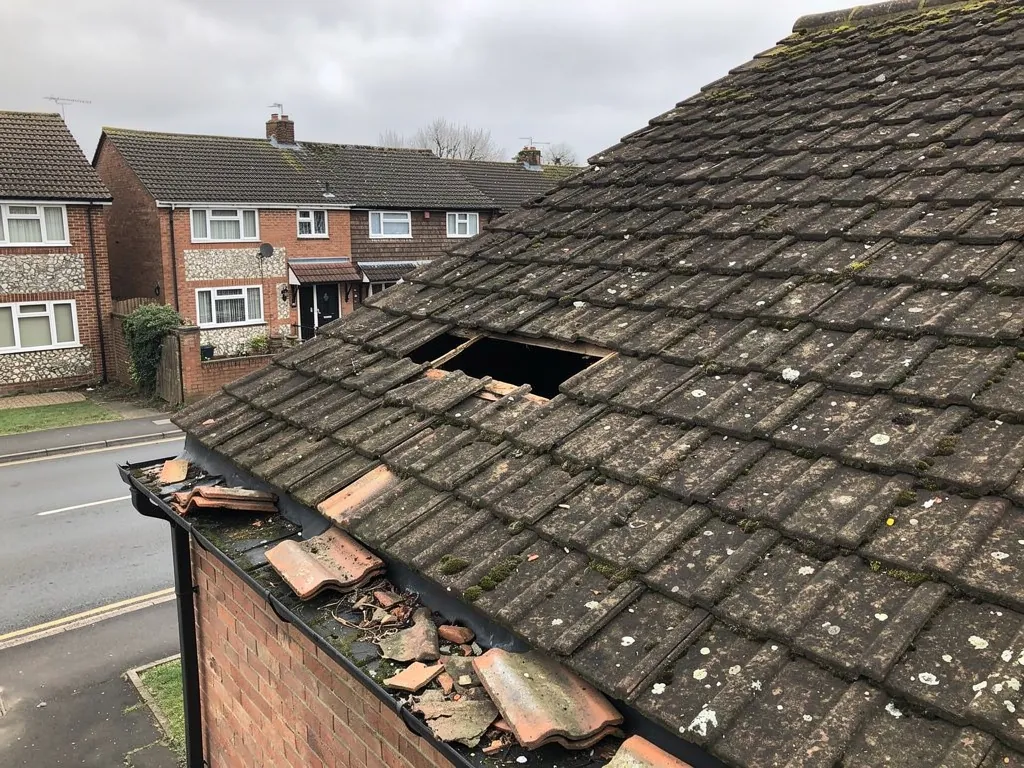
Tell a roofer you have a slipped tile and the first question back is about height. One tile on a bungalow is a short visit with a ladder. The same tile on the third floor of a terrace, over a public footpath, is a different job, and getting to it can cost more than mending it.
Nothing in the trade says a repair must have scaffolding. A handful of practical questions settle it. How high is the fault, and how steep is the slope? What is the covering? Is there a path or a drive underneath? How long will someone be up there, and how much has to be carried across the roof? Quick, light work can often be handled with a simple ladder, a tower or a lift. Work involving lead, a long run of ridge or a patch of slope stripped back usually needs a platform and an edge to work against.
Below we go through each way of reaching a roof, the national price figures for scaffolding, and the licence that applies when poles stand on the pavement. The survey that precedes our quote gives you pictures of the roof itself, and the written total shows how we would reach it before you commit to anything.
Repairs that can be done without scaffolding
Plenty of repairs never involve a scaffold pole. Putting back a few slipped tiles, re-fixing a ridge cap that has moved, clearing a blocked outlet or re-sealing the collar round a vent pipe can all be small jobs when the fault sits low on a slope within easy reach. The roofer sets a ladder against the gutter with a stand-off bracket, and for anything further up the slope a roof ladder hooks over the ridge so the weight spreads across the covering instead of resting on single tiles.
Height is the first test, and the type of roof is the second. A garage, a low extension or a bungalow with a gentle slope is far easier to work on than a steep two-storey roof carrying a tall stack. A shallow pitch is no guarantee of safety, either. Wet moss on slate or clay is slippery at any angle, and a roofer who does not trust the footing should say so and rig something better.
What we look at before naming a method
We study the fault from the ground and again from inside the loft, then decide how the roof will be reached. A ladder is wrong for a task that needs both hands and somewhere to rest materials, however small the task looks on paper. Where a ladder or tower is safe and sensible, the quote says so and carries no scaffold at all.
Our guide to roof repair without scaffolding goes deeper into which repairs suit which method.
Ladders, towers and cherry pickers compared
A full scaffold is one answer among several, and the job picks the right one. A ladder plus a roof ladder suits short repairs low on the slope. A mobile tower is a wheeled platform that moves along the wall, which suits gutter runs, fascia boards and eaves repairs over a short length. A cherry picker is a lorry-mounted lift with a basket, and it reaches one point without any erecting at all, provided the ground is clear and firm.
Every option has limits. A ladder is unsafe to leave overnight across a drive or path. A tower wants level, solid ground, and it gives no guard rail where the slope meets the wall. A lift needs space for the vehicle to stand, so a fence, a garage or a conservatory between the road and the wall can rule it out. On a terrace or a corner plot there may be nowhere to park one.
Method follows the job. A tower or lift is no saving if it leaves the roofer stretching awkwardly or the repair half done.
Scaffolding earns its place when several things coincide: a high roof, a repair bigger than a few tiles, materials that must be carried up, or work along an edge such as a gable or a chimney. It gives a safe place to stand and a fixed edge to work against while flashings or ridge cappings are fitted properly, and that is why the neat finish we aim for on those details leans on it.
What a scaffold adds to a repair bill
On a small repair, access is often the biggest extra. Checkatrade's scaffolding guide (table dated October 2026) lists typical hire charges for a house:
| Property | Typical scaffold cost |
|---|---|
| Two-storey semi-detached house | around £875 a month |
| Terraced house | around £800 a month |
| Detached bungalow | around £1,000 a month |
| Detached house | around £1,200 a month |
| Chimney scaffold | around £660 a week |
Treat these as national middle-of-the-market numbers. A smaller erection, a shorter hire or a tower in place of a full scaffold will come in lower, and a long frontage or awkward corner will come in higher. Checkatrade's separate replacement guide puts scaffolding for a whole re-roof at £700 to £1,300.
The effect on a repair can be dramatic. A modest patch repair might cost a few hundred pounds without access equipment, and a scaffold at the figures above can multiply that. So ask, before accepting any price, whether access is included. It also pays to bunch jobs. If the chimney lead, the ridge and the guttering all want attention, one hire for all three beats three separate visits. Our roof repair cost guide shows where the other pieces of a bill fit around this one.
Chimneys, lead and ridges: access matters most
Chimneys are where access counts for most, since the work sits at the highest and most exposed spot on the roof. MyJobQuote, in a guide last updated on 22 September 2026, gives a chimney lead patch repair at £150 to £250. Replacing all the lead round the stack costs £350 to £460 without scaffolding and £700 to £920 with it. The difference is access, and on a tall stack nobody should treat it as optional.
Lead flashing seals the joint between slope and stack. It must be cut, dressed and tucked into the brickwork, so the roofer needs a platform wide enough to kneel on and room to lay sheets flat. Trying that from a ladder is neither safe nor tidy. The same applies to flaunching, the mortar that beds the pots on top, and to any repointing or rebuild of the stack.
Along the ridge, hips and gable edge
Capping that runs along the apex is the ridge. A hip is the same detail running down a sloping corner, and the verge is where tiles finish at a gable end. Repairs along all three are long and linear. A short stretch can sometimes be reached from a roof ladder, but a longer run, or any repair where cappings are fixed mechanically to BS 5534 with screws or clips, goes more neatly from a scaffold with a rail to lean against and a safe route along the whole length.
If the stack itself is the worry, our chimney repairs page describes the work in more depth.
The highway licence when poles stand on the pavement
Scaffolding on or over a public footpath or road needs a licence. Section 169 of the Highways Act 1980 bars anyone from putting up or keeping scaffolding that obstructs a highway without permission from the highway authority. Ask who makes the application, and whether the fee and the wait are allowed for in the access price.
Which authority issues it depends on the address. West Sussex County Council looks after Bognor Regis, Chichester, Arundel, Littlehampton, Worthing and Horsham. It needs at least 10 working days between application and erection, asks £266 for a month and £178 to extend, and offers a one-working-day fast track for an extra £52. Across the border, Hampshire County Council licenses scaffolds for Havant and East Hampshire. Its terms are £211.90 for the opening fortnight, and the application has to be in ten clear working days before the scaffold goes up. Within Portsmouth the city council is the highway authority.
Timing is the real lesson. A repair that can wait fits the notice period easily. A leak cannot wait, so on urgent jobs we make the roof safe first, using a ladder, tower or lift where that is possible, and plan the proper repair around a scaffold afterwards. A private drive or rear garden involves no highway licence, which is why two similar houses can end up with different access.
A full re-roof raises the same questions on a larger scale, and our guide to scaffolding for roof replacement covers them.
Fragile roofs and edges: when it is unsafe to start
Some roofs cannot take a person's weight at all, and no care on a ladder alters that. HSE guidance on fragile surfaces lists fibre cement sheets and rooflights among them, and its A14 asbestos guidance calls asbestos cement roofs fragile every time. Where a surface might not bear weight, work needs a platform, edge protection and boards or a covered walkway, not just a ladder. Our roof asbestos check explains why sheeting gets identified before anyone steps onto it.
Edges are the second hazard. Falls happen at the eaves, along a gable and round a skylight or hatch. A scaffold puts a rail and toe board at exactly those places, while a tower or ladder does not. Moss, loose tiles and rain add to the danger, and so does a heavy load such as a roll of lead or a pack of slates.
When a roofer should stop and re-plan
If a roofer finds soft decking, rotten battens or movement in the structure, the plan has to change. Adding more weight to a damaged roof to finish a quick repair is how a small job turns into an accident. Making the area safe, recording what was found and agreeing a different way in is the right move.
You can help. Keep children and pets clear of the foot of the wall, move cars off the drive and warn any neighbour who shares the boundary. We explain how the roof will be reached before work begins, so the day brings no surprises.
Reading a quote that mentions scaffolding
When two quotes for one repair sit far apart, access is a common reason. One may include a full scaffold and its licence while the other assumes a ladder and adds scaffolding later as an extra. Before comparing them, ask each roofer three things. Is scaffolding in the price, and what kind? Is VAT in the price, given that the standard rate is 20 per cent and many national guide figures leave it out? And what happens if the survey shows that the way in has to change?
With the survey finished, you get the figure on paper as a single sum. It reflects the roof as we found it and the way we plan to reach it, so the access you are quoted is the access you get. The survey photographs show why a repair needs the method we have chosen, and we price the work fairly.
Think about the moment as well. If several small repairs are likely over the next few years, say chimney lead, a patch of ridge and some guttering, doing them together on one scaffold is better than paying for access three times. And where an old roof keeps needing mends, access costs can tip the sum towards a new one. Our guide on whether it is cheaper to repair or replace a roof works through that choice, and the roof repairs page sets out the repairs we take on.
Questions
Scaffolding and repair questions
Can I have a roof repair done from a ladder only?
Yes, when the fault is low, the slope is reachable and the job is small, such as replacing a few tiles. A roof ladder spreads weight across the slope. If the work calls for lead, a long run of ridge or materials carried up, a ladder alone will not do, and the survey will say so.
Does the roofer or the householder pay for the highway licence on a scaffold?
That depends on how the job is quoted, so ask your roofer to confirm who pays and who applies. West Sussex County Council asks £266 for a month of scaffolding and needs ten working days' notice. Ask any roofer whether the licence is included before you accept a price.
Can I use my neighbour's drive or garden for access?
Only with their agreement, and it is wise to ask early and in writing. Poles on a neighbour's land, or a platform overhanging their boundary, need their permission. If they refuse, the roofer may need another method, such as a lift from the road, and the quote can change.