
Bungalow re-roofing · 9 min read
Re-roofing a bungalow: costs, materials and what to expect
What replacing a bungalow roof involves: what it tends to cost, which coverings suit a low pitch, what hips and valleys add, and where a loft room or asbestos cement changes the job.
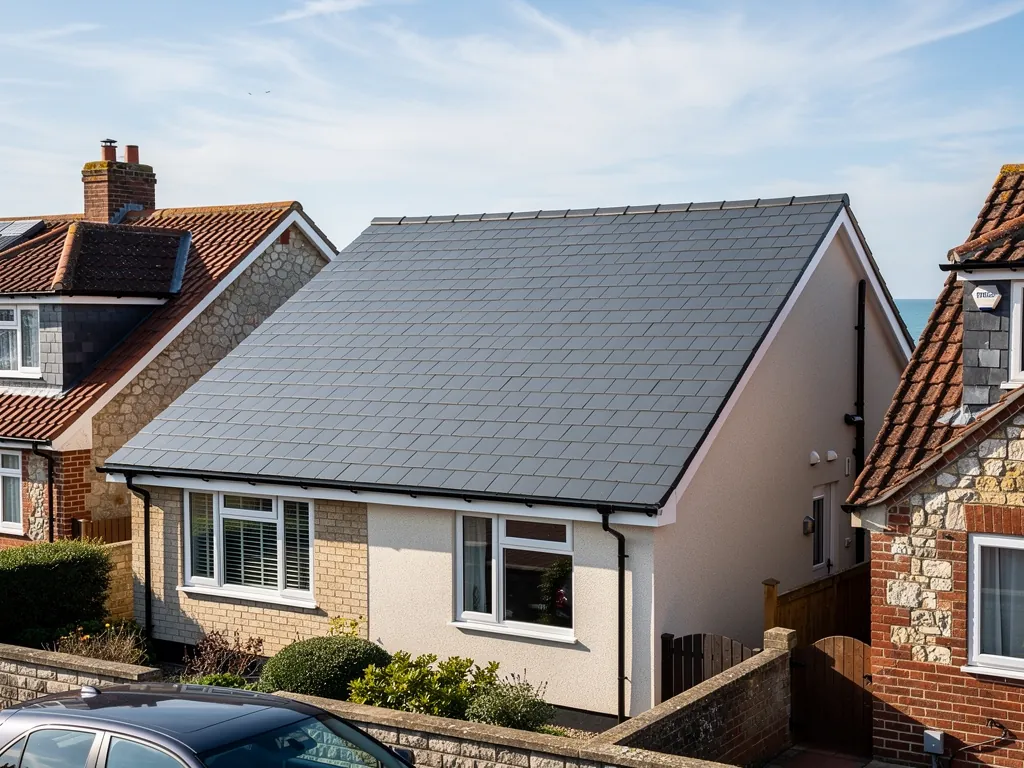
A bungalow keeps its whole roof in one place. No upper storey hides the slopes, the eaves sit low enough to see from the garden, and the roof spreads over a bigger footprint than a two-storey house with the same floor area. That changes the sum. Getting up there is easier and cheaper, but there is more covering to buy and more length of hip, valley and gable edge to finish properly.
Plenty of bungalow owners around Bognor come to a re-roof after years of patching, or after a buyer's survey flagged the covering. Below you will find what national cost guides publish, how the slope angle narrows the choice of tile or slate, what hips and valleys add, what to do about rooms in the roof, and what to check if the bungalow went up in the years between the wars, when some builders used asbestos cement.
Every figure here is a typical UK range from a named guide. None is a price for your roof. Our roof replacement work begins with a survey and pictures of your own slopes; the price comes after, in writing.
What a bungalow roof replacement costs
National guides give a wide spread, because two things dominate: the area of the roof and the covering laid on it. Checkatrade's October 2026 roof replacement guide puts the UK average at around £8,000, with most jobs between £4,000 and £19,000. A second table in that guide, split by roof shape and flagged as excluding VAT, gives £9,250 to £18,000 for a hip roof and £7,000 to £16,250 for a gable roof. Checkatrade also gives around £1,000 a month for scaffold on a detached bungalow, in a table updated October 2026.
Hips push the figure up because each one is an extra sloping edge to cap and seal. Many bungalows have a hip at one end or both, and that is a big reason a single-storey roof can cost as much as a taller house. The difference between the two shapes is laid out in hip against gable roof cost.
The covering shifts the total again. Checkatrade's slate guide (price table dated September 2026) gives £160 to £210 per square metre for natural slate and £95 to £125 for Spanish slate. Stripping the old covering, fresh battens (the thin timber laths the tiles hang from) and underlay all sit inside a re-roof, and so does tidying the eaves and the gable edges.
What turns up beneath the old tiles can move the total, such as soft timber along the eaves. That is why nobody should name a firm figure for your bungalow before someone has been up and looked. Chimneys on the ridge or gable, a flat-roofed porch and the state of the fascia boards all feed into the same total, and the survey is where each one gets its answer.
A low slope narrows the choice of covering
Slope angle is measured in degrees, and bungalow roofs often sit shallower than those of taller houses. Every covering has a floor below which wind can push rain back up beneath the overlaps, so the material must suit the slope before colour even comes up.
Marley publishes minimum angles for its own products and they vary widely. Its interlocking concrete tiles run from 12.5 degrees for the Mendip 12.5 and 15 for the Wessex up to 22.5 for the Double Roman and 25 for the Anglia. Marley concrete plain tiles need 35 degrees. Its clay plain tiles need 30 to 40 degrees depending on the range, while the Lincoln clay pantile goes as low as 15. Read the data sheet for the exact product, because ranges differ.
Natural slate gives the least room on a shallow roof. Cupa Pizarras states that BS 5534:2014+A2:2018 points to 20 degrees as the floor for natural slate at moderate exposure, using a 500 mm slate, and that hooks should not hold slates on any slope under 25 degrees. A flatter slope also calls for a deeper headlap, meaning the depth by which each course covers the one two rows beneath.
Marley adds that on slopes under 30 degrees the windward side can suffer strong suction, so nails and clips are chosen for the particular roof. If your present covering was laid below its maker's floor, that alone could explain a leak that repairs never cure. Changing to another covering is possible, but weight and pitch both need checking first.
Hips, valleys and long eaves
A wide bungalow roof puts much of the work into its edges. Take the vocabulary one piece at a time. The ridge is the capped line on top, where the two main slopes meet. Each hip is a capped diagonal running down the outer corner of a hipped end. A valley sits at an inside corner where two slopes feed water into one channel, and is normally lined in lead. The verge is the finished edge that overhangs a gable wall.
Capping tiles are often where an older roof gives way first. BS 5534 was revised in 2014, and since then each ridge and hip cap gets a screw or a clip, with bedding mortar added only as a supplement. Dry-fix kits, where fixings replace the mortar bed, are tested to BS 8612:2018. A hipped bungalow can have many metres of it, and the length drives the bill, as our ridge tile repairs hub explains.
Valleys and where roofs meet walls
Valleys, flashings against walls and the line where a flat-roofed extension runs into the main slope are the spots that leak when finished carelessly. The Royston Lead brochure lists code 4 as the lightest weight for flashings, while parapet, box and tapered valley gutters start at code 5. A lead code is simply a number tied to the thickness of the sheet. The lead roofing hub covers the choices.
Do not overlook the eaves. A long run of fascia and soffit, the boards under and behind the gutter, is usually easiest to renew while the roof is stripped and the scaffold stands, since the same access serves both. If those boards look tired, ask for them to be included in the survey. The page on guttering, soffits and fascias says more.
Chalet bungalows, loft rooms and roof windows
A chalet bungalow has rooms in the roof, normally lit by dormers or roof windows. That makes a re-roof more involved, because covering, insulation and windows all belong to the same envelope and have to be dealt with together.
If a loft conversion is on the cards, do the roof first or at the same time. Our answer on re-roofing before a loft conversion gives the reasons. Opening the roof twice wastes effort, and the new insulation can go in once.
Insulation and Part L
Re-covering a roof can pull the Building Regulations into play. Under Approved Document L (2021 edition), an existing roof worse than 0.35 should be upgraded towards 0.16 (Table 4.3), and that duty arrives once over 50 per cent of one element is renovated, or over 25 per cent of the whole external envelope. A roof window has to reach 1.4 or reach Band B in the Window Energy Rating scheme, and the 2026 edition keeps the same limits from 24 March 2027. For the detail, read our guide to roof insulation when re-roofing.
The Planning Portal gives two thresholds below which no building control application is normally needed: under 25 per cent of the building envelope, and under 50 per cent of the roof. Arun lists re-covering a pitched or flat roof as approvable work on its building control page, so ask the council's team, or a registered building control approver, what your bungalow needs. A new covering that adds 15 per cent or more in weight is another trigger.
Adding or altering dormers carries separate planning rules. Our pitched roofing page is the place to start, and skylights and roof windows covers glazing in the slope.
Older bungalows, asbestos cement and fragile roofs
The Victoria County History describes the interwar estates at Middleton-on-Sea and Elmer, and says some were of ephemeral construction, with asbestos walls in places. It says nothing about any single house. It does mean the question should be asked before anyone lifts a sheet.
The HSE tells owners to presume asbestos is present if the building dates from before 2000. Asbestos cement sheet turns up as roof sheeting, garage roofs, soffits and rainwater goods. Lifting weathered sheets with care, and without breaking them, falls under non-licensed work. Where sheets are badly damaged or start crumbling, the HSE has to be notified before work begins, and the job moves into the notifiable non-licensed category. Asbestos insulating board, which can appear in soffits, is licensed work in most cases.
Asbestos cement roofs are always fragile. Nobody should walk on one, and the material should be identified before any quote is accepted.
Household asbestos waste needs a hazardous waste consignment note, completed by the contractor as the waste producer. It is double-wrapped, labelled and kept out of general skips. If you suspect the material, look at checking a roof for asbestos before arranging anything.
Plenty of bungalows also carry a flat-roofed garage or extension with a separate covering in felt, EPDM or GRP. Renewing it alongside the main roof can share the scaffold and the waste run, and our flat roofing page sets out the options. If the garage sheets prove to be asbestos cement, the same handling rules follow, and the cost depends on how the sheets are removed and where they go. Ask that to be settled at survey, not once the first sheet has cracked.
Scaffold, licences and living at home
On a bungalow the eaves are within reach, and that helps the price. In Checkatrade's October 2026 scaffolding table, a detached bungalow comes to around £1,000 a month, with £800 for a terrace, £875 for a semi-detached house and £1,200 for a detached house. Scaffold is also the way a roof is made safe for the crew, so it rarely drops out of a full re-roof.
Section 169 of the Highways Act 1980 requires a licence once poles or boards block the footway or carriageway, issued by the highway authority. West Sussex County Council asks for at least 10 working days' notice and charges £266 for the first month. If the whole scaffold sits inside your drive and boundary, the highway rules may not come into it. Our page on scaffold licences in West Sussex explains the process.
Most owners stay at home during a re-roof. The covering usually comes off in stages, with underlay laid behind the strip, instead of the whole roof being opened at once. Our answer on living at home during a re-roof deals with noise, dust and the days when the weather decides.
Bats and the nests of wild birds have legal protection, and a roof stripped bare can disturb either. Mention any sign of bats in the roof at the survey, so the plan allows for them.
Before pricing, we go up, take pictures and say whether the roof wants mending, patching or replacing. The written quote carries a single total, priced fairly. If you hold two quotes, see that both include scaffold and VAT, which is 20 per cent on a full re-roof.
Questions
Bungalow re-roofing questions
Does having no upper storey make a bungalow re-roof cheaper?
Getting up there costs less, since Checkatrade's October 2026 table puts scaffold for a detached bungalow at about £1,000 a month against £1,200 for a detached house. The covering is separate. A wide bungalow roof can hold more area than a taller house, and hips add edges to finish, so the final total can land close to a house of similar footprint.
Is roof insulation fitted during a bungalow re-roof free of VAT?
A re-roof carries the standard 20 per cent rate. HMRC's VAT Notice 708/6 allows a zero rate on installing insulation for roofs or lofts from 1 May 2023 to 31 March 2027, after which it reverts to 5 per cent, but whether a mixed job qualifies depends on if the work counts as one supply. Ask how the VAT is treated on the quote.
Can a retired owner claim a grant towards a new bungalow roof?
Nothing at national level funds a new roof. The schemes that exist are aimed at insulation and heating: ECO4 stops on 31 December 2026, and the Great British Insulation Scheme closed in March 2026. On a low income, or living with a disability? Arun is the council to ask about local help. Check gov.uk before paying anyone a fee to apply.