
Winter re-roofing · 9 min read
Can a roof be replaced in winter?
Whether a roof can be replaced in winter: which days the work stops, what wind does to scaffold and slopes, which materials mind the cold, and how to plan a start date that holds.
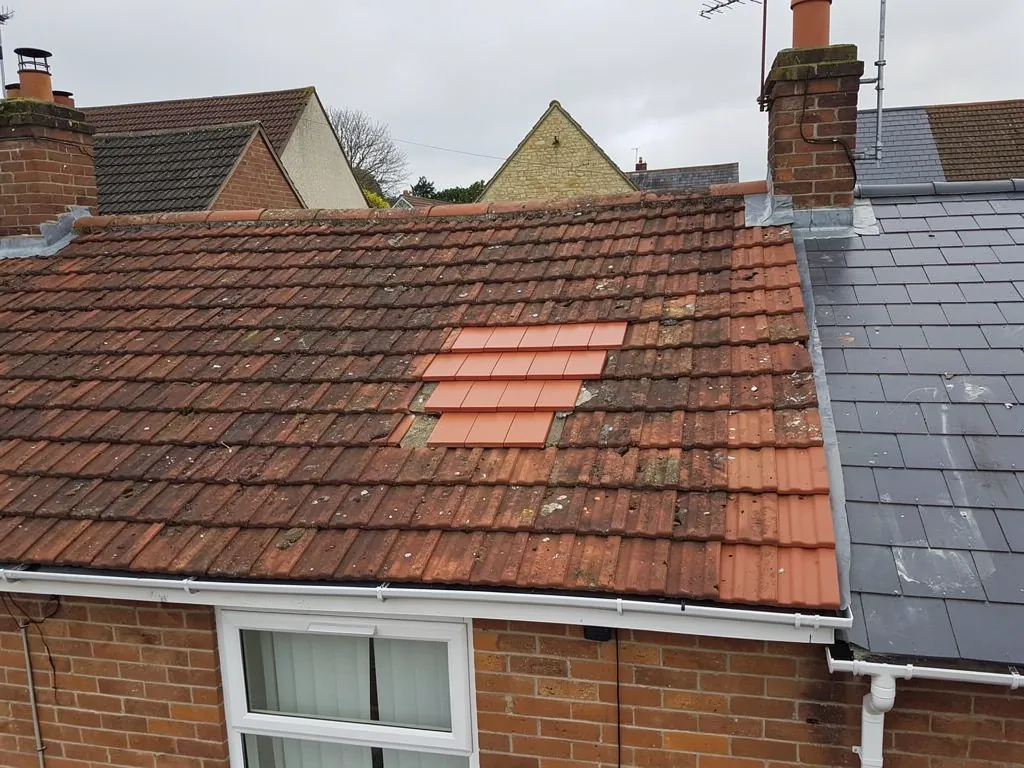
Yes, a roof can be replaced in winter. Roofers work through the colder months, and plenty of re-roofs are done between October and March because the old one has failed, not because anyone chose the season. What winter changes is the rhythm of the job. There are fewer hours of daylight, more days when the work stops, and any slope exposed to the sky has to be covered with more care.
The question usually comes from one of two directions. Either a roof has started leaking and the owner wonders whether to wait for spring, or a job is booked and the forecast has turned. The answer to both depends on the roof, the covering and the weather on the actual day, not on the calendar.
This guide covers the days a winter job stops, what wind does to a stripped slope and a scaffold, which materials need more care in the cold, what it is like to live in the house, and how to plan a start date. It is part of our roof replacement service. What the work costs is settled by the survey and the written quote, not by the month on the calendar.
The days a winter roof job stops
A roofer will lay a roof in cold, dry weather without a second thought. What halts the work is wet, wind and ice. A slope with its old covering stripped off and its new underlay not yet fixed is the one place on the building that cannot be left to the elements, so the crew works to a plan that never has more of the roof open than it can close by dusk.
Heavy rain stops most coverings going on, since tiles and slates are fixed to dry battens and a soaked deck is no place for new felt. Strong gusts stop work for a different reason: lifting sheets and tiles at height is dangerous when they can catch the wind, and materials can blow off the scaffold. Ice on the slope or the boards stops work on the same basis. The decision to stand down is the roofer's, made on site, and a good firm makes it without argument.
What a lost day really costs
On a job that lasts a week or two, a handful of lost days is normal in winter. Most owners worry about the roof being left open, but the larger cost is the scaffold standing longer. Licences run for fixed periods, and the answer on rain during a roof replacement explains how a firm protects the roof when the weather turns mid-job.
It helps to ask three questions before you book. How much of the roof will be opened at a time? What will cover it overnight? And what will the firm do if the forecast turns before the roof is finished? A clear answer to each is a good sign. A vague one is worth noting.
Wind, sheeting and a bare slope
Wind is the winter problem that matters most, and the coast has plenty of it. A strong blow does two things to a re-roof in progress. It makes the work at height unsafe, and it tugs at anything that is loose, including underlay waiting for its battens, bundles of tiles on the scaffold and any sheeting that has been fixed to the poles.
Marley points out that on slopes below 30 degrees the windward side can be hit by strong suction. Think of a bungalow, a lean-to or a low extension roof, where the wind lifts the covering instead of pressing it down. It is also why the fixings are specified roof by roof, and why a careful firm will not walk away from a newly laid slope with its fixings still to come.
Wienerberger states that each single-lap tile needs a minimum of one mechanical fixing,, and BS 5534 governs how slating and tiling are fixed. Tiles are normally clipped or nailed as they go on, not afterwards, so a gale blowing in after dark meets a finished slope and not a loose one.
Scaffold with sheeting acts as a sail in strong wind. Whether the sheets stay on, and how the scaffold is tied to the building, is a matter for the scaffold firm, which has its own rules for gales. If you see a scaffold behaving badly in a blow, say so to the roofer at once.
What lies under the covering, whether insulation, boards or old felt, also affects how much has to be protected on each day.
Scaffold licences and winter start dates
Scaffold is where winter weather turns into money. Section 169 of the Highways Act 1980 forbids scaffolding that obstructs the highway unless the highway authority has licensed it, and that takes notice. West Sussex wants 10 working days at least between applying and putting poles up; a month costs £266, and a one-working-day fast track adds £52. Hampshire wants ten clear working days, asks £211.90 for the opening fortnight and offers no extensions.
Those lead times have a practical effect. A start date in November is arranged in October. If bad weather then runs the job past the licence end date, West Sussex charges £335 unless the extension was requested beforehand. Hampshire has none, so the scaffold has to come down when the licence ends and be licensed afresh to go back up. A firm that knows this builds a margin into the dates, and you should expect to be told about it.
Scaffold hire and the weather
Checkatrade's October 2026 scaffolding table shows around £800 a month for a terrace, £875 for a semi-detached house, £1,000 for a detached bungalow and £1,200 for a detached house. Because hire is charged by the month, a job that stretches through a wet fortnight is the one most likely to cross into a second month.
Our page on scaffold licences in West Sussex sets out the process and the fees. Portsmouth is its own highway authority; ask the scaffold firm what the city council requires.
Ask your roofer what happens to the date if the licence runs short, and whether the quote allows for it.
Materials that mind the cold
Most pitched coverings are laid dry, with each tile or slate nailed or clipped to a batten, and the cold changes little about them beyond making fingers slower. Other parts of a roof are less forgiving, and your roofer should name them for you.
Lead is one. Working it in low temperatures is a subject of its own, covered in our page on leadwork in cold weather. If your valleys, flashings and stack collars are lead, ask the roofer how they will be sequenced against the forecast.
Anything laid wet needs the most thought. GRP, the fibreglass system, is brushed on wet and sets where it lies. Wet products need conditions that suit their manufacturer's data sheet, and a firm that ignores the sheet because the programme is tight is not one to hire. EPDM, a synthetic rubber laid in one sheet, and felt each have their own working conditions too, set out on their sheets and not in a general rule of thumb.
Dry-fix and bedded ridges
The ridge is the capped line along the summit. A bedded ridge sits in mortar; a dry-fix one is held by screws and clips. BS 8612:2018 covers the testing of dry-fix kits. With less wet mortar in the job there is less to schedule around the weather, although either system has to be fixed to the maker's instructions. Our ridge tile repairs page covers the choice.
The honest approach is to ask the roofer which parts of your roof are weather-sensitive and how they will be handled.
Living in the house with the roof open
Most households stay put during a re-roof, winter included. The work is noisy, because old tiles come off and battens are nailed on, and there is dust from the loft as the covering comes away. Your own part is small: clear the loft of anything you care about, move cars away from the eaves, and bring washing in.
The practical winter difference is warmth. Ask how the section being worked on is covered while it is open, and expect the loft to be draughtier than usual until the new underlay is down. Our answer on living at home during a re-roof covers noise, dust and where to be when a slope is open.
Insulation and Part L in the cold months
Winter is when thin insulation shows itself, and many owners ask about topping it up while the roof is open. Insulation is bound up with the Building Regulations. Approved Document L (2021 edition) asks for a renovated roof worse than 0.35 to be upgraded towards 0.16, and that upgrade duty applies where renovation reaches over 50 per cent of one element. The Planning Portal gives two limits for skipping a building control application, under 25 per cent of the building envelope and under 50 per cent of the roof. Arun, though, lists re-covering on its own building control page, so put the question to the council, or to a registered approver, before you start.
If insulation goes in, the VAT treatment depends on whether the job is a single supply, and the quote should explain it. The standard VAT rate is 20 per cent. The zero rate for installing energy-saving materials is due to end on 31 March 2027, after which it reverts to 5 per cent.
Planning a winter job around a leaking roof
Many winter re-roofs begin with a leak. If water is coming in tonight, the priority is not a re-roof. It is limiting the damage: buckets under drips, belongings moved, photographs taken. Which? advises calling your insurer promptly, and IStructE calls photographs of the damage and of any temporary covering vital evidence. Receipts matter too. That holds whoever ends up doing the work.
We put leaks and storm damage first on the diary and make the roof safe before talking about anything bigger. The verdict comes next: mend, patch or replace. If a patch holds until a drier spell and a proper job, that is the recommendation. If the covering is spent, the recommendation changes, and the answer on the best time to replace a roof looks at timing in more detail.
What to ask before booking in winter
Ask how much of the roof is opened at a time, what covers it overnight, who files for the scaffold licence and for how long it runs, and what happens to the dates if the weather keeps the crew off the roof. Find out whether the price covers scaffold and VAT, so that two quotes are comparable.
You get pictures of your own roof with the survey; the quote is in writing and gives a single total, and we price it fairly. A winter start is perfectly workable when the plan allows for the weather, and the plan is what you are paying for as much as the tiles.
Questions
Winter re-roofing questions
Would January be a poor month to book a new roof?
Not if the roof needs doing. The risk lies in the plan more than the month: how much roof is open at once, how the work is covered overnight, and what happens to the scaffold licence when weather costs days. A firm that answers those clearly can work through winter. One that cannot is the problem, whatever the season.
Should I wait until spring if my roof is leaking now?
Not without making it safe first. Limit the water, photograph the damage, call your insurer, and keep the paperwork for any temporary repair. A repair or patch may see the roof through to a drier period, and the survey will show whether it needs replacing at all. Waiting with an open leak risks wet timbers and ceilings.
Do winter delays add to the cost of a new roof?
They can, mainly through scaffold. Hire is charged by the month, and West Sussex lists £335 for a late extension to a scaffold licence while Hampshire grants none. Ask whether the written quote allows for weather days and who pays if the scaffold has to stay up longer, so the answer is on paper before the work starts.