
Leadwork in winter · 9 min read
Leadwork in winter and wet weather
Lead can be laid in poor weather, but not every job should be. This guide sets out what rain, frost and wind change on a leadwork repair, and how to judge whether a repair should go ahead or be held back.
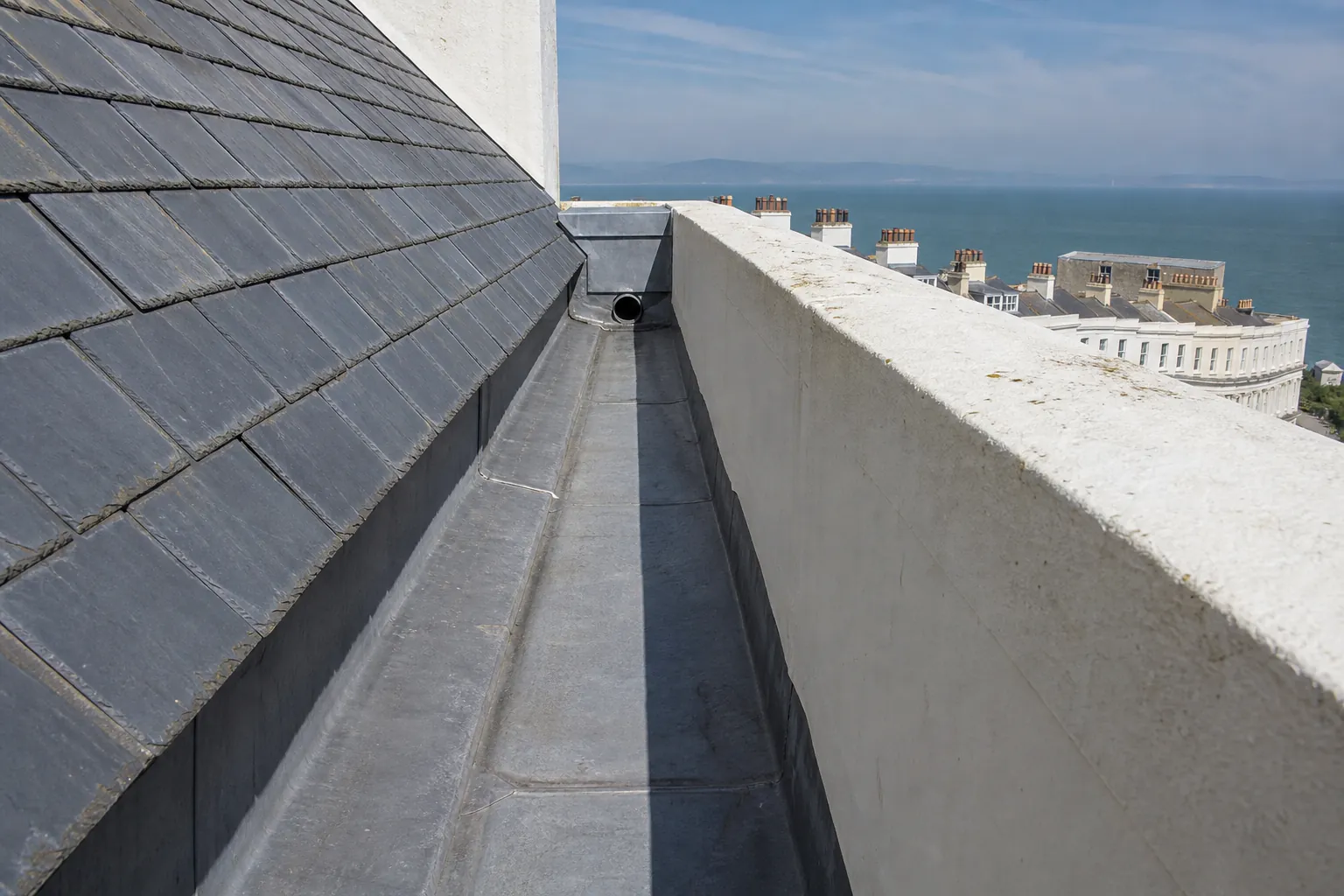
Lead rarely fails on a calm, dry afternoon. It fails when a gale has lifted a flashing, when a week of rain has found a gap or when frost has loosened the pointing that held an edge in place. So the people who need leadwork most often need it in the worst weather to do it.
That puts a roofer in a position that is easy to misread. There are two bad answers. One is to refuse everything until spring and leave you with water coming through the ceiling. The other is to rush a permanent repair onto a wet roof so that it fails the next time the weather turns. The right answer sits between them, and it depends on what the weather is doing and what the repair needs.
Along the Sussex coast, low winter sun, sea weather and gales are part of the year, and a good plan allows for that. This guide takes the conditions one at a time: cold, wet, frost and wind. It then explains what a temporary measure can do and when the lasting repair should wait. It is general advice about how leadwork behaves, not a fixed rule, and the decision on a particular roof comes from looking at it.
Why the weather matters more with lead
Lead is forgiving in some ways. It is soft, it can be shaped by hand and it holds its shape once dressed. But a leadwork repair is a sequence of small jobs, and the weather interferes with several of them at once.
First, the repair opens the roof. To renew a flashing, the old lead comes out, the wall chase is cleaned, the substrate is checked and the new sheet goes in. While that happens, the joint is exposed. A sudden shower on an open chase sends water straight in behind the lead, and the work then closes over wet materials.
Second, many of the things that hold lead depend on dry conditions. Sealants, mortars and coatings all come with data sheets that set limits on temperature and surface moisture. If the data sheet says a surface must be dry and above a certain temperature, then a damp, cold roof is the wrong place to use it, whatever the roofer would like. We follow the maker's instructions for each product, and the limits differ from one to the next.
Movement is a year-round fact
Lead expands as it warms and shrinks as it cools. A flashing is cut and clipped with that movement in mind, and the same rule applies whatever the season. Fixing lead in cold weather does not change the design, but it does mean the sheet will grow in the following summer. Clips that allow for movement and rolls that stop sheets creeping are part of every sound detail. Our guide to lead clips explains what they do.
The question for any winter job is therefore not whether lead can be worked in the cold. It is whether the substrate, the fixings and the access are all fit for the day.
Rain, damp timber and trapped moisture
Rain is the biggest single problem for leadwork, and not only because it makes the roof slippery. The danger is moisture that gets locked in. Lead is a metal sheet, and once it is dressed over a damp timber deck, a damp wall chase or a wet batten, the water has nowhere to go. It sits under the sheet, and the timber starts to decay out of sight.
What we check before laying
Before new lead goes down, the surface it sits on needs checking. The timber should be sound and dry to the touch, with no standing water, no soft patches and no fungal growth. Where a leak has been running for a while, boards and battens beneath old lead are often damp, and renewing the lead without dealing with them means a second visit. If the timber is wet but sound, it can be left to dry under cover before the lead goes on. If it is rotten, it comes out.
Brickwork and chases matter too. A chase cut into a wet wall will not hold pointing or sealant well, and a flashing tucked into it can be undermined within a season. Pale damp patches on the wall, or salts blooming on the brick, tell you the wall is wet and may need time or attention first.
Rain can also ruin the finish. Coatings such as patination oil need a clean, dry sheet, so that stage is left until the weather allows. Our guide to patination oil explains why.
None of this means every drop of rain stops the work. A light shower on a short job with a tarpaulin ready is different from an afternoon of heavy rain. The rule is that the lead is never closed over wet material, and an exposed joint is never left open overnight.
Frost, cold mornings and pointing
Frost causes two different problems for leadwork, one on the surface and one in the joints.
Ice underfoot
The first is safety. Frosted slates, tiles and lead sheet are slippery, and a roof that looks dry at nine o'clock can still be glazed in the shade of a chimney or a gable. A cold roof is a reason to start later or to wait, because a fall from a pitched roof is a far bigger problem than a delayed repair. Frost is also a matter for the scaffold, where boards and ladders ice over.
Mortar and wet joints
The second is the pointing that holds lead in a wall chase. Fresh mortar that freezes before it has set can crumble, lose its bond and fall out in the next few months. This is one of the reasons many roofers prefer to hold the top edge of a flashing with lead wedges first and finish the pointing only when the weather suits. Our short answer on lead wedges shows how they work. Tiles that have taken in water and then frozen can also crack, which is why a hard frost often shows up as a rash of broken tiles beside a repair. See our page on frost damage to roof tiles for the signs.
A stretch of frost does not rule out leadwork altogether. Lead can often be fitted and held mechanically while the mortar stage waits, and a sealed, wedged edge is a perfectly sound way to carry a roof through a cold week. The final pointing is then done when the temperature allows. Where a roofer tells you the pointing will be done later, ask when and what holds the edge in the meantime.
Look at the forecast as a whole, not the day. A mild afternoon followed by a freezing night is the worst case for fresh mortar, even if the work itself went well.
Gales, wind and big sheets of lead
Wind is the third condition, and on a coastal roof it is always part of the plan. Bognor, the Peninsula and the harbour villages take real sea weather in autumn and winter, and a gale can turn a loose sheet of lead into a sail.
Why a flashing lifts
Wind gets under any edge that is not held down. A flashing with a slipped wedge, a missing clip or a gap in the pointing can lift, fold back and flap against the wall, and each movement works it a little looser. It can tear completely if the gust is strong enough. Many winter call-outs for leadwork begin like this: the roof was fine in the summer, a gale took hold of a loose edge, and rain followed.
The same force acts on the repair. A big sheet being carried across a roof or held in place for fixing can catch the wind and pull away from the person holding it. That is a safety problem as much as a quality one. On a gusty day, the sensible choices are to cut sheets smaller, to fix as you go, or to stop. Scaffold sheeting and ladders add to the load, and a roof ladder on a pitch in a gale is a poor place to be.
Reading the day
Gusts, not the average wind, set the limit. A day that looks fine from the ground can have sharp gusts at roof level, especially close to the sea or on an open estate. We watch the forecast for the job and the hour, and we stop when conditions say so. No single wind-speed figure fits every job, because the right call depends on the roof, the access and the sheet being handled.
After a gale, check the lead from the ground. If a flashing is lifted or a piece is lying in the garden, our guide on checking a roof after a storm shows what to look for without climbing.
Making a leak safe now and fixing it properly later
The most useful split in winter is between making a leak safe and making the permanent repair. They do not always happen together, and they should not be confused.
The make-safe visit
When water is coming in, the first job is to stop it and protect what is underneath. That might mean a temporary cover over an open joint, a protected patch over a split, or dry-fixing a lifted flashing so it cannot flap. Leaks and storm damage take priority, and stopping the water comes ahead of any permanent work. A temporary repair buys time, but only for a while: tape peels, tarpaulin flaps and sealant cracks. Our page on temporary roof repair explains how long such a repair can reasonably be left, and our page on roof repairs in winter covers the wider picture.
The lasting repair
The permanent leadwork is planned for a window when the weather allows it. That window need not be spring. A run of dry, mild days in January is as good as any. What matters is that the substrate is dry, the access is safe and the sealants, mortars and coatings can do their work. If the leak is small, the lead is sound and the temporary cover is holding, waiting a few weeks costs little. If the lead is worn or the timber is wet, waiting may cost more.
Our verdict has three possible answers. It can be a repair, a patch to carry the roof through the bad weather, or a replacement of the lead. Photographs from the survey show the reason, and the quote you receive is written with one total. The job in winter is the smallest one that holds, and if a lasting repair can safely wait, you will be told.
The same thinking applies to flat roofs. See our page on flat roof winter repairs for how that works, and our lead roofing and leadwork page for the lead work we carry out.
Questions
Winter leadwork questions
Can lead flashing be replaced in the rain?
It is possible on a short job under cover, but it is rarely the best choice. Rain wets the chase and the timber under the lead, and the repair closes that moisture in. A temporary cover to stop the leak is the better step in heavy rain, with the permanent flashing renewed when the substrate is dry.
Does cold weather make lead brittle or likely to crack?
Cold itself is not the usual cause of cracking. Cracks tend to come from repeated movement as the lead warms and cools, particularly where sheets are too long or fixed too rigidly. A well-clipped flashing with rolls or drips to control movement can be laid in winter and will expand through the following summer.
How long can a leaking lead flashing wait for better weather?
It depends on how much water is getting in, what is underneath and how well the temporary cover holds. A small, controlled leak can often wait a few weeks, but wet insulation and timber get worse the longer they stay wet. Photographs from a survey help decide, and stopping the water comes first.