
Terraced house re-roofing · 9 min read
Re-roofing a terraced house: scaffold, access and the neighbours
How a terrace re-roof differs from a detached one: scaffold on the pavement, shared walls and stacks, slate or clay on older rows, and the courtesy owed to the neighbours either side.
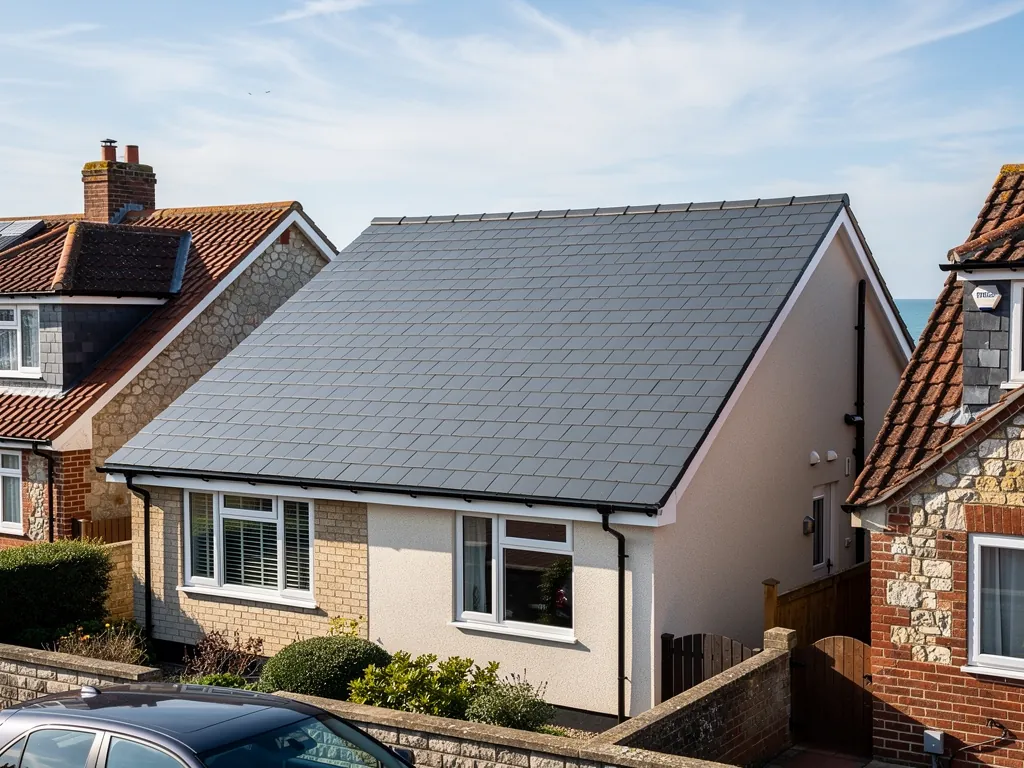
A terraced house is a roof in a queue. Yours sits between two others, the pavement may run right under the eaves, and the back may only be reachable through the house or down a shared alley. None of that stops a re-roof. It does mean the job is planned around access and the neighbours at least as much as around the tiles.
Terraces in Bognor take several forms. Arun District Council's conservation area papers call The Steyne an area of modest terraces dating from the 1820s, two and three storeys high with bays and balconies, and call Aldwick Road a run of early 19th-century, Victorian and Edwardian terraces. Whatever the street, what they share is a roof that touches someone else's.
What follows covers scaffold and the licence it can need, party walls and shared stacks, the coverings that suit older rows, and what the national cost guides publish. It sits within our wider roof replacement service. The numbers are typical UK ranges. Your own survey gives the real figure.
Why scaffold decides a terrace job
A detached house has room for its scaffold on its own ground. A terrace often has the poles on the footway, and a front elevation with nowhere else to put anything. So the scaffold becomes a larger share of both the price and the programme.
Checkatrade's October 2026 scaffolding table lists around £800 a month for a terraced house, against £875 for a semi, £1,000 for a detached bungalow and £1,200 for a detached house. Treat those as middle-of-the-road figures; a three-storey terrace on a steep street will not behave like the average.
Section 169 of the Highways Act 1980 bars anyone from keeping scaffolding that obstructs the highway without a licence. Allow for the notice. In West Sussex the county council sets a minimum of 10 working days from application to erection, with £266 payable for a month, and sells a one-working-day fast track at £52 extra. Over the border, Hampshire sets ten clear working days, £211.90 for a first fortnight, and nothing in the way of extensions. For a terrace in Portsmouth, the city council acts as the highway authority, so ask the scaffolders what it needs.
What the licence period means for the roof
A licence runs for a fixed period, and overrunning costs money: West Sussex lists £335 for a late extension. A realistic start date therefore leaves slack for the weather. Our page on scaffold licences in West Sussex walks through the application, and the answer on scaffolding for a roof replacement deals with the money. If the scaffold is already up for the roof, the same access can serve a stack, a gutter or a bay, which is an argument for deciding those jobs together.
Party walls, parapets and the line between roofs
Every terraced roof is its own roof, yet each one shares walls with its neighbours. Where a slope reaches the dividing wall, rain must be shed without finding a way into either house, and that junction relies on metal flashings, not on tiles.
Some terraces have parapets, low walls that stand proud of the slope at the gable or the front. The roof lining runs up the face of such a wall and is sealed with lead. Lead arrives in numbered codes that stand for thickness. Royston's cast-lead brochure confines code 3 to soakers and starts its flashing codes at 4. A soaker is a small folded lead sheet, one per course, tucked beneath the tiles where the slope meets a wall.
The Planning Portal says Building Regulations approval always applies to the removal of a chimney breast, since it forms part of the structure. A breast on a party wall also calls for a party wall notice. Even an ordinary re-roof can touch the shared line, so tell the people next door before the poles go up.
Next door's roof may be in worse shape than yours. New tiles beside old ones will show from the street, which is no fault in either, but the line between them should be dressed with care and the survey should record how it stands. Owners of neighbouring houses who want work done around the same time can talk to each other about sharing the scaffold and the delivery, though each house is still its own contract.
Chimney stacks that serve more than one house
On many terraces the stacks sit astride the dividing wall, each flue belonging to a different house. Chimneys get a mention in Arun's appraisals of both The Steyne and Aldwick Road, as features of the skyline. They are also the tallest and most weathered part of any terraced roof, and where a stack meets the slope it is sealed with lead.
MyJobQuote, in a guide last updated on 22 September 2026, gives £150 to £250 for patching a stack's leadwork, and £350 to £460 for renewing it all when no scaffold is needed, climbing to £700 to £920 when it is. The gap is access, and it explains why a terrace re-roof is a sensible moment to deal with a tired stack: the scaffold is up anyway.
Pots, flaunching and flashings
Flaunching is the sloped mortar cap that anchors the pots and throws water clear of the stack top. The flashing is the lead collar between stack and slope. Both deserve a look once the old covering is off, because a leaking stack shows up indoors as a brown patch upstairs and is easily put down to the tiles. Our chimney repairs hub describes each part, and lead roofing covers the flashings.
Think twice before taking a stack down. A chimney breast needs approval to remove, and one on a party wall needs a conversation with the neighbour as well. The sequence is set out in chimney removal.
Tell us at the survey which stacks you want looked at while the poles stand. The written quote then covers them inside its single total, and you are not left guessing what was in or out.
Slate, clay and what an older terrace expects
The coverings seen on older rows are not accidental. In Aldwick Road Arun finds stucco, slate and flint everywhere, and regrets that modern interlocking concrete tiles often sit where slate once did. Its advice for The Steyne is to put natural slate or plain clay back where something modern has displaced it.
If your terrace lies in a conservation area, the choice of covering becomes a talk with the council before it is a purchase. Putting back the same material seldom needs planning permission, though a change that alters how the street looks may, and listed buildings need listed building consent for anything touching their character. Our guide to re-roofing a listed building lays out the routes. Before ordering tiles, put the question to Arun's planners.
Cost and life of the covering
Natural slate costs more on day one and lasts longer. CORC puts well-kept slate at 100 years or longer. In Checkatrade's slate table, last updated in September 2026, slate comes to £160 to £210 per square metre and slate roofers to £280 to £360 a day. Concrete interlocking tile is lighter and cheaper, and Marley expects it to give around 60 years while adding that this is no guarantee.
Swapping between heavy and light coverings alters the load on the rafters. The Planning Portal puts a covering that adds 15 per cent or more to the weight under building control, and recommends that an engineer or surveyor looks first if the new load differs a great deal. Bay roofs on older terraces are often small and lined in lead, and they need the same attention as the main slopes.
Working in a row: dust, deliveries and neighbours
A terrace re-roof is a public event. Old tiles come down, new materials go up, and the people either side hear every minute of it. A few habits make that easier on everybody.
Speak to the neighbours first. Give them a rough start date, how long the work is likely to run, and a number to ring if something looks wrong. Where the back garden is reached through the house or down a shared passage, agree the route beforehand. Where kerbside space is tight, a delivery of tiles needs somewhere to stop, and the delivery driver needs to know where.
Rubbish goes off site and the street is left tidy, which on a narrow road needs thought as well. Our answer on living at home during a re-roof says what the household can expect, including noise and the days when weather interferes.
Wildlife under the tiles
Roosting bats and occupied nests are protected in law, and opening up a loft-side slope is exactly when either could be found. Tell the surveyor about droppings or flutter in the eaves, because early warning saves a stalled job.
Comparing two quotes
Before you compare two prices, ask whether each includes the scaffold, the licence and VAT, and whether the work covers the stacks and the party wall junctions. Our visit starts on the roof, with pictures and a plain verdict on what it needs. The quote we write afterwards carries one total, and we price it fairly.
Costs, VAT and doing the whole row
For the roof itself, the useful national ranges are those for roof replacement in general. Checkatrade's guide, updated in October 2026, quotes an average near £8,000 with most jobs between £4,000 and £19,000, and a figure near £12,000 for a three-bedroom semi. Checkatrade's scaffolding table puts a month on a terrace at around £800, updated October 2026.
National figures say little about what makes a terrace distinct: scaffold on the footway, a stack astride the party wall, slate that has to match, a dividing wall that needs fresh flashing. Ask the surveyor to say which of those apply to your house, because each one moves the total in its own way, and to put the answer in the written quote.
The standard rate of VAT, 20 per cent, applies to a re-roof. Some quotes include it and some leave it out, so find out before you compare. Government guidance on energy-saving materials allows a zero rate for insulation in roofs or lofts until 31 March 2027, but whether a mixed job qualifies hinges on how it is supplied, and the quote should explain the treatment.
Whether to do the whole row or only your own house is a matter for the neighbours. A joint job can share scaffold costs, but every house keeps its own contract and its own price. The survey of your roof decides what yours needs, and nobody has to match the house next door.
One more practical point: ask for a start date that leaves room for the licence period and for weather. A fixed date that ignores both is a promise that tends to be broken.
Questions
Terraced house re-roof questions
Do I have to arrange the pavement scaffold paperwork on a terrace myself?
Ask your roofer; the quote should say who files it. Hampshire County Council spells out that the scaffold firm, not the householder, applies for its customer. West Sussex wants at least 10 working days' notice and Hampshire ten clear working days, so the start date has to allow for the wait. Ask the firm to confirm the licence is in hand before you fix a date with anyone.
Can I re-roof my half of a terrace without touching next door's roof?
Each house has its own roof, so you can. The part needing care is the junction at the party wall, where the flashing must be redone cleanly beside the neighbour's older covering. The survey should record that line. Raise any shared stack early, because a stack can involve the neighbour as well as you.
My terrace sits in a conservation area: does the new roof need permission?
A matching replacement does not normally call for planning permission. A conservation area adds care over materials, and a listed building needs consent for work affecting its character. An Article 4 direction can also withdraw rights across a defined area. Arun's planners can say what applies to your street before you order tiles.