
New slate roof cost · 8 min read
How much does a new slate roof cost in the UK?
Typical UK prices for stripping a roof and laying a new slate covering, drawn from published per-metre rates for natural and Spanish slate and the costs around them.
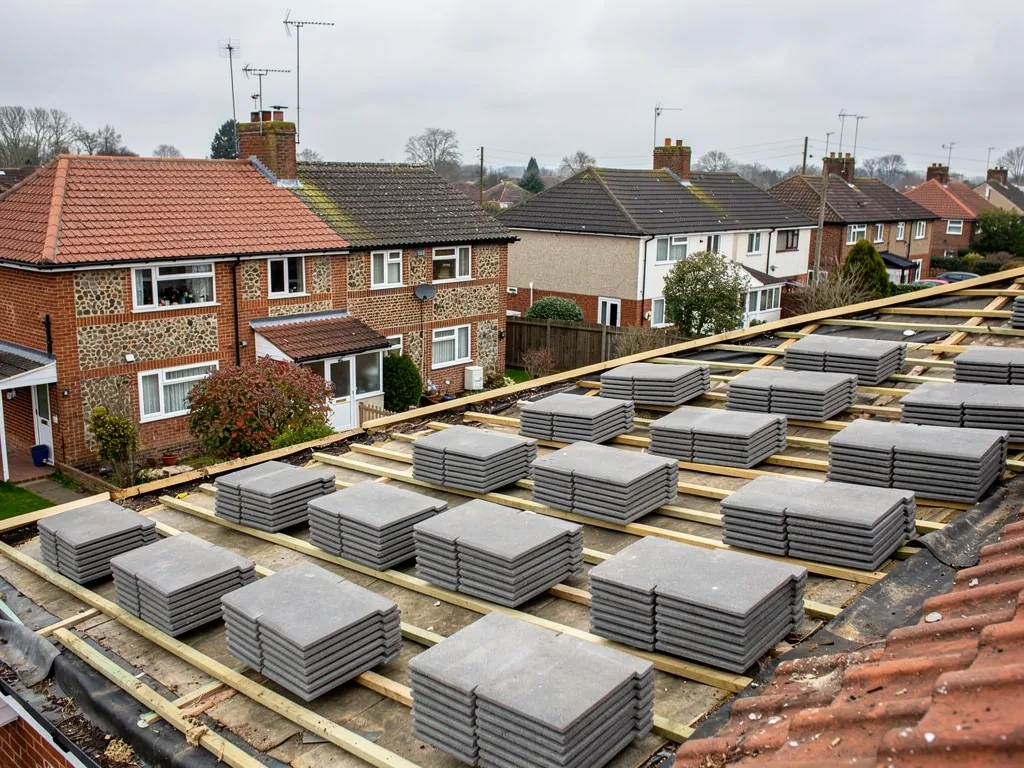
A new slate roof is among the larger bills a house can produce, and for many owners it is the only one they will ever pay. Slate costs more to lay than concrete tile, and it lasts longer, so the sum is not just what the job costs today but how many decades you get out of it.
This guide sets out the national figures, with a named source and a date beside each, and then shows how a bill is built up: the slate itself, the labour of fixing it, the scaffold that makes the work safe, and the tax on top. The numbers are typical UK ranges for an ordinary house. A roof with many hips, valleys, dormers and chimneys costs more than a plain gable, and no national average can price yours.
Think of the figures as a yardstick for sense-checking a quotation. The one that counts arrives in writing once somebody has been up on your roof, backed by photographs and ending in a single total.
The typical UK price per square metre for slate
Checkatrade, in a slate roof cost guide whose table was last updated in September 2026, puts natural slate at £160 to £210 for each square metre, averaging £184. It prices Spanish slate, the cheaper import, at £95 to £125 per square metre. Both rates are for the covering, measured over the sloping area of the roof and not the footprint of the house.
Picture a roof with 50 square metres of slope. At the natural slate rates the covering comes to £8,000 to £10,500. At the Spanish slate rates it comes to £4,750 to £6,250. That arithmetic only illustrates the guide. A real roof is measured on site, and the answer shifts with every hip, valley and dormer.
Treat the figures as a starting point, because a rate per metre never says everything a price must cover. Put the same question to every roofer about what the number covers: stripping and disposing of the old covering, new battens and underlay, ridge and verge finishes, lead flashings, access and VAT. Two quotes that look far apart are often just two different scopes of work.
Several things push a slate bill up or down before the slate is chosen. Hips, valleys and dormers each add cutting and lead. A steep slope slows the work and may call for extra access. Every chimney needs its own flashings. And what the stripped roof reveals counts too: tired battens or soft timber under the old slates are replaced before the new covering goes on, and that is only known once the old roof is off.
For the area rates in more depth, our answer on slate roof cost per square metre goes through them.
Spanish slate, natural slate and what the gap buys
The gap between the two rates is wide. On that 50 square metre slope it runs to thousands of pounds, which is why Spanish slate gets suggested so often. It is genuine natural slate, quarried and split like any other, and it sells at a lower price than the premium stone.
What the money buys is not always visible from the pavement. Slates differ in thickness, in how evenly they split, in how steady their colour stays, and in how they weather over decades. A cheaper slate can make a perfectly good roof, and an expensive one can be a poor match for the building. The sensible question to ask a supplier is what a given slate is rated for and what it will say about its working life.
Where the choice matters most
On a house in a conservation area, or a listed one, the council may expect a particular kind and size of natural slate. Around The Steyne and Waterloo Square, Arun's conservation guidance asks for original slate or clay to be reinstated where something unsuitable took its place. In those streets the price per metre is the smaller part of the decision.
Our guide to Welsh against Spanish slate compares the two for look, quality and fit, and man-made slates, which cost less again, are a different trade-off altogether. Whichever you choose, ask to see a sample slate in daylight before the order goes in, because colour under a showroom bulb can mislead.
What sits around the slate in the price
The slate is only one layer. A slate roof is a system and every part has a cost. The battens are the timber strips the slates hang from. The underlay is the membrane under them. Lead flashings seal the joins against walls and chimneys. Ridge and hip pieces cap the apex and the angled corners. Along a gable end, the verge is the edge where the slates finish against the wall.
Under BS 5534 as revised in 2014, a mortar bed alone has stopped being trusted for the top courses, so each ridge and hip piece is fixed mechanically too. That adds a little to the labour and a good deal to the life of the finish. Lead has its own cost, sold by a thickness code. Code 4, for example, is the lightest the Royston Lead brochure lists for flashings.
Labour and day rates
Checkatrade quotes £280 to £360 as the going day rate for a slate roofer. Slate goes on slower than concrete tile because each piece is fixed by hand, so labour takes a bigger share of the total than on a tile roof. A larger or more complicated roof takes more days, which is exactly where a plain roof and a fussy one part company.
Be wary of a very low price for slate. When the labour or the materials sit far below the published rates, something has usually been left out or skimped, and a slate roof laid badly costs a great deal to put right. A fair price for a good job is the target, not the lowest number on the table.
Some older slates are worth saving. When a roof is being stripped, sound slates can be sorted, cleaned and laid again, with new ones mixed in for the broken few. That suits a building where the original look matters, and it can lower the materials bill. It slows the labour, though, since every slate is checked by hand, so the saving is real but smaller than the slate price alone suggests.
Scaffolding, licences and access
A full re-roof cannot be done safely without proper access, and for a house that means scaffolding. For a two-storey semi, Checkatrade's scaffolding table, last updated in October 2026, shows around £875 a month. Terraces come in nearer £800, detached bungalows at £1,000 and detached houses at £1,200, and a scaffold just for the chimney adds roughly £660 a week.
Poles that block a pavement or a road need a licence under section 169 of the Highways Act 1980, which the highway authority grants. The West Sussex county council wants a minimum of 10 working days and charges £266 for a month. Across the border, Hampshire's rule is ten clear working days between application and start, and the fee is £211.90 for the first fortnight. For a Portsmouth street, the city council as highway authority is the body to ask.
The notice period matters when a roof is already leaking. A temporary repair can keep the weather out while the licence is processed. It matters at quote stage too, because some prices include the scaffold and some do not, and a price that omits it will grow when the scaffold arrives.
Before choosing between quotes, find out which of them has scaffold, waste removal and VAT inside the total.
VAT, Building Regulations and insulation
Re-roofing attracts VAT at the standard 20 per cent, and cost guides do not always say whether their figures already include it, so ask. Any insulation in the job may be taxed differently, depending on how the work is supplied, and the written quote spells out the position.
The Building Regulations come into a full re-roof as well. Under Planning Portal guidance, building control approval is normally unnecessary where less than 25 per cent of the total building envelope and less than 50 per cent of the roof are affected. Arun District Council's own building control page, though, names the recovering of pitched and flat roofs as approval work, so the council, or whichever building control body you use, should confirm the position for your job.
Thermal upgrades, weight and pitch
Approved Document L can bring the thermal limits into play where more than half the roof surface is renovated, and stripping a covering is exactly that kind of job. A change of material also affects weight. Approval comes into play when the new covering weighs 15 per cent or more beyond the old, and the Portal advises a structural check before the heavier material arrives. Replacing slate with concrete tile is the textbook example.
Slate also has a minimum pitch. Cupa Pizarras points out that BS 5534 indicates a floor of 20 degrees for natural slate in moderately exposed spots, and advises against hook fixings on anything under 25 degrees. A shallow roof may call for a different covering or fixing, and that changes the price.
Lifespan, and whether a slate roof pays back
People accept the higher price because of how long the covering lasts. Well-kept slate reaches 100 years and more, according to CORC, and Checkatrade agrees that stone slate may last more than a hundred. Neither is a promise: a roof laid poorly, or never looked at, will fall short. For comparison, Marley's figure for concrete tile is around 60 years, and it stresses that this is not a guarantee.
Set against a covering that might need replacing within your time in the house, slate can be the better buy even when the first bill is larger. Sound slates can also be reclaimed, so a roof being stripped may be relaid in part, which pulls the cost back towards a repair.
Repair first, where it will hold
If your roof is slate already, a new roof is not always the answer. Slipped slates, a handful of cracked ones or tired flashings can often be put right for far less. A roofer climbs up, records the fault in photographs, and says whether it needs mending, a temporary fix or a new covering. Our guide to the signs a slate roof is failing explains what separates a repair from a replacement.
Our slate roofing page explains the work we do. When the survey is finished, you get a quote on paper with one total.
Questions
Slate roof price questions
Is a Spanish slate roof as good as Welsh?
Spanish slate is a natural slate, and it costs less per square metre. Welsh slate carries a higher reputation and is often expected on older and protected buildings. Either can make a long-lived roof when it is laid well, so the choice turns on the look, the building and the budget.
Does a new slate roof price include scaffolding?
Not always. Scaffold is often a large part of the bill, and some quotes leave it out. Check each quotation for scaffold, any highway licence, disposal of the old covering and VAT, so the totals can be compared fairly.
Why do two slate quotes differ by thousands?
Usually the scope, the slate or both. One may use Spanish slate and the other natural, one may include scaffold and new lead while the other does not, and a complicated roof takes more days than a plain one. Ask both to confirm what their total covers.