
Damp chimney breast · 9 min read
Damp chimney breast: causes and cures from the roof side
A brown patch on the chimney breast is usually water that found a way in higher up. This guide shows how to read the stain, which roof-side faults cause it and what the cure involves.
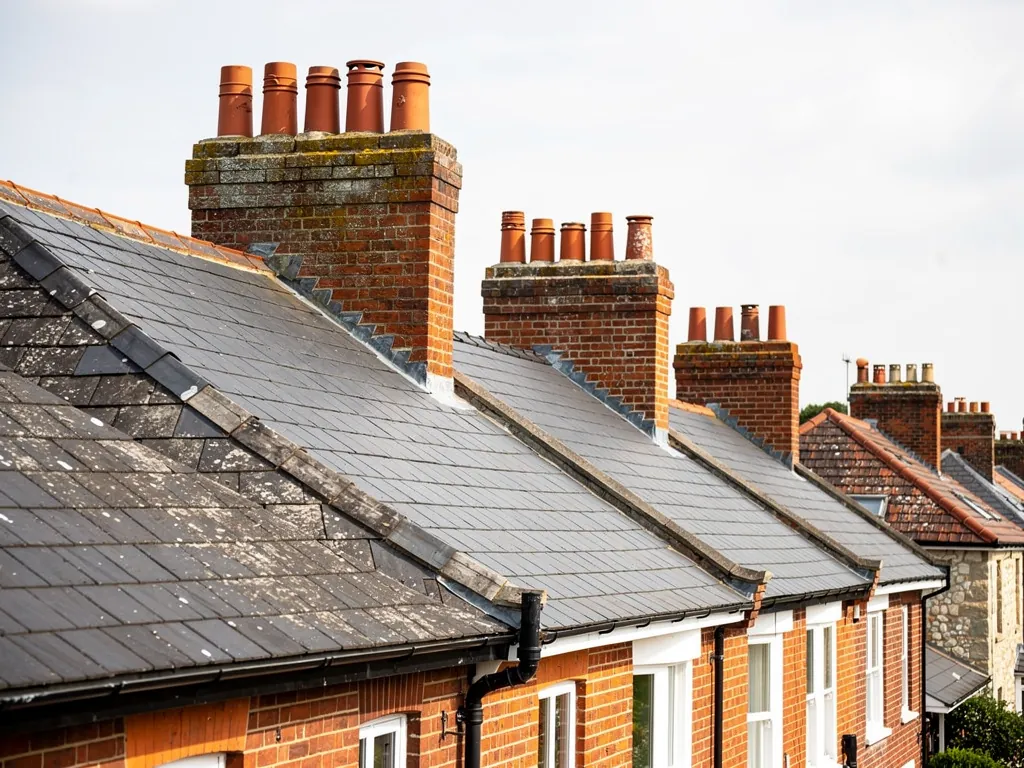
A damp chimney breast is one of the few household stains that points straight at a place. Water does not travel far sideways through brick, so a mark on the wall in the living room or the bedroom above it usually has a source on that same line, somewhere between the fireplace and the top of the stack.
That source is often outside. A flashing that has lifted, a crown of cement that has cracked, a pot that has loosened in its bed or a run of mortar that has washed out will each feed rain into the brickwork. Sometimes the cause sits indoors instead, in condensation on a cold flue wall. The trick is to tell which, because the cures are completely different and decorating over the top of either fails within a season or two.
Below we take the clues one at a time, starting with what the stain itself is telling you. Then come the roof-side faults, the checks you can make safely from the loft and the ground, and typical prices from national cost guides. We finish with the point at which the breast itself, rather than the roof above it, becomes the job.
Everything here is general guidance. Your own stack may need only a small repair.
Reading the stain before you touch the roof
Start with when the damp shows. A patch that appears after a day of driving rain and fades in dry spells is almost always rain getting in. A patch that stays put through a dry fortnight, or that comes and goes with cold nights rather than wet days, points the other way, towards condensation or old moisture trapped in the masonry.
Then note where it sits. On a ground-floor breast, a stain low down near the hearth suggests a different story from one high up near the ceiling, because water takes a long route through the stack and can emerge a long way below where it entered. In the bedroom, a mark just under the ceiling line often matches a fault at roof level, while a stain that starts at the loft floor and spreads down is worth tracing upwards.
Colour, texture and smell
Brown tide marks with a darker edge are the classic sign of repeated wetting and drying. Powdery white crystals on the plaster or brick are salts that the water has carried out of the masonry and left behind as it evaporated. Peeling wallpaper, blistered paint and a damp, earthy smell all point to a wall that has been wet for some time.
Black speckling is a different matter. Mould tends to settle where a wall stays cold and the room air is damp, and that again leans towards condensation.
Photograph the stain now, with something in the frame for scale, and again after the next wet spell. Two pictures a few weeks apart tell a roofer more than any description, and they help if a storm turns out to be the cause. If the mark is spreading quickly, treat it as a leak and have the roof looked at promptly rather than waiting to see.
The roof-side causes: flashing, flaunching, pots and mortar
Where the chimney leaves the roof, four parts do the waterproofing. Any one of them can let water in.
The flashing is a band of lead that closes the gap where the stack meets the tiles. It steps up the side of the brickwork, tucked into cut mortar joints, and a small gutter behind the chimney carries water round the back. Lifted edges, cracks at the folds or gaps where the lead has pulled out of the joint let rain run behind it and into the brick.
The flaunching is the sloping cement bed on the top of the stack. It grips the pots and sheds water outwards. Cement cracks with age and frost, and once the crown is split rain goes straight down the flue walls. The pots themselves can loosen in a failing bed, and a cracked pot lets water into the flue.
Finally there is the brickwork. Mortar joints that have eroded, particularly on the exposed face of a stack, let water soak into the brick rather than shed it.
How long the lead should last
MyJobQuote (guide updated on 22 September 2026) gives well-fitted lead a working life beyond 80 years. If a flashing has failed far sooner than that, the cause is usually how it was fitted, a hard-set sealant line instead of a proper tuck into the joint, or movement in the stack beneath it. The Royston Lead brochure lists code 4 as the lightest sheet for flashings, with code 3 recommended for soakers only. Soakers are little folded lead pieces that sit between the courses of tile. Our guide on chimney flashing goes through that part in detail.
Damp that is not rain: condensation and the unused flue
Not every damp breast has a roof fault above it. A flue that is no longer used behaves differently from a working one. With no fire burning, the stack stays cold, the flue fills with still air, and damp from the house settles as condensation on the cool masonry. The stain then shows up on the room side of the breast, usually worst in colder months, and it can appear with no rain in sight.
Capping the top of an unused chimney keeps rain out, but a sealed flue with no air movement can make this worse. The usual approach is a cap or cowl that keeps the weather out while letting the flue breathe, or a vent into the flue at the base. Our guide to chimney pots, caps and cowls covers the choices at the top.
Telling the two apart
A few quick questions help. Does the stain follow the weather or the temperature? Is the flue ever used, or has a gas fire or stove been fitted into it? Is the room well ventilated? A stack that is wet on the outside face at roof level, or that shows damp in the loft as well as in the room, is more likely to have a water-entry fault.
If you have a stove or a fire that you do use, have the flue swept before you chase a roof fault, because soot and debris can hold moisture against the lining. Ask whoever sweeps it what they see inside. A sweep and a roofer deal with different faults, so ask which one you need.
Where a roofer finds nothing wrong outside, say so plainly and point you back to ventilation. We would rather tell you that than sell a new flashing the stack does not need.
Safe checks from the loft and the ground
You can learn a lot without climbing anything. Never go on the roof yourself to look at a chimney. A slipped tile, a wet slope and a leaning ladder are a poor combination, and a roofer will take photographs of every part anyway.
From the garden or the pavement, use binoculars or a phone on its zoom setting. Look for lifted or missing lead round the base of the stack, white crust or dark streaking down the brick, mortar that has fallen away, a pot that sits at an angle and a crack across the cement crown. Compare the stack with its neighbour, because a pair of semi-detached houses often shows the same detail done two ways.
From the loft
If the chimney passes through your loft, take a torch and study the brickwork at the point where it passes through the roof. Staining on the timber nearest the stack, dark patches on the underlay round it or damp insulation beside it all say water is arriving at the joint. Do not walk on the ceiling joists unless boards are laid.
Check the breast on every floor if you can. A damp patch that shows at each level, in line with the flue, tells you the water is getting into the stack itself rather than into one room.
Write down what you find with dates. When you call a roofer, ask them to photograph the same spots from the roof so you can compare their pictures with yours. That comparison is what lets you judge the verdict instead of just accepting it.
If you hear water, see it dripping or find a wet ceiling, put a bucket under it, move belongings and arrange a visit promptly.
What the repair involves and what it costs
The repair follows the cause. A split crown is broken out and re-laid. A loose pot is lifted and re-bedded. A failed flashing is stripped back to the brick and dressed again in new lead, with the top edge tucked into a cut joint rather than sealed with mastic. Eroded joints are raked out and repointed.
Published prices give a sense of scale. MyJobQuote, last updated on 22 September 2026, sets a patch on chimney lead at £150 to £250 and a full replacement of that lead at £350 to £460 without scaffolding or £700 to £920 with it. Checkatrade's October 2026 table gives an average near £750 for repointing a chimney. Treat those as national ballparks, not a figure for your stack.
The gap between the two lead figures is access. Checkatrade's scaffolding table, last updated in October 2026, gives a chimney scaffold at around £660 a week. A scaffold that stands over the footway needs a highway licence beforehand, which adds waiting time.
One written price
The survey leads to a written quote carrying a single total. Our prices are good and fair. Whichever roofer you ask, ask if the total takes in VAT and scaffolding, and what they saw up there, because a lower number saves nothing when the scaffold appears afterwards.
Many of these repairs are small. A short run of lifted lead is a different job from rebuilding a stack, and we aim to do only the work the stack needs. Read our guide to chimney repair cost, or see the full chimney repairs service.
Drying out, redecorating and when the breast itself is the job
Once the water entry is stopped, the wall still holds what it has absorbed. Brick and plaster can take a long time to dry, and the stain may linger or even look worse for a while as salts migrate to the surface. Resist the urge to repaint at once. Fresh paint over a damp wall blisters, and a stain-blocking primer only hides a problem that may still be active.
A sensible order is to fix the roof side, then let the wall dry through a spell of ordinary weather, then watch the patch. If it does not grow after the next wet period, the repair has worked. Brush off any salt crust, let the plaster dry fully, and redecorate with a paint that lets the wall breathe. If plaster is crumbling or has gone soft, it will need cutting back and replastering.
When the breast is coming out
Sometimes the damp is the prompt for a bigger decision, such as taking the breast out to gain floor space. The Planning Portal says Building Regulations approval always applies when chimney breasts are removed, as the breast is structural. A breast shared with a neighbour on a party wall also calls for a party wall notice. Speak to your building control body before work starts.
Removing a breast means supporting the stack above, and if the stack is no longer wanted it often comes down entirely, with the roof made good. In a conservation area, check the council's position on stacks first.
Do not remove the breast to cure damp. Fix the water entry first, then decide on the layout.
Questions
Damp chimney breast questions
Can a damp chimney breast be cured from inside the house?
Only if the cause is indoors, such as condensation on a cold, unused flue. When rain is getting in at the flashing, crown or pot, treating the wall from inside hides the stain while the water keeps arriving. Find the entry point first, repair it, then let the wall dry before any redecorating.
Does a damp patch mean the whole stack needs rebuilding?
Rarely. Most damp chimney breasts trace back to one worn part, such as lifted lead or a cracked crown. Rebuilding is for a stack whose brickwork has failed or that has started to lean. Our survey photographs say which it is before any price is given.
Is it safe to light the fire in a chimney breast that is damp?
Ask a sweep or a qualified fitter before you do. A wet flue and a blocked or broken liner both change how the chimney behaves. Fix the water entry, have the flue swept and inspected, then decide whether to use it. Do not seal the top of a working flue.