
Leaking conservatory roof · 9 min read
Leaking conservatory roof: repair or replace?
Where a conservatory roof leaks, how to tell a leak from condensation, which repairs last, and the signs that a new roof will cost you less than another winter of patching.
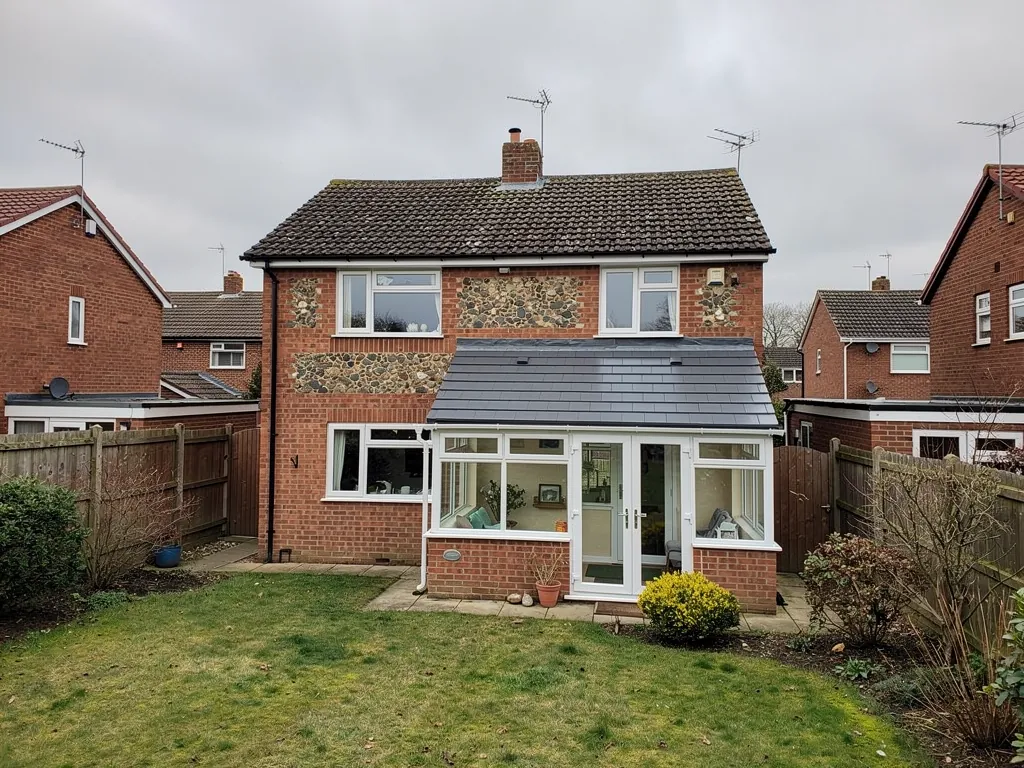
A drip into a bucket in the conservatory is easy to notice and hard to place. Water runs along bars and seals before it falls, so the spot where it lands can be a metre from the spot where it came in. Many owners lose a winter to the wrong repair for exactly that reason.
The question underneath the drip is always the same: will a repair hold, or is this roof finished? The answer depends on a short list of things. Where the water is entering. What the infill and the seals look like close up. Whether the frame is sound. And how many repairs the roof has already had.
This guide goes through the usual leak points, explains how to separate a true leak from condensation, and sets out what a lasting repair involves compared with a stop-gap. It ends with the signs that point to replacement. Nothing here replaces looking at your roof. On the survey we get up there, photograph the fault and put a verdict in writing: repair, patch or replace. Our conservatory roof replacement page covers the wider job.
Where a conservatory roof lets water in
A conservatory roof is a series of joints held together by seals. Water finds the weakest one. Working from the house outwards, the usual suspects are these.
The junction with the house wall
At the wall of the house, a lead strip known as a flashing is dressed over the bars and tucked into a cut groove in the brickwork. Once the lead lifts or splits, or the pointing around it gives way, rain runs behind it and into the room. It is one of the places owners miss, because it is high and out of sight. Lead flashing can last for over 80 years according to MyJobQuote, so a failed one is usually a fixing or pointing problem and not worn-out metal.
Bars, caps and gaskets
Along each bar, a rubber gasket or a cap seals the gap between the bar and the panel. Rubber hardens in sun and frost, shrinks and pulls away. Caps crack or work loose. Water then tracks down the bar, which is why the drip often lands in the middle of the room and not at the edge.
The ridge, hips and valleys
The ridge crowns the roof, a hip is the sloped outer corner of a faceted roof, and a valley is the inward angle where two slopes drain into each other. Each is a junction with more sealing than a plain run of bar, so each is a likelier place for a failure than the flat of a panel. We have a separate answer on leaks at the ridge.
Leak or condensation: how to tell
A wet patch is not always a leak. Conservatories collect condensation because warm, damp air meets cold glass or plastic, and the moisture runs down the inside of the roof and drips off the bars. It looks like a leak, and many owners spend money sealing a roof that was never admitting rain.
A few clues separate the two. Condensation shows up on cold, still mornings and after a shower or a day of drying washing in the room. It appears across a whole panel and not at one spot, and it often dries by lunchtime. A true leak follows the weather: it drips during or just after rain, in the same place each time, and it gets worse in wind-driven rain that is pushed up under the joints.
Try this on a dry day. Look along the underside of the bars for dark staining, which tells you a gasket has been letting water through for some time. Check the house wall inside the room just below the roof line for a damp stain, which suggests the flashing and not the panels. And look between the layers of any glass unit: moisture that has crept between two panes is a failed seal. It will not drip, but it will not clear, and it is neither a leak nor condensation in the room.
If the drip only appears on cold, still mornings and the panel is wet across its whole width, suspect condensation before you suspect the roof.
Condensation has its own causes and cures, including ventilation and the type of roof, which we cover in our answer on a conservatory roof that drips with condensation.
Repairs that last
A lasting repair deals with the cause and not the stain. The ones that hold are usually modest and specific.
Replacing hardened gaskets and cracked caps along the affected bars is the commonest. It takes a short time on a sound frame and brings the seal back to a state where it can do its job. If the lead flashing at the house wall has lifted, it can be re-dressed, re-pointed into its groove and sealed, or replaced with new lead where it has split. Checkatrade's June 2026 table prices lead flashing repairs at £50 to £70 per metre, excluding VAT, as a national guide, though a conservatory flashing is a small run in an awkward position and the real cost depends on access and condition.
One panel, not the whole roof
A cracked or slipped panel can often be replaced alone, provided the replacement matches and the bars around it are sound. A single clouded polycarbonate sheet is a different matter, because its neighbours are the same age and will soon follow. Our answer on replacing a single panel sets out what to check first.
Guttering
Water that overflows the gutter at the eaves can run back under the roof edge and look like a leak above. Clearing the gutter or correcting its fall can be all the repair needed. Manufacturers' guidance for plastic guttering gives a fall of roughly 1:600 to 1:350 depending on the system, so a gutter that sits dead level or tilts the wrong way will hold water.
A lasting repair sounds unexciting, but it is the job we steer you towards when it will do.
Repairs that only buy time
There is a second kind of repair, and it is worth recognising before you pay for it. Silicone smeared along the length of a bar will stop a drip for a few weeks. Sealant tape over a crack, a bead run around a failing cap, a dab on a hairline split: these are patches. A patch can be sensible on a roof already nearing the last stretch of its service, but they are not the same as a fix.
Sealant fails for good reasons. Glazing bars move with temperature, and a rigid bead cracks along the line of movement. Silicone does not bond well to old, dirty or wet surfaces, and a bead put over a failed gasket hides the problem without curing it. Worse, sealant can trap water. If the bead blocks the path by which the bar is meant to drain, the water goes sideways, into the frame.
Patching makes sense in two cases. One is a roof at the end of its life that you plan to replace in spring, where a careful patch keeps the room dry meanwhile. The other is a temporary seal while a part is on order. In both, you should know the patch is a patch.
The question to ask any roofer is simple: is this repair meant to last, or to get me through the winter? We state which it is in the verdict and mark it clearly on the survey photographs, so you are paying for a repair and not a promise.
When the same area has been sealed more than once, it is usually worth stopping to ask whether the roof itself is the issue.
When replacing the roof is the sounder answer
Replacement is the right answer when the repairs have stopped being repairs. Several signs point that way together.
- The roof has leaked in more than one place, or has been sealed more than once in the same place.
- Panels are clouded, cracked or scratched, or polycarbonate sheets have gone brittle. Published guides give around 10 to 15 years for a polycarbonate conservatory roof, so a roof older than that is living on borrowed time.
- Glass units have misted between the panes, which means the seals have failed.
- The bars are corroded, the gaskets crumble when touched, or the frame has moved so the joints no longer meet.
Any one of these may be repaired. Several at once add up to a roof that has done its work.
What replacement can look like
A new roof does not have to mean the same roof. The choice among plastic, glass and a solid tiled roof is covered in our guide to glass, polycarbonate and tiled conservatory roofs. If you change to a solid roof, the Planning Portal points out that a replacement roof has to satisfy Building Regulations, which affects the programme. A like-for-like change to the same type of infill is a simpler job, although it is worth asking building control what applies to your project.
The cost of replacing is set out in our guide to the cost of a conservatory roof. Set it against the cost of another winter of patches, buckets and damp, and the sum often leans the same way.
Making it safe, and talking to your insurer
If water is coming in now, deal with the room first. Move furniture, electrics and anything that can stain. Put a bucket or tray under the drip. Never step onto a conservatory roof to look at it, since the panels will not take a person's weight and a fall through one can cause serious injury. If you must check, use binoculars from the ground or a window.
A temporary cover is the next step: a tarpaulin or sheeting over the area, fixed so it will not flap, can keep a room usable until the repair. We prioritise leaks, and we make safe the area under a leaking roof before anything else. A temporary cover is not the repair, and it needs to come off or be replaced when the proper job is done.
Insurance
If the leak followed a storm or a sudden event, tell your insurer before arranging repairs yourself. Which? advises keeping receipts for any emergency work and photographing the damage, and the Institution of Structural Engineers also stresses photographs. Which? treats a leak through a poorly kept roof as wear and tear, which insurers treat differently from a sudden storm event. It also cites Financial Conduct Authority figures showing only 32% of storm-related claims made in 2024 ended in a payout. A complaint goes to the insurer first and, if unresolved, to the Financial Ombudsman Service, which is free.
Your policy wording decides what is covered, and that conversation is between you and your insurer. What we provide is the survey photographs and a written, dated record of the condition of the roof, which you may find useful when you talk to your insurer. Our answer on whether home insurance covers a conservatory roof goes into this further.
Questions
Conservatory leak questions
Why does my conservatory roof only leak in strong wind?
Wind drives rain sideways and upwards, and it pushes water past seals that cope perfectly well with rain falling straight down. It points to a gasket, cap or flashing that is only just failing. The place the water appears may be well away from where it entered, so look along the bars on both sides.
Will sealant fix a leaking conservatory roof for good?
Rarely. Sealant can stop a drip for a while, but bars move with the weather and a rigid bead cracks along the line of movement. It bonds poorly to dirty or damp surfaces, and it can hide a failed gasket. Treat it as a patch to get through winter unless the survey shows it is all the roof needs.
Could the damp patch on the house wall be a conservatory roof leak?
It could. A stain on the house wall just below the roof line often points to the lead flashing where the conservatory meets the house, not to the panels. Water runs behind a lifted or unpointed flashing and shows on the wall inside. Photographs from a ladder or tower show whether the lead has lifted.