
EPDM rubber roofing · 9 min read
EPDM rubber roofing: how it is fitted, how long it lasts and what it costs
EPDM is a rubber sheet that covers a flat roof in a single piece. Here is how it goes down, where it goes wrong, how long it should last and what UK cost guides publish.
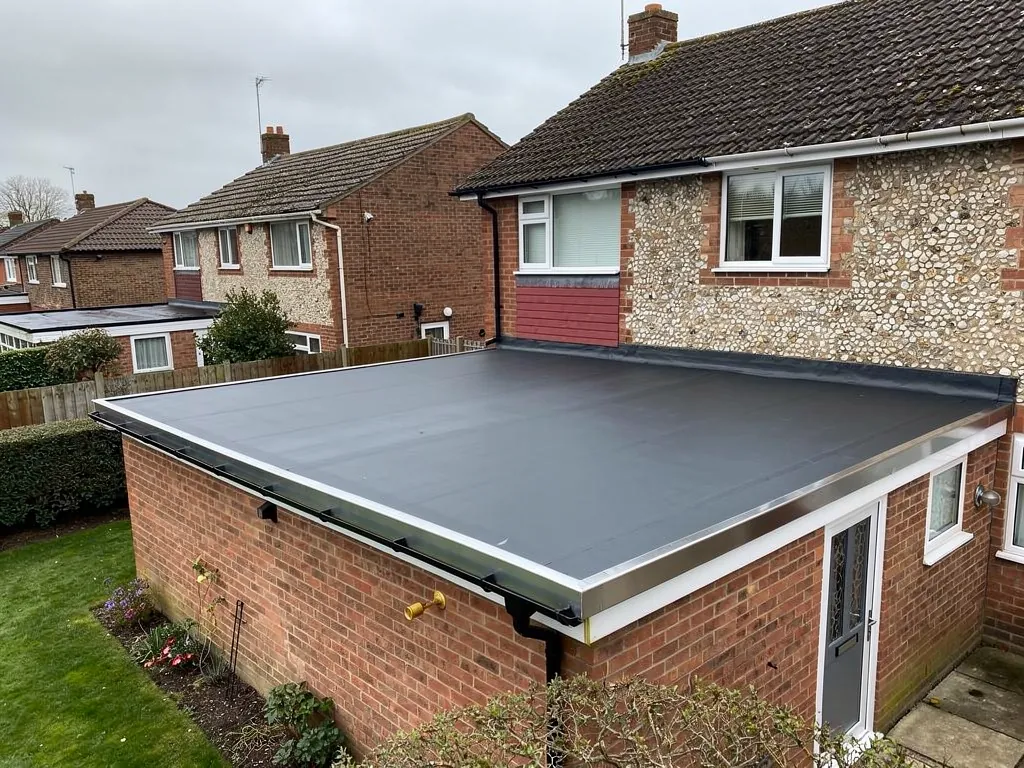
EPDM is the black rubber sheet you see on garage roofs, extension roofs and the flat tops of porches. It arrives on site rolled up, gets cut to the roof, stuck down and finished at the edges with trims. Done well it is quiet, neat and light on joins, which is why many flat roof specialists reach for it first.
It is not the answer to every flat roof. A membrane is only as good as the deck under it, the falls that carry water away and the details at every wall, outlet and edge. A good sheet laid on a soft, ponding deck fails just as surely as a poor one.
Below you will find what the material is, how a roofer lays it, the places it tends to fail, the lifespan figures published by third parties and the typical UK costs. Each figure carries its source and date. They describe the national market, not your roof. Your real price comes from a survey of the roof you actually have, and the quote written from it.
What EPDM is and why roofers choose it
The letters stand for ethylene propylene diene monomer, a synthetic rubber. Manufacturers roll it into a sheet and sell it as a single-ply membrane, meaning one layer does the waterproofing instead of the several stuck-together layers a felt roof uses. The sheets come wide, so many small roofs can be covered with no join across the middle at all. A garage, a dormer top or a kitchen extension often needs just one piece.
That matters because joins are where flat roofs leak. Every seam is a line that has to stay sealed through years of heat, cold and movement. Fewer seams means fewer places to check, and when a roofer does have to join two sheets, the join is made with purpose-made tape or adhesive supplied by the manufacturer.
The rubber also stays flexible. A timber deck swells in a wet winter and shrinks in a dry summer, and a stiff covering can crack along those movements. A rubber sheet stretches with them, which suits the timber extensions and garages that make up so much of the flat roofing around Bognor.
Where it suits and where it does not
EPDM suits plain rectangular roofs and roofs with a few outlets and upstands. An upstand is the short vertical section where the membrane turns up a wall. It is less comfortable on roofs full of awkward junctions, such as a dormer cheek with several cut corners, or a busy roof terrace with constant foot traffic. Those cases call for a conversation about GRP or a built-up felt system, and our guide to EPDM, GRP and felt compared sets the three side by side.
How an EPDM roof is fitted, step by step
A tidy EPDM job starts well before the rubber comes out of its packaging. The order of work is what separates a roof that lasts from one that blisters at the first hot week.
Preparing the deck
The roofer strips the old covering where it has failed and checks what is underneath. The deck is the sheet material or boarding that carries the roof, and it has to be sound, dry and clean before anything is stuck to it. Soft or stained boards are cut out and replaced. If the roof holds water, new firrings go down. Firrings are tapered timbers that build a slope across the deck, and they are the usual cure for ponding.
Laying the sheet
Where the roof is insulated, the insulation boards are laid first and the membrane goes over them, which is the arrangement known as a warm roof. The sheet is unrolled and left to relax so it settles flat. It is then folded back and stuck to the deck or the insulation with adhesive, working in sections so there are no trapped air pockets. Some systems use ballast or mechanical fixings instead, and the manufacturer's instructions decide which applies.
Corners, upstands and edges
The finishing is where skill shows. Corners are folded or made up with preformed pieces so the rubber is not stretched thin. The sheet is turned up the wall as an upstand and sealed under a flashing, the strip of metal that stops water running behind the membrane. At the roof edge an aluminium or similar trim holds the sheet and throws water clear into the gutter. Outlets and pipes get their own collars. A neat edge also decides how the roof looks from the street.
Where EPDM roofs go wrong
Rubber that has failed usually tells you why, and the causes are few.
Standing water is the first. A roof that does not drain leaves puddles on the membrane for days, which loads the deck, collects debris and speeds up the wear of every seam under the pool. BS 6229:2025, which replaced the 2018 edition in December 2025, keeps a minimum finished fall of 1:80, and roofers design for something steeper, around 1:40, so water keeps leaving the roof after the deck has settled. Our guide to flat roof falls and drainage explains how a fall is built.
Punctures come next. Rubber is tough but it is not armour. A dropped tool, a satellite dish bracket, a ladder foot or a heel of a boot on a sharp stone can cut it. Roof ladders and boards protect the surface, and anyone going up for a gutter clean or an aerial fitting needs to treat it as a waterproof layer rather than a floor.
Poor adhesion is the third. If the deck was damp or dusty when the sheet was stuck down, the bond fails in patches and the rubber lifts. Gales then catch the raised area and work at it. That is why the dry spell for the work and the condition of the deck matter so much.
The last cause is the details. Failures cluster at corners, around outlets, under badly dressed flashings and along edge trims that were left loose. Wind-driven rain on this coast finds an unsealed upstand quickly. When we survey a leaking EPDM roof, the repair is often at one of these points rather than out across the sheet, which is why a patch can be the straight answer where a whole new roof would be overkill.
If puddles are still on the roof the day after rain, tell your roofer before any repair is priced. Ponding changes the job.
How long an EPDM roof lasts
Published lifespans for EPDM are wide because the sources measure different things and different workmanship. GreenSpec, a UK building materials guide, gives an expected service life of 20 to 30 years for single-ply membranes of this type. Less, in its flat roof cost guide last updated in March 2026, puts EPDM at 30 to 50 years. A fair summary is 20 to 30 years or more, with the upper end belonging to roofs that were laid on sound decks with proper falls and neat details.
Treat those as typical ranges and not promises. A manufacturer's warranty is a separate thing from a lifespan: it states what the maker will do if the product itself fails, usually under conditions about the installer and the deck. It does not say how long your roof will last in practice.
Several things cut a lifespan short:
- a deck that stays damp or rots from below
- ponding that is never cured
- repeated foot traffic on an unprotected sheet
- edge trims and flashings that were never properly fixed
- debris left to build up around outlets
Several things help it along. A clear outlet, a quick look over the roof after a storm and a wipe-down of leaves before they rot cost almost nothing. Our answer on how long an EPDM roof lasts goes into the signs of age in more detail.
Near the sea, the practical risks are wind and debris more than the rubber itself. Gales lift anything loose and throw grit and twigs onto the surface. A roof that is checked after a rough spell is cheaper to look after than one found only when the ceiling stains.
What an EPDM roof costs
National guides do not give a single EPDM price, so the fair approach is to show the pieces that exist. Checkatrade gives repair rates per square metre for each covering. Its table is dated June 2026, and it says every figure excludes VAT:
| Flat roof covering | Typical repair cost per m² |
|---|---|
| Bitumen felt | £100 to £140 |
| EPDM rubber | £120 to £170 |
| GRP fibreglass | £130 to £180 |
For small repairs, the Less guide quotes £150 to £500 for a patch, a re-dressed edge or a sealed split. For a whole new flat roof, Checkatrade's replacement table, last updated in October 2026 and headed as plus VAT, gives £2,800 to £7,500 across flat roofs generally. That range covers all coverings, so it describes the market and not EPDM in particular.
What moves the price
Size is the obvious driver, but access, the state of the deck and the insulation specification matter as much. A roof that needs the deck replaced costs more than one that only needs recovering. A roof above the ground floor may need scaffolding. Checkatrade's scaffold table, dated October 2026, shows about £875 per month where the house is a two-storey semi. Scaffold that sits over the footway needs a highways licence from the highway authority, and your roofer can say who handles the paperwork.
Standard VAT is 20 per cent and easy to miss, so ask each roofer if the figure on the page has it in. Our quote arrives in writing once we have seen the roof, as a single total, and fair pricing is how we work. The national figures for a whole new flat roof are in our other cost guide.
Insulation, approval and choosing a roofer
Under Approved Document L of the Building Regulations, stripping off and renewing a flat roof's waterproof layer is classed as renovation. The 2021 edition requires the thermal element to be upgraded when more than 50 per cent of its surface is renovated, and re-covering a whole small roof will usually pass that line. The 2026 edition takes effect on 24 March 2027 with the same triggers. This is why a new EPDM roof is often specified with insulation under it, laid as a warm roof.
The Planning Portal says a re-roofing job does not normally need a building control application where less than 25 per cent of the total building envelope is affected and less than 50 per cent of the roof surface is involved. A wider view comes from Arun District Council: its building control pages name re-covering of flat and pitched roofs as work needing approval. Ask the council's building control team or a registered building control approver what your job needs. Where notification is required, we deal with it for you, and we also explain the insulation choice and how it affects the finished build-up and the edge heights.
Questions worth asking any roofer
- Is the deck being inspected and, if needed, replaced?
- What fall will the finished roof have?
- Is insulation included, and to what standard?
- Does the price include VAT and any scaffold?
- How are the corners, upstands and edge trims being finished?
Photographs of the actual fault tell you more than a phone estimate does. Our survey photos come with a written quote, and we give a plain verdict: patch it, re-cover it or replace the deck. The advice is always the smallest job that really cures the problem, and we leave the site clear and carry the waste off. For the wider picture, our flat roofing page covers every covering we work with.
Questions
EPDM roofing questions
Can a damaged EPDM roof be patched instead of replaced?
Often, where the rest of the sheet and the deck are sound. A puncture, a lifted corner or a failed seam can be cut out and repaired with a stuck-down patch. The Less guide gives £150 to £500 for small flat roof repairs. If the deck is soft or the roof ponds, a patch will not hold and re-covering is the better sum.
Is a black rubber roof hot in summer?
The sheet does warm in strong sun, and a dark surface takes more heat than a pale one. What matters for the room below is the insulation under the membrane, which is why a warm roof build-up is common on new work. Ask for the insulation to be named in the written quote.
How should I compare an EPDM quote with a felt quote?
Check that both cover the same area and the same deck work, and whether each includes VAT, scaffolding, insulation and edge trims. The cheaper figure on paper is not the cheaper roof if one leaves out the new deck or the falls. Ask each roofer what fall the finished roof will have.