
Repair or replace · 10 min read
Flat roof repair or replacement: how to decide
How to tell whether a flat roof can be mended or needs a new covering, from the symptoms you can see to the age, deck, falls and cost figures that settle the question.
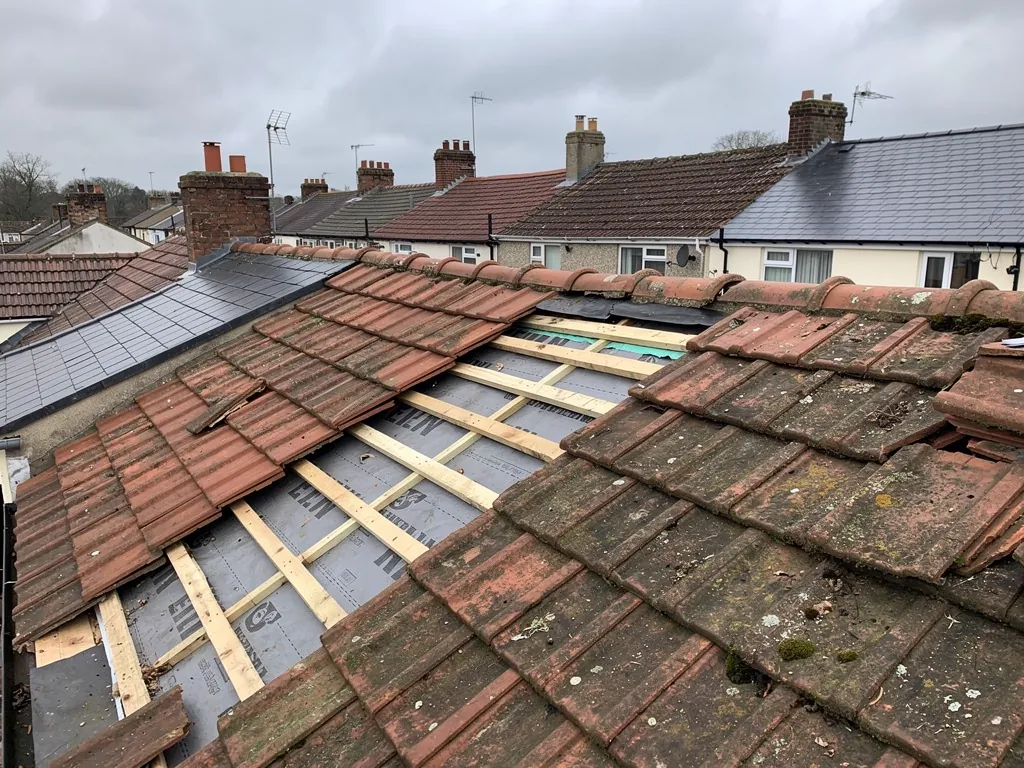
A flat roof starts leaking and the first instinct is to call whoever can patch it fastest. Sometimes that is the right move. A split along a seam or a lifted edge can be sealed in an afternoon and left to do its job for years. Other times the same patch buys a few weeks, and the roof fails again at the next downpour, because the problem was never the hole. It was the age of the covering, or the state of the boards under it, or the way the roof holds water.
The choice between repair and replacement is where a roofer's advice counts most, and where a homeowner is most exposed to a roof they do not need, or a patch that was never going to hold. This guide sets out the questions that decide it, in the order we ask them, with the national figures for cost and lifespan alongside.
None of it replaces looking at the roof itself. Photographs of the actual fault, the view from the room beneath and the state of the edges tell us more than any rule of thumb. What the rules of thumb do is help you understand the verdict when you receive it, and judge whether it sounds right. For the money side of a full replacement, see what a flat roof costs, and for our own work see flat roofing.
Where the water is coming from decides everything
Before anything else, find out whether the leak is one fault or a symptom of a tired roof. Water on a flat roof rarely appears where it enters. It runs along the deck or the insulation and drops out somewhere convenient, often well away from the real opening.
A single, findable cause points towards repair. The usual candidates are a split at a seam or joint, a blister that has burst, a failed seal around a pipe or rooflight, a lifted edge trim or a blocked outlet. Each can be put right locally, and if the surrounding covering is sound, the repair has every chance of lasting.
Several leaks at once, or a leak that moves each time the roof is patched, point the other way. They suggest that the covering has lost its grip across a wide area, and that sealing one spot only pushes the water to the next weak one. Tracing the entry point properly means checking seams, edges, outlets and penetrations in turn.
What to note before anyone visits
Write down when the leak appears: only in heavy rain, only after a dry spell, or all the time. Note where the stain sits on the ceiling and whether the room below is a bathroom or kitchen, where condensation can mimic a leak. Photograph the roof from a window if you can do so safely. Do not climb onto a flat roof to look, because old coverings can be slippery and boards underneath can be soft.
A roofer who asks these questions first is already working towards a straight verdict rather than a sales visit.
When a repair will hold
Mend it when the damage is local and the roof around it is in decent shape. In practice four things line up: the covering is within its normal life, the deck is dry and firm, the roof drains, and only one area or detail has failed.
Small flat roof repairs are modest money. Less (March 2026) puts them at £150 to £500, which buys work like closing a seam, refixing a trim or patching a felt blister. Checkatrade's June 2026 table gives repair rates per square metre of £100 to £140 for bitumen felt, £120 to £170 for EPDM and £130 to £180 for GRP, all excluding VAT. Those are national figures, and an ordinary flat roof with ordinary access sits within them.
Repairs also suit a roof that is going to be replaced eventually but not yet. If an extension roof is in its last few years and the owners plan to refit the room next year, a patch that keeps water out until then is sensible and cheaper than replacing early. We call that a patch to see you through, and we say plainly that this is what it is.
What a good repair looks like
A proper repair does more than cover the damage with a strip of sealant. It cuts back the failed area to sound material, dries the surface, and lays new material that is stuck down to the old and lapped so water runs off the joint. It is dressed up any upstand and finished neatly at the edge. Ask what will be used, and why that material suits your covering, because a repair product that is wrong for the membrane underneath will peel.
If a repair comes with a clear reason for why it will hold, you can accept it. If it comes with only a promise, ask again.
When the covering has reached the end
Age is the plainest sign. Flat roof coverings do not last as long as pitched ones, and the published figures vary by material and by source. Less gives torch-on felt 10 to 20 years, with workmanship the swing factor: 20 for a good job, under 10 for a poor one. It gives GRP 25 to 40 years and EPDM 30 to 50 years, while GreenSpec puts EPDM at 20 to 30 years. CORC reports felt lasting longer, at 30 years or more, so the sources disagree. Take them as a general guide to when to look closely, not as dates on which a roof expires.
Look for the signs that go with age. In felt, these are surface cracking, bare patches where the protective layer has worn away, blisters and open laps. In GRP, they are cracks and crazing, especially across joints and corners. In EPDM, they are lifting seams, tears at upstands and edges that have pulled away from the trim. Our guide to signs a flat roof needs replacing covers each one in more detail.
When the covering is old and failing in several places, repairs become a series of small bills that add up. At that point a replacement is not an upsell, it is the smaller long-term cost. We will say so only when the photographs support it.
A roof that has been repaired three times in two years is telling you something. Ask what the fourth repair would fix that the first three did not.
The reverse also holds. A young roof with one fault should not be replaced, whatever anyone says. Nor should a guarantee be read as a lifespan, since a covering sold with a long one can still fail early if it was laid badly.
What the deck and the falls tell you
The covering is only the top layer. The boards or panels beneath it, and the slope they are laid to, decide how long any covering lasts.
A wet or soft deck
If the covering has leaked for some time, the deck can be damp, stained or soft underfoot. A deck in that state will not hold new material, and it cannot be fixed with a patch. Rotten boards have to be cut out and replaced, and that is almost always done as part of a re-cover, not a repair. Signs include a spongy feel when walked on, dark staining on the ceiling below that keeps returning, and a musty smell in the room underneath.
Standing water
Pools that linger long after the rain has gone mean the roof is not draining. BS 6229:2025, which replaced the 2018 edition in December 2025, keeps a minimum finished fall of 1:80, and roofers usually design steeper, around 1:40, so the roof still sheds water once built. A roof that ponds is under constant strain, as the water sits on every joint and seam. Fixing one seam on such a roof is likely to leave the cause untouched.
Putting back a proper fall usually means new firrings, tapered timbers fixed to the deck so the covering lies to a slope. That is part of a replacement, and it is one reason a ponding roof is rarely a repair job. A little shallow ponding can be acceptable on a sound roof; deep or lasting ponding is not.
A roof that has a sound deck and drains well is usually a good candidate for repair. One with a soft deck or no fall is usually not.
Doing the sum: repair, patch or replace
Put the findings together and the verdict tends to fall into one of three groups.
Repair. One identifiable fault, a covering within its normal life, a firm dry deck and a roof that drains. The right job is the least work that cures it.
Patch to see you through. A covering close to retirement, but with a sound deck, or a plan to rebuild or demolish soon. A patch keeps the water out for a known period, and we say how long we expect it to last and why.
Replace. A covering that has failed in several places, a soft deck, standing water with no fall, or repairs that keep recurring. The roof is no longer worth mending.
On cost, the national guides give a useful scale. Small repairs run to a few hundred pounds, as set out above. A full flat roof is a different order of money: Checkatrade, in its roof replacement guide updated in October 2026, puts flat roofs at £2,800 to £7,500, with VAT on top. Those two numbers show why the decision matters. A repair that holds is good value. A repair that fails after a season has cost the repair bill and delayed the replacement, with water damage to the room below in the meantime.
Overlay as a middle route
Sometimes a new covering can be laid over the old one without stripping it. That can save the cost of removal and disposal, but it only works where the existing roof is dry, firm and flat enough, and it can trap damp if it is not. It is worth asking about on a young, dry roof, but not on a tired one.
If you want a second opinion on a quote that says replace, ask to see the photographs on which it is based.
What changes in law and cost when you replace
A repair and a replacement are treated differently in the rules. A small repair needs no building control application. The Planning Portal's test is whether less than 25 per cent of the total building envelope and less than 50 per cent of the roof is affected: below both, an application is not normally needed. Arun's building control team takes a wider view, listing re-covering of flat and pitched roofs as approval work, so for anything bigger than a repair ask the council, or your roofer, what applies to your job.
A full replacement brings in Part L. In Approved Document L a new membrane over a flat roof is renovation, and where more than 50% of the surface of the roof is renovated, the roof has to be improved. In the 2021 edition the improved figure for an existing roof is 0.16 W/(m²·K), and the 2026 edition takes effect on 24 March 2027 for building work not connected with higher-risk buildings. In practice, that usually means insulation goes in with the new covering. We set out the detail in our guide to flat roofs and Building Regulations.
That has a cost effect. A replacement that includes insulation costs more than a like-for-like covering, but it is the right job, and it can make the room beneath warmer. Also bear in mind that a covering laid heavier than the old one can need a structural check, since the Planning Portal lists a new covering that adds 15 per cent or more to the roof's weight as needing approval.
Finally, after storm damage contact your insurer before arranging anything permanent, put a temporary repair in place, and hold on to photos and receipts. What is covered depends on the policy.
Questions
Repair or replace questions
Can I just keep patching my flat roof every winter?
You can, for a while, if each patch is small and the deck stays dry. The sum changes once the patches add up or the water starts reaching the boards. Then each repair costs money and still leaves the roof failing, and a full re-cover becomes the lower cost over the next few years.
Does ponding water mean I need a new flat roof?
Not always. A shallow pool that clears within a day or two on an otherwise sound roof can be acceptable. Deeper or longer-lasting ponding suggests the falls are wrong, and a proper correction usually means new firrings under a new covering. A survey should measure where the water sits before anyone recommends either option.
Is a flat roof overlay the same as a repair?
No. An overlay lays a new covering over the old one, so it is closer to a replacement in cost and in the rules, though it skips stripping. It suits a dry, firm roof and is not a fix for a wet deck. A repair treats one fault and leaves the rest of the covering alone.