
Flat roof costs · 9 min read
How much does a new flat roof cost in the UK?
What a new flat roof costs in the UK, using the ranges national cost guides publish in 2026, and the access, deck, insulation and tax questions that move one roof above or below the average.
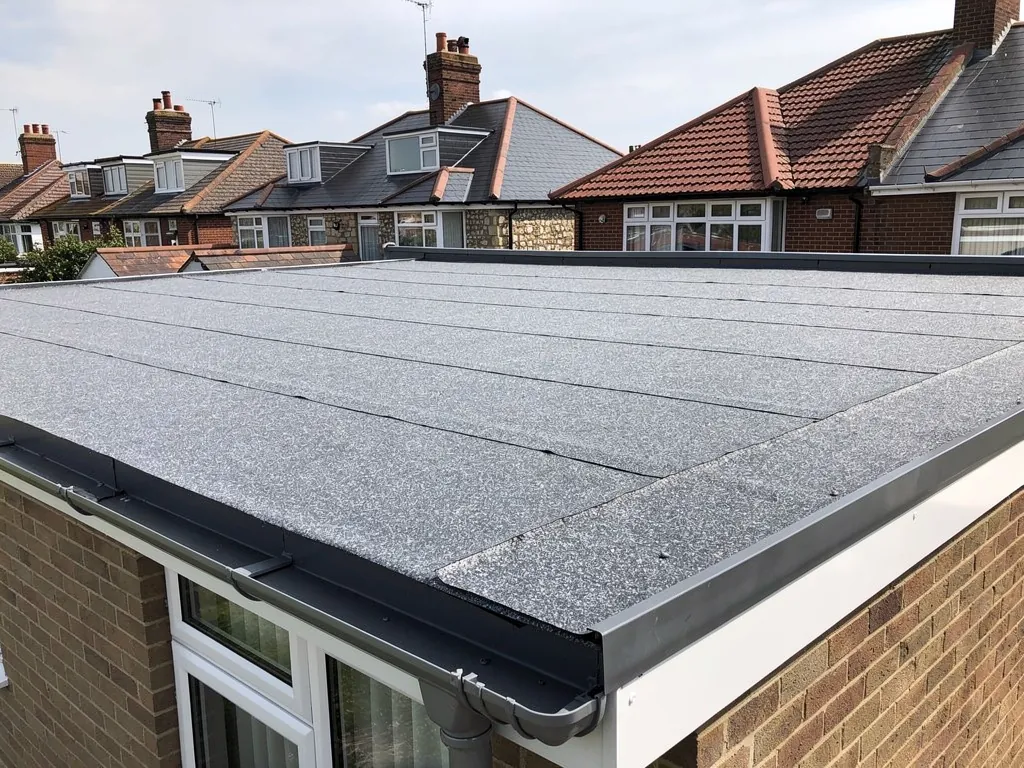
A flat roof is the one part of a house that homeowners expect to price in a single sentence. It looks simple: a rectangle, a covering, an edge. So the first quote that arrives far above or below a neighbour's can feel like a trick. It rarely is. Two roofs with the same footprint can call for quite different jobs, and the price follows the job.
This guide gives the national picture first. The ranges come from named cost guides, each with the date of its table, and they are typical UK figures, a guide to the market and not a quote for your roof. Then it goes through the things that push a flat roof job up or down: the area, whether the deck underneath is sound, how the roofer reaches it, what insulation goes in, and how VAT is shown.
Use it to judge whether a quote sits in a sensible place before you accept one. Nothing beats a written quote based on a proper look at the roof in question, but an average tells you which questions to ask. If you are still deciding between mending and replacing, our guide to flat roof repair or replacement comes first.
The typical UK range for a new flat roof
National guides put a new flat roof in a wide band, and the width is the point. Checkatrade's roof replacement guide, updated in October 2026, gives flat roofs a range of £2,800 to £7,500, and the table is headed plus VAT. A band that wide covers small porches and large extensions alike, so it marks the market rather than any one roof.
The same Checkatrade guide has a figure for a smaller, very common job: a garage roof re-covered in felt, at around £1,000 to £2,000, with an average of £1,500. A single garage is a small, simple roof with few details, so it sits near the bottom of the flat roof range, while a long extension, a block of flats or a roof with several rooflights and an awkward parapet sits near the top.
Notice what these numbers leave out. They do not give the area, because a guide cannot know it. They do not name the covering being laid, and they cannot say whether the deck beneath is sound. A roof of a few square metres over a porch and a roof over a whole ground floor extension are both flat roofs, and a single average cannot serve for both.
Use the range to spot a quote that looks wrong. A price well under the bottom of the band deserves a question about what has been left out. A price well over the top deserves a question about what has been added. Either way, ask for the written total and read what it covers. Our flat roofing page explains the work we do.
What makes one flat roof dearer than another
Area comes first, because the covering, the boards and the labour all scale with it. But three other things matter nearly as much, and none of them show in a national average.
The deck underneath
The deck is the layer of boards the covering sits on. If the old covering has let water in for a while, the boards can be damp or soft, and laying new membrane over them only hides the problem. Cutting out and replacing boards adds time and material, and it is often visible only when the old covering has been stripped. A survey that checks the underside from the room below, and the edges from above, tells us how likely that is before we write the price.
Details and edges
Every upstand against a wall, every roof light, every pipe and every outlet is a place the covering has to be made watertight by hand. A plain rectangle with a single edge trim goes down faster than a roof with a parapet on three sides and a chimney in the middle. Edge trims shape the finish as well as the price, because the trim is what the eye meets from the street.
Falls
A flat roof is meant to shed water, not hold it. If the existing roof ponds, getting it to drain may mean new tapered timbers under the covering, which is more work than a plain re-cover. We come back to falls in the section on insulation and regulations below.
All of this is why we ask for photographs before we visit, and why the written quote follows the survey.
Felt, EPDM or GRP: how the covering changes the bill
The three coverings laid most often on a flat roof are felt, EPDM and GRP. Felt here means torch-on bitumen felt in layers. EPDM is a rubber membrane that arrives on the roof as one big sheet. GRP is glass-reinforced plastic, laid wet and left to cure into one skin. Our guide to EPDM, GRP and felt sets them side by side.
National guides do not price all three for a full replacement in one table, but they do publish repair rates per square metre, and those show how the market ranks them. Checkatrade's June 2026 repair table gives bitumen felt at £100 to £140, EPDM at £120 to £170 and GRP at £130 to £180 per m², all before VAT is added. A repair rate is no replacement rate, since a full re-cover brings in stripping, boards and edges as well, yet the order is a useful hint.
The price of the covering is only half the sum, because the roof then has to last. Less (March 2026 update) gives torch-on felt 10 to 20 years, GRP 25 to 40 years and EPDM 30 to 50 years. GreenSpec gives EPDM a service life of 20 to 30 years, so sources do not agree, and none of these is a promise. A covering that costs less today but needs replacing twice is not the lower-cost roof.
If price is the whole question, put the same three questions to every roofer: what is the covering, how long do they expect it to last, and what does it need from you to get there.
Scaffold, access and the licence for the pavement
A flat roof on a single-storey extension can often be reached from a ladder and a platform. A flat roof on a first floor, or over a shop or a block of flats, needs scaffold, and then access becomes a real part of the bill. Checkatrade's scaffolding table of October 2026 gives £800 for a terrace, £1,000 for a detached bungalow, £1,200 for a detached house and around £875 for a semi, each priced per month. Those are national figures for ordinary access, and a tight street or a long run of roof edge can raise them.
Scaffolding that occupies the pavement needs a council licence under section 169 of the Highways Act 1980, which takes notice to obtain. West Sussex County Council quotes a 10 working day minimum between application and erection, at £266 for a month. Hampshire County Council sets ten clear working days, then £211.90 for a fortnight and £72 for each extra fortnight. Portsmouth is its own highway authority, and its terms are for the city council to confirm.
Those lead times shape the plan. If your flat roof is leaking now, we stop the water coming in with a temporary repair before anything else, and the full re-cover is then planned around the licence dates rather than rushed.
With two quotes on the table, ask each roofer whether scaffold is inside the total figure. A price that omits it is not the lower price if the scaffold shows up later as an extra. The same goes for VAT, which brings us to the last section.
Insulation, falls and the Building Regulations
Under Approved Document L, a new waterproof membrane is renovation work, and that is the reason re-covering can pull insulation into the job. Once more than half of one element, such as the roof, is renovated, that element has to be upgraded. In the 2021 edition the improved value for an existing roof is 0.16 W/(m²·K), and from 24 March 2027 the 2026 edition takes over with the same renovation triggers.
Insulation costs money and takes up height, so it appears in a replacement price when the work triggers it. It also changes the build-up of the roof, which is why the roofer must decide early between a warm roof and a cold roof. Our guide to flat roofs and Building Regulations sets out what building control expects and how the options differ.
Falls and drainage
BS 6229:2025, which replaced the 2018 edition in December 2025, keeps a minimum finished fall of 1:80, and roofers usually design for around 1:40 so that the completed roof clears its water. A roof with no fall will pond. If a proper fall means new firrings, which are timbers cut to a taper that make the slope, the job is bigger than a plain re-cover and the price reflects it.
These are real costs inside a proper replacement, not extras to be argued over afterwards. A quote that includes them is likely to be higher than one that does not, and the difference is the work a good flat roof needs.
VAT, day rates and reading the written quote
VAT is the last piece. The standard rate is 20%. The flat roof row in Checkatrade's replacement table is headed as plus VAT, so £5,000 on that basis becomes £6,000 once tax is added. Some guides leave VAT out of their ranges and some do not say, which is why the first question on any quote is whether the figure includes it.
A flat roof is priced as a job, not by the day, but day rates show what labour costs in the market. Checkatrade puts roofers at around £35 to £45 per hour or £280 to £360 per day. Small jobs often carry a minimum price, since getting to site, setting up and tidying away take time whatever the size.
Before comparing two flat roof prices, check three things: whether VAT is included, whether scaffold is included, and what each roofer found when they looked at the deck.
Ours is a quote on paper, one total price, sent after we have looked at the roof and photographed it. Prices are good and fair here. The aim of a single written total is simple: the figure you accept is the figure you are asked to pay, with no second conversation halfway through the job.
If a leak is what brought you to this page, work out where the water comes from before you plan a replacement, because a repair may be all it needs. Our guide to repair or replacement works through that decision step by step.
Questions
Flat roof cost questions
Is a garage flat roof much cheaper to replace than a house extension?
Usually it is lower, because a garage is small and simple. Checkatrade gives £1,000 to £2,000 for re-felting one, averaging £1,500, against £2,800 to £7,500 for flat roofs in general. A garage with a rotten deck, a parapet or a rooflight can still land higher.
Do the national flat roof prices include scaffold and VAT?
Not reliably. Checkatrade's replacement table is headed as plus VAT, and scaffold has a separate guide of its own. Ask every roofer to confirm in writing whether the total includes both, because that one answer can explain most differences between two prices.
Is it worth paying for a survey before agreeing a flat roof price?
A visit to look at your roof and price the work is different from a paid survey report. Checkatrade puts a flat roof inspection at about £150 on average and a fuller roof survey at £300 to £500, plus VAT. For a straightforward re-cover, ask each roofer up front whether their visit costs anything.