
Torch-on felt · 9 min read
Torch-on felt roofing: the modern built-up system
A modern bitumen roofing system, laid in layers and heated onto the deck: that is torch-on felt. Here is how it is fitted, what can go wrong, how long it lasts and what it costs.
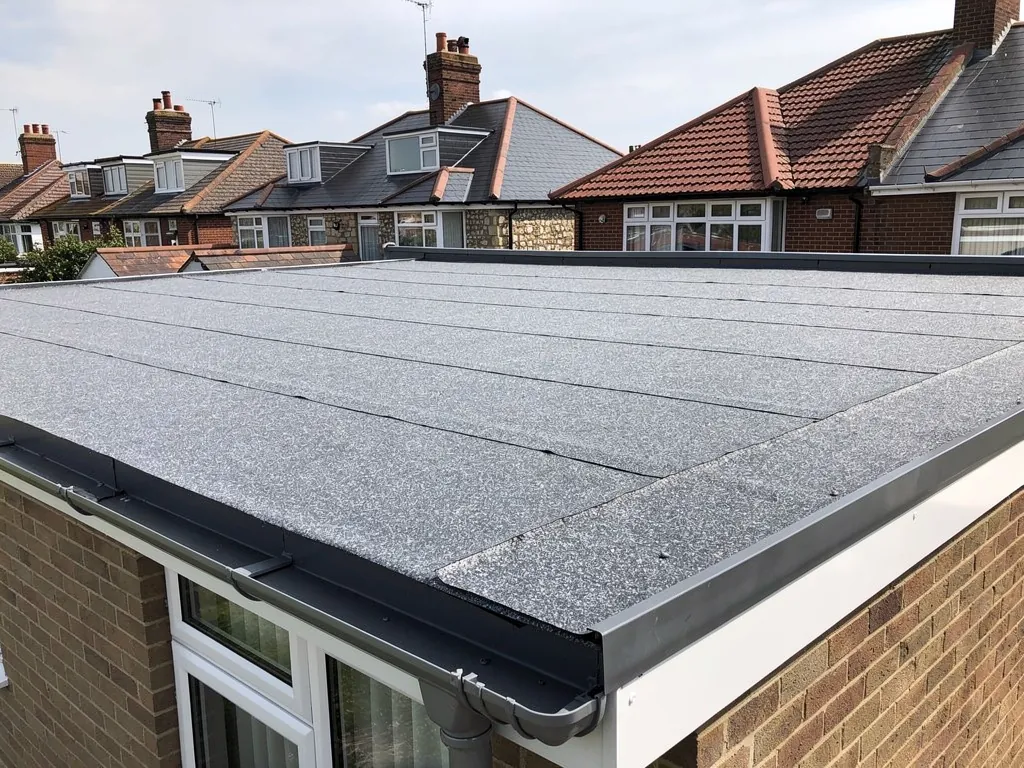
Say felt roof and many people picture a shed with a black, tarry covering that curls at the corners within a few winters. The torch-on version is a different animal. It is a modern built-up system: reinforced bitumen sheets, laid in layers, with the joins fused together by heat from a gas torch. It has been a standard flat roof covering for a long time, and it is still widely used on garages, extensions and the flat tops of bay windows.
The method brings real strengths. The layers are fused, so the roof has some depth to it, and a decent felt roof copes with a fair amount of movement. It brings real cautions as well, mostly to do with the open flame, the quality of the laps and the way trapped damp turns into blisters.
This guide walks through the parts of a felt roof, how the work is done, the safety questions worth asking, the typical causes of failure and the published lifespans and prices. Every number is a national range credited to its source, while your own roof is priced only after it has been surveyed.
What modern torch-on felt is and how it differs from shed felt
Old roofing felt was a thin sheet of paper or fibre soaked in tar and nailed or glued down. Torch-on felt is built from bitumen sheets that are thicker, reinforced with a stable core and made to be heated on. The underside of the roll carries a layer of bitumen that softens under the flame and bonds to whatever it is pressed against.
A roof is made of more than one sheet. A base layer goes on first. A cap sheet follows, usually with a mineral finish on the top face, which shields the bitumen from sunlight and wear. Roofs that face harder use or sit over rooms that matter get extra layers. The combined thickness is what makes it a built-up system, and it is also what gives the roof a margin when a small fault appears in one sheet.
Where it is used
Felt suits garages, outhouses, workshops, the flat roofs of extensions and the roofs of porches and bays. It copes with simple shapes best and with the more complicated outlines less happily, where the sheets have to be cut and folded. For a roof with many corners, GRP may follow the shape more easily, and the guide that compares EPDM, GRP and felt sets out the trade-offs.
Cost is another draw, and a sensible one to weigh up early. Checkatrade's repair table lists bitumen felt at the lowest of the three common flat coverings. A good felt job, though, depends on the preparation and the skill of the person with the torch much more than on the cost of the rolls.
How a torch-on felt roof is laid
The order of work follows the roof from the timber up.
Deck, vapour control and insulation
The roofer begins with the deck, the boarding that carries the roof. It must be dry, firm and flat, with any soft or stained boards replaced. Where the roof is to be insulated, a vapour control layer goes on first. This is a sheet that stops warm, damp air from the house reaching the cold side of the insulation, where it would turn to water. The insulation boards go over it. Putting the insulation under the waterproofing like this is called a warm roof.
If the roof needs a better fall, firrings (tapered timbers) are fixed to the joists before the deck goes down. Standing water does more harm to a flat covering than almost anything else. BS 6229:2025 keeps a minimum finished fall of 1:80, and roofers usually design for about 1:40.
Base layer and cap sheet
The base layer is rolled out and fixed. Then the cap sheet is laid, and this is where the torch comes in. The roofer heats the underside of the roll and the surface beneath until the bitumen turns glossy and begins to flow, then presses the sheet down as it unrolls so a small bead squeezes out along the edge. That bead tells you the lap has fused. The laps run in the direction water flows so they do not face the rain.
Upstands, trims and outlets
Where it meets a wall the felt is carried up as an upstand and finished with a flashing or a chase cut into the brickwork. Edge trims hold the felt at the perimeter and form a drip into the gutter. Outlets and pipes are made up with preformed pieces. Each of these detail points matters more than the flat middle of the roof, because they are where movement and weather work hardest.
The fire question: what to ask before the torch comes out
Torch-on means a live gas flame working on a roof, often just centimetres from timber. That is not a reason to avoid felt, but it is a reason to ask how the work is controlled. The risk is not usually the open roof; it is the hidden places where heat travels, such as under eaves, into a roof void or behind timber cladding next to the flame.
Sensible questions for any roofer include these:
- Where will the flame be kept away from timber and soffits?
- What is kept within reach in case something smoulders?
- Will the roof be checked again after the work stops for the day?
- What is the plan if there is a gap in the deck, a void or a vent close to the work?
A roofer who has done this many times will answer easily. One who looks puzzled is telling you something.
When another covering is the better choice
Some roofs are poor candidates for a flame. A roof that abuts timber boarding, a thatch, or a loft full of stored boxes needs a closer look. Where the risk cannot be controlled sensibly, a cold-applied system such as an adhesive-fixed EPDM sheet or a GRP shell avoids the flame altogether. The choice is a safety one as well as a technical one, and it is made after the survey, not before it.
The Planning Portal also notes that a new covering whose fire performance differs significantly from the old one brings the Building Regulations into play. A like-for-like felt replacement is the simple case. Moving to a different material is the one to check with your building control body.
Where felt roofs fail
Felt fails in recognisable ways, and each one points to a cause.
Blisters are the best known. A blister is a raised bubble in the cap sheet where moisture or air has been trapped between layers or under the felt. In sunshine the trapped damp expands and pushes the felt up. A small, intact blister can be left under watch. A split blister lets water into the layers beneath and needs cutting out and patching. A scatter of blisters across a whole roof usually says the deck or the underlay was damp when the felt went on. Our answer on what causes blisters on felt covers them in more depth.
Open laps are another. If the heating was poor, the edge of one sheet never fused to the next, and over time it lifts and lets water in. You can see it as a dark line at a join where the cap sheet has curled upward.
Ponding speeds everything up. Water that stays on the surface after rain hurries the wear of the mineral finish, and a bare bitumen surface perishes in sunlight. The mineral grit also washes down towards the outlets, which tells you where the water is going.
Edges and upstands fail as well. A flashing that has come loose, a trim with no drip or an upstand finished too low lets driven rain behind the felt. Along this coast, gales push rain sideways, so an edge detail that would be adequate inland can be tested often here. The repair is then a local one, and we say plainly when a patch will hold and when it will not.
How long felt lasts and what it costs
Published lifespans for torch-on felt disagree, which is itself useful. The Less flat roof guide (March 2026) gives 10 to 20 years, saying a well-done job can reach 20 and a badly done one may give out inside 10. CORC puts felt at 30 or more years. The gap is explained by workmanship, the number of layers, the quality of the deck and the care the roof gets afterwards. A warranty, whatever it says, is not a lifespan.
On price, Checkatrade's repair table (June 2026) gives bitumen felt at £100 to £140 per m², excluding VAT, against £120 to £170 for EPDM and £130 to £180 for GRP. In its replacement guide, updated in October 2026, a garage re-felt comes in at around £1,000 to £2,000, with an average of £1,500, and the table headed plus VAT gives £2,800 to £7,500 for flat roof replacement generally.
| Source | Job | Typical UK figure |
|---|---|---|
| Checkatrade, June 2026 | Bitumen felt repair, per m², excluding VAT | £100 to £140 |
| Less, March 2026 | Small flat roof repairs | £150 to £500 |
| Checkatrade, October 2026 | Garage re-felt | £1,000 to £2,000 |
| Checkatrade, October 2026 | Flat roof replacement, plus VAT | £2,800 to £7,500 |
What moves the number is the roof, more than the felt. Area, deck condition, insulation, the number of outlets and upstands, and access all pull it up or down. Where the roof sits above the ground floor, a scaffold may be needed, and that is a cost of its own. Standard VAT is 20 per cent. Good, fair pricing is how we work, and the roof's own survey sets the figure you get.
Insulation, approval and choosing the right felt job
A new felt covering that replaces the old waterproof layer is renovation under Approved Document L. Renovating more than 50 per cent of the roof's surface obliges the thermal element to be upgraded, which is why a re-felt of a small roof frequently becomes a warm roof job with new insulation. The 2021 edition applies now. The 2026 edition takes effect on 24 March 2027 and keeps the same renovation triggers.
The Planning Portal sets its no-application threshold at under 25 per cent of the total building envelope and under 50 per cent of the roof, and withdraws it for a covering that adds real weight or behaves very differently in a fire. Arun District Council's pages name re-covering of roofs as approval work, so confirm the position with its building control team or a registered building control approver. Should a notification be due, we handle that step.
What to look for in a good felt job
- A deck that is dry and sound before any layer goes on
- Insulation named in the quote, with a vapour control layer under it
- Laps that show a fused bead along the edges
- Edge trims with a proper drip
- Upstands finished high enough, with a flashing at the top
Our survey includes photographs of your own roof, and the verdict is plain: patch it, re-felt it or replace the deck. We recommend whatever small job really cures the fault, and the written quote shows a single total. We take the waste away when we finish. More on the choice of coverings is on our flat roofing page, and our guide to falls and drainage explains how water is kept moving.
Questions
Torch-on felt questions
Can a second layer of felt go over a tired first one?
Sometimes, if the deck underneath is dry and sound and the old covering is firmly stuck down. A soft deck, a wet insulation layer or a felt full of blisters means the old roof comes off first. New felt laid over wet material buries the fault rather than curing it. A survey tells you which case you are in.
What does a poorly laid felt roof look like after a few winters?
Typical signs are open laps that have curled upwards, blisters that have split, bare patches where the mineral grit has washed away and dark staining where water sits. Cracks at the edge trims and loose flashings at the wall are also common. A photograph of each problem helps decide whether a patch will do.
Is the smell of a new felt roof harmful?
Heated bitumen has a noticeable smell while the work is going on, which fades once the roof cools. Close windows below, warn neighbours who share the wall and keep pets and children away from the working area. If you have a respiratory condition or any specific worry, tell the roofer beforehand so the work can be planned around it.