
Asbestos check · 9 min read
Is my garage roof asbestos? How to tell
How to judge whether the corrugated sheets on your garage are likely to be asbestos cement: the date test, the clues on the roof, what the HSE says, and what to do next.
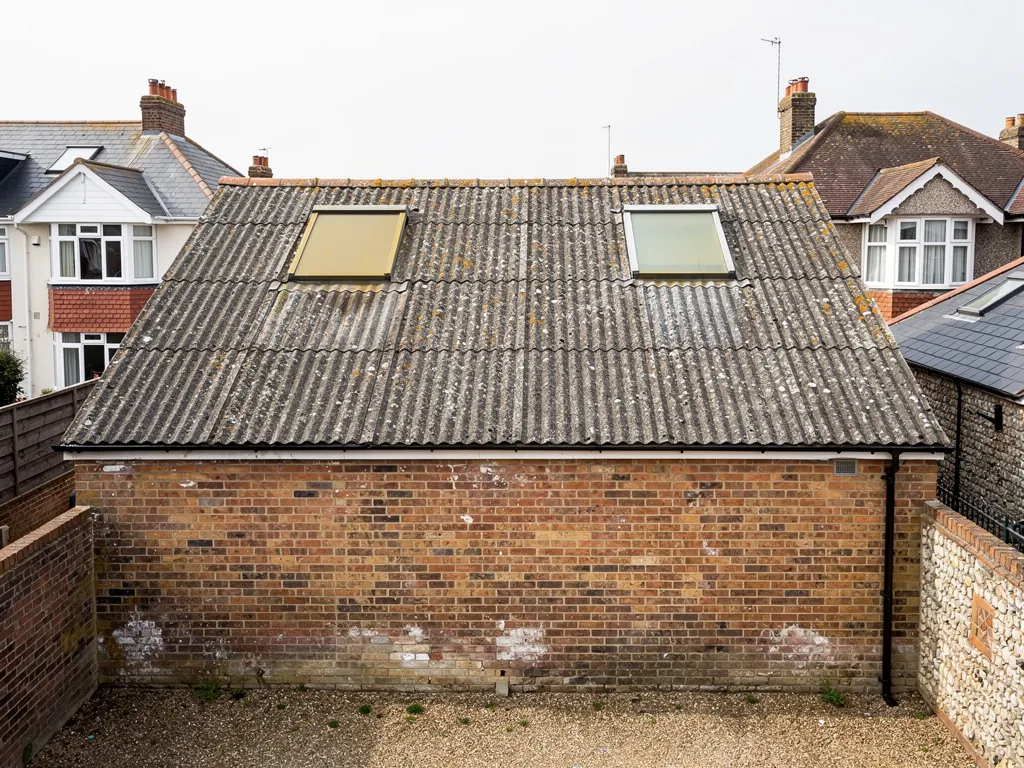
Standing in the drive and looking up at a grey, ribbed garage roof, nobody can say for certain what it is made of. The sheets might be asbestos cement laid in the middle of the last century, a modern fibre cement substitute, or something else entirely. From the drive they can be near enough identical, and that is the heart of the problem.
What you can do is gather evidence. The age of the garage matters most, then the profile and fixings of the sheets, then what else on the building might share the material. Put together, those clues tell you whether to treat the roof with caution. They do not give a certificate, and nothing in this guide is a substitute for a laboratory result.
The aim is a sensible next step, not alarm. Many of these roofs are safe to leave alone for years. The danger comes from breaking, drilling or scrubbing them, so knowing what you have decides what you do next. For the wider job, see our garage roof replacement page.
The date test and what the HSE tells householders
The simplest clue is a date. The HSE's advice for anyone responsible for a building is blunt: for a building put up or refurbished before 2000, assume asbestos is present. That is the starting position, and it applies to the garage as much as to the house. A garage put up in the 1950s, 1960s or 1970s, or re-roofed at any time before the turn of the century, falls inside it.
The advice does not say every such roof is asbestos. It says to assume it until you know otherwise, because the cost of wrongly assuming a roof is safe is higher than the cost of wrongly treating it with care. For a garage whose age you do not know, check the paperwork from the purchase of the house, look for a date on any plans, and ask long-standing neighbours when the estate was built. Garages from the same estate usually share a roofing material.
Where local history helps
Local records can fill gaps. The Victoria County History of Sussex records that some interwar houses at Southdean in Middleton-on-Sea, and at Elmer, were built with asbestos walls. That does not mean any particular garage or house in those places has asbestos, but it shows that cement-based sheet materials were in use around the Bognor coast in the 1930s, and bungalows of that period often have garages from the same time or a little later. If your property sits on one of the older estates, give the date test extra weight and look closer at the other clues in this guide.
A garage built or re-roofed after 2000 is a different matter, though the date is only the first filter. Roofs are sometimes patched with salvaged sheets, so a modern garage with an older section deserves the same look as an old one.
Reading the roof from the ground
With the date in mind, look at the roof itself, from the ground and without touching it. Asbestos cement garage roofing usually comes as large corrugated sheets in a pale grey, with a regular wave profile along the slope and a lap where one sheet overlaps the next. Over time the surface roughens and darkens, and moss and lichen take hold in the troughs. A pitch that is shallow, with no ridge tiles and no felt visible at the edges, fits the pattern.
The sheets are held down by fixings through the crests of the wave, often with a small cap or washer on each. Look along the eaves, where the cut edge of a sheet can sometimes be seen: a dense, fibrous grey edge suggests cement rather than metal or plastic. Steel sheeting is easy to rule out, since it is a metal edge with a painted or coated face, and bitumen sheets are dark, flexible and obviously not cement.
Why a lookalike is still possible
The trouble is that modern fibre cement sheets, made without asbestos, were designed to match the old profile. The two can be near enough indistinguishable at ground level. The HSE accepts the same difficulty with other materials. On the page listing where asbestos is found, it says it is difficult to tell the difference between insulating board and non-asbestos equivalents. So a roof that matches every visual clue is a roof you should treat as asbestos until a laboratory says otherwise.
Look also for signs of damage: cracks, broken corners, sheets that have slipped at the laps or holes where a fixing has pulled through. These do not change what the material is, but they change how urgent the next step is, because damaged cement is the stage at which fibres are most likely to be released.
The rest of the garage can carry the same material
A garage roof is rarely the only place a material was used. The HSE's guidance names roof sheeting and rainwater goods together as asbestos cement products, so if the roof is a candidate, the gutters and downpipes become one too. A rigid grey gutter or a square-section downpipe from the same era as the roof is worth noting in the same breath.
The soffit, the board closing the gap beneath the eaves, and the fascia at the front edge are the other candidates. External soffits appear on the HSE's list of places asbestos insulating board is found. This is a different material from the cement sheets, and the rules for removing it are generally stricter, since most of that removal is licensed work. A board soffit under a cement-sheet roof is therefore a second question, not a repeat of the first.
Walls, linings and flues
Older sectional garages have cement panel walls, and some have a flue or a boarded lining on the inside. A lining board that is smooth, pale and brittle at the edges deserves the same caution. None of this can be settled by touching. The point of looking is to build a list of things to point out to a surveyor so they are all assessed in one visit, rather than finding a board soffit halfway through a job priced only for sheets.
For gutters in particular, our answer on whether old garage gutters are asbestos too explains how they fit into the picture. Note anything you spot and mention it when you talk to the surveyor, so nothing has to be added to the price later.
Why the only reliable answer comes from analysis
Everything so far is circumstantial. The only way to be certain what a sheet is made of is to have a sample analysed by a laboratory, and the key word is sample. Taking one means breaking a piece off, which is exactly what you want to avoid doing. A cracked sheet can release dust, and the HSE places the line between ordinary and notifiable work at the point where cement starts to break up and create significant dust.
So leave sampling to someone equipped for it. A surveyor who deals with asbestos will know how to take a piece with the right controls and how to seal and label it before it goes to the lab. Ask who is taking the sample, what controls they use and how long the result takes. You are entitled to see the report afterwards, and it is worth keeping alongside the deeds, since a buyer may ask.
Treat it as asbestos in the meantime
Until the result arrives, the working assumption is that the sheets are asbestos cement. Because the HSE calls asbestos cement roofs fragile, the first rule is to stay off the roof and stop anyone else going up. The second is not to drill, saw, scrub or pressure-wash the sheets. The third is to leave them intact: a roof that is not touched is not releasing fibres.
It is also worth telling anyone who might work near the garage, including a gutter cleaner, an aerial fitter or a painter, what you suspect. Many accidents come from a well-meaning job done in ignorance rather than a deliberate removal.
What you can do if the sheets are asbestos cement
A positive result is not an emergency. Careful handling of weathered cement that has not been badly damaged sits in the HSE's non-licensed category, and many garages carry these sheets for years without trouble. Your choices narrow to four. You can leave the roof alone and monitor it. You can repair a local fault if the sheet around it is sound. You can cover it with a new roof over the top. Or you can have the sheets taken off and replaced.
Which is right depends on condition, not on the material alone. Sound sheets with a leaking joint may need nothing more than attention to the lap. Cracked, crumbling or heavily mossed sheets point towards removal. A roof you intend to convert, insulate or build on will usually need the sheets dealt with, since work above and below them gets in the way. Our guide to overcladding an asbestos roof explains the covering-over option and its limits.
Choosing between the four
The decision usually turns on three questions. How sound are the sheets today? What do you want from the garage in ten years: storage, a workshop, a conversion? And does the structure underneath look fit for a new load? A straight answer from a surveyor, with photographs of the fixings, the laps and the eaves, is worth more than any rule of thumb. We give our verdict before quoting, then put one written total in the quote. If the roof can stay as it is, the verdict says that.
For removal, our guide to asbestos garage roof removal covers the rules, the waste and what to expect.
Surveys, sellers and keeping a record
The question often surfaces at a sale. A buyer's survey flags a cement-sheet garage roof, and the seller has no paperwork. Having an analysis result, or a note from a surveyor, saves a negotiation. A garage that has been checked and recorded is simpler to sell than one that is merely suspected, and a roof with a clear plan against it, whether leave, overclad or replace, gives both sides something solid to discuss.
If you are the buyer, ask the seller for any report, for the date of the garage and for details of any past work on the roof. A roof that was recently patched or re-fixed may have been disturbed, and the records show who did it and how. Keep every document in one folder, including photographs with dates.
Our survey step
When we survey a garage roof, we photograph the whole roof from safe positions, the laps, the fixings and the eaves, along with the soffit and the gutters, and we tell you what the evidence suggests and what it cannot show. If the sheets look like cement, the next step is a written recommendation: leave, repair, overclad or replace, with the reasoning. Photographs come with the quote. Our roof asbestos check page describes how the survey works, and you can send pictures of your own garage through the quote form.
Nothing replaces the laboratory result when you need certainty, and nothing about a cautious approach costs much. Treating an unknown roof as asbestos until proven otherwise is the plan the HSE itself recommends for pre-2000 buildings.
Questions
Garage roof asbestos questions
Was a garage built in the 1980s likely to have been roofed in asbestos cement?
The HSE does not guess at likelihood. Its position is that anything put up or refurbished before 2000 should be assumed to contain asbestos, which takes in a garage from the 1980s. Assume the sheets are asbestos cement until a laboratory analysis, taken with proper controls, says otherwise, and plan any work around that assumption.
Does grey corrugated sheeting always mean asbestos?
No. Modern fibre cement sheets made without asbestos copy the old profile, and the HSE admits that similar materials are difficult to tell apart by eye. A grey ribbed roof from before 2000 should be treated as asbestos cement until tested, while one from after 2000 is more likely, though not certain, to be a substitute.
Should I get the roof checked before I buy a house with an older garage?
Yes, if the garage is old, because a cement-sheet roof can shape both the price and your plans for the building. Ask the seller for any report and the date of the garage. A surveyor can note the likely material from photographs, and a laboratory result removes the doubt before you exchange.