
Choosing gutter materials · 9 min read
uPVC, cast iron or aluminium gutters: which to choose
Plastic, iron or aluminium: what each gutter material is like to live with, where each belongs on a house, and the questions that decide the choice before price comes into it.
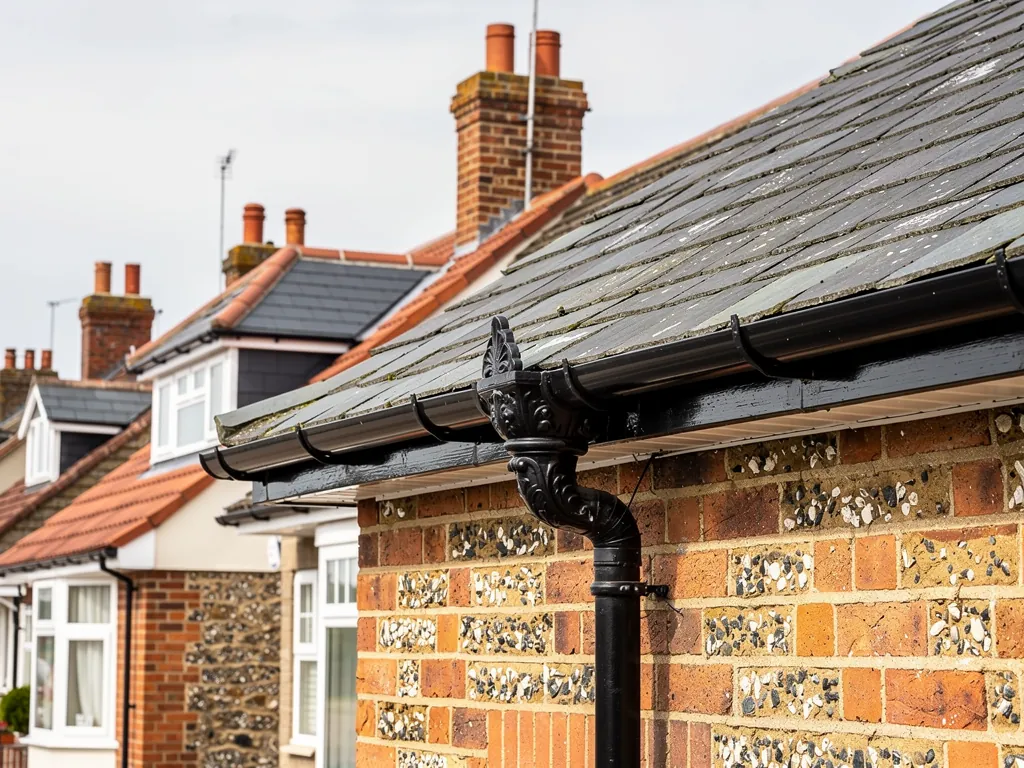
Gutter material is one of the few roofline choices that is truly yours to make. The roof covering is set by the house, and the boards are set by the eaves, but the channel that catches the rain can be plastic, iron or aluminium, and each looks and ages differently.
Most of the time the choice is quick. A modern house with plastic gutters gets plastic gutters. The harder cases are the ones where the house has character, where a conservation area or a listed building is involved, or where an owner wants something that will outlast the usual twenty years or so.
This guide goes through the three materials in turn and then the things that apply to all of them: the slope, the brackets, the board behind and the rules on older buildings. It uses sourced figures where a source exists and plain description where one does not. No material has a lifespan anyone can promise, so every figure here is a range and not a guarantee.
Three materials and what sets them apart
uPVC is a rigid plastic. It is light, it comes in a range of profiles and colours, and the parts clip or push together with rubber seals. It is common on modern houses and the quickest for a roofer to fit.
Cast iron is the traditional gutter material. It is heavy, it is joined with bolts and sealant rather than clips, and it has to be painted to protect it. A cast iron gutter has a crisp profile and a weight that plastic cannot match, and it is the material a period house was built with.
Aluminium sits in between. It is a metal, so it has a more solid look than plastic, but it is much lighter than iron. It is usually supplied with a factory-applied coating in a range of colours, and it can be made to imitate the profiles of cast iron, including the ogee, a profile with an S-shaped curve on its face.
What the choice actually affects
Four things change with the material: how the house looks, what the gutter costs to buy and fit, how much upkeep it wants and, on special buildings, whether the council will accept it. Every other gutter feature, such as the slope, the number of outlets and the strength of the bracket fixing, applies whatever the material.
Capacity belongs to the profile more than the material. Half-round, square and ogee channels carry different volumes of water, and each needs its own brackets and fittings. You cannot mix profiles along a run. Our guttering, soffits and fascias page covers the range of work we do, and the shapes themselves are weighed up in our separate answer on half-round, square and ogee channels.
One more point before the detail. Because gutters hang from the fascia, any of the three materials will sag if the board behind has gone soft. A good material on a bad board is a poor result, so the board is checked first, whatever you choose.
uPVC: the everyday choice
For most houses built in the last few decades, uPVC is the sensible default. It is light enough to handle from a ladder or low tower, it needs no painting, and it can be bought in white, black, brown, grey and cream. The fittings are cheap to replace if one cracks, so a damaged corner does not mean a whole new run.
Upkeep is mostly washing. Leaves and moss build up in the channel and the outside gets dirty, and a clean-out once or twice a year is the main task. How often to do it, and how, is set out in our gutter cleaning guide.
Lifespan is where numbers are thinnest. The sourced figures we hold are for the plastic boards beside the gutters, not the gutters themselves: Checkatrade says there is no fixed time between replacements of fascias and soffits, and a plastics retailer, the Plastic Centre, says 20 to 40 years, which is a seller's view. Gutters made of the same plastic are exposed to the same sun, frost and cleaning, so the range is a fair hint, though it is not a promise. Our answer on how long uPVC gutters last goes through the signs of age.
Where plastic is the weaker choice
Plastic expands and contracts with temperature, so long runs need joints that allow movement, and cheap fittings can crack in time. It also looks like what it is. On a period house with iron originals, plastic is out of character, and in a conservation area or on a listed building it may not be allowed. A plastic gutter can also be dented or cracked by a ladder, which is worth remembering for a bungalow where the eaves are within reach of every ladder that comes to the house.
Cast iron: period character with a price
Where a house was built with cast iron, keeping it is often the right call. The profile suits the house, the metal is strong, and a well-kept run can stay in place for a very long time.
The costs are weight, fitting and upkeep. Iron gutter sections are heavy, so they need stout brackets and a sound fascia to carry them. They are bolted together with sealant in the joints, and that sealant is where leaks start as it ages. The metal needs paint, and the paint needs renewing, with bare patches rubbed back and treated before they spread. On a seafront terrace in Bognor, that is a job to plan for rather than ignore.
Cast iron usually costs more to buy and to fit than plastic, though the gap depends on the profile and the length of the run. Our page on cast iron gutters on period and listed homes looks at repairing what is there, which is often the cheaper choice if the run is sound.
Cast iron on listed and conservation-area houses
If the house is listed, section 7 of the Planning (Listed Buildings and Conservation Areas) Act 1990 stops works that would affect its character unless they are authorised. Routine upkeep and minor repairs that copy the original are, per the South Downs National Park Authority, outside listed building consent. Swapping iron for plastic copies nothing, so that is a question for the council.
Arun District Council's guidance for the Aldwick Road conservation area describes imposing Victorian and Edwardian terraces. If your house sits in a conservation area, put the question of changing material to the council's planning team first.
Aluminium: the middle path
Aluminium appeals to people who want a metal look without the weight of iron. It is a lighter material that holds a crisp profile, and the coating is applied at the factory, so you do not repaint it the way you would an iron gutter. Many suppliers make aluminium in cast-iron-style profiles, which can suit a house that wants the right outline but not the full weight.
It also comes in a form made on site. A machine at the house shapes a coil of aluminium into one continuous length, with joints only at corners and outlets. That removes the joints along the straight runs, which is where many leaks begin. Our answer on whether seamless gutters are worth it looks at the idea in more depth.
How long an aluminium gutter lasts depends on its coating and its fixings, and suppliers publish warranties rather than lifespans. Ask for the coating warranty in writing, and read it as a warranty and nothing more. It tells you what the maker will stand behind, not how long the gutter lasts. Ask too what the colour range is and how a scratched coating is touched up.
Questions to settle before ordering
Check three things with any aluminium offer. First, whether the profile matches the house, because a half-round channel on a Georgian-style front can look wrong. Second, whether the brackets are rated for the weight of the channel when it is full. Third, how the colour will be matched if a section is damaged later.
Because aluminium is a metal gutter on a plastic or timber fascia, the fixings should suit both. We would also never mix metals on one run without checking what touches what. The point of a survey is to settle these details before anything is bought.
Fall, brackets and the board behind
Whichever material wins, the gutter has to be fitted to a slope so water runs to the outlet. The slope is small, about 1mm of drop for every 600mm of run on Brett Martin's advice, and FloPlast gives 1:350 for its MiniFlo system. Taken together, the working range is around 1:600 to 1:350, depending on the system. These are manufacturers' recommendations, not a British Standard, but they show the scale: a gutter that looks level is close to right, and one that looks tilted is probably wrong.
Brackets count for as much. Brett Martin puts its supports no more than 900mm apart. A heavier channel, such as iron, usually wants its brackets closer or stronger still, and the fixings need a solid board to bite into. That brings us back to the fascia: if it is soft, nothing holds.
It is also worth thinking about where water goes at the other end. The number and position of the outlets affect how much water each section of gutter has to carry, and a long run with one outlet at the end is more likely to overflow in a downpour than the same run with a central outlet.
The cost of getting it slightly wrong
A gutter with the wrong fall holds a pool of water, and the pool breeds moss, silt and early failure. In iron, standing water also rusts the channel from within. That is why we mark the line with a string rather than judging by eye, and why we check the fall again before the last bracket goes in. Our answer on what fall a gutter should have is a short read if you want to check your own run.
Choosing for your house, and what to ask for
A few plain rules help. On a modern house with plastic boards and no special status, uPVC is the practical choice and the one we expect to recommend. On a Victorian or Edwardian terrace, cast iron or an iron-style profile in aluminium keeps the character, and the council should be asked first if there is a conservation area. On a listed building, copy what is there and seek advice before changing anything. A bungalow near the coast at Aldwick or Felpham will usually take plastic, though a metal gutter can suit a feature roofline.
Old gutters on older outbuildings deserve a warning. Gutters and pipes made of asbestos cement count, for HSE, as non-licensed work if they are lowered carefully and kept intact. HSE also tells owners to assume asbestos in a home from before 2000. If you have grey, brittle gutters on a garage or lean-to, tell us before we touch them.
Getting a fair comparison
If you want prices in two materials, ask for each as a separate written quote with one total. Ask whether VAT is inside it, which at the standard 20 per cent is a fifth on top of any figure that leaves it out. Ask whether scaffold is included, and whether the old gutters are taken away. We visit, photograph the eaves and the boards, and then write the quote.
Our price is good and fair, and we recommend whichever material does the job well for the house in front of us. If that is the cheaper one, you will hear it from us. Our guide to what guttering costs explains what drives the number.
Questions
Gutter material questions
Can I fit plastic gutters to a house that had cast iron?
On an ordinary unlisted house in no special area, yes, though it changes the look. On a listed building it is not a like-for-like repair, and works affecting the character need consent. In a conservation area, ask Arun District Council or your own council before you change material.
Is aluminium better than uPVC for gutters?
Neither is better in every case. Aluminium looks more solid and can be had in iron-style profiles, while uPVC is lighter, easier to fix and simple to replace in parts. Its life depends on the coating and the fixings, so ask the supplier for the coating warranty and treat it as a warranty, not a promise.
Do all the gutters on a house have to be the same material?
They do not have to be, but a mixed run looks odd, and different metals touching can cause trouble. A lower extension in plastic beside iron on the main house is a common compromise. Whatever you choose, keep the same profile along one continuous run so brackets and fittings match.