
Rotten fascia boards · 9 min read
Rotten fascia boards: repair, cap or replace?
How to tell tired paint from a board that has gone soft, and when a patch, a cap or a full replacement is the smallest job that will properly fix the fascia behind your gutters.
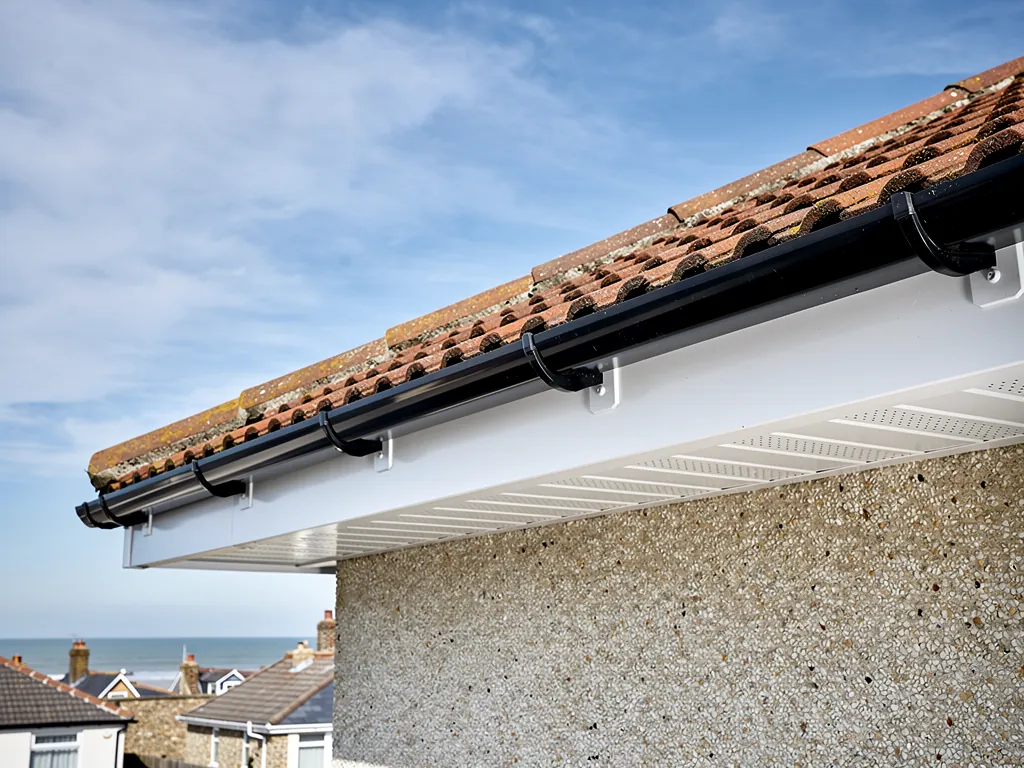
Behind every gutter sits the fascia, the long board nailed across the rafter feet at the edge of the roof. Gutter brackets screw into it, it shuts the eaves gap, and on most houses it also carries the outer edge of the soffit, which is the boarding under the overhang. Once the fascia weakens, the gutter weakens too, and the warning is often a length of gutter that has sagged or leaned away from the wall.
Timber rot is slow and quiet. It starts as flaking paint or a dark stain, creeps along the bottom edge where the board stays wet, and can be well advanced before anyone looks up at it from the pavement. At that stage nobody is asking whether to act. The only open point is how much of the board still has life in it.
This guide takes the decision in the order a roofer takes it on site: how to test the board, why the damage happens where it does, what each repair route involves, and what moves the price. Our verdict comes from photographs of your own eaves, and the job we recommend is the smallest one that holds.
How to tell a rotten board from tired paint
Flaking paint on its own is a decorating problem. Timber that has gone soft is a building problem, and the two can look alike from the ground. The difference shows when the board is touched.
From a safe position, look along the run for these signs: paint lifting in sheets, dark or black patches along the lower edge, boards that bow outward or have opened a gap at a joint, and gutter brackets that no longer sit square. A board that has gone soft is often darker than its neighbours, and the surface may look cracked in small blocks rather than peeling.
The screwdriver test
A roofer presses a blunt screwdriver or a thumbnail into the bottom edge and the back corner, where water collects. Sound timber resists and the tool skates across it. Rotten timber crumbles, gives under a light push or comes away in damp, stringy pieces. Soft timber at the lower edge usually means the whole width of the board is suspect, so the test is repeated along the run, not at one spot.
Do not lean a ladder against a board you suspect is rotten. The ladder loads the gutter and the fascia, and a weak board can give way under it. Use the ladder against the wall below the eaves or, better, leave the close inspection to someone who can reach it safely.
Photographs are the next best tool. A phone held up on a pole, or a zoomed picture from an upstairs window, shows whether the damage is a single board end or a long run. If you send pictures with an enquiry, we can often say which of the three routes is likely before we visit, then confirm it at the survey.
Why fascias rot where they do
Almost every rotten fascia has a water story behind it. The board sits at the lowest point of the roof, so every drip, splash and overflow ends up on or behind it. Timber that is wetted again and again, and never gets the chance to dry fully, is the timber that rots.
The usual causes, roughly in order of how often a roofer finds them:
- a blocked or overflowing gutter that spills over the front and runs down the face of the board
- a leaking joint or union in the gutter that drips onto the same spot for years
- a gap between the roof edge and the gutter, so rain from the roof misses the channel and lands behind it
- an unprotected board end, where cut timber soaks up water along the grain
- old paint that has failed, leaving bare wood exposed to the weather
That list is why a new board fixed behind a gutter that still overflows is a short-lived repair. The cause has to be put right in the same visit, or the replacement will follow the old board in a few years. Water spilling over the front of a gutter is the commonest of these, and the gutter has to be sorted out in the same visit.
Sea weather and exposed gables
Houses near the Channel take driving rain and gales, and a board on an exposed gable gets wetter than one in a sheltered street. Paint on the weather side needs renewing more often than paint facing a hedge or a neighbour.
Rot can also sit hidden. Water that gets behind a gutter runs along the back of the fascia, and the front face can look passable while the back is soft. That is one reason a gutter often has to come off for a proper look, rather than being judged from the pavement.
Repair, cap or replace: choosing the smallest job that holds
There are three routes, and the right one depends on how much of the board is sound and what is behind it.
Repair a short section
Where rot is confined to a board end or a patch and the rest rings sound, the bad timber is cut out and a new piece spliced in. The joint is primed, filled and painted, and the gutter goes back on. This is the lowest-cost route and it is a fair one when the surrounding board is firm. It is not a good choice when the paint is failing along the whole run, because the next patch is only a season or two away.
Cap over sound timber
Capping fits a uPVC cover over the existing fascia, which gives a low-maintenance finish and saves repainting. The catch is in the word sound. A cap placed over a soft board gives you a smart face on a weak backing, and the gutter brackets still need something solid to bite into. If the screwdriver test fails anywhere along the run, capping that stretch is the wrong job. Our guide to fascia capping sets out when it works.
Replace the board
Where the timber is soft along much of its length, or where the rafter ends behind it are damp, the board is removed and a new one fixed. Rafter ends are checked at the same time, because they are the part of the roof structure that sits right behind the fascia. A new board in uPVC or timber then takes the gutter. The bigger picture, including soffits, is in our piece on a full roofline replacement.
Ask any roofer which of the three routes they are quoting for, and why. A quote that says only "new fascias" does not tell you whether the old timber was tested.
Soffits, ventilation and the asbestos question
A fascia rarely fails alone. The soffit runs back from it to the wall, and the same water that rots the board often stains or softens the soffit above it. Where soffits are replaced, the ventilation they provide needs to be kept: many roofs depend on air drawn in at the eaves, and a new soffit without vents can cut that off.
Houses built or altered before 2000 bring a second point. In HSE guidance, asbestos insulating board is named as a material found in external soffits. HSE adds that it is difficult to tell from non-asbestos board by eye, so any building from before 2000 should be treated as though it contains asbestos. Taking that board out is, in most cases, licensed work.
What that means for a fascia job is simple. If your soffits are a flat, grey-white sheet board rather than timber or plastic, tell us before any work starts. We would not cut, drill or snap it. The board stays where it is until its type has been established, and the job is planned around that result.
Boards behind the board
If the rot has spread into rafter ends, wall plate or the ends of the roof sarking, the job is bigger than a roofline repair. Sarking is the boarding or felt layer under the roof covering. The survey photographs show how far it goes, and the written quote then covers the work the roof genuinely needs and no more.
What moves the price of fascia work
Three things set the cost of fascia work: how many metres of board are involved, how high the eaves are, and what must be taken down to get at it. The gutter is nearly always removed and refitted, so the job is priced with that in mind.
Checkatrade's price guide puts fascias and soffits near £150 per linear metre across the UK. Read that as a pointer rather than a price: a bungalow with straight, low runs and a tall gable with returns and hips are different jobs. The figure says nothing about your house.
Access and scaffold
Eaves beyond ladder reach call for a scaffold, and it can account for a large share of the bill. In Checkatrade's scaffolding table (last updated October 2026) a two-storey semi-detached house is around £875 a month and a detached bungalow £1,000. Those national figures leave out VAT at 20 per cent, so ask whether a price has VAT and scaffold in it before you compare it with another.
Section 169 of the Highways Act 1980 requires a licence for scaffolding erected over a public footway, and the highway authority issues it, so check with your roofer who handles it. In West Sussex the council wants at least 10 working days' notice and charges £266 for a month. Hampshire's rule is ten clear working days, at £211.90 for the first fortnight. A fast-failing board does not wait for that, so the make-safe comes first.
Material choice also moves the figure. Timber costs less to buy and needs repainting; uPVC costs more up front and mostly needs washing. The price you are given after the survey is one written total for the job, covering whichever route the board needs.
Working safely, wildlife and what to ask a roofer
Fascia work is work at height beside a fragile gutter, and it should not be done from a wobbling ladder. If a board is rotten enough to pull away, it is also weak enough to drop a gutter full of water. Keep children and pets away from the base of a run you suspect is failing.
The eaves are also where birds nest and where bats can roost. Both are protected, and a nest that is in use must be left alone. If you see birds going in and out at the eaves, say so before work starts.
A short list of questions will tell you whether a quote is built on a proper look at the board:
- Did the roofer test the timber along the whole run, or only look from the ground?
- Which of the three routes is being priced, and why that one?
- Will rafter ends be checked once the gutter is off?
- Does the price include scaffold, VAT and the removal of old boards?
- What happens to the eaves ventilation if the soffit is touched?
Our survey answers all five, with photographs of your own eaves, and one written total follows. Old boards and gutter sections leave with us and the site is cleared. If the board proves sound after all, the verdict is a coat of paint and a gutter put right. Our soffit and fascia cost guide has more on the figures, and the guttering, soffits and fascias page lists everything we do on the roofline.
Questions
Fascia board questions
Can I just paint over a fascia that feels soft?
Paint will not stop rot that is already in the timber. It will hide the surface for a season while the board keeps weakening behind it. If the screwdriver test shows soft wood, the rotten part has to be cut out or the board replaced. Painting is the right step only once the timber is confirmed sound.
Is a rotten fascia covered by home insurance?
Rot that builds over years usually counts as wear and tear, not sudden damage. A fascia ripped off in a gale is a different case. Whichever it is, contact your insurer before arranging anything, keep people clear of the damaged section, and file away photographs and any receipts.
Does the gutter have to come off to replace a fascia?
Yes, in nearly every case. The brackets are fixed to the board, so the gutter is taken down, the board replaced and the gutter refitted, or a new run is fitted if the old one is brittle or damaged. Seeing the back of the board is also how rot behind the gutter gets found.