
Soffit and fascia costs · 9 min read
How much should soffits and fascias cost?
What replacement soffits and fascias cost in the UK, how a roofer works the figure out from the length of your roofline, and the extras that turn a modest estimate into a larger one.
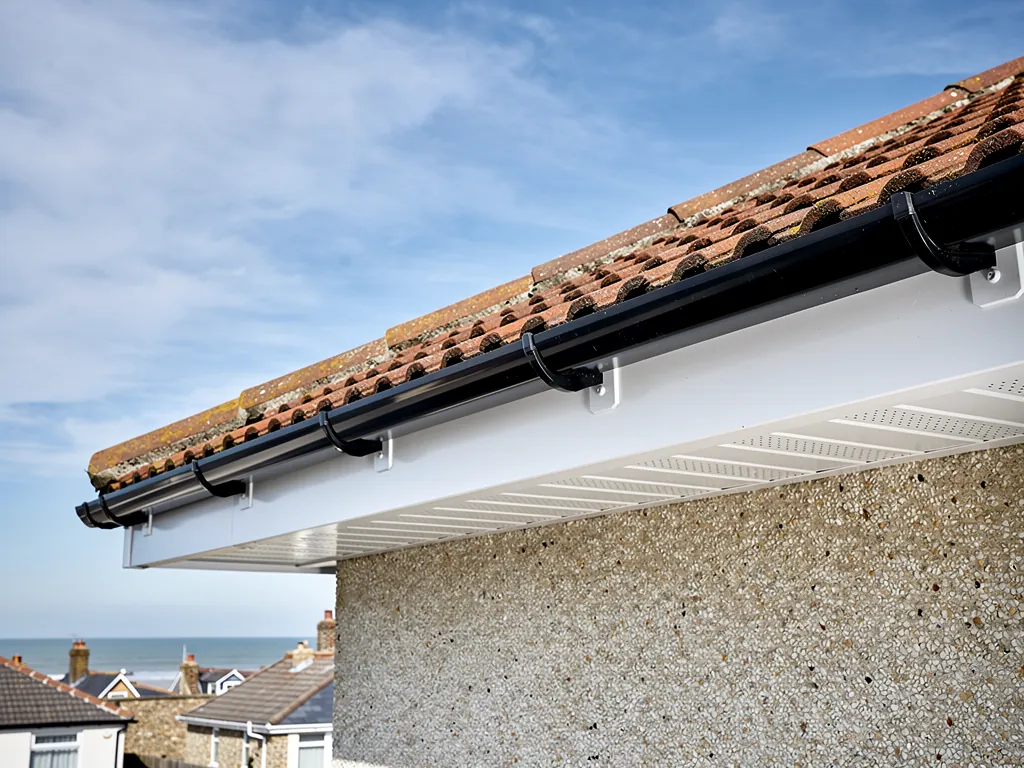
Fascias and soffits are the boards you only look at when something goes wrong. The fascia is the board across the lower ends of the rafters, the one the gutter hangs from. The soffit is the panel you see when you look up at the overhang from the garden path. Together they finish the edge of the roof and keep weather and wildlife out of the eaves.
Because they run the full length of the house, the price is mostly a matter of length. That makes a figure per metre the natural place to start, and national guides do give one. What they cannot show is the height your boards sit at, the state of the timber behind them, or whether your house was built early enough for the soffits to be something other than ordinary board.
This guide takes the sourced figure first, then each thing that moves it. It is a map for reading quotes, not a quote. The written price comes after a survey, and it is the one that counts.
The national figure, and what it leaves out
In Checkatrade's national guide, fascias and soffits average out at around £150 a metre, within £115 to £185. It is a typical UK figure drawn from the wider market, not from any one firm, and it is the only per-metre number worth using as a starting point.
It helps to run the arithmetic once. At £150 a metre, ten metres of roofline comes to £1,500, and thirty metres comes to £4,500. A semi-detached house has far more edge than ten metres, once you count the front, the back and the side of any extension, so the boards alone can land well above what people expect. Treat these as sums to show the scale, not as a prediction for your house.
The guide does not say whether VAT is inside the figure, and it does not say whether the scaffold is. Both can add materially. If a quote seems low next to the per-metre rate, the first thing to check is what has been left out. The second is whether the length used was the real length.
What the rate does cover
A rate of this kind assumes a normal job: old boards come off, new boards go on, the joints are sealed, and the edges are finished neatly. It assumes the timber behind the fascia, the rafter ends, is sound enough to take a fixing. When it is not, the roofer has to cut out and treat or replace that timber first, and the rate no longer describes the work.
Our guide on whether replacing soffits and fascias is worth it covers the condition side, and the page you are reading stays with the money.
Measuring a roofline properly
The first job on any survey is the tape. The roofer walks the whole house and writes down every edge that carries a board. The eaves on the front and back are the obvious ones. Then come the sides of a hipped roof, which has eaves all the way round, and the porch, bay and garage roofs that have their own small stretches.
Gable ends need a mention. The sloping edge at a gable is the verge, and the board that finishes it is a bargeboard. It is a different part from a fascia, because a bargeboard sits higher and is fixed differently, so the roofer measures it as well. Some houses have bargeboards that need replacing while the fascias are fine, and some the other way round.
Two houses with the same floor area can have lengths that differ by half. A square bungalow with a hipped roof has more edge than a gabled house of the same footprint, because every side has eaves. Extensions, dormers and bay windows each add a few metres, and some need their own soffit, which is more detail work than a long straight stretch.
Height changes the price
The same length costs more when it sits at the second storey. Fitting boards at height is slower, more careful work, and it needs different access. That is why a per-metre figure only gets you part of the way, and why a roofer who has not seen your house cannot give a firm number.
Walk round with the roofer if you can. Pointing out the soft board by the back door, or the corner that has always leaked, saves them hunting for it and you paying for the hunt.
Board type and the years you get from it
Replacement boards are commonly uPVC, a rigid plastic that is painted by the manufacturer rather than by you. The alternative is timber, which can be primed and painted to suit an older house but needs repainting as the years go on. Some people prefer a composite board, which sits between the two. Timber and composite boards can cost more to fit than plain white plastic, and the gap widens on a long roofline.
Lifespan is part of the sum, because a board is a purchase you want to repay over time. Published lifespans disagree. Checkatrade says the right moment to replace boards depends on upkeep and material, while the Plastic Centre, which sells uPVC boards, claims 20 to 40. That second figure comes from a seller with an interest, so treat it as the optimistic end. The honest planning figure sits between the two, and the real life of any set turns on board quality and fitting.
Colour matters to the eye more than to the price. White is the usual choice, black and anthracite grey are widely available, and woodgrain finishes can cost more. We look at the visual side in our answer on black, white or wood-effect fascias.
Capping over the old board
Fascia capping means fitting a thin plastic skin over boards that are already there. It is cheaper on the day because the old timber stays in place. It is only a sound option when the boards underneath are dry and firm, because capping hides rot rather than curing it. We would only recommend it after we have been up and checked the timber.
Soffits sometimes carry vents, which we come back to below, so a soffit price can differ from a plain board price for that reason alone.
Scaffold, towers and the pavement
Access is the line on a roofline quote that people most often overlook. A low tower may do for a bungalow, while a house of two storeys normally needs full scaffold, and on a long job the scaffold hire may run into the same range as the boards on a short one.
Checkatrade's scaffolding table, updated in October 2026, reads £800 for a terrace, £1,000 for a detached bungalow and £1,200 for a detached house, each for a month's hire. Those are national hire rates for the scaffold on its own, and they come before any boards, labour or VAT. For a single-day job, a month's hire is more than you need, and a good roofer plans the work so the scaffold stands for as short a time as the job allows.
Should the scaffold overhang the public footway, the Highways Act 1980 (section 169) requires a licence, which takes notice to obtain. West Sussex County Council wants 10 working days' notice before erection and charges £266 for a month. On the Hampshire side of the border applications need ten clear working days of notice, plus £211.90 for the first fortnight. In a terrace those costs sit beside the main price.
The timing also matters in autumn and winter, when weather delays stretch a scaffold's time on site. Ask when the job is expected to finish, and what happens to the hire if rain interrupts it.
Sharing the scaffold with other work
If the roof edge needs attention, or the gutters are due, the scaffold can serve all of it. Our guide on how much guttering costs sets out the gutter side, and the page on replacing soffits, fascias and gutters on a four-bed house shows how the three jobs fit together under one scaffold.
Older houses and asbestos in the soffit
Boards on a house built before 2000 might not be what they look like. Assume asbestos, says HSE, in any home built or refurbished before 2000. External soffits appear on HSE's list of locations to check, because asbestos insulating board (AIB) was used there.
By eye, HSE notes, AIB items look much like their non-asbestos equivalents. From the ground, and often from close up, a flat grey-white soffit board gives nothing away. Taking a sample for analysis is how it is confirmed, not guesswork and not a look.
The reason it matters for cost is that removing AIB is mostly licensed work, which is a different job from swapping ordinary boards. If a soffit might be AIB, we stop and ask for it to be identified before any board is drilled, cut or pulled down, and we plan the work from the result. Breaking an unidentified board to see what it is would be the wrong way round.
Where gutters or pipes are asbestos cement, HSE regards them as non-licensed work when they come down carefully and in one piece. Household asbestos waste needs a consignment note when it leaves the property. Any of this shifts a roofline price, up to the point of becoming a separate job.
Where the old boards have gone
Ordinary board waste leaves site with us when the work finishes. Asbestos waste is different, with its own wrapping, labelling and handling, and that is why the identification step comes first.
Tell us the age of the house when you enquire. It is far better known at the start than discovered halfway up a scaffold.
Vents, wildlife, VAT and the final figure
A few smaller items can nudge a roofline price. Many roofs breathe through the eaves, and a vented soffit or a continuous vent strip is one way to keep that air path open. Marley's guidance on cold-roof ventilation, with a high-resistance underlay, calls for 25mm of opening along the eaves on pitches of 15 degrees or less and 10mm on steeper ones. Whether your roof needs a vent, and which kind, is something we check on site, because a roof with no vent and a roof with a blocked vent behave differently.
Eaves are also where bats and nesting birds sometimes live, and both are legally protected, so evidence of either would pause the job while we decide the next step.
Rot behind the boards
The biggest unknown in any quote is what lies behind the fascia. Rafter ends that stayed damp for years may have gone soft. Replacing a few of them, or treating and splicing them, is extra work, and it is only visible once the old board is off. A good survey finds most of it in advance, and any quote that cannot change if a surprise turns up is worth a second look.
VAT and the final price
Standard-rate VAT is 20 per cent, so a price quoted without it needs a fifth added on top. Look at each quote and check that VAT, scaffold, waste and the finish to the board edges are covered. The survey is followed by a written quote carrying one total, and we believe the figure is good and fair.
You can start the process on our guttering, soffits and fascias page, and send photographs of the eaves with your enquiry.
Questions
Roofline price questions
Is the £150 a metre figure for fascia and soffit boards a fair guide?
It is a fair starting point for the boards from a national guide, Checkatrade, though not a price for your house. The length, the height, the timber behind and whether VAT or scaffold sits inside it all move the result. Use it to spot a quote that looks far too low or high, and ask each roofer how they measured.
Do I need a licence to put scaffold up for roofline work?
Only when the scaffold overhangs or blocks the footway or road. Then a licence is needed from the highway authority, which in our area is West Sussex County Council or Hampshire County Council depending on the address. The fee and the notice period are separate from the roofer's price, so ask whether they are included.
Can I replace just the fascias and leave the soffits alone?
Yes, when the soffits are sound, and many jobs are done that way. The boards meet at the eaves, so the roofer needs to see how they join before pricing. If the soffits are original and the house is old enough, they should be identified before anyone disturbs them.