
Guttering costs · 9 min read
How much does it cost to get guttering done?
A plain guide to what sets the price of new gutters on a house or bungalow: the length of run, the fittings, the height of the eaves, the scaffold and the boards behind them.
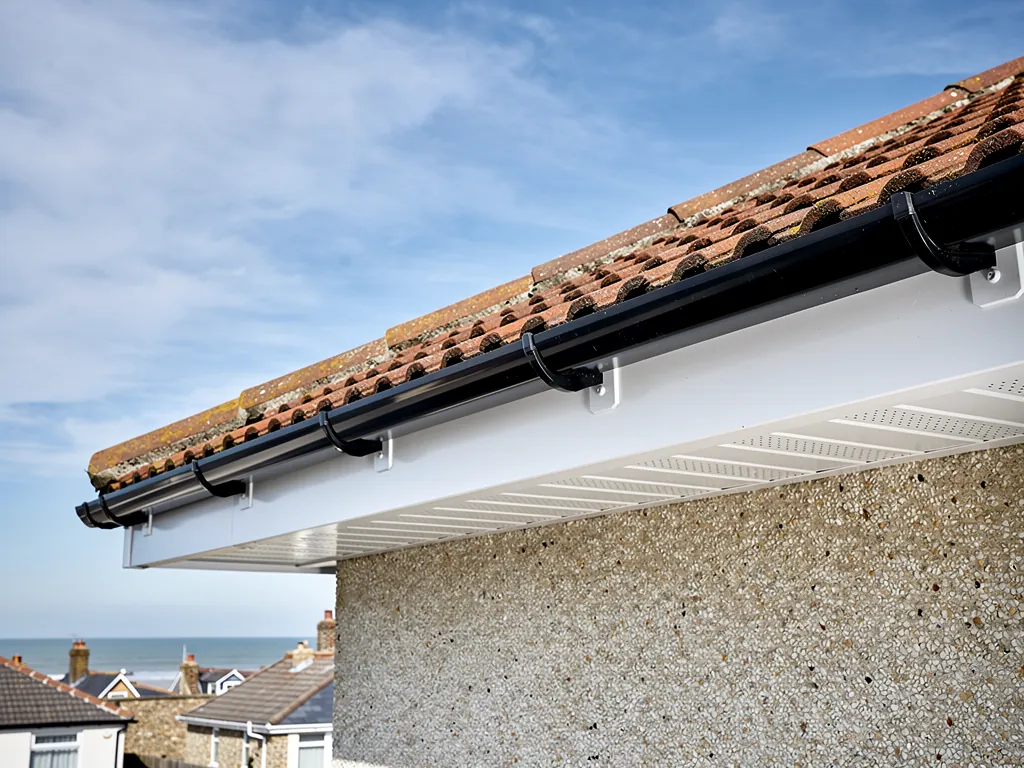
Ask for a guttering price and the first thing a roofer needs is a number you may not have: how many metres of gutter run round your house. The second is how high it all sits. Those two answers explain more of a quote than the colour or the brand of the plastic.
This guide sets out what goes into the price of new guttering, in the order the pieces add up. It uses the national cost guides where they give a figure, names each one, and says where a figure is missing rather than inventing one. Scaffold hire and the fascia boards behind the gutter are the two items that most often move a bill by hundreds of pounds, so they get their own sections.
Nothing here is a price for your house. Photographs of your own eaves, taken during the survey, are what turn these pieces into one written total, and that is the figure to hold a roofer to.
What goes into a guttering price
A guttering job has four moving parts. The first is the run: the total length of gutter along every eave that carries water. The second is the fittings that break that run up, such as corners, stop ends, unions and the outlets where water drops into a downpipe. The third is the downpipes themselves. The fourth is access, meaning how the roofer reaches the eaves safely.
Materials and labour follow from those four. A detached house with a long run and four corners needs more of everything than a mid-terrace with a single straight front and back. Two houses of the same floor area can still sit a long way apart on price, because a hipped bungalow has eaves on every side while a gabled house has them on two.
It helps to know what a gutter is made of, because the words come up on every quote. The fascia is the board fixed across the ends of the rafters, and most gutters are bracketed to it. The soffit is the board closing the underside of the overhang, between the fascia and the wall. The gutter itself is the channel, the downpipe carries the water to the drain, and the hopper is the box that catches water from a pipe or from an upper roof and passes it down.
Why a cost per metre misleads
People like a rate per metre, and a few exist for roof work. A rate hides the fittings, though, and a short run with many corners can cost more than a long straight one. It also hides the height. The same metre of gutter on a bungalow eave and on the second storey of a terrace is not the same job.
So the fair way to read any national figure is as a pointer to where your own price might land. The measured, written quote is the real number, and our guttering, soffits and fascias page explains how we survey for it.
Length, corners and downpipes
Start with the length. On a simple semi-detached house the front and back runs are the bulk of it. Add a side extension, a garage or a porch and each new roof edge adds metres, a corner and often another downpipe. A rear extension with its own flat roof may need its own outlet as well.
Every corner is a joint, and a joint is the likeliest place for a leak to start in later years. A good fitter treats a corner as something to set carefully, so that water does not pool in the angle. Our guide to leaking gutter joints and sagging runs shows what failed joints look like.
Downpipes come next. Every length of gutter must fall towards an outlet, and manufacturer guidance gives the slope. Brett Martin says a gutter needs a fall of 1mm for every 600mm, while FloPlast quotes 1:350 for MiniFlo. Between them the workable slope sits at roughly 1:600 to 1:350, depending on the system. Brett Martin also keeps its brackets no more than 900mm apart. That is manufacturer advice, not a legal standard, but it explains why a long, level-looking run with few outlets sags or holds water.
A very long run may need an outlet in the middle, and that means an extra downpipe and an extra connection to the drain or a soakaway. Ask any roofer where each pipe will discharge, because the answer changes the price.
Hoppers and shared roofs
Where a lower roof receives water from a higher one, the water often arrives through a hopper or a short length of pipe. Those pieces are cheap to replace while the scaffold is up and costly to come back for later.
Material and profile
The material is the choice people expect to drive the price, and it does, though less than access does. Plastic guttering in uPVC is the usual choice on a modern house and the lightest to fit. Cast iron is heavier, needs more care to fit and usually costs more. Our comparison of uPVC, cast iron and aluminium gutters goes through the trade-offs, and it is the page to read before you ask for prices in more than one material.
The profile, meaning the shape of the channel, is the other choice. Half-round is the traditional look and the commonest. Square and ogee profiles are used where the style of the house suggests them. Different shapes need different brackets and fittings, so you cannot swap a profile partway along a run. Our answer on half-round, square or ogee gutters covers when each suits.
Capacity belongs here too. A wider or deeper channel carries more water, which matters on a large roof area feeding a single outlet. Using a bigger size than the roof needs costs more without doing more, and using too small a size causes the overflow that gives gutters a bad name. We would rather size the channel from the roof area it serves than from habit.
Colour is a minor line. Black, white, grey and brown plastic are all widely made, and the choice rarely moves a quote. Seamless gutters, formed from one length on site, are priced differently again, and we look at them in our seamless gutters answer.
Access and scaffolding: the part that surprises people
Reaching the gutter is a safety question first and a price question second. A bungalow eave can sometimes be worked using a ladder with a stand-off bracket, or a low platform tower. A two-storey house usually cannot, and a full job that replaces gutters, fascias and soffits together needs a scaffold along every elevation being worked on.
Checkatrade's scaffolding table, last updated in October 2026, lists around £875 per month for a semi-detached house, £800 on a terrace, £1,000 on a detached bungalow and £1,200 on a detached house. Those are national hire figures, and they are a reminder that on a small job the scaffold can cost as much as the gutters.
Licences when scaffold overhangs the footway
If any part of the scaffold sits on or above the footway, section 169 of the Highways Act 1980 makes a licence from the highway authority a legal requirement, so ask your roofer who makes the application. West Sussex County Council sets a minimum of 10 working days and a fee of £266 for a month. Over the border in Hampshire the notice is ten clear working days, and £211.90 covers the first fortnight. On a terrace or any house at the pavement edge, that waiting time belongs in the plan.
Because of this, the sensible approach is to do all the work that needs height in one visit. If the fascias are rotten, the soffits are loose and the roof edge needs attention, doing them in separate years means paying for access two or three times. Our guide to scaffolding for a roof repair explains when ladders and towers are enough.
Before you set one price beside another, find out whether scaffold is inside each of them. If it is missing, the lower figure may only be an unfinished one.
The fascia question
Gutters hang from the fascia, so the state of that board decides whether new gutters are a simple swap or the start of a larger job. If the board is sound, new brackets bite into it and the gutter goes on. If the board is soft, cracked or pulling away, new gutters fixed to it will sag again, whatever they are made of.
That is why a roofer looks at the fascias before pricing the gutters, and why the quote is written only after the survey. From the ground a board can look fine and still be soft behind the paint. Up close, with a screwdriver and a torch, the picture is clearer. Our guide to rotten fascia boards sets out the repair, cap or replace choice.
The national figure for the boards is higher than people expect. Checkatrade's guide gives fascias and soffits at around £150 per linear metre, against about £45 a metre for the guttering itself. That is a typical UK figure from a national guide, and it does not tell you whether VAT or scaffolding is inside it. It is still useful, because it shows how fast a full roofline adds up compared with the gutter channel alone. Our separate guide to what soffits and fascias should cost goes through that figure.
The practical point is timing. Changing gutters and leaving worn boards behind means the new gutters come off again when the boards are replaced. If the boards are near the end of their life, replacing everything at once costs less than doing it in two goes, because you only pay for access once. That is the reasoning behind our page on replacing soffits, fascias and gutters together.
Old gutters, asbestos cement, VAT and the written quote
Some older gutters are not plastic or iron at all. HSE counts rainwater goods made of asbestos cement among the products that can be handled as non-licensed work, provided they are lowered with care rather than smashed up. HSE also advises assuming asbestos is present in a house built or refurbished before 2000. If grey, brittle gutters or downpipes on an older house could be cement, the material is identified before anyone touches it, and the plan for removal and disposal changes the job.
Household asbestos waste also needs a consignment note, which is a further cost to weigh up. If your guttering is in that category, say so when you ask for a quote.
VAT, waste and the written price
VAT at the standard 20 per cent has to be added to any national figure that leaves it out, which means a fifth more on top. Once prices arrive, look at each for VAT, scaffold and removal of the old gutters. One total, in writing, follows our survey, and we think the price is good and fair.
Cleared waste is part of the job on our site: old gutters, offcuts and packaging leave with us.
Repair or replace
Not every gutter needs replacing. A loose bracket, a failed seal at a union or a blocked outlet is a small repair, and we tell you plainly. Gutters that are cracked along the channel, brittle with age or sagging on sound brackets are a different case. Our guide on whether to replace 20-year-old gutters helps with that call. We recommend whichever job does the work properly with the least disturbance.
Questions
Guttering price questions
Is a loose or leaking joint cheaper to fix than fitting new gutters?
Usually, yes, when the rest of the run is sound. Resealing a union or refitting a bracket is a short job, often done from a ladder or a low tower. If the gutter is brittle, cracked or sagging on good brackets, repeated repairs cost more over time than replacement. A survey with photographs settles which side of that line your gutters are on.
Do I have to pay for scaffolding to have gutters replaced?
That turns on how high the eaves are and how much is being done. Low bungalow eaves can sometimes be worked from a ladder or tower. Taller houses and full roofline jobs generally need scaffold, and a licence may be needed when it overhangs the footway. Check whether each quote includes it.
Should new gutters be fitted before or after the fascias are replaced?
After, or at the same time. Gutters are bracketed to the fascia board, so fitting new gutters to boards that are then pulled off means the gutter comes down twice. When the boards are sound the gutters can go on alone. When they are soft, replacing both in one visit also means you pay for access only once.