
Lead flat roofs · 9 min read
Lead flat roofs: rolls, drips and bays on period homes
A lead flat roof is laid in bays divided by rolls and stepped by drips. This guide explains how that works, what fails on period homes, and when lead is worth keeping.
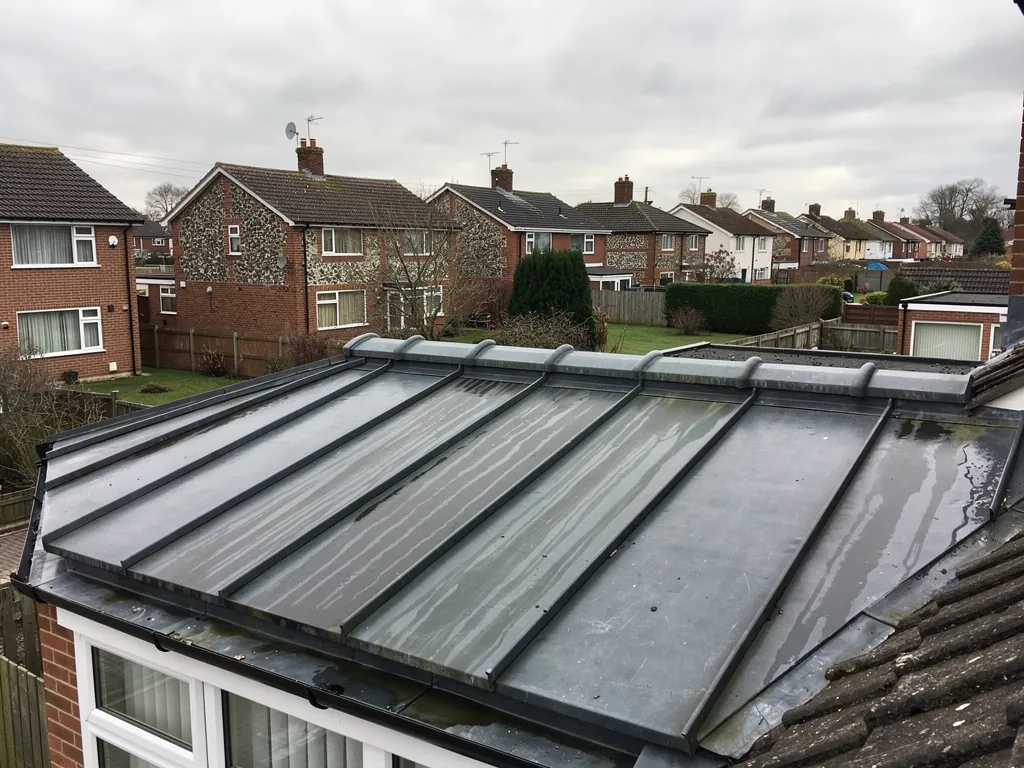
Flat roofs are not new to old houses. Victorian and Edwardian terraces often have a flat section behind the parapet, a flat top to a bay, a roof over a back addition or the flat crown of a dormer. Many of those were covered in sheet lead, because it could be shaped to the building and left to age for generations.
A lead flat roof does not look like a modern membrane. It is not one sheet but a patchwork of strips, each laid between ribs called rolls and stepped down the slope by drips. That layout is not decoration. It is how a rigid metal sheet copes with sun, frost and the slow movement of a building without tearing.
If you own an older home with a lead flat roof, three decisions come up sooner or later. Is it worth repairing? Should it be replaced in lead or in something else? And what will it cost? This guide covers the construction in plain terms, the falls and drainage it relies on, the faults to look for, the alternatives, and the figures and rules that apply. Throughout, the verdict comes from the roof itself, and we show you the photographs.
Where lead flat roofs are found and how long they last
On a period house, lead flat roofs sit in predictable places: a box gutter behind the front parapet, the top of a bay, a rear addition, a link between two buildings or the crown of a dormer. All share one trait. The lead has to keep water out of a roof with very little slope.
Lead has a long record on old buildings, which is why so many period roofs still carry it. Less gives a lead flat roof a typical life of 50 to 100 years, and MyJobQuote, in a guide last updated on 22 September 2026, gives lead flashing over 80 years. On the same guide, torch-on felt gets 10 to 20 years, GRP 25 to 40 years and EPDM 30 to 50 years, though GreenSpec states 20 to 30 years for EPDM, so sources differ.
Why the figure varies so much
The spread is wide because lead roofs do not age evenly. A well-laid roof over sound boards with a good fall can go on for generations, while the same sheet over a dipped deck, or beside outlets that keep clogging, may crack far sooner. The metal rarely gives up first. The build around it does.
Bognor's older streets show the type. The council's conservation area guidance places The Steyne in the 1820s and Aldwick Road in the Victorian and Edwardian eras, both streets of bays and chimneys where lead is tucked into every junction, and those junctions decide whether the rooms below stay dry.
For a smaller version of the same roof, see our guide to lead bay window roofs and porch canopies.
Rolls, drips and bays: how the sheet is laid
Three terms describe how a lead flat roof is put together, and a survey report is easy to read once you know them.
A bay is a single strip of lead running down the slope, between one roll and the next. Each bay is kept to a limited width, because a wider strip moves more as it heats and cools. The roof is divided so that no single sheet has to take up too much of that movement.
A roll is a raised rib, usually formed over a length of shaped timber fixed to the deck. The edge of one bay is dressed up and over the roll, and the edge of the next bay is dressed over that, so the joint sits on top of the rib, above the water. Water runs down beside the roll and never across it. Rolls also let the lead slide a little as it expands.
A drip is a small step in the deck, running across the slope. Where a long run of roof needs a change of level, the lead steps down at the drip, and the upper sheet overlaps the lower one so water cannot be driven back under it. Drips also cut the length of each bay, which limits movement again. At each drip the lower edge of the upper sheet laps the sheet below by enough to stop wind-driven rain being pushed back under it.
Why this layout matters
The pattern looks fussy, but without it a large sheet would creep downhill, ripple and tear. A roofer reading an old lead roof can see how the original builder meant it to work and judge whether later repairs respected that logic. Our answer on lead rolls and drips covers each detail more briefly.
Falls, outlets and drainage on a roof with little slope
A flat roof is not truly flat. It needs a slope so water leaves it, and lead is no exception. The current flat roof standard, BS 6229:2025, took over from the 2018 edition in December 2025 and retains a 1:80 minimum finished fall. Roofers usually design nearer 1:40, which leaves a working slope after the deck settles and the sheet is laid.
Where the joists of an old house run level, the slope comes from firrings, wedge-shaped timbers fixed on top before the deck goes down. A roof that ponds, with water lingering after rain, is telling you the fall is short or the deck has dipped.
Outlets and parapet gutters
Many period flat roofs drain to a gutter behind a parapet, with an outlet through the wall or into a hopper and downpipe. These parapet and box gutters carry the water from a large area into a narrow channel, so they take a heavier lead. Royston Lead's cast-lead brochure lists parapet and box gutters against codes 5 to 8, and tapered valley gutters in the same range.
The outlet is the point of greatest risk. If it blocks, the gutter fills, water climbs the sheet and finds the weakest lap. Keeping it clear protects the roof more than any other habit.
When a lead roof is relaid, the fall is checked before a sheet goes down. If the deck is rotten or dished, new boards and firrings come first, since lead laid over them would only move the leak. That is the square finish: proper falls, and edges neat enough to look right from the street.
What goes wrong with a lead flat roof
The faults on lead flat roofs fall into a few groups.
- Cracking and splitting. Lead moves with every change in temperature. A bay that is too wide, a roll that is too tight or a sheet fixed too rigidly can crack along the same line each winter, and thin sheet fatigues sooner than thick.
- Ponding. Standing water after rain shows a shortfall in the slope. It speeds fatigue and finds weak joints.
- Failed rolls and drips. If a roll has been crushed or a drip has been covered in sealant, the sheet loses the ability to move and starts to split.
- Open wall junctions. The turn-up against a wall, with its flashing above, is a common point of entry.
- Blocked outlets. Moss, leaves and debris back water up beneath the laps.
- A soft deck. Long-term leaks rot the boards, and the lead then follows the shape of the damage.
Old faults are often disguised. Bitumen paint, mastic and self-adhesive tape on a tired lead roof may quieten a drip, yet they stop the sheet moving and hide the cause. A surveyor treats a roof smothered in sealant as one with an unknown history and looks underneath.
Spotting trouble from the ground
A flat roof cannot be judged from the street, but stains on the upper walls, damp below a parapet, plants in the gutter and a ceiling that marks after heavy rain all deserve a roofer's attention. Do not walk on an old lead roof to check it, because footfall can crease the sheet and open a seam. We photograph every bay, roll and outlet, and you receive the pictures along with the quote.
Repair, keep or replace: reading the options
Our verdict turns on how much sheet and deck are still sound. Three outcomes are common.
Repair. A single cracked bay, a failed wall flashing or a damaged drip can often be put right locally. The affected strip is cut out and relaid, which suits firm boards and lead of adequate thickness.
Patch for now. If the lead is old, crazed and thin but the deck is dry, a patch can see the roof through a season or two. We say that it is a stopgap, and show you what would trigger the next step.
Replace. When the lead has worn through across much of the area, the deck is soft, or the fall is wrong, a full relay is the answer. The old covering and any rotten boards come off, the fall is corrected, and new lead is laid with rolls and drips to suit.
A lead roof that is relaid over a deck with the wrong fall will crack again, so the boards and slope are put right first.
Lead or something else?
Other coverings suit some flat roofs better. EPDM is a synthetic rubber laid as one large sheet, and Less gives it 30 to 50 years. GRP is a fibreglass shell formed on site, at 25 to 40 years. Torch-on felt lasts 10 to 20 years. All have fewer joints than lead, which suits a large, plain roof.
Lead keeps its advantages on a period building, where its appearance matches the original and where the roof is full of angles, upstands and parapets. On a listed building or in a conservation area, changing the material can need consent, so ask the council first. See our guide to leadwork on listed buildings and churches for how consent works.
Cost, regulations and getting a quote
The nearest published costs cover flat roofs generally. Checkatrade's replacement guide, in a table updated October 2026 and headed plus VAT, shows flat roofs at £2,800 to £7,500. That range is for flat roofs in general, not lead. A lead covering with rolls, drips and parapet details is priced on survey.
What moves a lead flat roof price is the area, the number of details, the thickness of the sheet, whether the deck and firrings need renewing and how the roof is reached. Checkatrade puts roofers at £280 to £360 a day before VAT, which is charged at 20 per cent. Ask each roofer whether the price covers both VAT and scaffolding.
Building Regulations and flat roofs
Approved Document L treats re-waterproofing a flat roof as renovation. An upgrade is expected once over 50 per cent of the roof's surface, or over 25 per cent of the external building envelope, is renovated, with 0.16 W/m²K the improved U-value for an existing roof. Your building control body can say how that applies.
The Planning Portal's own test is under 25 per cent of the envelope and under 50 per cent of the roof, whereas Arun District Council's building control pages list re-covering flat roofs as approval work, so check with them first, and keep their answer with your records.
The written quote comes after our survey: one total, with the photographs behind it. See our flat roofing service for roofs of every type, and the lead roofing and leadwork page for the full range of lead work.
Questions
Lead flat roof questions
Why does my lead flat roof have raised ribs and little steps instead of one smooth sheet?
Those ribs are rolls and the steps are drips. Together they divide the roof into strips that can expand and contract without tearing, and they keep the joints above the water. Without them a large sheet of lead would creep and crack. A roofer reading them can tell how the roof was meant to work.
Is it worth keeping a lead flat roof on a period terrace rather than switching to EPDM?
Often, if the lead is sound and the deck is firm. Lead matches the original look and handles angles and parapets well. EPDM suits plain, open roofs with fewer details. Where the lead has failed throughout, a full survey shows which option fits, and the written quote sets out the choice.
My flat roof holds water for a day after rain: does that mean the lead has failed?
Not necessarily, but it signals a problem with the fall. Standing water speeds wear and finds weak laps. The cause may be a dipped deck, a missing firring or a blocked outlet. A survey with photographs along each bay shows whether clearing, correcting the slope or relaying is the right answer.