
Tile hanging · 9 min read
Tile hanging: repairing and replacing vertical tiles
Vertical tiles on a wall do the work of a roof covering without the help of gravity. Here is what goes wrong with them, how a repair or re-hang is done and what to check first.
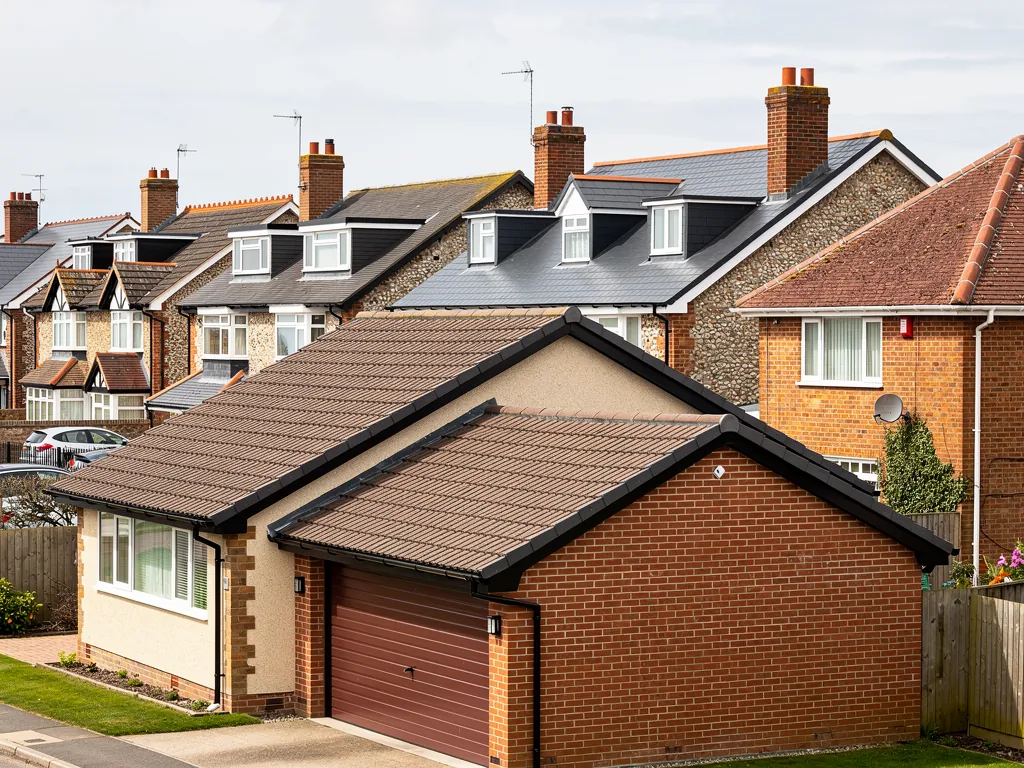
Tile hanging means dressing a wall in small tiles on timber battens, so rain is shed by the wall the way a roof sheds it. You see it on gable ends, upper storeys, bay windows and the cheeks of dormers. Done well it looks tidy and keeps a wall dry for a very long time. Done badly, or left alone as it ages, it starts to drop tiles, and the wall behind it takes on water.
It is also easy to overlook. People look up at the roof after a gale and forget that a tile on the wall is held by the same small nibs and nails. A few missing tiles on a first-floor wall can be a week old or ten years old, and from the pavement you cannot tell which. That uncertainty is a good reason to look closely at any wall that is hung with tiles.
This guide explains how tile hanging works, what the common faults are and what can be done about each one. It covers how to match old tiles, what the junctions with the roof need, the figures national guides offer for repair work and the consent questions that apply to listed and conservation-area houses. Where a term is new, it is explained on first use.
How vertical tile hanging is built
A tile-hung wall is a layered system. At the back sits the structure, which may be brick, block or a timber frame. Over it, in a well built wall, goes a waterproof membrane. Timber battens, thin strips fixed across the wall at a set spacing, are nailed through it, and the tiles hang from the battens by small projections on the back called nibs. Each tile overlaps the one below, so rain travels over the face and drips clear at the foot instead of working behind.
Plain tiles and decorative patterns
Most tile hanging uses plain clay tiles, flat or gently curved, which are cut to fit and laid in courses. Some walls mix in shaped tiles in bands for decoration. The shape matters when you need a replacement, because a rounded tile from one maker will not sit properly among square ones from another.
What is different from a roof
A roof tile is held down by its own weight and by the slope. A wall tile has almost no weight pressing it into the course below, so it relies on its nibs and fixings. BS 5534 is titled for slating and tiling of pitched roofs and vertical cladding, so vertical work has its own place in the standard. The practical lesson is that a hung tile loses its grip sooner than a roof tile does, and the battens behind it matter as much as the tiles you can see.
Our guide to plain clay tile roofs covers the same material used on a slope.
Signs that tile hanging needs attention
Most owners first see a gap, a tile lying in the flowerbed, or a stain inside. A walk round the house with binoculars finds more than a glance from the drive. These are the signs worth noting.
On the wall
Look for missing tiles and for tiles hanging at an angle. Cracked tiles show as a line across the face, and tiles that have lost their surface show a rough, flaking edge. A wall that bellies outwards, or courses that no longer run in a straight line, points to loose battens behind the tiles. Moss and algae growing across the tiles show that the wall stays wet for long periods.
Inside the house
Damp patches on the inside of an exterior wall, flaking paint, a musty smell and stains on a ceiling below a gable can all trace back to a hung wall. Water can enter at a damaged tile, run down the back of the membrane and appear several feet from the cause.
At the edges
The edges are where most trouble starts. Check beneath window sills, at the foot of the wall, around a bay and wherever the tiling meets the roof. A gap in the lead there is a faster route in than a missing tile.
If you spot any of these, take photographs from the ground and note the date. They help a roofer judge how fast the fault is moving, and they are useful if you later speak to an insurer.
What causes tiles to slip, crack and fail
Vertical tiles fail for a short list of reasons. Knowing which one applies decides whether a repair will hold.
Fixings and battens
Nails rust and loosen, and battens rot where moisture sits behind them. Once the battens give way, tiles lose their anchorage and slide as a group. The older the wall, the more likely it is that the timber and the nails have aged together, which is why patching tile by tile can turn into a chase. The sister problem on a pitched roof is described in our page on cracked roof tiles.
Frost, wind and exposure
Clay that holds water can crack when it freezes, and a gale throws grit and driven rain against the face of a wall that has little shelter. West Sussex homes near the Channel get sea weather, so a south or west wall that takes the worst of a storm needs checking after one.
Water running down from above
A split downpipe, an overflowing gutter or a dormer that leaks can soak a tile-hung wall below it. The tiles are only the symptom. Mend the tiles and leave the leak, and the wall will fail again. Check the gutter and any flashing above before you blame the tiles, and take a look at our page on leaking dormers if the wall is the side of one.
Age and the wrong replacement
Tiles wear out. Marley cites a minimum life of 60 years for clay tiles, though buildingconservation.com judges it a poor guide for old peg-tile roofs. A modern tile fitted among old ones also looks wrong and can sit differently.
Repair, partial re-hang or full replacement
The right answer turns on the survey result, and our advice is the lightest job that reaches the cause.
Spot repairs
With sound battens and just a handful of tiles cracked or gone, the cure is to replace those tiles and re-fix any that have loosened. The work goes quickly once access is in place. The risk is that the neighbouring old tiles are close to wearing out, and a patch simply moves the next failure along by a few courses.
Re-hanging a section
Where a whole area has failed, such as the lower courses that take the splash or a panel under a window, the sensible repair is to strip that panel back to the wall. The membrane is checked, new battens go on where the old have decayed, and the sound tiles are re-hung with the replacements mixed through. It costs more than a patch, and the repair lasts better because it deals with the structure behind the tiles.
Replacing the whole wall
When the battens are rotten across most of a wall, or the tiles are crumbling, a complete strip is cheaper in the end than repeated visits. The wall is re-tiled in new or reclaimed clay with fresh battens, membrane and fixings.
Matching the existing tiles
Old tiles vary in size, colour and finish. Reclaimed tiles take longer to find, and an odd one out is plain from the road. Our page on matching old roof tiles explains how a close match is found. Where nothing matches, one option is to re-hang the old tiles on the visible face and use the new ones on a rear elevation.
Junctions, lead and the weak points around the tiles
The tiles themselves are straightforward. The trouble lies in the places where tile hanging stops: at the roof, around windows, at corners and at the bottom of the wall.
Where the wall meets the roof
A tile-hung gable or dormer cheek meets the roof covering along an angled line. To keep water out there, soakers are slipped between the courses and the roof tiles, and a lead flashing is dressed over the top. Sheet lead is graded by code, with a higher number meaning thicker metal. Royston Lead restricts code 3 to soakers and lists codes 4 and up for flashings. Our page on lead soakers explains the part they play.
Around windows and corners
Cills, reveals and corners need special tiles or lead to turn the course. These details are cut and shaped by hand, and if they are skimped, water finds the gap. An external corner is usually finished with purpose-made angle tiles or a lead strip. A bay window roof and its tiled sides are one of the trickiest combinations, and our page on the lead bay window roof covers that.
The bottom edge
The lowest courses sit closest to splashing rain and soil, so they are the first to stay damp. A clear gap between the bottom tile and the ground or a paved surface helps the wall dry. If the lowest courses are always wet, raising the paving or fixing a faulty drain may do more than any amount of re-tiling.
The best repairs treat these junctions as part of the job. A neat finish matters here, since an untidy flashing or a patch in the wrong colour is visible from the street for years.
Costs, access and consent
National cost guides price roof repairs, not tile-hung walls, so any figure here is a pointer to scale, not a quote. Checkatrade's roof repair table, last updated in June 2026, gives clay tile repairs at £110 to £160 per m², excluding VAT, and lead flashing repairs at £50 to £70 per metre. Wall work is slower to set out than a plain slope because every course has to be cut around windows and corners, so treat the roof rates as the floor of the range. The final figure depends on the area, the access, the number of junctions, the state of the battens and whether reclaimed tiles are needed.
Scaffolding and licences
An upper-floor wall almost always needs scaffold, which often costs more than the repair. Checkatrade's scaffolding table, October 2026, shows roughly £875 monthly for a semi with two storeys. Poles that go up on the footway need a licence from the highway authority, so West Sussex County Council asks for at least 10 working days' notice; your roofer can say who makes the application.
Listed buildings and conservation areas
Where a house is listed, the National Park Authority says like-for-like repairs in matching materials need no listed building consent, but a change of material or pattern does. In a conservation area, ask the council's planning team before you replace tile hanging with another cladding. Arun's conservation guidance for The Steyne wants slate or clay plain tiles restored wherever modern substitutes have appeared.
Asbestos and old boards
HSE guidance for buildings dating from before 2000 is to assume asbestos is present somewhere. Some boards behind old cladding can contain it, so unfamiliar boards are identified before anyone cuts into them. Our pitched roofing page lists related work.
Questions
Tile hanging questions
Is tile hanging a roofing job or a building job?
It sits across both. The tiles and battens are roofing trades, and BS 5534 covers vertical cladding alongside roofs. The wall behind it belongs to the builder. A roofer who does the cladding should also check the flashings that join it to the roof, since that is where the two meet.
Can I just replace a few missing tiles myself?
The tile is easy to buy, but reaching an upper wall safely is not. It needs scaffold or a tower, and a missing tile often means the battens behind it are loose. Photographs taken from the ground are useful, and a roofer can then look at the whole wall before you spend anything.
Will new clay tiles look different next to my old ones?
Usually, yes, at first. New clay is brighter and more even than tiles weathered for decades. Reclaimed tiles matching in size and shade blend better, and mixing new tiles through the wall instead of in one block helps. The match is a judgement we discuss at the survey, using photographs of your wall.