
Pressure washing roofs · 9 min read
Pressure washing roofs: why it can do more harm than good
A pressure washer looks like the quick answer to a mossy roof, but a roof is not a patio. This guide explains how the jet can damage tiles, where the water goes and what a gentler clean does instead.
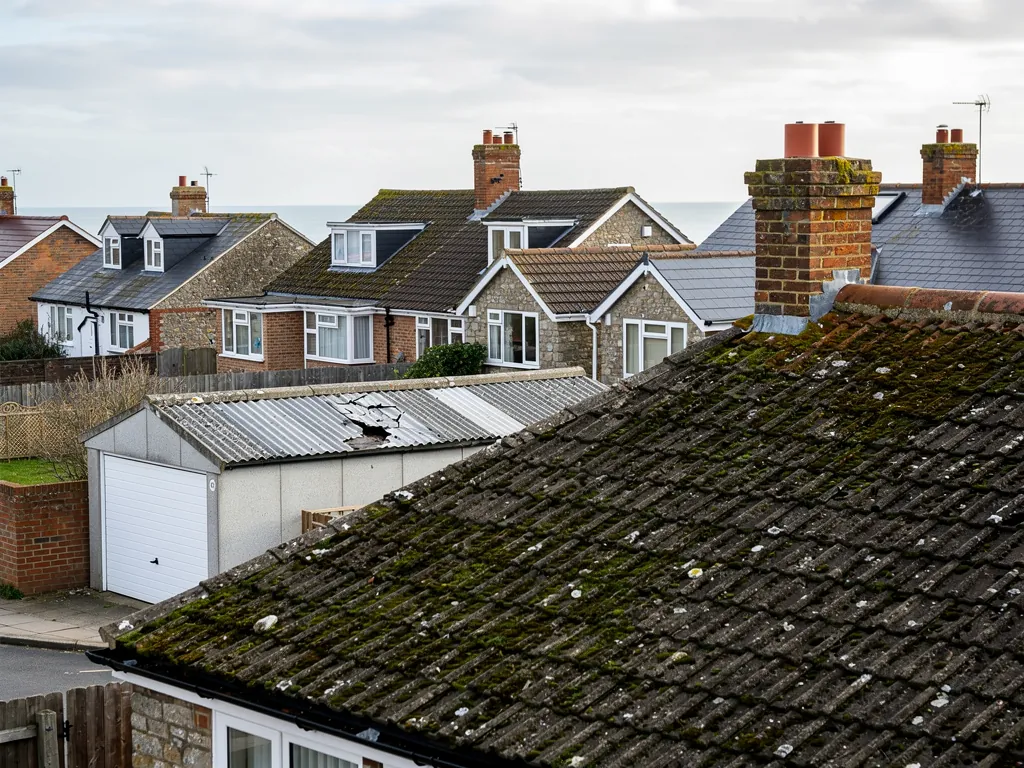
Pressure washers are brilliant on drives, patios and garden walls. Hold one up to a roof and the picture changes. A drive is flat, solid and built to take water. A roof is a pitched stack of overlapping pieces, each one designed to shed rain downhill and keep it out of the building. A jet that hits those pieces from below, or at a hard angle, asks the roof to do something it was never built for.
Many people have heard that pressure washing is bad for roofs, and a good number have still paid for it or tried it themselves. The result can look impressive on the day. It is only later that tiles start to crumble, a ceiling stain appears or the moss returns thicker than before. By then the link with the wash is hard to prove.
We would rather you knew the risks before choosing a method. This guide covers how a pressure washer damages tiles, where the water ends up, which roofs should never be washed this way, and what we do instead. It is not an argument against cleaning a roof. It is an argument for doing it with the right tool.
Why a roof is not a patio
On a patio the water lands on a solid surface and runs away. On a pitched roof the covering is laid in courses, each tile or slate overlapping the one below. The overlap, known as the lap, is what keeps rain out. Water falling from above runs down the face and over the lower edge, which is the direction the design expects.
A pressure jet reverses that. Aimed up the slope, as it often is when someone works from a ladder or the ground, it forces water into the gaps between tiles. It is not rain falling gently across a lap. It is a narrow stream with force behind it, and the roof was not built to resist that.
The surface matters too. Concrete, clay and slate each have a face that has weathered in its own way. Water hitting that face at speed can remove more than moss. A cleaned section that looks bright against its neighbours is sometimes a section that has lost its top layer, and the tile beneath is more open to the weather than the one beside it.
Why people reach for it
The appeal is plain. A pressure washer is cheap to hire, quick to use and gives an instant result. Moss blows away in seconds. That speed is also the problem, because there is no gentle option on the dial that makes a jet safe for a roof. A slower method gives a result that lasts, which is why it is usually the better buy. The extra time is spent on lifting growth gently, treating the surface and protecting the roof and the ground below.
How a jet can damage the tiles
Tiles weather. Over years the surface changes, edges soften and tiny cracks open. Moss often sits in those cracks. A jet strong enough to blast the moss out can enlarge the cracks, chip the edges and wear away the surface, leaving the tile rougher than before. A rough surface holds moisture and growth, so the roof tends to go green again sooner.
Concrete tiles are a particular worry because their colour sits at the surface. A wash that removes the top layer can leave a patchy roof that no amount of time will even out. Old clay tiles can be softer and more brittle than they look, and some hand-made tiles have uneven surfaces that a jet damages unevenly.
Slate suffers in a different way. Each slate is held by nails or hooks, often old ones. A jet can shift a slate, crack its lower edge or snap one outright. Ridge tiles sit on the apex line, bedded in mortar or held with clips, and a jet aimed at them can loosen the bedding or the fixings.
Damage you cannot see from the ground
Much of the harm is hard to spot. A hairline crack does not show from the garden. A tile that has been weakened looks sound for a season or two, then gives way in the next gale. By the time the damage is obvious, nobody links it to a wash that happened years earlier. A survey after any cleaning, with close photographs, is the only way to check. It is worth keeping the pictures with your house papers, because they date the roof's condition and help the next roofer see what has changed.
Where the water goes
Water forced under the laps does not simply run out again. It travels along the underlay, the sheet that lies beneath the tiles, and can reach the battens, the rafters and the loft insulation. A short burst may dry out without trouble. A prolonged wash on an older roof, where the underlay is tired or torn, can soak the structure.
The first sign is often a ceiling stain days after the wash, or a damp smell in the loft. By then the water has done its work and the cause is not obvious. If this happens, our answer on damp patches on a ceiling shows how to trace it.
Gutters are the other destination. A pressure wash sends a heavy load of moss, grit and loose tile granules down the roof and into the gutters and downpipes in a short time. Unless someone is collecting it, the outlet blocks, the gutter overflows and the water runs down the wall. Our guide to moss, gutters and downpipes explains the knock-on effects.
Spray and runoff
A jet also throws water and debris sideways. Windows, cars, plants and neighbours' gardens are all in range, and moss slurry stains paving and render. Any treatment used with the water ends up in the same places. Protecting what is below the roof takes time, which the quick wash tends to skip. Sheets over the garden, covers on the vents and a person watching the downpipe outlets all cost minutes, and all of them are easy to leave out when the machine is running.
Roofs that should never be pressure washed
Some roofs should not see a pressure washer at all. Top of the list is anything that might contain asbestos cement. For any building put up or refurbished before 2000, HSE says to assume asbestos is present, and its guidance treats every asbestos cement roof as fragile. Should the sheeting start breaking up and throw off significant dust, the job becomes notifiable non-licensed work. A jet is exactly the kind of force that breaks weathered sheeting. If there is any doubt, stay off the roof and seek advice.
Old and hand-made tiles come next. They are often softer, uneven and irreplaceable in practice, and a jet can ruin a surface that took a century to develop. The same applies to stone slates and old Welsh or Cornish slate. Roofs on historic buildings call for gentler care still, and our guide to cleaning roofs on historic and listed buildings covers it.
Felt, rubber and fibreglass flat roofs are vulnerable too, because a membrane can be lifted at the seams or punctured. Roofs with loose, slipped or missing tiles, or where the fixings have failed, can lose more under a jet. Rooflights, polycarbonate sheets and fragile panels should never be hit with a jet.
If you are not sure
If you do not know what your roof is made of or how old it is, treat it as fragile. Ask a roofer to look at it before any water goes near it. A short visit costs far less than a repair to a damaged covering or a ceiling. Mention any earlier repairs, patched sections or replaced tiles, since those weak spots are the first to suffer.
Risks to the person holding the lance
A roof wet with water and moss is an extremely slippery place, and the kick of a pressure lance makes it worse, particularly when the water starts running back down the slope under your boots. Anyone working from a roof ladder or a sloping surface has one hand on the lance and no hand free to save a slip. Falls from roofs are a leading cause of serious injury in the building trade, and householders have no training or equipment to match.
Working from the ground with a long lance sounds safer, yet it brings its own problem: the angle. From below, the jet points up the slope, which is the direction most likely to drive water under the tiles. Reaching the upper slopes from a ladder placed against the gutter risks bending or breaking the gutter and overbalancing.
Electricity is another risk. Overhead cables, security lights, satellite equipment and outside sockets are all within range of a spraying jet. Water and electrics do not mix, and anyone using a washer near them should be certain what is where.
Hire shop advice
Equipment hire shops often rent washers with no advice on roofs. The machine is the same one used on drives, and the person hiring it hears nothing of the lap, the underlay or the tile surface. If you must use a washer, keep well clear of roofs, and leave the roof itself to someone who knows what the covering will take.
Cleaning without the jet
There is a better way to clear a roof, and it is slower and gentler. On a roof with thick moss, we lift the growth by hand with scrapers and soft brushes, work down the slope with the fall of the tile, and bag the waste as it comes off, so nothing lands in the gutters. The tiles are not scoured, and no water is driven under the laps.
A biocide then goes on at low pressure. That is a product which destroys growth lodged in the surface of the tile. It is sprayed over the whole slope and left to do its work, with rain and wind clearing the dead growth over the following weeks. This is the approach known as soft washing. Our guide to soft washing and biocide treatment explains the method in full.
The result is not instant. A low-pressure treatment takes time to show, and the roof may look patchy in the meantime. That patience is the price of not damaging the tiles. It also leaves the surface intact, which is what keeps growth from taking hold again as quickly.
Questions to ask before you agree
Ask any roofer what pressure they use, how they protect the laps, what treatment follows and how they clear the gutters. Ask for pictures taken of the slopes both ahead of the work and once it is done. A firm that cleans with care will answer easily. We photograph your roof, tell you what we found and give one total price in writing, and our roof cleaning and moss removal page explains the work.
Questions
Pressure washing questions
Can a pressure washer be used on any roof if I keep the pressure low?
It is safer on some roofs than others, yet low pressure does not remove the risk of driving water under the laps. The covering, its age and the angle of the jet all matter. A roofer can tell you whether your roof will take any washing, and a soft treatment is usually the better route.
How can I tell if pressure washing has damaged my roof?
Look for a patchy colour, roughened or chipped tile surfaces, slipped tiles, granules in the gutters and new stains on the ceilings below. Some damage only shows after the next storm. A survey with close photographs of the slope is the best way to check.
Is it ever right to use a pressure washer near a roof?
On a drive, patio or wall beneath it, yes. On the roof itself, we would not. Keep any jet away from the tiles, take care with the overspill of moss and debris onto paving, and let someone with the right access equipment handle the roof.