
Historic roofs · 9 min read
Cleaning roofs on historic and listed buildings
Moss on an old roof is a different problem from moss on a modern one. This guide covers consent, fragile materials, gentle methods and the growth that is better left where it is.
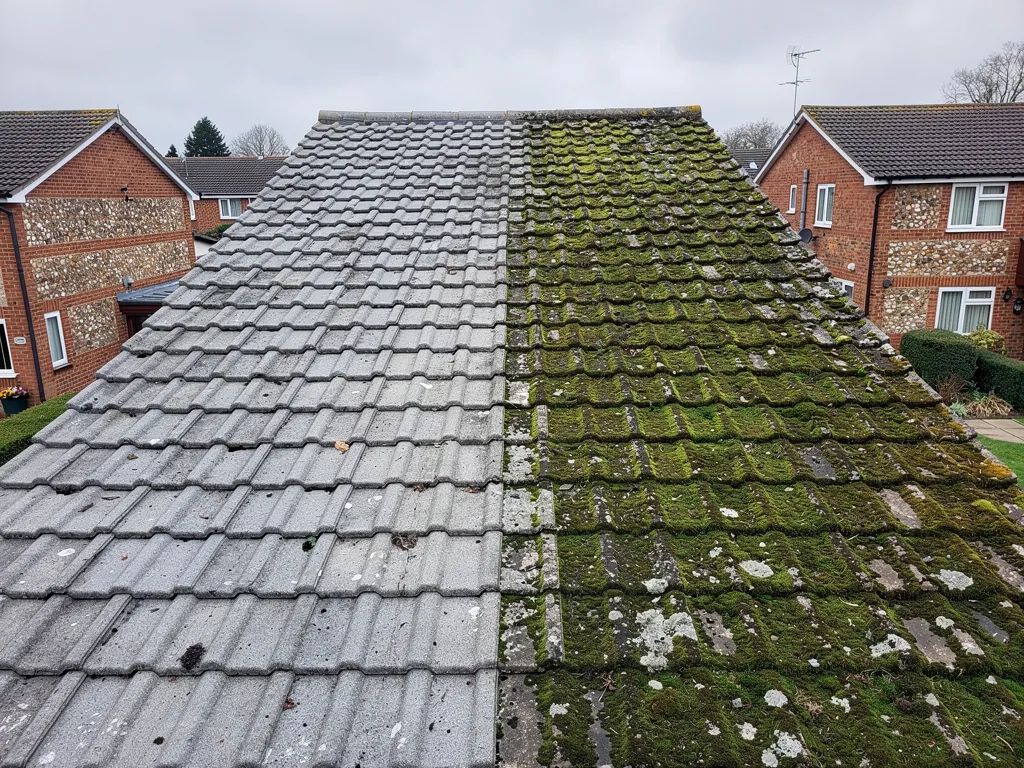
A listed cottage, a stuccoed terrace on the seafront and a church roof can all turn green, and the owners can all be tempted to ring the first cleaner who advertises. The risks are not the same as on a 1990s estate house. The tiles may be handmade and soft, the slates may be hanging on nails that have worked loose over a century, and the building may carry legal protection that affects what you may do to it.
Cleaning is usually the mildest thing you can do to a roof, but mild is relative. A method that suits modern concrete tile can strip the surface of an old clay tile, shake a slipped slate off its nail or push water into a lime-bedded ridge. What counts as harmless in one place can count as damage in another.
This guide covers consent, how the age of the covering changes the method, why some growth is better left alone, and what to ask before anyone climbs onto the roof. It is general advice: your own council confirms what applies to your own building.
Does cleaning a listed roof need consent?
The starting point is the law on listed buildings. Section 7 of the Planning (Listed Buildings and Conservation Areas) Act 1990 bars any alteration that erodes a listed building's special interest unless it has been authorised. Consent is the legal gate, and cleaning rarely reaches it. The yardstick is the character of the building, not the size of the job, so a small change in the wrong place can still count.
The South Downs National Park Authority describes the everyday position: everyday upkeep, and minor repairs carried out in place with matching materials, need no listed building consent. Where a method is gentle and reversible, it usually belongs in that category. Cleaning is upkeep, and gentle hand cleaning of the covering would normally sit on that side of the line. That is a sensible reading, not a guarantee. Nobody can tell you from a distance whether a particular method will alter the character of a particular roof.
Who to ask
Ask the council that handles listed buildings in your area before work starts, and keep the reply. In the Arun District that means Arun District Council's planning team, and inside the South Downs National Park the authority's own guidance explains who decides. Describe the method, the product and the roof covering in your message, and attach a photograph or two of the slope concerned. A short written answer protects you if a neighbour or a later buyer asks questions.
Anything beyond cleaning is a different matter. Re-covering, replacing slates or changing the pitch is covered in our guide to re-roofing a listed building, and the consent route for urgent works is in the page on emergency repairs to listed roofs.
Conservation areas and unlisted older homes
Not every old roof is listed. Many older houses in Bognor Regis stand in conservation areas, and others are simply old. Arun's records give dates for several: The Steyne and Waterloo Square (August 1979, enlarged July 1994); Aldwick Road in July 1994; the Railway Station area in September 1994; and the Hotham Park area around Upper Bognor Road in June 1993. Felpham village dates from February 1985 and North Bersted from February 1975.
A conservation area does not by itself forbid cleaning a roof. Section 55 of the Town and Country Planning Act 1990 excludes works that do not visibly alter how a building looks from outside, and taking moss off changes the look of a roof far less than re-covering it does. Where a council has made an Article 4 direction, certain rights are withdrawn. The two Arun directions found in the Bognor area, one controlling change of use to shared houses and the Craigweil House direction on verges and front hard surfaces, do not touch roofs.
What the seafront terraces tell us
Arun's guidance for Aldwick Road describes Victorian and Edwardian terraces dominated by stucco, slate and flint, and regrets the swapping of original slate for concrete interlocking tiles. It asks owners to restore the original covering. A roof that still carries natural slate is therefore what the council hopes to see, and it deserves a cleaning method that keeps it that way.
Our page on roofs in Bognor Regis conservation areas goes through the wider picture. Check any local rule with the council, not with us, because the council is the body that decides.
Why old coverings are easier to damage
Age changes the material and the fixings. Handmade clay tiles are often softer and more porous than modern machine-made ones, with a surface that can flake if scrubbed or blasted. Plain tiles on older roofs are small and hung on pegs or nibs, and each one is held by very little. Old stone slates and thick riven slates are heavy, and their fixings may have corroded or split the timber around them.
BS 5534, which governs slating and tiling, admits that its recommendations may be wrong for certain old roofs, particularly those laid with traditional or reclaimed materials. That caution carries over to cleaning. If the standard accepts that old roofs call for a different approach to fixing, a different approach to washing follows.
Slate on nails and hooks
Many Victorian and Edwardian roofs in Bognor are natural slate on nails. The nail holes weaken as the years pass, and slates slip. A person walking across such a roof, or a jet of water running upslope, can crack or dislodge several in a moment. Our guide on walking on a slate roof explains why we limit foot traffic.
On old roofs we treat every step as a risk to the covering. That means roof ladders, crawl boards and, where the roof demands it, scaffolding with a working platform so nobody needs to stand on the slope at all. The cleaning method follows from the access, never the other way round. A roof that cannot be reached without risk to the covering is a roof that waits until it can be.
Gentle methods that suit old tiles and slates
On a historic roof the first tool is the hand brush. Thick moss is lifted with a soft bristle brush or a plastic scraper, working with the lie of the tiles so the nibs and edges are not stressed. The loosened moss is collected and bagged. Pressure washing is not the method for a roof like this, as our guide to pressure washing roof tiles explains.
After the hand work, a low-pressure treatment can deal with what is left, and the choice of product matters more on old material. Ask for the manufacturer's data sheet and check that it is suitable for the covering and for the building's other materials, including lead, painted timber, render and stonework below. Run-off from a roof always lands somewhere, and on a stuccoed terrace some of it will trickle over the front of the building.
A test area and a record
On a roof you cannot easily replace, the sensible first step is a small test area, ideally on a less visible slope, so you can see how the surface reacts before the rest is touched. Take dated photographs before and after, and keep them with the deeds or the building's maintenance file, so the next owner and the next surveyor can see what was done and with what.
The patient route is usually the right one. Hand removal, followed by a mild treatment and a long wait for the weather to finish the job, takes longer than a quick blast and leaves the roof intact. The finished look is softer, which suits most old buildings better than a freshly scrubbed appearance.
Patina, lichen and growth worth leaving
Not all growth is a fault. On old tile and stone the soft colouring of age is part of what makes a roof look right. Lichen in particular grows slowly, sits on the surface and can give a warm orange, grey or yellow pattern that conservation officers often accept as part of a building's character. Our guide asking whether lichen on roof tiles is a patina or a problem sets out when to leave it and when to act.
Moss is different because it holds moisture against the tile and can fill the gaps between small plain tiles. Thick moss on a roof with soft clay, or in a valley where it blocks the flow, is worth removing. A scattering on the shaded slope of a stable roof may not be, and the survey is where that call is made, with the pictures laid out on the table.
Thatch, stone and unusual coverings
Some historic roofs are covered in materials that are not cleaned like tile at all. Arun's records mention a thatched eighteenth century cottage in the Upper Bognor Road area. Thatch, stone slates and Horsham stone need a specialist's judgement, because a cleaning method that suits clay would harm them. Our page on Horsham stone roofing shows how different that world is.
The sound advice on such roofs is often to leave the growth alone and keep the gutters and valleys clear. A survey that concludes nothing needs doing is a good survey, and that is a verdict we are happy to give.
Churches, protected wildlife and the questions to ask
Church roofs have their own rules. Church roofs follow their own rules. Under the ecclesiastical exemption, a Church of England building still hosting services falls under the faculty system rather than listed building consent, and some other denominations run approval processes of their own. The exemption stops short in places: once a church closes for worship, or is vested in the Churches Conservation Trust, the normal listed building controls return, and a scheduled monument needs scheduled monument consent. Whoever looks after a place of worship should settle the route before a contractor is booked.
Old roofs also shelter wildlife. Under the law every bat species is protected along with the places it rests, and the government's bat guidance names roof repair among the jobs that can disturb them. Birds' nests are protected while in use. If you spot either, pause and take advice before any work begins.
Before anyone climbs up
Ask four questions, in writing if you can, and keep the replies. Has anyone confirmed the building's listing and conservation area status with the council? What method and product are proposed for this covering? How will the roof be reached without standing on the slope? And what will be done if the work uncovers broken or slipped slates and tiles?
We answer these in the survey and put the answers in the written quote, which gives one total price. If the roof needs repair before it is cleaned, you hear that first, with photographs of the fault. The main roof cleaning and moss removal page describes our approach on ordinary roofs, and old ones start from the same survey with a lighter hand.
Questions
Old roof cleaning queries
Can I clean my own listed cottage roof with a moss killer from a garden centre?
Reaching the roof safely is the first difficulty, and the second is what the product does to old tiles, lead and run-off areas below. Ask your council whether the work counts as minor maintenance, read the product label for the covering you have, and think hard before standing on historic slates or tiles.
Will cleaning a thatched or stone-slate roof be the same as cleaning tile?
No. Thatch, stone slate and similar coverings respond badly to methods that suit clay and concrete, and moss can sometimes be part of how the roof sheds water. Use a specialist who knows the material, and ask what they will do before any product goes on.
Does a conservation area stop me cleaning the roof?
A conservation area does not stop ordinary maintenance, but extra controls can apply to some alterations, and Article 4 directions remove specific rights in some places. Arun's directions in Bognor do not cover roofs. Check with Arun District Council's planning team, and with the South Downs National Park Authority if the house is inside the Park.