
Drone roof inspections · 9 min read
Drone roof inspections: what they show and what they miss
A drone gets a camera over a roof without ladders or scaffold. This guide sets out what the pictures reveal, the faults they cannot reveal, and where a drone survey earns its fee.
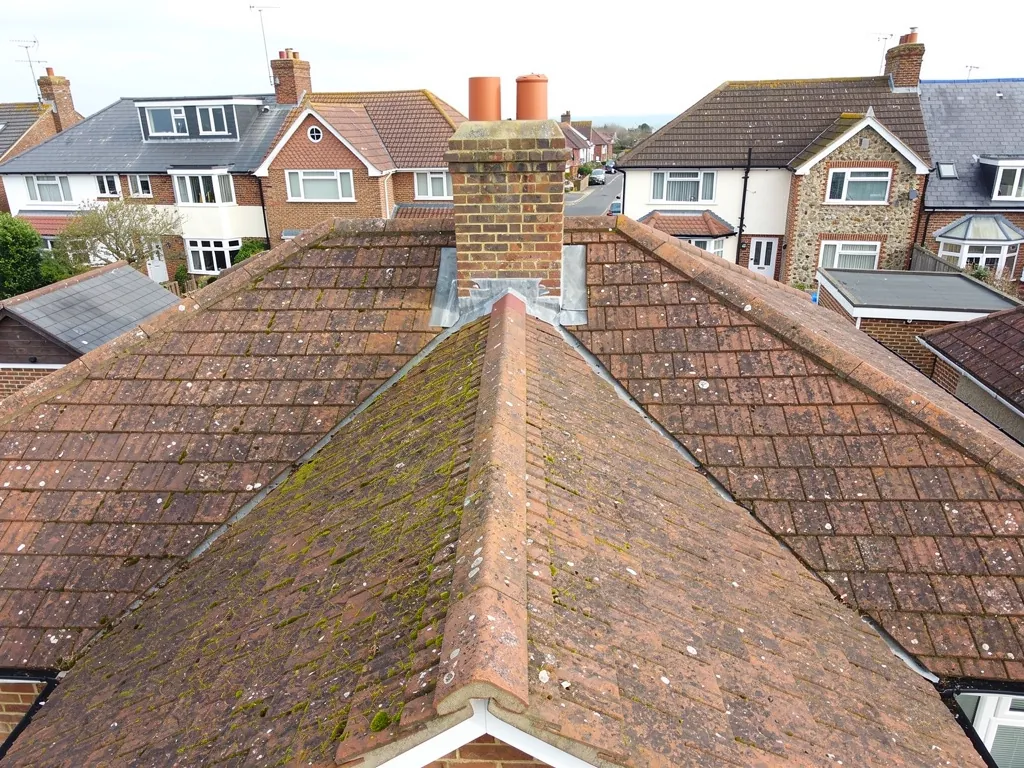
Pictures taken from above have changed how roofs get looked at. A small camera drone can rise over a ridge, hover above a chimney and send back sharp stills of slopes that nobody could safely stand on. For a tall house, a steep slate roof or a big flat roof, that is a real gain.
It is also easy to expect too much. A drone is a way of getting a camera into position, nothing more. It cannot feel a soft batten, hear a hollow tile or see the underside of the covering where leaks so often start. A drone roof inspection is useful when it is used for what a camera in the air does well, and then backed up by someone who can read what the pictures mean.
Below we go through the strengths, the blind spots, the cost and the situations where one method beats the other. It belongs with our wider pages on roof inspections and surveys, and if you are weighing the two approaches side by side, our comparison of drone and ladder inspections goes further.
How a drone survey is carried out
A drone survey is a short flight with a camera, followed by time at a desk. The pilot launches from the ground, usually the front or rear garden, flies a pattern over each slope and takes stills and video at different heights. The high pass gives the shape of the whole roof. Lower passes with the zoom lens give close views of the ridge, the hips, the chimney and the valleys. Some operators also fly a slow orbit round the stack so every face of it is recorded.
The footage is then reviewed and, in a proper survey, marked up. Each fault is circled, labelled and tied to a place on the roof, so the report reads as a set of findings rather than a film to scrub through. That second stage is where the value sits, because a picture of a cracked tile is only useful once someone has said which tile, how bad it is and what to do about it.
Who is flying matters
Two skills are involved and they are not the same one. Flying safely near houses, trees and cables is a pilot's skill. Reading a roof is a roofer's. A surveyor who can only do the first will hand you a pretty video, and a roofer who cannot fly will not be able to get the angles. If you are paying for a survey, ask who does the reading and whether the written findings are by a person who has worked on roofs of the same kind as yours.
Weather limits the day. Strong wind, rain and low sun all spoil the result, so a good operator will move the flight rather than force it.
What a drone shows well
The great strength of an aerial view is context. Standing in the street you see the front slope at a shallow angle, and the back of the house is hidden. From above, the whole roof sits in one frame, and patterns jump out: a line of slipped tiles beneath the ridge, a dark streak where a gutter has been overflowing, a patch of moss that shows where the slope stays damp. Faults that look minor at ground level can be seen to join up.
The ridge and the hips are easy to check, because the camera looks down on the capping and the joints between each piece. Chimney tops are another good use: open mortar, a leaning pot or a cracked crown can be seen without anyone going near the stack. Lead flashing at the base of the stack, hidden from the ground, comes into view too. Gutters, too, are readable from above, so a drone shows leaves and moss lying in them, and slipped brackets.
Roofs nobody should walk on
Some roofs are risky to step onto at all. The HSE says roofs made of asbestos cement are always fragile, and rooflights and old sheeting can give way underfoot. A drone lets the first look happen without anybody putting weight on the surface. Steep slate, high stacks and roofs over conservatories fit the same argument: the less time spent on the covering, the less chance of breaking it.
For a flat roof the aerial view shows where water has stood after rain, and where edge trims have lifted. Those are also the things worth knowing before any quote.
What a drone misses
Leaks often begin where a camera cannot go. Water gets in at a nail hole, a cracked tile edge or a failed lap, runs along the underlay and drips out somewhere else entirely. The underside of the covering, the underlay, the battens and the rafters are all invisible from the air. So are damp patches in the loft insulation, daylight at a poorly fitted tile, and the staining that gives away an old leak. A loft inspection finds these, and a drone cannot.
Fine detail is the second weakness. A hairline crack across a slate or a pinhole in a lead fold may not show at the distance a drone safely holds, particularly in glare or on dark covering. Zoom helps but also flattens perspective, which can hide the lift of a tile edge or the gap under a ridge capping. Nobody can tap a tile or press a batten to check it is sound. Mortar that looks whole on a screen may sound hollow and crumble under a thumb.
Interpretation, not just images
The third gap is judgement. Moss on a slope looks like a fault but may be harmless. A clean slope may hide a failing underlay. A picture can show that something is there, but only experience says whether it is the cause of the damp patch on your bedroom ceiling. That is why a drone survey is best understood as one tool in a survey, not a survey in itself.
A full survey also takes in the loft, the gutters and the chimney, which is why the drone is one part of it and not the whole.
Cost, and the scaffold you might not need
Checkatrade, in a table updated September 2026, gives around £210 for a drone survey of a house roof and £770 to £1,100 for commercial premises, plus VAT. That is a national figure, not a price for your house, and it assumes a normal house and ordinary access. A large or complicated roof, several buildings or a written report with marked-up photographs will sit towards the upper end, and a plain bungalow towards the lower. Our page on roof inspection cost looks at what moves the figure.
The argument for a drone is often scaffold. Checkatrade, in a table last updated in October 2026, puts a month of scaffold at around £875 for a two-storey semi, £1,000 for a detached bungalow, and a chimney scaffold at around £660 a week. If the roof stands over a pavement or a road, section 169 of the Highways Act 1980 needs the highway authority's licence, which takes time to obtain. West Sussex County Council asks for at least 10 working days' notice and charges £266 for a month. Paying for scaffold only to look is poor value, and a drone or a ladder avoids it.
When a scaffold is still needed
A drone does not remove the cost of access for the repair itself. Fixing a chimney, relaying a slope or replacing a hip needs somewhere safe to stand and work. The survey tells you what the job is; the scaffold, if it is needed, belongs to the job. Ladders, a tower or a cherry picker can also avoid scaffold for the look alone.
When quotes arrive, ask each firm whether VAT and any scaffold are inside the figure.
Flat roofs, ponding and fragile sheets
Flat roofs are where a drone is at its best and its worst. From above, the pattern of water left standing after rain is easy to read, along with dirt lines that show where it dried, lifting edge trims, blistered felt and debris blocking an outlet. BS 6229:2025, which took over from the 2018 edition in December 2025, keeps a minimum finished fall of 1:80 for flat roofs of this type. Water still lying days after rain suggests poor drainage, and the pictures show it.
Yet a drone cannot say why. Standing water might come from sagging boards, a blocked outlet or falls that were never right, and none of these shows from the sky. It also cannot test whether a blister is dry or wet underneath. Sun glare on a shiny membrane, and shadow from a parapet, can hide a split. For those reasons a flat roof survey normally needs somebody on or beside the roof as well. Our guide to the flat roof survey explains what is checked up close.
Fragile and asbestos-cement sheets
Garage and industrial roofs in corrugated sheet are a good case for the drone. For anything built or refurbished before 2000, the HSE advises assuming asbestos is there, and it treats every asbestos cement roof as fragile. A drone gives a first look with no one stepping on the sheets. It cannot identify the material, though. Only sampling or a specialist can, so the next step is a specialist test.
Getting a drone survey that is worth paying for
A few questions sort a useful survey from a video file. Ask for still photographs as well as footage, because stills can be zoomed, marked and compared. Ask for each image to be labelled with where it is on the roof, such as the north-west hip or the valley behind the chimney, so that a roofer arriving later can find the exact spot. Ask whether anyone will look at the loft, since that is where the second half of the story sits.
Ask, too, for a written verdict at the end. Repair, patch for now or replace is the answer you actually want, and a roofer's judgement behind it is what makes the images worth having.
Thermal cameras and other add-ons
Some operators fit a thermal camera. It shows temperature differences, which can hint at heat escaping or damp, but it does not show water and is easily fooled by sun, wind and shadow. Treat it as a clue that needs checking, not a finding.
Courtesy and practicalities
A drone flight over a terraced street passes close to neighbours, so tell them first. Ask for the pilot to avoid flying over people or neighbouring gardens, and have the roof clear of anything light that might blow off, such as covers and bin lids.
With us, photographs of your own roof arrive alongside the written quote. Where a close look is needed we go up and take it, because a repair is only as good as the diagnosis.
Questions
Drone survey questions
Can a drone find where a roof is leaking?
Rarely on its own. It can show slipped tiles, broken flashing, blocked gutters and standing water, which are common causes. The actual entry point is often a nail hole or a lap under the covering, and the damp it causes shows in the loft. A leak diagnosis usually combines aerial pictures with a look inside the roof space.
Is a drone survey cheaper than putting up scaffold to look at the roof?
For a look alone, yes. A month of scaffold on a two-storey house runs to hundreds of pounds before any licence, while Checkatrade gives around £210 for a drone survey of a house. For the repair itself the access question returns, and the quote that follows the survey puts it all in one figure.
Will a drone survey be accepted by a buyer or a lender?
That depends on the buyer, the lender and the surveyor involved, so ask them before paying. A report is stronger when it carries labelled photographs, a plain statement of condition and the name of the person who wrote it. Pictures from the air alone, without anyone checking the loft, may leave gaps that a buyer's own surveyor then asks to fill.